• Wyszukiwanie zaawansowane
  • Kategorie
  • Kategorie BISAC
  • Książki na zamówienie
  • Promocje
  • Granty
  • Książka na prezent
  • Opinie
  • Pomoc
  • Załóż konto
  • Zaloguj się

Lectures on the Hyperreals: An Introduction to Nonstandard Analysis » książka


zaloguj się | załóż konto
Logo Krainaksiazek.pl

koszyk

konto

szukaj
topmenu
Księgarnia internetowa
Szukaj
Książki na zamówienie
Promocje
Granty
Książka na prezent
Moje konto
Pomoc
 
 
Wyszukiwanie zaawansowane
Pusty koszyk
Bezpłatna dostawa dla zamówień powyżej 20 złBezpłatna dostawa dla zamówień powyżej 20 zł

Kategorie główne

• Nauka
 [2949965]
• Literatura piękna
 [1857847]

  więcej...
• Turystyka
 [70818]
• Informatyka
 [151303]
• Komiksy
 [35733]
• Encyklopedie
 [23180]
• Dziecięca
 [617748]
• Hobby
 [139972]
• AudioBooki
 [1650]
• Literatura faktu
 [228361]
• Muzyka CD
 [398]
• Słowniki
 [2862]
• Inne
 [444732]
• Kalendarze
 [1620]
• Podręczniki
 [167233]
• Poradniki
 [482388]
• Religia
 [509867]
• Czasopisma
 [533]
• Sport
 [61361]
• Sztuka
 [243125]
• CD, DVD, Video
 [3451]
• Technologie
 [219309]
• Zdrowie
 [101347]
• Książkowe Klimaty
 [123]
• Zabawki
 [2362]
• Puzzle, gry
 [3791]
• Literatura w języku ukraińskim
 [253]
• Art. papiernicze i szkolne
 [7933]
Kategorie szczegółowe BISAC

Lectures on the Hyperreals: An Introduction to Nonstandard Analysis

ISBN-13: 9780387984643 / Angielski / Twarda / 1998 / 293 str.
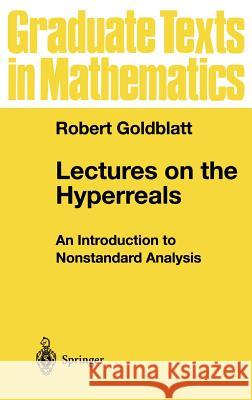
Robert Goldblatt; R. Goldblatt
Lectures on the Hyperreals: An Introduction to Nonstandard Analysis Goldblatt, Robert 9780387984643 Springer - książkaWidoczna okładka, to zdjęcie poglądowe, a rzeczywista szata graficzna może różnić się od prezentowanej.

Lectures on the Hyperreals: An Introduction to Nonstandard Analysis

ISBN-13: 9780387984643 / Angielski / Twarda / 1998 / 293 str.

Robert Goldblatt; R. Goldblatt
cena 363,12 zł
(netto: 345,83 VAT:  5%)

Najniższa cena z 30 dni: 346,96 zł
Termin realizacji zamówienia:
ok. 22 dni roboczych
Bez gwarancji dostawy przed świętami

Darmowa dostawa!

There are good reasons to believe that nonstandard analysis, in some ver- sion or other, will be the analysis of the future. KURT GODEL This book is a compilation and development of lecture notes written for a course on nonstandard analysis that I have now taught several times. Students taking the course have typically received previous introductions to standard real analysis and abstract algebra, but few have studied formal logic. Most of the notes have been used several times in class and revised in the light of that experience. The earlier chapters could be used as the basis of a course at the upper undergraduate level, but the work as a whole, including the later applications, may be more suited to a beginning graduate course. This prefacedescribes my motivationsand objectives in writingthe book. For the most part, these remarks are addressed to the potential instructor. Mathematical understanding develops by a mysterious interplay between intuitive insight and symbolic manipulation. Nonstandard analysis requires an enhanced sensitivity to the particular symbolic form that is used to ex- press our intuitions, and so the subject poses some unique and challenging pedagogical issues. The most fundamental ofthese is how to turn the trans- fer principle into a working tool of mathematical practice. I have found it vi Preface unproductive to try to give a proof of this principle by introducing the formal Tarskian semantics for first-order languages and working through the proofofLos's theorem.


Kategorie:
Nauka, Matematyka
Kategorie BISAC:
Mathematics > Mathematical Analysis
Wydawca:
Springer
Seria wydawnicza:
Graduate Texts in Mathematics
Język:
Angielski
ISBN-13:
9780387984643
Rok wydania:
1998
Wydanie:
1998
Numer serii:
000009678
Ilość stron:
293
Waga:
0.58 kg
Wymiary:
24.13 x 16.28 x 1.91
Oprawa:
Twarda
Wolumenów:
01
Dodatkowe informacje:
Bibliografia

R. Goldblatt

Lectures on the Hyperreals

An Introduction to Nonstandard Analysis

"Suitable for a graduate course . . . could be covered in an advanced undergraduate course . . . The author's ideas on how to achieve both intelligibility and rigor . . . will be useful reading for anyone intending to teach nonstandard analysis."-AMERICAN MATHEMATICAL SOCIETY

I Foundations.- 1 What Are the Hyperreals?.- 1.1 Infinitely Small and Large.- 1.2 Historical Background.- 1.3 What Is a Real Number?.- 1.4 Historical References.- 2 Large Sets.- 2.1 Infinitesimals as Variable Quantities.- 2.2 Largeness.- 2.3 Filters.- 2.4 Examples of Filters.- 2.5 Facts About Filters.- 2.6 Zorn’s Lemma.- 2.7 Exercises on Filters.- 3 Ultrapower Construction of the Hyperreals.- 3.1 The Ring of Real-Valued Sequences.- 3.2 Equivalence Modulo an Ultrafilter.- 3.3 Exercises on Almost-Everywhere Agreement.- 3.4 A Suggestive Logical Notation.- 3.5 Exercises on Statement Values.- 3.6 The Ultrapower.- 3.7 Including the Reals in the Hyperreals.- 3.8 Infinitesimals and Unlimited Numbers.- 3.9 Enlarging Sets.- 3.10 Exercises on Enlargement.- 3.11 Extending Functions.- 3.12 Exercises on Extensions.- 3.13 Partial Functions and Hypersequences.- 3.14 Enlarging Relations.- 3.15 Exercises on Enlarged Relations.- 3.16 Is the Hyperreal System Unique?.- 4 The Transfer Principle.- 4.1 Transforming Statements.- 4.2 Relational Structures.- 4.3 The Language of a Relational Structure.- 4.4 *-Transforms.- 4.5 The Transfer Principle.- 4.6 Justifying Transfer.- 4.7 Extending Transfer.- 5 Hyperreals Great and Small.- 5.1 (Un)limited, Infinitesimal, and Appreciable Numbers.- 5.2 Arithmetic of Hyperreals.- 5.3 On the Use of “Finite” and “Infinite”.- 5.4 Halos, Galaxies, and Real Comparisons.- 5.5 Exercises on Halos and Galaxies.- 5.6 Shadows.- 5.7 Exercises on Infinite Closeness.- 5.8 Shadows and Completeness.- 5.9 Exercise on Dedekind Completeness.- 5.10 The Hypernaturals.- 5.11 Exercises on Hyperintegers and Primes.- 5.12 On the Existence of Infinitely Many Primes.- II Basic Analysis.- 6 Convergence of Sequences and Series.- 6.1 Convergence.- 6.2 Monotone Convergence.- 6.3 Limits.- 6.4 Boundedness and Divergence.- 6.5 Cauchy Sequences.- 6.6 Cluster Points.- 6.7 Exercises on Limits and Cluster Points.- 6.8 Limits Superior and Inferior.- 6.9 Exercises on lim sup and lim inf.- 6.10 Series.- 6.11 Exercises on Convergence of Series.- 7 Continuous Functions.- 7.1 Cauchy’s Account of Continuity.- 7.2 Continuity of the Sine Function.- 7.3 Limits of Functions.- 7.4 Exercises on Limits.- 7.5 The Intermediate Value Theorem.- 7.6 The Extreme Value Theorem.- 7.7 Uniform Continuity.- 7.8 Exercises on Uniform Continuity.- 7.9 Contraction Mappings and Fixed Points.- 7.10 A First Look at Permanence.- 7.11 Exercises on Permanence of Functions.- 7.12 Sequences of Functions.- 7.13 Continuity of a Uniform Limit.- 7.14 Continuity in the Extended Hypersequence.- 7.15 Was Cauchy Right?.- 8 Differentiation.- 8.1 The Derivative.- 8.2 Increments and Differentials.- 8.3 Rules for Derivatives.- 8.4 Chain Rule.- 8.5 Critical Point Theorem.- 8.6 Inverse Function Theorem.- 8.7 Partial Derivatives.- 8.8 Exercises on Partial Derivatives.- 8.9 Taylor Series.- 8.10 Incremental Approximation by Taylor’s Formula.- 8.11 Extending the Incremental Equation.- 8.12 Exercises on Increments and Derivatives.- 9 The Riemann Integral.- 9.1 Riemann Sums.- 9.2 The Integral as the Shadow of Riemann Sums.- 9.3 Standard Properties of the Integral.- 9.4 Differentiating the Area Function.- 9.5 Exercise on Average Function Values.- 10 Topology of the Reals.- 10.1 Interior, Closure, and Limit Points.- 10.2 Open and Closed Sets.- 10.3 Compactness.- 10.4 Compactness and (Uniform) Continuity.- 10.5 Topologies on the Hyperreals.- III Internal and External Entities.- 11 Internal and External Sets.- 11.1 Internal Sets.- 11.2 Algebra of Internal Sets.- 11.3 Internal Least Number Principle and Induction.- 11.4 The Overflow Principle.- 11.5 Internal Order-Completeness.- 11.6 External Sets.- 11.7 Defining Internal Sets.- 11.8 The Underflow Principle.- 11.9 Internal Sets and Permanence.- 11.10 Saturation of Internal Sets.- 11.11 Saturation Creates Nonstandard Entities.- 11.12 The Size of an Internal Set.- 11.13 Closure of the Shadow of an Internal Set.- 11.14 Interval Topology and Hyper-Open Sets.- 12 Internal Functions and Hyperfinite Sets.- 12.1 Internal Functions.- 12.2 Exercises on Properties of Internal Functions.- 12.3 Hyperfinite Sets.- 12.4 Exercises on Hyperfiniteness.- 12.5 Counting a Hyperfinite Set.- 12.6 Hyperfinite Pigeonhole Principle.- 12.7 Integrals as Hyperfinite Sums.- IV Nonstandard Frameworks.- 13 Universes and Frameworks.- 13.1 What Do We Need in the Mathematical World?.- 13.2 Pairs Are Enough.- 13.3 Actually, Sets Are Enough.- 13.4 Strong Transitivity.- 13.5 Universes.- 13.6 Superstructures.- 13.7 The Language of a Universe.- 13.8 Nonstandard Frameworks.- 13.9 Standard Entities.- 13.10 Internal Entities.- 13.11 Closure Properties of Internal Sets.- 13.12 Transformed Power Sets.- 13.13 Exercises on Internal Sets and Functions.- 13.14 External Images Are External.- 13.15 Internal Set Definition Principle.- 13.16 Internal Function Definition Principle.- 13.17 Hyperfiniteness.- 13.18 Exercises on Hyperfinite Sets and Sizes.- 13.19 Hyperfinite Summation.- 13.20 Exercises on Hyperfinite Sums.- 14 The Existence of Nonstandard Entities.- 14.1 Enlargements.- 14.2 Concurrence and Hyperfinite Approximation.- 14.3 Enlargements as Ultrapowers.- 14.4 Exercises on the Ultrapower Construction.- 15 Permanence, Comprehensiveness, Saturation.- 15.1 Permanence Principles.- 15.2 Robinson’s Sequential Lemma.- 15.3 Uniformly Converging Sequences of Functions.- 15.4 Comprehensiveness.- 15.5 Saturation.- V Applications.- 16 Loeb Measure.- 16.1 Rings and Algebras.- 16.2 Measures.- 16.3 Outer Measures.- 16.4 Lebesgue Measure.- 16.5 Loeb Measures.- 16.6 ?-Approximability.- 16.7 Loeb Measure as Approximability.- 16.8 Lebesgue Measure via Loeb Measure.- 17 Ramsey Theory.- 17.1 Colourings and Monochromatic Sets.- 17.2 A Nonstandard Approach.- 17.3 Proving Ramsey’s Theorem.- 17.4 The Finite Ramsey Theorem.- 17.5 The Paris-Harrington Version.- 17.6 Reference.- 18 Completion by Enlargement.- 18.1 Completing the Rationals.- 18.2 Metric Space Completion.- 18.3 Nonstandard Hulls.- 18.4 p-adic Integers.- 18.5 p-adic Numbers.- 18.6 Power Series.- 18.7 Hyperfinite Expansions in Base p.- 18.8 Exercises.- 19 Hyperfinite Approximation.- 19.1 Colourings and Graphs.- 19.2 Boolean Algebras.- 19.3 Atomic Algebras.- 19.4 Hyperfinite Approximating Algebras.- 19.5 Exercises on Generation of Algebras.- 19.6 Connecting with the Stone Representation.- 19.7 Exercises on Filters and Lattices.- 19.8 Hyperfinite-Dimensional Vector Spaces.- 19.9 Exercises on (Hyper) Real Subspaces.- 19.10 The Hahn-Banach Theorem.- 19.11 Exercises on (Hyper) Linear Functionals.- 20 Books on Nonstandard Analysis.

Goldblatt, Robert Robert Goldblatt is a Professor of Pure Mathematic... więcej >


Udostępnij

Facebook - konto krainaksiazek.pl


Opinie o Krainaksiazek.pl na Opineo.pl

Partner Mybenefit

Krainaksiazek.pl w programie rzetelna firma Krainaksiaze.pl - płatności przez paypal

Czytaj nas na:

Facebook - krainaksiazek.pl
  • książki na zamówienie
  • granty
  • książka na prezent
  • kontakt
  • pomoc
  • opinie
  • regulamin
  • polityka prywatności

Zobacz:

  • Księgarnia czeska

  • Wydawnictwo Książkowe Klimaty

1997-2025 DolnySlask.com Agencja Internetowa

© 1997-2022 krainaksiazek.pl
     
KONTAKT | REGULAMIN | POLITYKA PRYWATNOŚCI | USTAWIENIA PRYWATNOŚCI
Zobacz: Księgarnia Czeska | Wydawnictwo Książkowe Klimaty | Mapa strony | Lista autorów
KrainaKsiazek.PL - Księgarnia Internetowa

Polityka prywatnosci - link
Krainaksiazek.pl - płatnośc Przelewy24
Przechowalnia Przechowalnia





