• Wyszukiwanie zaawansowane
  • Kategorie
  • Kategorie BISAC
  • Książki na zamówienie
  • Promocje
  • Granty
  • Książka na prezent
  • Opinie
  • Pomoc
  • Załóż konto
  • Zaloguj się

Languages and the First World War: Representation and Memory » książka


zaloguj się | załóż konto
Logo Krainaksiazek.pl

koszyk

konto

szukaj
topmenu
Księgarnia internetowa
Szukaj
Książki na zamówienie
Promocje
Granty
Książka na prezent
Moje konto
Pomoc
 
 
Wyszukiwanie zaawansowane
Pusty koszyk
Bezpłatna dostawa dla zamówień powyżej 20 złBezpłatna dostawa dla zamówień powyżej 20 zł

Kategorie główne

• Nauka
 [2946600]
• Literatura piękna
 [1856966]

  więcej...
• Turystyka
 [72221]
• Informatyka
 [151456]
• Komiksy
 [35826]
• Encyklopedie
 [23190]
• Dziecięca
 [619653]
• Hobby
 [140543]
• AudioBooki
 [1577]
• Literatura faktu
 [228355]
• Muzyka CD
 [410]
• Słowniki
 [2874]
• Inne
 [445822]
• Kalendarze
 [1744]
• Podręczniki
 [167141]
• Poradniki
 [482898]
• Religia
 [510455]
• Czasopisma
 [526]
• Sport
 [61590]
• Sztuka
 [243598]
• CD, DVD, Video
 [3423]
• Technologie
 [219201]
• Zdrowie
 [101638]
• Książkowe Klimaty
 [124]
• Zabawki
 [2473]
• Puzzle, gry
 [3898]
• Literatura w języku ukraińskim
 [254]
• Art. papiernicze i szkolne
 [8170]
Kategorie szczegółowe BISAC

Languages and the First World War: Representation and Memory

ISBN-13: 9781137550354 / Angielski / Twarda / 2016 / 256 str.
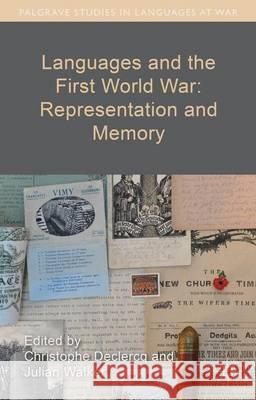
Christophe Declercq; Julian Walker
Languages and the First World War: Representation and Memory Christophe Declercq Julian Walker 9781137550354 Palgrave MacMillan - książkaWidoczna okładka, to zdjęcie poglądowe, a rzeczywista szata graficzna może różnić się od prezentowanej.

Languages and the First World War: Representation and Memory

ISBN-13: 9781137550354 / Angielski / Twarda / 2016 / 256 str.

Christophe Declercq; Julian Walker
cena 201,72 zł
(netto: 192,11 VAT:  5%)

Najniższa cena z 30 dni: 192,74 zł
Termin realizacji zamówienia:
ok. 22 dni roboczych
Bez gwarancji dostawy przed świętami

Darmowa dostawa!
inne wydania

This book examines issues around the representation and memory of the First World War. With contributions from international academics, the chapters cover a wide range of the historiographical aspects of war including the nature of representing the war in letters and diaries; the documentation of language change; the language of representing the war in reportage and literature; and the language of remembering the war. This book will appeal to a wide readership including linguists and historians and is complemented by the sister volume Languages and the First World War: Communicating in a Transnational War which examines language change and documentation during the war, covering issues such as languages at the front, propaganda and language manipulation, and recording language during the war.


Kategorie:
Nauka, Językoznawstwo
Kategorie BISAC:
History > Wars & Conflicts - World War I
Language Arts & Disciplines > Linguistics - Historical & Comparative
Language Arts & Disciplines > Linguistics - Sociolinguistics
Wydawca:
Palgrave MacMillan
Seria wydawnicza:
Palgrave Studies in Languages at War
Język:
Angielski
ISBN-13:
9781137550354
Rok wydania:
2016
Wydanie:
2016
Numer serii:
000447246
Ilość stron:
256
Waga:
0.43 kg
Wymiary:
22.5 x 14.43 x 2.03
Oprawa:
Twarda
Wolumenów:
01
Dodatkowe informacje:
Bibliografia
Obwoluta
Wydanie ilustrowane

Review 1 - Aviv Amit, Tel Aviv University, Israel
1. Broad Outline of the Project
This proposal focuses on varied aspects of languages during the First World War. These are investigated in the wider context of language change and contact based factors which caused variations in languages especially in Europe (UK, France, Belgium, Germany, Malta, Italy, Austria, Kosovo, Wales), but also in other places around the world (Canada, USA, Australia, Senegal, India). The authors propose to divide the project into two parts. Part I about 'Meetings between languages' and part II about 'Communication, Recording and Remembering'. Each part would open with an introduction and include papers presented at the 'Languages and the First World War' conference that was held at the University of Antwerp and the British Library on 18 and 20 June 2014. Each one of these books would be arranged into sections, including, among others: 'interpreting and translation', 'politics as a catalyst for language change', 'linguistic contact', 'language change', 'language and power', 'the language of remembrance'.

2. Critical Analysis of its Strengths and Weaknesses
Although there are many books on the topic of languages during WWI, this project is strategically located at the intersection of sociolinguistic, language contacts and historical studies, providing obvious links with other fields of research such as sociology, anthropology, literature and cultural studies, and therefore represents a great interest. In addition, the book's documentation is most impressive and varied to the point of including newspapers, private journals, songs, post-war literature, propaganda, memorials, phrasebooks, etc.
Given the great interest in the remembrance of the First World War, there is clearly a potential market for this project, notably at universities' departments where modules include sociolinguistics, twentieth-century history, discourse analysis and cultural representations of languages during the war. There is also possible interest in literature and modern history departments, but the focus on sociolinguistics means that this is likely to serve as a support text for reference purposes, rather than a key item on a reading list. However, given the fact that this period represents an important phase in the history of many languages, it is likely that an incisive, original consideration of language change and contacts between languages during this time would enjoy a long shelf-life and wide circulation.
The description of each essay is of course very brief and lacks a bibliography, so I do not know what sources each author might intend eventually to bring to bear on the discussion. In addition, there is no abstract for the introduction to present the comparative framework of each book.
The quality of the papers is very various. Some are excellent and demonstrate a solid awareness of the relevant issues and how they might be investigated (parts 1.2, 1.3, 2.1, 2.2, 2.3, 2.4, 3.4, 4.1, 5.1, 5.4, 6.1, 6.2, 6.3, 7.1, 7.2, 7.3, 8.1, 9.1, 9.2), while others maybe deal with important topics, but often not in a very illuminating fashion and are in need of tighter editing. In addition, some abstracts in the proposal are too short (parts 3.1, 3.3, 5.2, 8.2), and some even lack an abstract (part 5.5 and the introduction of Book I).
Whilst I very much like the concept for this project, I fear that the authors need to rethink considerably their proposal before it could be recommended for publication. The key problem that needs to be addressed is the structure of the project. The point of collecting all the papers presented at the conference into two books without any selection or adaptation is certainly not the best option to serve the needs of the potential reader. Hence, only the best papers should be considered for publishing to maintain a high standard publication and should be incorporated in one book instead of two.

3. Overall, my assessment is that the proposed pr

Acknowledgements
PART I: THE HISTORIAN'S PROBLEMS
1. Problems and challenges of a historical approach
2. Translation, interpretation and mistranslation: Belgian exiles and 'reformed' soldiers, their records and problems encountered by English language researchers
PART II: REPRESENTING THE PRESENT
3. 'Fake Belgium' Linguistic issues in the diary of Father Achiel Van Walleghem (1914-1919)
4. Out of the Trenches: The Rhetoric of Letters from the Western Front
PART III: LANGUAGE USE AND CHANGE
5. 'Aussie': code-switching in an Australian soldiers' magazine – an overview
6. From Antwerp to Britain and back again: the language of the Belgian refugee in Britain during the First World War
7. Language Changes in the Jewish Community in Kosovo and Metohija after the Balkan Wars (1912-1913) and the First World War (1914-1918)
PART IV: LITERATURE AND REPRESENTATION
8. 'Excursion into a Foreign Language': Frederic Manning and Ford Madox Ford
9. 14 / 1914. On Jean Échenoz's Great War, meta-discourse and the English reception
10. 'The Language of Espionage: Mata Hari and the creation of the spy-courtesan'
PART V: COMMEMORATION AND MEMORY
11. ''Here is our blood. When are our rights?' Flemish Graffiti and the Great War'
12. The Languages of Remembrance: An Attempt at a Taxonomy
13. Wartime citations in Ernest Weekley's An Etymological Dictionary of Modern English (1921) and contemporary dictionaries
14. War Discourse: still talking about the First World War in Britain, 1914-2014

Julian Walker is a British Library educator, an artist and writer. His books on language include Discovering Words, Team Talk: Sporting Words and their Origins and Trench Talk.


Christophe Declercq is a lecturer in translation (University College London, UK and University of Antwerp, Belgium) who has been working on Belgian refugees in Britain for well over a decade. On the subject, he has spoken widely at conferences in both Britain and Belgium, has worked with the BBC and VRT (Belgian television) and manages several social media outlets.

With several terms from the First World War still present in modern speech, Languages and the First World War presents over 30 essays by international academics investigating the linguistic aspects of the 1914-18 conflict.
The first of the two volumes covers language change and documentation during the period of the war, while the second examines the representation and the memory of the war.


Communicating in a Transnational War examines languages at the front, including the subject of interpretation, translation and parallels between languages; communication with the home front; propaganda and language manipulation; and recording language during the war.


Representation and Memory examines historiographical issues; the nature of representing the war in letters and diaries; the documentation of language change; the language of representing the war in reportage and literature; and the language of remembering the war.


Covered in the process are slang, censorship, soldiers' phrasebooks, code-switching, borrowing terms, the problems facing multilingual armies, and gendered language.

Walker, Julian Julian Walker is an artist and writer who leads wo... więcej >


Udostępnij

Facebook - konto krainaksiazek.pl


Opinie o Krainaksiazek.pl na Opineo.pl

Partner Mybenefit

Krainaksiazek.pl w programie rzetelna firma Krainaksiaze.pl - płatności przez paypal

Czytaj nas na:

Facebook - krainaksiazek.pl
  • książki na zamówienie
  • granty
  • książka na prezent
  • kontakt
  • pomoc
  • opinie
  • regulamin
  • polityka prywatności

Zobacz:

  • Księgarnia czeska

  • Wydawnictwo Książkowe Klimaty

1997-2025 DolnySlask.com Agencja Internetowa

© 1997-2022 krainaksiazek.pl
     
KONTAKT | REGULAMIN | POLITYKA PRYWATNOŚCI | USTAWIENIA PRYWATNOŚCI
Zobacz: Księgarnia Czeska | Wydawnictwo Książkowe Klimaty | Mapa strony | Lista autorów
KrainaKsiazek.PL - Księgarnia Internetowa

Polityka prywatnosci - link
Krainaksiazek.pl - płatnośc Przelewy24
Przechowalnia Przechowalnia




