• Wyszukiwanie zaawansowane
  • Kategorie
  • Kategorie BISAC
  • Książki na zamówienie
  • Promocje
  • Granty
  • Książka na prezent
  • Opinie
  • Pomoc
  • Załóż konto
  • Zaloguj się

International Handbook of Migration, Minorities and Education: Understanding Cultural and Social Differences in Processes of Learning » książka


zaloguj się | załóż konto
Logo Krainaksiazek.pl

koszyk

konto

szukaj
topmenu
Księgarnia internetowa
Szukaj
Książki na zamówienie
Promocje
Granty
Książka na prezent
Moje konto
Pomoc
 
 
Wyszukiwanie zaawansowane
Pusty koszyk
Bezpłatna dostawa dla zamówień powyżej 20 złBezpłatna dostawa dla zamówień powyżej 20 zł

Kategorie główne

• Nauka
 [2946600]
• Literatura piękna
 [1856966]

  więcej...
• Turystyka
 [72221]
• Informatyka
 [151456]
• Komiksy
 [35826]
• Encyklopedie
 [23190]
• Dziecięca
 [619653]
• Hobby
 [140543]
• AudioBooki
 [1577]
• Literatura faktu
 [228355]
• Muzyka CD
 [410]
• Słowniki
 [2874]
• Inne
 [445822]
• Kalendarze
 [1744]
• Podręczniki
 [167141]
• Poradniki
 [482898]
• Religia
 [510455]
• Czasopisma
 [526]
• Sport
 [61590]
• Sztuka
 [243598]
• CD, DVD, Video
 [3423]
• Technologie
 [219201]
• Zdrowie
 [101638]
• Książkowe Klimaty
 [124]
• Zabawki
 [2473]
• Puzzle, gry
 [3898]
• Literatura w języku ukraińskim
 [254]
• Art. papiernicze i szkolne
 [8170]
Kategorie szczegółowe BISAC

International Handbook of Migration, Minorities and Education: Understanding Cultural and Social Differences in Processes of Learning

ISBN-13: 9789401784603 / Angielski / Miękka / 2014 / 753 str.
Zvi Bekerman (Hebrew University of Jerus;Thomas Geisen
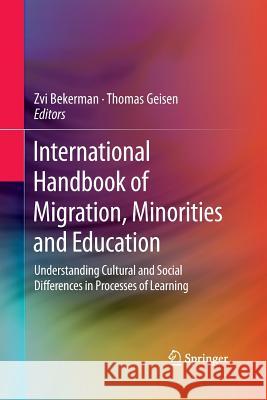
International Handbook of Migration, Minorities and Education: Understanding Cultural and Social Differences in Processes of Learning Bekerman, Zvi 9789401784603 Springer - książkaWidoczna okładka, to zdjęcie poglądowe, a rzeczywista szata graficzna może różnić się od prezentowanej.

International Handbook of Migration, Minorities and Education: Understanding Cultural and Social Differences in Processes of Learning

ISBN-13: 9789401784603 / Angielski / Miękka / 2014 / 753 str.

Zvi Bekerman (Hebrew University of Jerus;Thomas Geisen
cena 1533,32 zł
(netto: 1460,30 VAT:  5%)

Najniższa cena z 30 dni: 1465,09 zł
Termin realizacji zamówienia:
ok. 22 dni roboczych
Bez gwarancji dostawy przed świętami

Darmowa dostawa!
inne wydania

Educational research on migration and minorities has a long record of research and discussion in which the so-called conflict of cultures has been seen as the crucial reason for the marginalization of migrants and minority members since they grow up with a fundamental cleavage between cultures. In educational theory, this thesis is now under review because it has been shown to support essentializing processes of ethnization and culturalization. The in-between-ness of minorities is no longer seen only as a hindrance but also as a benefit for biographical development. In this branch of educational debate transculturality and recognition are posited as highly relevant concepts which define belonging differently, by referring to networks, relatives and interactions. However, in turn these, too, must be approached critically, since the perspectives of transculturality and recognition seem to neglect the relevance of social belonging. Migrants and minorities are affected by these theoretical directions and debates because they are always at risk of being caught in essentialized cultural definitions and being perceived as threats to social unity. Migrants and minorities respond to these difficulties in multiple ways. On the one hand, they strive towards integration in a variety of social spheres, e.g. school and workplace, in order to achieve social mobility. On the other hand, they articulate demands for cultural self-determination. For educational processes in societies with high levels of migration or with substantial minority cultures, questions related to the meaning of cultural heterogeneity and the social and cultural limits of learning and communication are very important. It is precisely here where educational theorizing, urgently needs to find answers to current questions about individual freedom, community/cultural affiliations, and social and democratic cohesion. The contributions of this edited volume will enhance the knowledge in the field of migrant/minority education, with a special emphasis on the meaning of culture and social learning for educational processes. "


Kategorie:
Nauka, Ekonomia i biznes
Kategorie BISAC:
Social Science > Emigration & Immigration
Social Science > Popular Culture
Social Science > Socjologia
Wydawca:
Springer
Język:
Angielski
ISBN-13:
9789401784603
Rok wydania:
2014
Wydanie:
2012
Ilość stron:
753
Waga:
1.06 kg
Wymiary:
23.39 x 15.6 x 3.94
Oprawa:
Miękka
Wolumenów:
01
Dodatkowe informacje:
Wydanie ilustrowane

Introduction; Thomas Geisen and Zvi Bekerman.- Part 1: Culture, Difference and Learning.- Introduction – Culture, Difference and Learning; Pat Cox.- Understanding Cultural Differences as Social Limits of Learning: Migration Theory, Culture and Adolescence; Thomas Geisen.- Beyond Limits and Limitations: Reflections on Learning Processes in Contexts of Migration and Young People; Pat Cox.- The Concept of Ethnicity and its Relevance for Biographical Learning; Ursula Apitzsch.- “No place. Nowhere” for migrants’ subjectivity!? Critical reflections on the dominant discourses about integration; Athanasios Marvakis.- Learning to live together – Towards a new integration society; Piñeiro Esteban and Jane Haller.- “And the mixture is all of us – and we`re still mixing”: Opportunities of Managing Diversity in local educational programs; Andreas Thiesen.- Family child-raising and educational strategies among European mixed couple; Sofia Gaspar.- Cradling a Baby, Holding a Pencil: A Gendered Literacy Campaign; Esther Schely-Newman.- Living in different worlds and learning all about it: Migration narratives in perspective; Joanne Cassar.- Early childhood education in multilingual settings; Drorit Lengyel.- Part 2: Education in Multilingual Societies.- Introduction – Education in Multilingual Societies; Lynn M. Aylward.- The State, Official-Language Education and Minorities: Estonian-Language Instruction for Estonia’s Russian-Speakers and the Võro; Kara D. Brown.- The Inuit Qajimajatuqangit Conversation: The Language and Culture of Schooling in the Nunavut Territory of Canada; Lynn M. Aylward.- Ambivalence: Minority parents positioning when facing school choices; Zvi Bekerman and Moshe Tatar.- Social Change and Minority Education: A Sociological and Social Historical View on Minority Education in Croatia; Jadranka Čačić-Kumpes.- Re-Imagining Home In Alberta’s Francophone Communities; Laura A. Thompson.- New school, new system: The experiences of immigrant students in Irish schools; Merike Darmody, Emer Smyth, Delma Byrne and Frances McGinnity.- Beyond Cultural Differences: Understanding and Negotiating the Conflict between Chinese Immigrant Parents and Canadian Teachers; Yan Guo and Bernard Mohan.- Part 3: Heterogeneity and Learning in Schools.- Introduction – Heterogeneity and Learning in Schools; Irina Schmitt.- Dealing with Diversity and Social Heterogeneity: Ambivalences, Challenges and Pitfalls for Pedagogical Activity; Christine Riegel .- A Learning Curve: The Education of Immigrants in Newcastle-upon-Tyne and Bremen from the 1960s to the 1980s; Sarah E. Hackett.- School policies, gender-sex-sexuality and ethno-cultural re-production in Sweden, Canada and Germany; Irina Schmitt.- Effects of the Head Start program in the USA as indicators of ethnic inequalities; Claudia Koehler.- Learning Insularity: Social Capital, Social Learning and Staying at Home among European Youth; Christos Govaris and Stavroula Kaldi.- School performance of children of Indian and Cape Verdean immigrants in basic schooling in Portugal; Teresa Seabra.- Migration, Educational Policies & Practices: constructing difference in Buenos Aires and in Madrid; Ana Bravo-Moreno and Jason Beech.- Part 4: Higher Education.- Introduction – Higher Education; Marisol Clark-Ibáñez.- Encountering An-Other: The Culture of Curriculum and Inclusive Pedagogies; Ruth Arber.- Possible selves and goal orientations of East African undergraduate students in the United States; Joash M. Wambua and Cecil Robinson.- A Passport to Education: Undocumented Latino University Students Navigating their Invisible Status; Marisol Clark-Ibáñez, Fredi Garcia-Alverdín and Gricelda Alva.- Part 5: Religion and Learning.- Introduction – Religion and Learning; Eoin Daly.- Integration by Other Means: Hindu schooling in the Netherlands; Michael S. Merry and Geert Driessen.- Negotiating the School Curriculum for the Malay Muslims in Singapore; Charlene Tan and Hairon Salleh .- Migrant children’s precarious religious liberties in education: the salience of demographic and social contingencies under a formally pluralist public philosophy; Eoin Daly.- Educational processes and ethnicity among Hindu migrants in Portugal; Helena Sant’ana.- Part 6: Community, Work and Learning.- Introduction – Community, Work and Learning; Georgina Tsolidis.- Multiculturalism in a deeply divided society: The case of Cyprus; Michalinos Zembylas.- Learning who they ‘really’ are: From stigmatization to opportunities to learn in Greek Romani education; William New and Michael S. Merry.- Learning difference in the Diaspora – Sharing sacred spaces; Georgina Tsolidis.- Deciphering Somali Immigrant Adolescents’ Navigation and Interpretation of Resources Embedded in Social Relationships; Moosung Lee and Na’im Madyun.- Agency and everyday knowledge of Filipina migrants in Dubai, United Arab Emirates; Simone Christ.- Ethnicized youth subcultures and “informal learning” in transitions to work; Vitor Sérgio Ferreira and Axel Pohl.-  “I am illiterate. But I am a doctor of Capoeira”: Integration of marginalized youth in Brazil; Karin E. Sauer.- Learning Insularity: Social Capital, Social Learning and Staying at Home among European Youth; David Cairns and Katarzyna Growiec.- Conclusions; Zvi Bekerman and Thomas Geisen.- Author Index.- Subject Index.

Zvi Bekerman, teaches anthropology of education at the School of Education and the Melton Center, at the Hebrew University of Jerusalem. From 2003 to 2007 he was a Research Fellow at the Truman Institute for the Advancement of Peace, Hebrew University. His main interests are in the study of cultural, ethnic and national identity, including identity processes and negotiation during intercultural encounters and in formal/informal learning contexts. Since 1999 he has been conducting, with the support of the Ford, Spencer and Bernard Van Leer Foundations, a long term ethnographic research project on the integrated/bilingual Palestinian-Jewish schools in Israel. He has also recently become involved in the study of identity construction and development in educational computer-mediated environments. In brief, his interests lie in human learning processes, their development and practice, both in formal/informal and real/virtual environments; processes which, from the socio-historical perspectives within which he has been raised and from which he continues to learn, comprise a large portion of human activity. He has published numerous papers in these fields of study and is the editor (with Seonaigh MacPherson) of the refereed journal Diaspora, Indigenous, and Minority Education: An International Journal (Taylor & Francis, 2007). His recently published books include (edited with Nicholas Burbules and Diana Keller Silverman) Learning in Places: The Informal Education Reader (Peter Lang, 2006); (with Claire McGlynn) Addressing Ethnic Conflict through Peace Education: International Perspectives (Palgrave McMillan, 2007); (with Ezra Kopelowitz) Cultural Education-Cultural Sustainability: Minority, Diaspora, Indigenous and Ethno-Religious Groups in Multicultural Societies (Routledge Education – LEA, 2008) and (with Diana Silberman-Keller, Henry A. Giroux, and Nicholas Burbules) Mirror Images: Popular Culture and Education (Peter Lang – 2008).

Thomas Geisen, is senior lecturer and researcher at the School of Social Work at the University of Applied Sciences Northwestern Switzerland. His main interests are in the study of migration, ethnicity and cultural issues as well as in questions of identity and belonging. Other fields of interest and research are work/labor relations and violence. His research encompasses racism, migrant families, family relations of right-wing youth and disability management. He has published numerous books and papers in these fields; among his recent publications are:  Arbeit und Subjektwerdung in der Moderne. Ein dialogue imaginaire zwischen Karl Marx und Hannah Arendt (VS Verlag, 2011); (edited with Henry Harder) Disability Management and Workplace Integration (Gower, 2011); (edited with Pat Cox and Roger Green) Qualitative Research and Social Change. European Contexts (Palgrave Macmillan, 2008); (edited with Anthony Andrew Hickey and Allen Karcher) Migration, Mobility and Borders. Issues of Theory and Policy (IKO Verlag, 2004); (edited with Christine Riegel) Jugend, Partizipation und Migration. Orientierungen im Kontext von Integration und Ausgrenzung (VS Verlag, 2007) and Jugend, Zugehörigkeit und Migration. Subjektpositionierungen im Kontext von Jugendkultur, Ethnizitäts- und Geschlechterkonstruktionen (VS Verlag, 2007); edited Arbeitsmigration. WanderarbeiterInnen auf dem Weltmarkt für Arbeitskraft (IKO Verlag, 2005).

Migrants and minorities are always at risk of being caught in essentialized cultural definitions and being denied the right to express their cultural preferences because they are perceived as threats to social cohesion. Migrants and minorities respond to these difficulties in multiple ways — as active agents in the pedagogical, political, social, and scientific processes that position them in this or that cultural sphere. On the one hand, they reject ascribed cultural attributes while striving towards integration in a variety of social spheres, e.g. school and workplace, in order to achieve social mobility. On the other hand, they articulate demands for cultural self-determination. This discursive duality is met with suspicion by the majority culture. For societies with high levels of migration or with substantial minority cultures, questions related to the meaning of cultural heterogeneity and the social and cultural limits of learning and communication (e.g. migration education or critical multiculturalism) are very important. It is precisely here where the chances for new beginnings and new trials become of great importance for educational theorizing, which urgently needs to find answers to current questions about individual freedom, community/cultural affiliations, and social and democratic cohesion. Answers to these questions must account for both ‘political’ and ‘learning’ perspectives at the macro, mezzo, and micro contextual levels. The contributions of this edited volume enhance the knowledge in the field of migrant/minority education, with a special emphasis on the meaning of culture and social learning for educational processes.


Udostępnij

Facebook - konto krainaksiazek.pl


Opinie o Krainaksiazek.pl na Opineo.pl

Partner Mybenefit

Krainaksiazek.pl w programie rzetelna firma Krainaksiaze.pl - płatności przez paypal

Czytaj nas na:

Facebook - krainaksiazek.pl
  • książki na zamówienie
  • granty
  • książka na prezent
  • kontakt
  • pomoc
  • opinie
  • regulamin
  • polityka prywatności

Zobacz:

  • Księgarnia czeska

  • Wydawnictwo Książkowe Klimaty

1997-2025 DolnySlask.com Agencja Internetowa

© 1997-2022 krainaksiazek.pl
     
KONTAKT | REGULAMIN | POLITYKA PRYWATNOŚCI | USTAWIENIA PRYWATNOŚCI
Zobacz: Księgarnia Czeska | Wydawnictwo Książkowe Klimaty | Mapa strony | Lista autorów
KrainaKsiazek.PL - Księgarnia Internetowa

Polityka prywatnosci - link
Krainaksiazek.pl - płatnośc Przelewy24
Przechowalnia Przechowalnia





