• Wyszukiwanie zaawansowane
  • Kategorie
  • Kategorie BISAC
  • Książki na zamówienie
  • Promocje
  • Granty
  • Książka na prezent
  • Opinie
  • Pomoc
  • Załóż konto
  • Zaloguj się

Interacting Electrons and Quantum Magnetism » książka


zaloguj się | załóż konto
Logo Krainaksiazek.pl

koszyk

konto

szukaj
topmenu
Księgarnia internetowa
Szukaj
Książki na zamówienie
Promocje
Granty
Książka na prezent
Moje konto
Pomoc
 
 
Wyszukiwanie zaawansowane
Pusty koszyk
Bezpłatna dostawa dla zamówień powyżej 20 złBezpłatna dostawa dla zamówień powyżej 20 zł

Kategorie główne

• Nauka
 [2946600]
• Literatura piękna
 [1856966]

  więcej...
• Turystyka
 [72221]
• Informatyka
 [151456]
• Komiksy
 [35826]
• Encyklopedie
 [23190]
• Dziecięca
 [619653]
• Hobby
 [140543]
• AudioBooki
 [1577]
• Literatura faktu
 [228355]
• Muzyka CD
 [410]
• Słowniki
 [2874]
• Inne
 [445822]
• Kalendarze
 [1744]
• Podręczniki
 [167141]
• Poradniki
 [482898]
• Religia
 [510455]
• Czasopisma
 [526]
• Sport
 [61590]
• Sztuka
 [243598]
• CD, DVD, Video
 [3423]
• Technologie
 [219201]
• Zdrowie
 [101638]
• Książkowe Klimaty
 [124]
• Zabawki
 [2473]
• Puzzle, gry
 [3898]
• Literatura w języku ukraińskim
 [254]
• Art. papiernicze i szkolne
 [8170]
Kategorie szczegółowe BISAC

Interacting Electrons and Quantum Magnetism

ISBN-13: 9780387942865 / Angielski / Twarda / 1994 / 255 str.
Auerbach Association;Auerbach
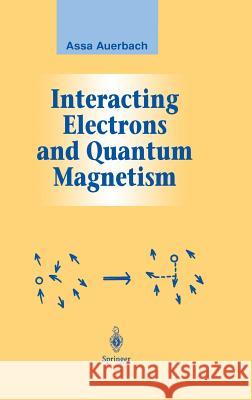
Interacting Electrons and Quantum Magnetism Assa Auerbach Auerbach 9780387942865 Springer - książkaWidoczna okładka, to zdjęcie poglądowe, a rzeczywista szata graficzna może różnić się od prezentowanej.

Interacting Electrons and Quantum Magnetism

ISBN-13: 9780387942865 / Angielski / Twarda / 1994 / 255 str.

Auerbach Association;Auerbach
cena 342,95 zł
(netto: 326,62 VAT:  5%)

Najniższa cena z 30 dni: 327,68 zł
Termin realizacji zamówienia:
ok. 22 dni roboczych
Bez gwarancji dostawy przed świętami

Darmowa dostawa!

In the excitement and rapid pace of developments, writing pedagogical texts has low priority for most researchers. However, in transforming my lecture l notes into this book, I found a personal benefit: the organization of what I understand in a (hopefully simple) logical sequence. Very little in this text is my original contribution. Most of the knowledge was collected from the research literature. Some was acquired by conversations with colleagues; a kind of physics oral tradition passed between disciples of a similar faith. For many years, diagramatic perturbation theory has been the major theoretical tool for treating interactions in metals, semiconductors, itiner- ant magnets, and superconductors. It is in essence a weak coupling expan- sion about free quasiparticles. Many experimental discoveries during the last decade, including heavy fermions, fractional quantum Hall effect, high- temperature superconductivity, and quantum spin chains, are not readily accessible from the weak coupling point of view. Therefore, recent years have seen vigorous development of alternative, nonperturbative tools for handling strong electron-electron interactions. I concentrate on two basic paradigms of strongly interacting (or con- strained) quantum systems: the Hubbard model and the Heisenberg model. These models are vehicles for fundamental concepts, such as effective Ha- miltonians, variational ground states, spontaneous symmetry breaking, and quantum disorder. In addition, they are used as test grounds for various nonperturbative approximation schemes that have found applications in diverse areas of theoretical physics.


Kategorie:
Nauka, Fizyka
Kategorie BISAC:
Technology & Engineering > Materials Science - General
Science > Physics - Condensed Matter
Gardening > General
Wydawca:
Springer
Seria wydawnicza:
Graduate Texts in Contemporary Physics
Język:
Angielski
ISBN-13:
9780387942865
Rok wydania:
1994
Wydanie:
1994. Corr. 2nd
Numer serii:
000009677
Ilość stron:
255
Waga:
0.53 kg
Wymiary:
24.28 x 16.0 x 1.88
Oprawa:
Twarda
Wolumenów:
01
Dodatkowe informacje:
Wydanie ilustrowane

I Basic Models.- 1 Electron Interactions in Solids.- 1.1 Single Electron Theory.- 1.2 Fields and Interactions.- 1.3 Magnitude of Interactions in Metals.- 1.4 Effective Models.- 1.5 Exercises.- 2 Spin Exchange.- 2.1 Ferromagnetic Exchange.- 2.2 Antiferromagnetic Exchange.- 2.3 Superexchange.- 2.4 Exercises.- 3 The Hubbard Model and Its Descendants.- 3.1 Truncating the Interactions.- 3.2 At Large U: The t-J Model.- 3.3 The Negative-U Model.- 3.3.1 The Pseudo-spin Model and Superconductivity.- 3.4 Exercises.- II Wave Functions and Correlations.- 4 Ground States of the Hubbard Model.- 4.1 Variational Magnetic States.- 4.2 Some Ground State Theorems.- 4.3 Exercises.- 5 Ground States of the Heisenberg Model.- 5.1 The Antiferromagnet.- 5.2 Half-Odd Integer Spin Chains.- 5.3 Exercises.- 6 Disorder in Low Dimensions.- 6.1 Spontaneously Broken Symmetry.- 6.2 Mermin and Wagner’ Theorem.- 6.3 Quantum Disorder at T = 0.- 6.4 Exercises.- 7 Spin Representations.- 7.1 Holstein-Primakoff Bosons.- 7.2 Schwinger Bosons.- 7.2.1 Spin Rotations.- 7.3 Spin Coherent States.- 7.3.1 The ? Integrals.- 7.4 Exercises.- 8 Variational Wave Functions and Parent Hamiltonians.- 8.1 Valence Bond States.- 8.2 S = ½ States.- 8.2.1 The Majumdar-Ghosh Hamiltonian.- 8.2.2 Square Lattice RVB States.- 8.3 Valence Bond Solids and AKLT Models.- 8.3.1 Correlations in Valence Bond Solids.- 8.4 Exercises.- 9 From Ground States to Excitations.- 9.1 The Single Mode Approximation.- 9.2 Goldstone Modes.- 9.3 The Haldane Gap and the SMA.- III Path Integral Approximations.- 10 The Spin Path Integral.- 10.1 Construction of the Path Integral.- 10.1.1 The Green’ Function.- 10.2 The Large S Expansion.- 10.2.1 Semiclassical Dynamics.- 10.2.2 Semiclassical Spectrum.- 10.3 Exercises.- 11 Spin Wave Theory.- 11.1 Spin Waves: Path Integral Approach.- 11.1.1 The Ferromagnet.- 11.1.2 The Antiferromagnet.- 11.2 Spin Waves: Holstein-Primakoff Approach.- 11.2.1 The Ferromagnet.- 11.2.2 The Antiferromagnet.- 11.3 Exercises.- 12 The Continuum Approximation.- 12.1 Haldane’ Mapping.- 12.2 The Continuum Hamiltonian.- 12.3 The Kinetic Term.- 12.4 Partition Function and Correlations.- 12.5 Exercises.- 13 Nonlinear Sigma Model: Weak Coupling.- 13.1 The Lattice Regularization.- 13.2 Weak Coupling Expansion.- 13.3 Poor Man’ Renormalization.- 13.4 The ? Function.- 13.5 Exercises.- 14 The Nonlinear Sigma Model: Large N.- 14.1 The CP1 Formulation.- 14.2 CPN-1 Models at Large N.- 14.3 Exercises.- 15 Quantum Antiferromagnets: Continuum Results.- 15.1 One Dimension, the ? Term.- 15.2 One Dimension, Integer Spins.- 15.3 Two Dimensions.- 16 SU(N) Heisenberg Models.- 16.1 Ferromagnet, Schwinger Bosons.- 16.2 Antiferromagnet, Schwinger Bosons.- 16.3 Antiferromagnet, Constrained Fermions.- 16.4 The Generating Functional.- 16.5 The Hubbard-Stratonovich Transformation.- 16.6 Correlation Functions.- 17 The Large N Expansion.- 17.1 Fluctuations and Gauge Fields.- 17.2 1/N Expansion Diagrams.- 17.3 Sum Rules.- 17.3.1 Absence of Charge Fluctuations.- 17.3.2 On-Site Spin Fluctuations.- 17.4 Exercises.- 18 Schwinger Bosons Mean Field Theory.- 18.1 The Case of the Ferromagnet.- 18.1.1 One Dimension.- 18.1.2 Two Dimensions.- 18.2 The Case of the Antiferromagnet.- 18.2.1 Long-Range Antiferromagnetic Order.- 18.2.2 One Dimension.- 18.2.3 Two Dimensions.- 18.3 Exercises.- 19 The Semiclassical Theory of the t — J Model.- 19.1 Schwinger Bosons and Slave Fermions.- 19.2 Spin-Hole Coherent States.- 19.3 The Classical Theory: Small Polarons.- 19.4 Polaron Dynamics and Spin Tunneling.- 19.5 The t? — J Model.- 19.5.1 Superconductivity?.- 19.6 Exercises.- IV Mathematical Appendices.- Appendix A Second Quantization.- A.1 Fock States.- A.2 Normal Bilinear Operators.- A.3 Noninteracting Hamiltonians.- A.4 Exercises.- Appendix B Linear Response and Generating Functionals.- B.1 Spin Response Function.- B.2 Fluctuations and Dissipation.- B.3 The Generating Functional.- Appendix C Bose and Fermi Coherent States.- C.1 Complex Integration.- C.2 Grassmann Variables.- C.3 Coherent States.- C.4 Exercises.- Appendix D Coherent State Path Integrals.- D.1 Constructing the Path Integral.- D.2 Normal Bilinear Hamiltonians.- D.3 Matsubara Representation.- D.4 Matsubara Sums.- D.5 Exercises.- Appendix E The Method of Steepest Descents.


Udostępnij

Facebook - konto krainaksiazek.pl


Opinie o Krainaksiazek.pl na Opineo.pl

Partner Mybenefit

Krainaksiazek.pl w programie rzetelna firma Krainaksiaze.pl - płatności przez paypal

Czytaj nas na:

Facebook - krainaksiazek.pl
  • książki na zamówienie
  • granty
  • książka na prezent
  • kontakt
  • pomoc
  • opinie
  • regulamin
  • polityka prywatności

Zobacz:

  • Księgarnia czeska

  • Wydawnictwo Książkowe Klimaty

1997-2025 DolnySlask.com Agencja Internetowa

© 1997-2022 krainaksiazek.pl
     
KONTAKT | REGULAMIN | POLITYKA PRYWATNOŚCI | USTAWIENIA PRYWATNOŚCI
Zobacz: Księgarnia Czeska | Wydawnictwo Książkowe Klimaty | Mapa strony | Lista autorów
KrainaKsiazek.PL - Księgarnia Internetowa

Polityka prywatnosci - link
Krainaksiazek.pl - płatnośc Przelewy24
Przechowalnia Przechowalnia





