• Wyszukiwanie zaawansowane
  • Kategorie
  • Kategorie BISAC
  • Książki na zamówienie
  • Promocje
  • Granty
  • Książka na prezent
  • Opinie
  • Pomoc
  • Załóż konto
  • Zaloguj się

Industrial Robotics Control: Mathematical Models, Software Architecture, and Electronics Design » książka


zaloguj się | załóż konto
Logo Krainaksiazek.pl

koszyk

konto

szukaj
topmenu
Księgarnia internetowa
Szukaj
Książki na zamówienie
Promocje
Granty
Książka na prezent
Moje konto
Pomoc
 
 
Wyszukiwanie zaawansowane
Pusty koszyk
Bezpłatna dostawa dla zamówień powyżej 20 złBezpłatna dostawa dla zamówień powyżej 20 zł

Kategorie główne

• Nauka
 [2946912]
• Literatura piękna
 [1852311]

  więcej...
• Turystyka
 [71421]
• Informatyka
 [150889]
• Komiksy
 [35717]
• Encyklopedie
 [23177]
• Dziecięca
 [617324]
• Hobby
 [138808]
• AudioBooki
 [1671]
• Literatura faktu
 [228371]
• Muzyka CD
 [400]
• Słowniki
 [2841]
• Inne
 [445428]
• Kalendarze
 [1545]
• Podręczniki
 [166819]
• Poradniki
 [480180]
• Religia
 [510412]
• Czasopisma
 [525]
• Sport
 [61271]
• Sztuka
 [242929]
• CD, DVD, Video
 [3371]
• Technologie
 [219258]
• Zdrowie
 [100961]
• Książkowe Klimaty
 [124]
• Zabawki
 [2341]
• Puzzle, gry
 [3766]
• Literatura w języku ukraińskim
 [255]
• Art. papiernicze i szkolne
 [7810]
Kategorie szczegółowe BISAC

Industrial Robotics Control: Mathematical Models, Software Architecture, and Electronics Design

ISBN-13: 9781484289884 / Angielski / Miękka / 2022 / 634 str.
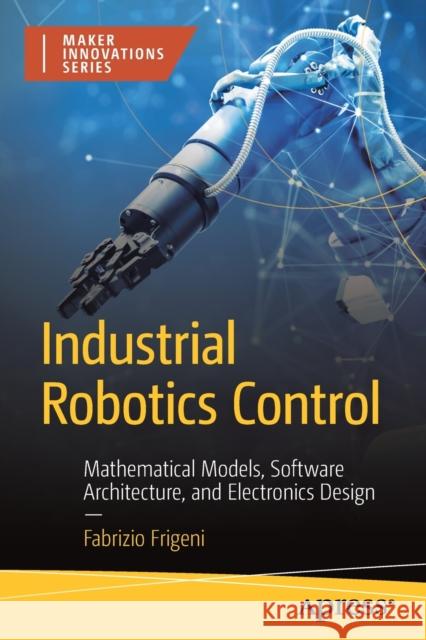
Fabrizio Frigeni
Industrial Robotics Control: Mathematical Models, Software Architecture, and Electronics Design Fabrizio Frigeni 9781484289884 Apress - książkaWidoczna okładka, to zdjęcie poglądowe, a rzeczywista szata graficzna może różnić się od prezentowanej.

Industrial Robotics Control: Mathematical Models, Software Architecture, and Electronics Design

ISBN-13: 9781484289884 / Angielski / Miękka / 2022 / 634 str.

Fabrizio Frigeni
cena 171,00
(netto: 162,86 VAT:  5%)

Najniższa cena z 30 dni: 170,53
Termin realizacji zamówienia:
ok. 16-18 dni roboczych
Bez gwarancji dostawy przed świętami

Darmowa dostawa!

Build a complete control system for industrial robots, learning all the theory and practical tips from the perspective of an automation engineer. Explore the details of kinematics, trajectories, and motion control, and then create your own circuit board to drive the electric motors and move the robot.After covering the theory, readers can put what they’ve learned in practice by programming a control firmware for the robot. Each software component is described in detail, from the HMI and the interpreter of motion commands, to the servo loop controller at the core of each servo drive. In particular, the author presents the commutation algorithm and the servo loop controller for brushless synchronous motors, which are typically employed in robotics applications. Readers will also learn how to calibrate the robot, commission it to the end-user, and design a digital twin to test and monitor the entire workcell in a safe simulated environment.Finally, the book delves into hardware, covering how to select and use electric motors and encoders, how to build servo drives and motion controllers, and how to design your own PCBs. Different electronic components and their application circuits are analyzed, showing the advantages and drawbacks of each.By the end of the book you should be able to design and build electronic boards and write their core firmware to control any kind of industrial robot for all sorts of different practical applications.What you’ll learnSolve kinematics models of robotsGenerate safe paths and optimal motion trajectoriesCreate a digital twin of your robot to test and monitor its movementsMaster the electronic commutation and closed-loop control of brushless motorsDesign electronics circuit boards for motion applicationsWho This Book Is ForRobotics engineers (and students) who want to understand the theory behind the control of robotics arms, from the kinematic models of their axes to the electronic commutation of their motors. Some basic calculus and linear algebra is required for the understanding of the geometrical framework, while some electronics foundations are helpful to grasp the details of the circuits design.

Build a complete control system for industrial robots, learning all the theory and practical tips from the perspective of an automation engineer. Explore the details of kinematics, trajectories, and motion control, and then create your own circuit board to drive the electric motors and move the robot.After covering the theory, readers can put what they’ve learned in practice by programming a control firmware for the robot. Each software component is described in detail, from the HMI and the interpreter of motion commands, to the servo loop controller at the core of each servo drive. In particular, the author presents the commutation algorithm and the servo loop controller for brushless synchronous motors, which are typically employed in robotics applications. Readers will also learn how to calibrate the robot, commission it to the end-user, and design a digital twin to test and monitor the entire workcell in a safe simulated environment.Finally, the book delves into hardware, covering how to select and use electric motors and encoders, how to build servo drives and motion controllers, and how to design your own PCBs. Different electronic components and their application circuits are analyzed, showing the advantages and drawbacks of each. By the end of the book you should be able to design and build electronic boards and write their core firmware to control any kind of industrial robot for all sorts of different practical applications.What you’ll learn

  • Solve kinematics models of robots
  • Generate safe paths and optimal motion trajectories
  • Create a digital twin of your robot to test and monitor its movements
  • Master the electronic commutation and closed-loop control of brushless motors
  • Design electronics circuit boards for motion applications
Who This Book Is For                                             Robotics engineers (and students) who want to understand the theory behind the control of robotics arms, from the kinematic models of their axes to the electronic commutation of their motors. Some basic calculus and linear algebra is required for the understanding of the geometrical framework, while some electronics foundations are helpful to grasp the details of the circuits design.

Kategorie:
Technologie
Kategorie BISAC:
Technology & Engineering > Automation
Technology & Engineering > Robotics
Technology & Engineering > Electrical
Wydawca:
Apress
Język:
Angielski
ISBN-13:
9781484289884
Rok wydania:
2022
Dostępne języki:
Ilość stron:
634
Waga:
0.90 kg
Wymiary:
23.39 x 15.6 x 3.35
Oprawa:
Miękka
Dodatkowe informacje:
Wydanie ilustrowane

Preface

Who is this book for?

Structure of the book 


Chapter 1 Industrial Robots

1.1 Nomenclature

1.2 Mechanical Configurations

1.3 Structure of a Robot Control System

1.4 Digital Twin

Part I: Robot Geometry


Chapter 2 Geometrical Framework 

2.1 Reference Frames 

2.2 Frame Operations 

2.3 Frame Translations

2.4 Frame Rotations

2.5 Properties of a Rotation Matrix

2.6 Composing Rotations: Euler Angles

2.7 Decomposing a Rotation Matrix

2.8 Column Vectors

2.9 Expressing Rotations

2.10 Combining Translations and Rotations

2.11 Example

2.12 Inverted Transformation 


Chapter 3 Forward Kinematics

3.1 Mechanical Structure

3.2 Step by Step Solution

3.3 Combined Transformation Matrix

3.4 Numerical Test

3.5 Zero Frame

3.6 Tool Frame

3.7 Mechanical Coupling


Chapter 4 Inverse Kinematics

4.1 Closed-Form Derivation

4.2 Non-Linear Problem

4.3 Non-Unique Solution

4.4 Singularities

4.5 IK Step 1 – Decoupling

4.6 IK Step 2 – Solve the Arm

4.7 IK Step 3 – Solve the Wrist

4.8 Numerical Test

4.9 Zero Frame

4.10 Tool Frame

4.11 Mechanical Coupling


Part II: Robot Movements


Chapter 5 Path Planning

5.1 PTP Movements

5.2 Path Movements

5.3 Quaternions

5.4 SLERP

5.5 Line

5.6 Circle

5.7 Spline

5.8 De Casteljau’s Algorithm

5.9 Round Edges

5.10 Transitions

5.11 Path Length

5.12 External Path Corrections


Chapter 6 Workspace Monitoring

6.1 Linearization

6.2 Safe Zones

6.3 Forbidden Zones

6.4 Wireframe Model

6.5 Safe Orientation

6.6 Self-Collision

6.7 Capsules

6.8 Exclusive Zones

6.9 Collision Detection


Chapter 7 Trajectory Generator

7.1 S-Curve Profile

7.2 Sinusoidal Profile

7.3 Bezier Profile

7.4 Time-Optimal Movements

7.5 Differential Kinematics

7.6 Path Speed Definitions

7.7 Optimal Motion in Practice

7.8 Time Filtering

7.9 External Path Corrections


Chapter 8 Statics and Dynamics

8.1 Statics

8.2 Singularities

8.3 Dynamics

8.4 Dynamic Model

8.5 Lagrangian Method

8.6 Newton-Euler Method

8.7 Parameters Identification

8.8 Torque Feed-Forward

8.9 Trajectory Optimization

8.10 Teach by Hand

8.11 Motor Sizing

Part III: Robot Software


Chapter 9 Firmware

9.1 Human-Machine-Interface

9.2 Interpreter

9.3 Main Controller

9.4 Kernel Interface

9.5 Servo Drives

9.6 Electronic Commutation


Chapter 10 Calibration

10.1 Robot Calibration

10.2 Tool Calibration

10.3 Cell Calibration


Chapter 11 Commissioning

11.1 Safety

11.2 Tuning


Chapter 12 Simulation

12.1 Unity 3D

12.2 Building a Scene

12.3 Importing CAD Models

12.4 Programming Scripts

12.5 Communication Functions

12.6 User Interface

12.7 Machine Learning


Chapter 13 Machine Vision

13.1 Smart Camera

13.2 Vision Functions

13.3 Deep Learning

13.4 Convolutional Networks

Part IV: Robot Hardware


Chapter 14 Motors

14.1 DC Motors

14.2 Stepper Motors

14.3 Brushless Motors

14.4 Linear Motors

14.5 Motor sizing


Chapter 15 Encoders

15.1 Hall Sensors

15.2 Quadrature

15.3 SSI

15.4 Tamagawa


Chapter 16 Servo Drives

16.1 Power Switches

16.2 Gate Driver

16.3 Current Sensing


Chapter 17 Power Management

17.1 DC bus voltage

17.2 Protection functions

17.3 Voltage converter


Chapter 18 Main Controller

18.1 Microcontroller

18.2 IOs

18.3 Fieldbus

18.4 Integrated solution

18.5 Display


Chapter 19 Fabrication

19.1 PCB Design

19.2 Mechanics


Appendix: Kinematic Models

COBOT

SCARA

PALLETIZER

DELTA

Fabrizio Frigeni is a multi-cultural engineer, hobbyist, teacher and entrepreneur. Hailing from Italy, he holds a degree in Electrical Engineering from the Polytechnic University of Milan; then worked on laser physics for his Master’s degree at the University of Illinois at Chicago, USA; and later completed a doctoral degree in microelectronics at the Technical University of Dresden, Germany.

He has gained extensive experience in the fields of automation, robotics, computer vision, and machine learning, while working for several years on assignments in Austria, Brazil, India and China. He has been based in Shanghai since 2009, where he has first managed local engineering teams, and then started his own company to teach, consult, and design control systems for automated machines and robots.


Udostępnij

Facebook - konto krainaksiazek.pl


Opinie o Krainaksiazek.pl na Opineo.pl

Partner Mybenefit

Krainaksiazek.pl w programie rzetelna firma Krainaksiaze.pl - płatności przez paypal

Czytaj nas na:

Facebook - krainaksiazek.pl
  • książki na zamówienie
  • granty
  • książka na prezent
  • kontakt
  • pomoc
  • opinie
  • regulamin
  • polityka prywatności

Zobacz:

  • Księgarnia czeska

  • Wydawnictwo Książkowe Klimaty

1997-2025 DolnySlask.com Agencja Internetowa

© 1997-2022 krainaksiazek.pl
     
KONTAKT | REGULAMIN | POLITYKA PRYWATNOŚCI | USTAWIENIA PRYWATNOŚCI
Zobacz: Księgarnia Czeska | Wydawnictwo Książkowe Klimaty | Mapa strony | Lista autorów
KrainaKsiazek.PL - Księgarnia Internetowa

Polityka prywatnosci - link
Krainaksiazek.pl - płatnośc Przelewy24
Przechowalnia Przechowalnia






