• Wyszukiwanie zaawansowane
  • Kategorie
  • Kategorie BISAC
  • Książki na zamówienie
  • Promocje
  • Granty
  • Książka na prezent
  • Opinie
  • Pomoc
  • Załóż konto
  • Zaloguj się

Heterogeneous Graph Representation Learning and Applications » książka


zaloguj się | załóż konto
Logo Krainaksiazek.pl

koszyk

konto

szukaj
topmenu
Księgarnia internetowa
Szukaj
Książki na zamówienie
Promocje
Granty
Książka na prezent
Moje konto
Pomoc
 
 
Wyszukiwanie zaawansowane
Pusty koszyk
Bezpłatna dostawa dla zamówień powyżej 20 złBezpłatna dostawa dla zamówień powyżej 20 zł

Kategorie główne

• Nauka
 [2946600]
• Literatura piękna
 [1856966]

  więcej...
• Turystyka
 [72221]
• Informatyka
 [151456]
• Komiksy
 [35826]
• Encyklopedie
 [23190]
• Dziecięca
 [619653]
• Hobby
 [140543]
• AudioBooki
 [1577]
• Literatura faktu
 [228355]
• Muzyka CD
 [410]
• Słowniki
 [2874]
• Inne
 [445822]
• Kalendarze
 [1744]
• Podręczniki
 [167141]
• Poradniki
 [482898]
• Religia
 [510455]
• Czasopisma
 [526]
• Sport
 [61590]
• Sztuka
 [243598]
• CD, DVD, Video
 [3423]
• Technologie
 [219201]
• Zdrowie
 [101638]
• Książkowe Klimaty
 [124]
• Zabawki
 [2473]
• Puzzle, gry
 [3898]
• Literatura w języku ukraińskim
 [254]
• Art. papiernicze i szkolne
 [8170]
Kategorie szczegółowe BISAC

Heterogeneous Graph Representation Learning and Applications

ISBN-13: 9789811661686 / Angielski / Miękka / 2023 / 318 str.
Chuan Shi; Xiao Wang; Philip S. Yu
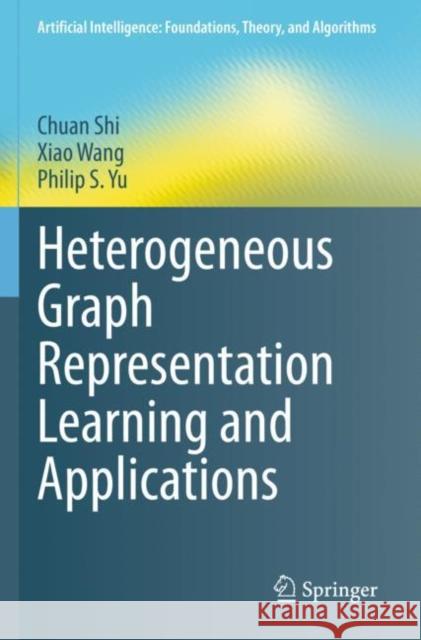
Heterogeneous Graph Representation Learning and Applications Chuan Shi Xiao Wang Philip S. Yu 9789811661686 Springer - książkaWidoczna okładka, to zdjęcie poglądowe, a rzeczywista szata graficzna może różnić się od prezentowanej.

Heterogeneous Graph Representation Learning and Applications

ISBN-13: 9789811661686 / Angielski / Miękka / 2023 / 318 str.

Chuan Shi; Xiao Wang; Philip S. Yu
cena 645,58 zł
(netto: 614,84 VAT:  5%)

Najniższa cena z 30 dni: 616,85 zł
Termin realizacji zamówienia:
ok. 22 dni roboczych
Bez gwarancji dostawy przed świętami

Darmowa dostawa!
inne wydania

Representation learning in heterogeneous graphs (HG) is intended to provide a meaningful vector representation for each node so as to facilitate downstream applications such as link prediction, personalized recommendation, node classification, etc. This task, however, is challenging not only because of the need to incorporate heterogeneous structural (graph) information consisting of multiple types of node and edge, but also the need to consider heterogeneous attributes or types of content (e.g. text or image) associated with each node. Although considerable advances have been made in homogeneous (and heterogeneous) graph embedding, attributed graph embedding and graph neural networks, few are capable of simultaneously and effectively taking into account heterogeneous structural (graph) information as well as the heterogeneous content information of each node.In this book, we provide a comprehensive survey of current developments in HG representation learning. More importantly, we present the state-of-the-art in this field, including theoretical models and real applications that have been showcased at the top conferences and journals, such as TKDE, KDD, WWW, IJCAI and AAAI. The book has two major objectives: (1) to provide researchers with an understanding of the fundamental issues and a good point of departure for working in this rapidly expanding field, and (2) to present the latest research on applying heterogeneous graphs to model real systems and learning structural features of interaction systems. To the best of our knowledge, it is the first book to summarize the latest developments and present cutting-edge research on heterogeneous graph representation learning. To gain the most from it, readers should have a basic grasp of computer science, data mining and machine learning.

Representation learning in heterogeneous graphs (HG) is intended to provide a meaningful vector representation for each node so as to facilitate downstream applications such as link prediction, personalized recommendation, node classification, etc. This task, however, is challenging not only because of the need to incorporate heterogeneous structural (graph) information consisting of multiple types of node and edge, but also the need to consider heterogeneous attributes or types of content (e.g. text or image) associated with each node. Although considerable advances have been made in homogeneous (and heterogeneous) graph embedding, attributed graph embedding and graph neural networks, few are capable of simultaneously and effectively taking into account heterogeneous structural (graph) information as well as the heterogeneous content information of each node.



In this book, we provide a comprehensive survey of current developments in HG representation learning. More importantly, we present the state-of-the-art in this field, including theoretical models and real applications that have been showcased at the top conferences and journals, such as TKDE, KDD, WWW, IJCAI and AAAI. The book has two major objectives: (1) to provide researchers with an understanding of the fundamental issues and a good point of departure for working in this rapidly expanding field, and (2) to present the latest research on applying heterogeneous graphs to model real systems and learning structural features of interaction systems. To the best of our knowledge, it is the first book to summarize the latest developments and present cutting-edge research on heterogeneous graph representation learning. To gain the most from it, readers should have a basic grasp of computer science, data mining and machine learning.

Kategorie:
Informatyka, Bazy danych
Kategorie BISAC:
Computers > Data Science - Data Analytics
Wydawca:
Springer
Seria wydawnicza:
Artificial Intelligence: Foundations, Theory, and Algorithms
Język:
Angielski
ISBN-13:
9789811661686
Rok wydania:
2023
Dostępne języki:
Ilość stron:
318
Waga:
0.52 kg
Wymiary:
23.5 x 15.5
Oprawa:
Miękka
Dodatkowe informacje:
Wydanie ilustrowane

1.     Introduction

1.1   Basic concepts and definitions

1.2   Graph representation

1.3   Heterogeneous graph representation and challenges

1.4   Organization of the book

2.     The State-of-the-art of Heterogeneous Graph Representation

2.1   Method taxonomy

2.1.1        Structure-preserved representation

2.1.2        Attribute-assisted representation

2.1.3        Dynamic representation

2.1.4        Application-oriented representation

2.2   Technique summary

2.2.1        Shallow model

2.2.2        Deep model

2.3   Open sources


Part One: Techniques

3.     Structure-preserved Heterogeneous Graph Representation

3.1   Meta-path based random walk 

3.2   Meta-path based decomposition

3.3   Relation structure awareness

3.4   Network schema preservation

4.     Attribute-assisted Heterogeneous Graph Representation

4.1   Heterogeneous graph attention network

4.2   Heterogeneous graph structure learning

5.     Dynamic Heterogeneous Graph Representation

5.1   Incremental Learning

5.2   Temporal Interaction

5.3   Sequence Information

6.     Supplementary of Heterogeneous Graph Representation

6.1   Adversarial Learning

6.2   Importance Sampling

6.3   Hyperbolic Representation


Part Two: Applications  

7.     Heterogeneous Graph Representation for Recommendation

7.1   Top-N Recommendation

7.2   Cold-start Recommendation

7.3   Author Set Recommendation

8.     Heterogeneous Graph Representation for Text Mining

8.1   Short Text Classification

8.2   News Recommendation with Preference Disentanglement

8.3   News recommendation with long/short-term interest modeling

9.     Heterogeneous Graph Representation for Industry Application

9.1   Cash-out User Detection

9.2   Intent Recommendation

9.3   Share Recommendation

9.4   Friend-Enhanced Recommendation

10.   Future Research Directions

11.   Conclusion


Chuan Shi is the professor in School of Computer Sciences of Beijing University of Posts and Telecommunications, deputy director of Beijing Key Lab of Intelligent Telecommunication Software and Multimedia. The main research interests include data mining, machine learning, artificial intelligence and big data analysis. He has published more than 100 refereed papers, including top journals and conferences in data mining, such as IEEE TKDE, ACM TIST, KDD, AAAI, IJCAI, and WWW. And in the meanwhile, his first monograph about heterogeneous information networks has been published by Springer. He has been honored as the best paper award in ADMA 2011 and ADMA 2018, and has guided students to the world champion in the IJCAI Contest 2015, the premier international data mining competition. He is also the recipient of “the Youth Talent Plan” and “the Pioneer of Teacher's Ethics” in Beijing.


Xiao Wang is the assistant professor in School of Computer Sciences of Beijing University of Posts and Telecommunications. He was a postdoc in the Department of Computer Science and Technology at Tsinghua University. He got his Ph.D. in the School of Computer Science and Technology at Tianjin University and a joint-training Ph.D. at Washington University in St. Louis. The main research interests include data mining, machine learning, artificial intelligence and big data analysis. He has published more than 50 refereed papers, including top journals and conferences in data mining, such as IEEE TKDE, KDD, AAAI, IJCAI, and WWW. He also serves as SPC/PC member and Reviewer of several high-level international conferences, e.g., KDD, AAAI, IJCAI, and journals, e.g., IEEE TKDE.

Philip S. Yu's main research interests include big data, data mining (especially on graph/network mining), social network, privacy preserving data publishing, data stream, database systems, and Internet applications and technologies. He is a Distinguished Professor in the Department of Computer Science at UIC and also holds the Wexler Chair in Information and Technology. Before joining UIC, he was with IBM Thomas J. Watson Research Center, where he was manager of the Software Tools and Techniques department. Dr. Yu has published more than 1,300 papers in refereed journals and conferences with more than 133,000 citations and an H-index of 169. He holds or has applied for more than 300 US patents. Dr. Yu is a Fellow of the ACM and the IEEE. He is the recepient of ACM SIGKDD 2016 Innovation Award and the IEEE Computer Society's 2013 Technical Achievement Award.

Representation learning in heterogeneous graphs (HG) is intended to provide a meaningful vector representation for each node so as to facilitate downstream applications such as link prediction, personalized recommendation, node classification, etc. This task, however, is challenging not only because of the need to incorporate heterogeneous structural (graph) information consisting of multiple types of node and edge, but also the need to consider heterogeneous attributes or types of content (e.g. text or image) associated with each node. Although considerable advances have been made in homogeneous (and heterogeneous) graph embedding, attributed graph embedding and graph neural networks, few are capable of simultaneously and effectively taking into account heterogeneous structural (graph) information as well as the heterogeneous content information of each node.


In this book, we provide a comprehensive survey of current developments in HG representation learning. More importantly, we present the state-of-the-art in this field, including theoretical models and real applications that have been showcased at the top conferences and journals, such as TKDE, KDD, WWW, IJCAI and AAAI. The book has two major objectives: (1) to provide researchers with an understanding of the fundamental issues and a good point of departure for working in this rapidly expanding field, and (2) to present the latest research on applying heterogeneous graphs to model real systems and learning structural features of interaction systems. To the best of our knowledge, it is the first book to summarize the latest developments and present cutting-edge research on heterogeneous graph representation learning. To gain the most from it, readers should have a basic grasp of computer science, data mining and machine learning.


Udostępnij

Facebook - konto krainaksiazek.pl


Opinie o Krainaksiazek.pl na Opineo.pl

Partner Mybenefit

Krainaksiazek.pl w programie rzetelna firma Krainaksiaze.pl - płatności przez paypal

Czytaj nas na:

Facebook - krainaksiazek.pl
  • książki na zamówienie
  • granty
  • książka na prezent
  • kontakt
  • pomoc
  • opinie
  • regulamin
  • polityka prywatności

Zobacz:

  • Księgarnia czeska

  • Wydawnictwo Książkowe Klimaty

1997-2025 DolnySlask.com Agencja Internetowa

© 1997-2022 krainaksiazek.pl
     
KONTAKT | REGULAMIN | POLITYKA PRYWATNOŚCI | USTAWIENIA PRYWATNOŚCI
Zobacz: Księgarnia Czeska | Wydawnictwo Książkowe Klimaty | Mapa strony | Lista autorów
KrainaKsiazek.PL - Księgarnia Internetowa

Polityka prywatnosci - link
Krainaksiazek.pl - płatnośc Przelewy24
Przechowalnia Przechowalnia



