Termin realizacji zamówienia: ok. 22 dni roboczych.
Darmowa dostawa!
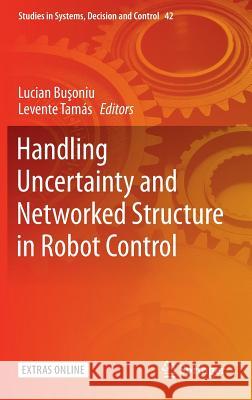
Thisbook focuses on two challenges posed in robot control by the increasingadoption of robots in the everyday human environment: uncertainty and networkedcommunication.
Part I Learning Control in Unknown Environments.- Robot Learning for Persistent Autonomy.- The Explore-Exploit Dilemma in Nonstationary Decision Making under Uncertainty.- Learning Complex Behaviors via Sequential Composition and Passivity-based Control.- Visuospatial Skill Learning.- Part II Dealing with Sensing Uncertainty.- Observer Design for Robot Manipulators via Takagi-Sugeno Models and Linear Matrix Inequalities.- Homography Estimation between Omnidirectional Cameras without Point Correspondences.- Dynamic environment perception and 4D reconstruction using a mobile Rotating Multi-beam Lidar sensor.- ROBOSHERLOCK: Unstructured Information Processing for Robot Perception.- Active SLAM : Problem Overview and an Application to Navigation Under Uncertainty.- Interactive Segmentation of Textured and Textureless Objects.- Part III Control of Networked and Interconnected Robots.- Vision-based quadcopter navigation in structured environments.- Bilateral Teleoperation the Presence of Jitter: Communication Performance Evaluation and Control.- Implementation of consensus algorithms under harsh communication constraints.- Hybrid Consensus-based Formation Control of Nonholonomic Mobile Robots.- A Multi Agent System for Precision Agriculture.
Lucian
Busoniu received the M.Sc. degree (valedictorian) from the Technical University
of Cluj-Napoca, Romania, in 2003 and the Ph.D. degree (cum laude) from the
Delft University of Technology, the Netherlands, in 2009. He has held research
positions in the Netherlands and France, and is currently an associate
professor with the Department of Automation at the Technical University of
Cluj-Napoca. His fundamental interests include planning-based methods for
nonlinear optimal control, reinforcement learning and dynamic programming with
function approximation, and multiagent systems; while his practical focus is
applying these techniques to robotics. He has coauthored a book and more than
50 papers and book chapters on these topics. He was the recipient of the 2009
Andrew P. Sage Award for the best paper in the IEEE Transactions on Systems,
Man, and Cybernetics.
Levente Tamas received the M.Sc. (valedictorian) and the Ph.D.
degree in electrical engineering from Technical University of Cluj-Napoca,
Romania, in 2005 and 2010, respectively. He took part in several postdoctoral
programs dealing with 3D perception and robotics, the most recent one spent at
the Bern University of Applied Sciences, Switzerland. He is currently with the
Department of Automation, Technical University of Cluj-Napoca, Romania. His
research focuses on 3D perception and planning for autonomous mobile robots,
and has resulted in several well ranked conference papers, journal articles, and
book chapters in this field.
This
book focuses on two challenges posed in robot control by the increasing
adoption of robots in the everyday human environment: uncertainty and networked
communication. Part
I of the book describes learning control to address environmental uncertainty.
Part II discusses state estimation, active sensing, and complex scenario
perception to tackle sensing uncertainty. Part III
completes the book with control of networked robots and multi-robot teams.
Each chapter features in-depth technical coverage and case studies
highlighting the applicability of the techniques, with real robots or in
simulation. Platforms include mobile ground, aerial, and underwater robots, as
well as humanoid robots and robot arms. Source code and experimental data are
available at http://extras.springer.com.
The text gathers contributions from academic and industry experts,
and offers a valuable resource for researchers or graduate students in robot
control and perception. It also benefits researchers in related areas, such as
computer vision, nonlinear and learning control, and multi-agent systems.