• Wyszukiwanie zaawansowane
  • Kategorie
  • Kategorie BISAC
  • Książki na zamówienie
  • Promocje
  • Granty
  • Książka na prezent
  • Opinie
  • Pomoc
  • Załóż konto
  • Zaloguj się

Handbook of State Aid for Film: Finance, Industries and Regulation » książka

zaloguj się | załóż konto
Logo Krainaksiazek.pl

koszyk

konto

szukaj
topmenu
Księgarnia internetowa
Szukaj
Książki na zamówienie
Promocje
Granty
Książka na prezent
Moje konto
Pomoc
 
 
Wyszukiwanie zaawansowane
Pusty koszyk
Bezpłatna dostawa dla zamówień powyżej 20 złBezpłatna dostawa dla zamówień powyżej 20 zł

Kategorie główne

• Nauka
 [2949965]
• Literatura piękna
 [1857847]

  więcej...
• Turystyka
 [70818]
• Informatyka
 [151303]
• Komiksy
 [35733]
• Encyklopedie
 [23180]
• Dziecięca
 [617748]
• Hobby
 [139972]
• AudioBooki
 [1650]
• Literatura faktu
 [228361]
• Muzyka CD
 [398]
• Słowniki
 [2862]
• Inne
 [444732]
• Kalendarze
 [1620]
• Podręczniki
 [167233]
• Poradniki
 [482388]
• Religia
 [509867]
• Czasopisma
 [533]
• Sport
 [61361]
• Sztuka
 [243125]
• CD, DVD, Video
 [3451]
• Technologie
 [219309]
• Zdrowie
 [101347]
• Książkowe Klimaty
 [123]
• Zabawki
 [2362]
• Puzzle, gry
 [3791]
• Literatura w języku ukraińskim
 [253]
• Art. papiernicze i szkolne
 [7933]
Kategorie szczegółowe BISAC

Handbook of State Aid for Film: Finance, Industries and Regulation

ISBN-13: 9783030101008 / Angielski / Miękka / 2018 / 666 str.
Paul Clemens Murschetz; Roland Teichmann; Matthias Karmasin
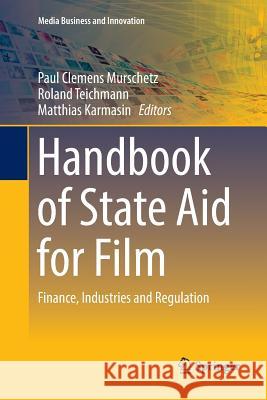
Handbook of State Aid for Film: Finance, Industries and Regulation Murschetz, Paul Clemens 9783030101008 Springer - książkaWidoczna okładka, to zdjęcie poglądowe, a rzeczywista szata graficzna może różnić się od prezentowanej.

Handbook of State Aid for Film: Finance, Industries and Regulation

ISBN-13: 9783030101008 / Angielski / Miękka / 2018 / 666 str.

Paul Clemens Murschetz; Roland Teichmann; Matthias Karmasin
cena 806,99
(netto: 768,56 VAT:  5%)

Najniższa cena z 30 dni: 771,08
Termin realizacji zamówienia:
ok. 22 dni roboczych
Bez gwarancji dostawy przed świętami

Darmowa dostawa!
Kategorie:
Nauka, Ekonomia i biznes
Kategorie BISAC:
Business & Economics > Industries - Media & Communications
Business & Economics > Finanse publiczne
Business & Economics > International - Economics & Trade
Wydawca:
Springer
Seria wydawnicza:
Media Business and Innovation
Język:
Angielski
ISBN-13:
9783030101008
Rok wydania:
2018
Wydanie:
Softcover Repri
Ilość stron:
666
Waga:
0.95 kg
Wymiary:
23.39 x 15.6 x 3.56
Oprawa:
Miękka
Wolumenów:
01
Dodatkowe informacje:
Wydanie ilustrowane


Chapter 1: Why Study State Aid for Film? A First Clarification.- Chapter 2: Introducing the Book’s Topics.- Part I: Exploring Scholarly Themes.- Chapter 3: The Economics of Film Financing: An Introduction.- Chapter 4: Private Equity Finance: The Role of Private Investors in the European Film Market.- Chapter 5: Film Governance in the EU: Caught in a Loop?.- Chapter 6: Governance, Public Interest, and Public Film Funding: Discussing a new Theoretical Framework.- Chapter 7: State Subsidies to Film and their Effects at the Box Office: Theorizing and Measuring Why Some Genres do Better than Others.- Chapter 8: How Film Financing Shapes Project Strategy: Applying Organizational Economics to a Case Study in Norway.- Chapter 9: How Hollywood Applies Industrial Strategies to Counter Market Uncertainty: The Issues of Financing and Exhibition.- Part II: AnalysingCurrent Practices.- Chapter 10: Public Funding for Film and other Audio-visual Works in Europe: Key Industry Statistics 2010 – 2014.- Chapter 11: The European Commission’s Approach to Film Funding: Striking a Difficult Balance.- Chapter 12: Supporting Film Distribution across Europe: Why is Overcoming National Barriers so Difficult?.- Chapter 13: Film Funding Law in the European Union: Discussing the Rationale and Reviewing the Practice.- chapter 14: Public Film Funding in Australia: Recent History and Empirical Analysis.- Chapter 15: Exploring the Ecosystem and Principles of Austria’s Film Subsidy Schemes: Is Austria A “Best-Practice” Model for a Successful Film Policy?.- Chapter 16: Film Subsidies, History and the “Economization of Culture” in Austria: An Expert Interview.- Chapter 17: Public Film Funding under a “Federalist Policy Paradigm”: A Synoptic Analysis of State Aid for Film in Germany.- Chapter 18: France’s Protected and Subsidized Film Industry: Is the Subsidy Scheme living up to its Promises?.- Chapter 19: Government Failure: The Ineffectiveness of Italian State Subsidies to Film.- Chapter 20: Evaluating the Effects of Protectionism on the Film Industry: A Case Study Analysis of Korea.- Chapter 21: Diversifying Public Film Funding Policies across Regions: The Case of Latin America.- chapter 22 Feature Film Funding between National and International Priorities: How does New Zealand Bridge the Gap?.- Chapter 23: Regulating the Mandatory Participation of TV Networks in Financing the Movie Industry: The Case of Spain.- Chapter 24: Public Film Policy and the Rise of Economic Principles: The Case of Switzerland.- Chapter 25: Film Funding in the United Kingdom: The “Corporate Welfare System” and its Discontents.- Chapter 26: Beyond the “Studio System”: Public Support for Films in the United States.- Chapter 27: Evidencing the Economics of Film Festival Funding: Do Government Subsidies Help?.- Part III – Predicting Future Directions.- Chapter 28: Where are the Women Directors? Gender Equality for Directors in the European Film Industry.- Chapter 29: “Avant-Garde Film” Goes Digital Video: How does the United States Fund Digital Video Art and Experimental Filmmaking?.- Chapter 30: Movie Analytics and the Future of Film Finance: Are Oscars and Box Office Revenue Predictable?.- Chapter 31: An Irish Film Industry or a Film Industry in Ireland? The Paradoxes of Film Tax Incentives.- Chapter 32: Tax Incentive Schemes for Film Production: A Pivotal Tool of Film Policy?.- Chapter 33: Film Financing in the Era of “Connected TV”: How do “Legacy” Broadcasters Respond to Market Changes?.- Chapter 34: Crowd-funding Movies: A Business Model Analysis from Strategic Management Studies.

Paul Clemens Murschetz is Professor at Berlin University of Digital Sciences. He has been visiting senior lecturer for the University of Westminster’s School of Media, Arts and Design (Department of Journalism and Mass Communication) and W2-Professor at CBS-Cologne Business School GmbH. Paul holds an MA and PhD. in management from the Vienna University of Economics and Business Studies (1989/1992), an MSc. in media and communication studies from the London School of Economics and Political Science (1996), and a Habilitation from the Alpen-Adria-Universität Klagenfurt, Austria.

Roland Teichmann, LLM, is CEO of the Austrian Film Institute since 2004. Roland began his career in the Federal Economic Chamber. In 2001 he became general manager of the Association of the Audiovisual and Film Industry. Since then, he has held several leadership positions: board member of the Austrian Film Commission, advisory board member of the Association of Austrian Film Producers (aafp), Austrian representative of the International Producers Association (FIAPF), representative for Austria at EFAD (European Film Agency Directors), chairman of the advisory board of the Television Film Fund managed by the Austrian communication regulatory authority RTR and member of the European Film Academy (EFA). Roland is also national representative for Austria at Eurimages and used to teach film funding and financing at the University of Music and Performing Arts Vienna.

Matthias Karmasin is full Professor and Chair for the Department of Media and Communication Studies at the Alpen-Adria University Klagenfurt in Austria. Further, he is corresponding member of the philosophic-historic class of the Austrian Academy of Sciences (ÖAW) and Director of the Institute for Comparative Media and Communication Studies aligned to it. His research focuses on media accountability, media ethics, media management, political communication, and communication theory. He is editor and co-author of 30 books and more than 100 scientific research articles.

This book is an analysis of the specificities of public film funding on an international scale. It shows how public funding schemes add value to film-making and other audio-visual productions and provides a comprehensive analysis of today’s global challenges in the film industry such as industry change, digital transformation, and shifting audience tastes. Based on insights from fields such as cultural economics, media economics, media management and media governance studies, the authors illustrate how public spending shapes the financial fitness of national and international film industries. This highly informative book will help both scholars and practitioners in the film industry to understand the complexity of issues and the requirements necessary to preserve the social benefits of film as an important cultural good.


Udostępnij

Facebook - konto krainaksiazek.pl


Opinie o Krainaksiazek.pl na Opineo.pl

Partner Mybenefit

Krainaksiazek.pl w programie rzetelna firma Krainaksiaze.pl - płatności przez paypal

Czytaj nas na:

Facebook - krainaksiazek.pl
  • książki na zamówienie
  • granty
  • książka na prezent
  • kontakt
  • pomoc
  • opinie
  • regulamin
  • polityka prywatności

Zobacz:

  • Księgarnia czeska

  • Wydawnictwo Książkowe Klimaty

1997-2025 DolnySlask.com Agencja Internetowa

© 1997-2022 krainaksiazek.pl
     
KONTAKT | REGULAMIN | POLITYKA PRYWATNOŚCI | USTAWIENIA PRYWATNOŚCI
Zobacz: Księgarnia Czeska | Wydawnictwo Książkowe Klimaty | Mapa strony | Lista autorów
KrainaKsiazek.PL - Księgarnia Internetowa

Polityka prywatnosci - link
Krainaksiazek.pl - płatnośc Przelewy24
Przechowalnia Przechowalnia







