• Wyszukiwanie zaawansowane
  • Kategorie
  • Kategorie BISAC
  • Książki na zamówienie
  • Promocje
  • Granty
  • Książka na prezent
  • Opinie
  • Pomoc
  • Załóż konto
  • Zaloguj się

Handbook of Elemental Speciation: Techniques and Methodology » książka

zaloguj się | załóż konto
Logo Krainaksiazek.pl

koszyk

konto

szukaj
topmenu
Księgarnia internetowa
Szukaj
Książki na zamówienie
Promocje
Granty
Książka na prezent
Moje konto
Pomoc
 
 
Wyszukiwanie zaawansowane
Pusty koszyk
Bezpłatna dostawa dla zamówień powyżej 20 złBezpłatna dostawa dla zamówień powyżej 20 zł

Kategorie główne

• Nauka
 [2944077]
• Literatura piękna
 [1814251]

  więcej...
• Turystyka
 [70679]
• Informatyka
 [151074]
• Komiksy
 [35590]
• Encyklopedie
 [23169]
• Dziecięca
 [611005]
• Hobby
 [136031]
• AudioBooki
 [1718]
• Literatura faktu
 [225599]
• Muzyka CD
 [379]
• Słowniki
 [2916]
• Inne
 [443741]
• Kalendarze
 [1187]
• Podręczniki
 [166463]
• Poradniki
 [469211]
• Religia
 [506887]
• Czasopisma
 [481]
• Sport
 [61343]
• Sztuka
 [242115]
• CD, DVD, Video
 [3348]
• Technologie
 [219293]
• Zdrowie
 [98602]
• Książkowe Klimaty
 [124]
• Zabawki
 [2385]
• Puzzle, gry
 [3504]
• Literatura w języku ukraińskim
 [260]
• Art. papiernicze i szkolne
 [7151]
Kategorie szczegółowe BISAC

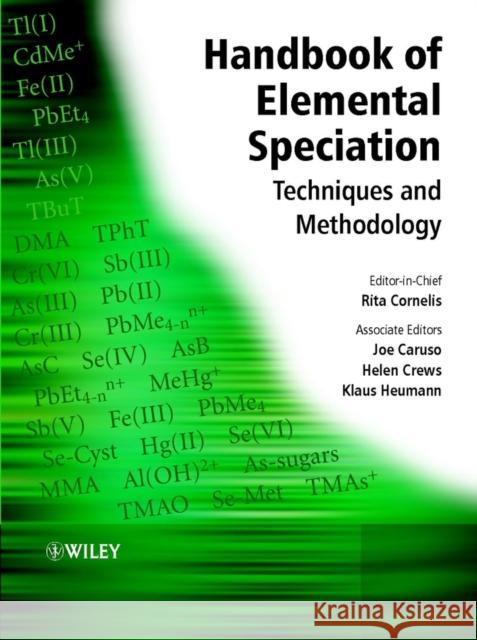
Handbook of Elemental Speciation: Techniques and Methodology

ISBN-13: 9780471492146 / Angielski / Twarda / 2003 / 670 str.
Klaus G. Heumann; Rita Cornelis; Joe Caruso
Handbook of Elemental Speciation: Techniques and Methodology Caruso, Joseph A. 9780471492146 John Wiley & Sons - książkaWidoczna okładka, to zdjęcie poglądowe, a rzeczywista szata graficzna może różnić się od prezentowanej.

Handbook of Elemental Speciation: Techniques and Methodology

ISBN-13: 9780471492146 / Angielski / Twarda / 2003 / 670 str.

Klaus G. Heumann; Rita Cornelis; Joe Caruso
cena 1998,02
(netto: 1902,88 VAT:  5%)

Najniższa cena z 30 dni: 1973,61
Termin realizacji zamówienia:
ok. 30 dni roboczych.

Darmowa dostawa!

This international collection of chapters comprehensively covers different aspects of procedures for speciation analysis at all levels starting from sample collection and storage, through sample preparation approaches to render the species chromatographable, principles of separation techniques used in speciation analysis, to the element specific detection.

  • International renowned editors and contributors
  • Includes coverage of electrochemical methods, biosensors for metal ions, radioisotope techniques and direct solid speciation techniques
  • Provides information on quality assurance and risk assessment, and speciation-relevant legislation
Each chapter is a stand-alone reference covering a given facet of elemental speciation analysis written by an expert in a given field with the volume as a whole providing an excellent introductory text and reference handbook.

Kategorie:
Nauka, Chemia
Kategorie BISAC:
Science > Chemia - Analityczna
Wydawca:
John Wiley & Sons
Język:
Angielski
ISBN-13:
9780471492146
Rok wydania:
2003
Ilość stron:
670
Waga:
1.56 kg
Wymiary:
25.6 x 19.25 x 4.17
Oprawa:
Twarda
Wolumenów:
01

"This book provides broad coverage of the different aspects of the analysis of elemental species..." ( Journal of the American Chemistry Society, 2004 Vol. 126)

"...a welcome contribution to the literature...will provide a useful insight..." (Trends in Analytical Chemistry, Vol 23(4), April 2004)

"...the reader can use this book as a reference book for the next 5 to 10 years.." (Applied Organmettallic Chemistry, Jan 2004)

"...a long–awaited high–quality handbook...will be of great value in both academia and industry." (Angewandte Chemie, Vol.43, No.42, 25th October 2004)

"Each chapter, written by an expert on the field, is a stand alone reference...an excellent introductory text" (International Journal of Environmental Analytical Chemistry 2004)

"...provides an excellent compendium of information on all the important methods of speciation analysis..." (Analytical & Bioanalytical Chemistry, No.380, 2004)

"...this is a long–awaited high–quality handbook for speciation analysis ...(and) has the potential to become one of the most frequently used books in the personal shelves of specialists in the field and teachers of analytical chemistry!" (also in German, Angewandte Chemie, 2004; Vol 43; No. 42)

List of Contributors.

Preface.

Technical Abbreviations and Acronyms.

1 Introduction.

2 Sampling: Collection, Storage.

2.1 Sampling: Collection, Processing and Storage of Environmental Samples.

2.2 Sampling of Clinical Samples: Collection and Storage.

2.3 Food: Sampling with Special Reference to Legislation, Uncertainty and Fitness for Purpose.

2.4 Sampling: Collection, Storage Occupational Health.

3 Sample Preparation.

3.1 Sample Treatment for Speciation Analysis in Biological Samples.

3.2 Sample Preparation Techniques for Elemental Speciation Studies.

3.3 Sample Preparation Fractionation (Sediments, Soils, Aerosols and Fly Ashes).

4 Separation Techniques.

4.1 Liquid Chromatography.

4.2 Gas Chromatography and Other Gas Based Methods.

4.3 Capillary Electrophoresis in Speciation Analysis.

4.4 Gel Electrophoresis for Speciation Purposes.

5 Detection.

5.1 Atomic Absorption and Atomic Emission Spectrometry.

5.2 Flow Injection Atomic Spectrometry for Speciation.

5.3 Detection by ICP–Mass Spectrometry.

5.4 Plasma Source Time–of–flight Mass Spectrometry: a Powerful Tool for Elemental Speciation.

5.5 Glow Discharge Plasmas as Tunable Sources for Elemental Speciation.

5.6 Electrospray Methods for Elemental Speciation.

5.7 Elemental Speciation by Inductively Coupled Plasma–Mass Spectrometry with High Resolution Instruments.

5.8 On–line Elemental Speciation with Functionalised Fused Silica Capillaries in Combination with DIN–ICP–MS.

5.9 Speciation Analysis by Electrochemical Methods.

5.10 Future Instrumental Development for Speciation.

5.11 Biosensors for Monitoring of Metal Ions.

5.12 Possibilities Offered by Radiotracers for Method Development in Elemental Speciation Analysis and for Metabolic and Environmentally Related Speciation Studies.

6 Direct Speciation of Solids.

6.1 Characterization of Individual Aerosol Particles with Special Reference to Speciation Techniques.

6.2 Direct Speciation of Solids: X–ray Absorption Fine Structure Spectroscopy for Species Analysis in Solid Samples.

7 Calibration.

7.1 Calibration in Elemental Speciation Analysis.

7.2 Reference Materials.

8 Screening Methods for Semiquantitative Speciation Analysis.

9 Risk Assessments/Regulations.

9.1 Environmental Risk Assessment and the Bioavailability of Elemental Species.

9.2 Speciation and Legislation.

Index.

The areas of speciation analysis have being undergoing a continual evolution and development for the last 20 years. A fundamental tool for speciation analysis has been the combination of a chromatographic separation technique with atomic spectrometry, permitting a sensitive and specific detection of the target element. Recent impressive progress toward lower detection limits in ICP–MS, toward higher resolution in separation techniques, especially capillary electrophoresis and electro–chromatography, and toward higher sensitivity in electrospray mass spectrometry for molecule–specific detection at trace levels in complex matrices has allowed new frontiers to be crossed.

This first volume of The Handbook of Elemental Speciation, brings together a collection of chapters covering comprehensively different aspects of procedures for speciation analysis at the different levels starting from sample collection and storage, through sample preparation approaches to render the species chromatographable, principles of separation techniques used in speciation analysis, to the element specific detection. This already very broad coverage of analytical techniques is completed by electrochemical methods, biosensors for metal ions, radioisotope techniques and direct solid speciation techniques. Special concern is given to quality assurance and risk assessment, and speciation–relevant legislation.

Each chapter is a stand–alone reference covering a given facet of elemental speciation analysis written by an expert in a given field with the volume as a whole providing an excellent introductory text and reference handbook for analytical chemists in academia, government laboratories and industry, regulatory managers, biochemists, toxicologists, clinicians, environmental scientists, and students of these disciplines.

The second volume will present in detail a summary of each key element determined by speciation methods, and its detection and measurement within the four key areas of the environment, food, occupation and clinical health. .


Udostępnij

Facebook - konto krainaksiazek.pl


Opinie o Krainaksiazek.pl na Opineo.pl

Partner Mybenefit

Krainaksiazek.pl w programie rzetelna firma Krainaksiaze.pl - płatności przez paypal

Czytaj nas na:

Facebook - krainaksiazek.pl
  • książki na zamówienie
  • granty
  • książka na prezent
  • kontakt
  • pomoc
  • opinie
  • regulamin
  • polityka prywatności

Zobacz:

  • Księgarnia czeska

  • Wydawnictwo Książkowe Klimaty

1997-2026 DolnySlask.com Agencja Internetowa

© 1997-2022 krainaksiazek.pl
     
KONTAKT | REGULAMIN | POLITYKA PRYWATNOŚCI | USTAWIENIA PRYWATNOŚCI
Zobacz: Księgarnia Czeska | Wydawnictwo Książkowe Klimaty | Mapa strony | Lista autorów
KrainaKsiazek.PL - Księgarnia Internetowa

Polityka prywatnosci - link
Krainaksiazek.pl - płatnośc Przelewy24
Przechowalnia Przechowalnia








