HPLC and Uhplc for Practicing Scientists » książka





HPLC and Uhplc for Practicing Scientists
ISBN-13: 9781119313762 / Angielski / Miękka / 2019 / 416 str.
HPLC and Uhplc for Practicing Scientists
ISBN-13: 9781119313762 / Angielski / Miękka / 2019 / 416 str.
(netto: 391,76 VAT: 5%)
Najniższa cena z 30 dni: 407,15
ok. 30 dni roboczych.
Darmowa dostawa!
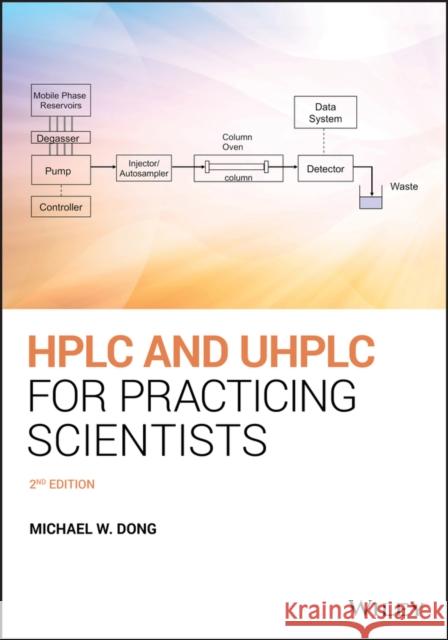
Author's Biography xviiBiographies of Contributors xixPreface xxiForeword xxiiiAcknowledgments xxv1 Introduction 11.1 Introduction 11.1.1 Scope 11.1.2 What Is HPLC? 21.1.3 A Brief History 31.1.4 Advantages and Limitations 41.1.5 Ultra-High-Pressure Liquid Chromatography (UHPLC) 41.2 Primary Modes of HPLC 41.2.1 Normal-Phase Chromatography (NPC) 51.2.2 Reversed-Phase Chromatography (RPC) 51.2.3 Ion-Exchange Chromatography (IEC) 61.2.4 Size-Exclusion Chromatography (SEC) 81.2.5 Other Separation Modes 81.3 Some Common-Sense Corollaries 101.4 How to Get More Information 111.5 Summary 111.6 Quizzes 111.6.1 Bonus Quiz 12References 122 Basic Terms and Concepts 152.1 Scope 152.2 Basic Terms and Concepts 162.2.1 Retention Time (tR), Void Time (tM), Peak Height (h), and Peak Width (wb) 162.2.2 Retention Volume (VR), Void Volume (VM), and Peak Volume 162.2.3 Retention Factor (k) 182.2.4 Separation Factor (alpha) 192.2.5 Column Efficiency and Plate Number (N) 202.2.6 Peak Volume 202.2.7 Height Equivalent to a Theoretical Plate or Plate Height (HETP or H) 212.2.8 Resolution (Rs) 212.2.9 Peak Symmetry:Asymmetry Factor (As) and Tailing Factor (Tf) 232.3 Mobile Phase 242.3.1 General Requirements 242.3.2 Solvent Strength and Selectivity 252.3.3 pH Modifiers and Buffers 272.3.4 Acidic Mobile Phases 282.3.5 Ion-Pairing Reagents and Chaotropic Agents 292.3.6 High-pH Mobile Phases 292.3.7 Other Operating Parameters: Flow Rate (F) and Column Temperature (T) 302.4 The Resolution Equation 312.5 The Van Deemter Equation 332.6 Isocratic vs. Gradient Analysis 352.6.1 Peak Capacity (n) 352.6.2 Gradient Parameters (Initial and Final Solvent Strength, Gradient Time (tG), and Flow Rate) 362.6.3 The 0.25 DeltatG Rule: When Is Isocratic Analysis More Appropriate? 372.7 The Concept of Orthogonality and Selectivity Tuning 382.8 Sample Capacity 412.9 Glossary of HPLC Terms 412.10 Summary and Conclusion 422.11 Quizzes 422.11.1 Bonus Quiz 44References 443 HPLC Columns and Trends 453.1 Scope 453.1.1 Glossary and Abbreviations 453.2 General Column Description and Characteristics 463.2.1 Column Hardware - Standard vs. Cartridge Format 473.3 Column Type 473.3.1 Types Based on Chromatographic Mode 483.3.2 Column Types Based on Dimension 483.3.3 Column Length (L) 483.4 Column Packing Characteristics 503.4.1 Support Type 503.4.2 Particle Size (dp) 513.4.3 Surface Area and Pore Size (dpore) 513.4.4 Bonding Chemistries 523.5 Modern HPLC Column Trends 543.5.1 Silica Support Material 543.5.2 Hybrid Particles 553.5.3 Novel Bonding Chemistries 583.5.4 Shorter and Narrower Columns Packed with Small Particles 613.5.5 Micro-LC and Nano-LC 623.5.6 Monoliths 643.5.7 Superficially Porous Particles (SPP) 653.5.8 Micropillar Array Chromatography (muPAC) 673.6 Guard Columns 693.7 Specialty Columns 693.7.1 Bioseparations Columns 693.7.2 Chiral Columns 693.7.3 Supercritical Fluid Chromatography (SFC) Columns 713.7.4 Hydrophilic Interaction Liquid Chromatography (HILIC) Columns 723.7.5 Mixed-Mode Chromatography (MMC) Columns 723.7.6 Application-Specific Columns 733.8 RPC Column Selection Guides 733.8.1 Some General Guidelines for Bonded Phase Selection 753.9 Summary 763.10 Quizzes 763.10.1 Bonus Quiz 78References 784 HPLC/UHPLC Instrumentation and Trends 814.1 Introduction 814.1.1 Scope 814.1.2 HPLC Systems and Modules 814.1.3 Ultra-High-Pressure Liquid Chromatography (UHPLC) 834.2 HPLC and UHPLC Solvent Delivery Systems 834.2.1 High-Pressure and Low-Pressure Mixing Designs in Multisolvent Pumps 854.2.2 System Dwell Volume 864.2.3 Trends 884.3 Injectors and Autosamplers 884.3.1 Operating Principles of Autosamplers 884.3.2 Performance Characteristics and Trends 894.4 Detectors 914.5 UV/VIS Absorbance Detectors 924.5.1 Operating Principles 924.5.2 Performance Characteristics 944.5.3 Trends in UV/Vis Absorbance Detectors 944.6 Photodiode Array Detectors 944.6.1 Operating Principles 944.6.2 Trends in PDA Detectors 954.7 Other Detectors 954.7.1 Refractive Index Detector (RID) 964.7.2 Evaporative Light Scattering Detector (ELSD) 964.7.3 Charged Aerosol Detector (CAD) 974.7.4 Conductivity Detector (CD) 974.7.5 Fluorescence Detector (FLD) 974.7.6 Chemiluminescence Nitrogen Detector (CLND) 984.7.7 Electrochemical Detector (ECD) 994.7.8 Radiometric Detector 994.8 Hyphenated and Specialized Systems 994.8.1 LC/MS and LC/MS/MS 994.8.2 LC/NMR 1004.8.3 Other Hyphenated Systems 1024.8.4 Supercritical Fluid Chromatography (SFC) 1024.8.5 Preparative LC and SFC 1024.8.6 Micro- and Nano-LC (Capillary LC) 1024.8.7 Multidimensional LC 1024.8.8 Lab-on-a-Chip 1044.8.9 Specialized Applications Systems 1044.9 HPLC Accessories 1054.9.1 Solvent Degasser 1054.9.2 Column Oven 1054.9.3 Valves for Column and Mobile Phase Selection 1064.10 Chromatography Data Systems (CDS) 1064.10.1 User Interface and CDSWorkflow 1074.11 Instrumental Bandwidth (IBW) 1084.11.1 How to Measure IBW 1094.11.2 IBW of UHPLC Systems 1104.12 Manufacturers and Equipment Selection 1114.13 Trends in HPLC and UHPLC Equipment 1114.14 Summary 1124.15 Quizzes 1124.15.1 Bonus Quiz 114References 1145 UHPLC: Perspectives, Performance, Practices, and Potential Issues 1175.1 Introduction 1175.1.1 Scope 1175.1.2 Glossary and Abbreviations 1175.1.3 Historical Perspectives: What Is UHPLC? 1185.2 Practical Concepts in UHPLC 1205.2.1 Rationale for Higher System Pressure 1205.2.2 Rationale for Low-Dispersion Systems 1215.2.3 Rationale for Low Dwell Volumes 1215.2.4 Other UHPLC Instrumental Characteristics 1225.3 Benefits Of UHPLC and Case Studies 1225.3.1 Benefit #1: Fast Separations with Good Resolution 1225.3.2 Benefit #2: High-Resolution Analysis of Complex Samples 1245.3.3 Benefit #3: Rapid HPLC Method Development 1245.3.4 Flexibility for Customizing Resolution 1295.3.5 Other Benefits of UHPLC 1305.4 Potential Issues and How to Mitigate 1325.4.1 Safety Issues 1325.4.2 Viscous Heating 1335.4.3 Instrumental and Operating Nuances 1335.4.4 Injector Precision 1355.4.5 UV Detection Noise vs. Mixer Volumes 1355.4.6 Method Translation (Conversion) 1385.5 How to Implement UHPLC and Practical Aspects 1395.5.1 How to Transition from HPLC to UHPLC 1395.5.2 End-Fittings 1405.5.3 A Summary of UHPLC System Performance Tradeoffs 1405.6 Myths in UHPLC 1425.7 Summary and Conclusions 1425.8 Quizzes 1425.8.1 Bonus Quiz 144References 1446 LC/MS: Fundamentals, Perspectives, and Applications 147Christine Gu6.1 Introduction 1476.1.1 Scope 1476.1.2 LC/MS Technology and Instrumentation 1476.1.3 Basic Terminologies and Concepts for MS 1486.1.4 Interfacing HPLC and MS 1506.2 LC/MS Instrumentation 1506.2.1 Ion Sources 1506.2.2 Fragmentation 1526.2.3 Mass Analyzers 1536.2.4 Detectors 1556.3 Small-Molecules Drug Research and Development 1576.3.1 Mass Measurement and Elemental Composition Determination 1576.3.2 Structural Elucidation 1596.3.3 Trace Quantitation 1626.4 Emerging Biopharmaceutical Applications 1646.4.1 Intact Mass Measurement of Proteins 1666.4.2 Structural Characterization of Proteins (Bottom-Up and Top-Down Approaches) 1666.4.3 Peptide Quantitation 1706.5 Environmental, Food Safety, Clinical, Toxicology, and "Omics" Applications 1716.6 Future Perspectives 1716.7 Quizzes 1726.7.1 Bonus Quiz 174References 1747 HPLC/UHPLC Operation Guide 1777.1 Scope 1777.2 Safety and Environmental Concerns 1777.2.1 Safety Concerns 1777.2.2 Environmental Concerns 1797.3 Mobile Phase and Sample Preparation 1807.3.1 Mobile Phase Premixing 1807.3.2 Mobile Phase Additives and Buffers 1807.3.3 Filtration 1807.3.4 Degassing 1817.3.5 Samples, Diluents, and Sample Preparation 1817.4 Best Practices in HPLC/UHPLC System Operation 1827.4.1 Pump Operation 1827.4.2 HPLC Column Use, Precaution, Connection, and Maintenance 1837.4.3 Autosampler Operation 1847.4.4 Column Oven and Switching Valve 1867.4.5 UV/Vis Detector Operation 1867.4.6 HPLC System Shutdown 1877.4.7 Guidelines for Increasing HPLC Precision 1877.5 From Chromatograms to Reports 1897.5.1 Qualitative Analysis Strategies 1927.5.2 Quantitation Analysis Strategies 1927.6 Summary of HPLC Operation 1937.7 Guides on Performing Trace Analysis 1937.8 Summary 1957.9 Quizzes 1957.9.1 Bonus Quiz 196References 1968 HPLC/UHPLC Maintenance and Troubleshooting 1998.1 Scope 1998.2 HPLC System Maintenance 1998.2.1 HPLC Pump 2008.2.2 UV/Vis Absorbance or Photodiode Array Detectors (PDA) 2028.2.3 Injector and Autosampler 2048.3 HPLC Troubleshooting 2048.3.1 General Problem Diagnostic and Troubleshooting Guide 2058.3.2 Common HPLC Problems 2068.4 Troubleshooting Case Studies 2138.4.1 Case Study 1: Reducing Baseline Shift and Noise for Gradient Analysis 2138.4.2 Case Study 2: Poor Peak Area Precision 2148.4.3 Case Study 3: Poor Assay Accuracy Data 2158.4.4 Case Study 4: Equipment Malfunctioning and Problems with Blank 2168.5 Summary and Conclusion 2178.6 Quizzes 2188.6.1 Bonus Quiz 219References 2199 Pharmaceutical Analysis 2219.1 Introduction 2219.1.1 Scope 2219.1.2 Glossary and Abbreviations 2219.2 Overview of Drug Development Process 2229.3 Sample Preparation Perspectives 2249.4 HPLC, SFC, and HPLC/MS in Drug Discovery 2249.5 HPLC Testing Methodologies for DS and DP 2259.5.1 Identification Test (DS, DP) 2279.5.2 ASSAY (Rough Potency and Performance Testing, DP) 2279.5.3 Stability-Indicating Assay (Potency and Purity Testing of DS and DP) 2309.5.4 Assay of Preservatives 2389.5.5 Assay of Pharmaceutical Counterions 2389.5.6 Assay of Potential Genotoxic Impurities (PGI) 2399.6 Cleaning Verification 2399.7 Bioanalytical Testing 2409.8 Summary 2429.9 Quizzes 2429.9.1 Bonus Quiz 243References 24310 HPLC Method Development 24510.1 Introduction 24510.1.1 Scope 24510.1.2 Considerations Before Method Development 24510.1.3 HPLC Method Development Trends in Pharmaceutical Analysis 24610.2 A Five-Step Strategy for Traditional HPLC Method Development 24610.2.1 STEP 1: Defining Method Types and Goals 24610.2.2 STEP 2: Gathering Sample and Analyte Information 24810.2.3 STEP 3: Initial HPLC Method Development 24810.2.4 STEP 4: Method Fine-Tuning and Optimization 25310.2.5 STEP 5: Method Prequalification 25610.2.6 Summary of Method Development Steps 25710.2.7 Phase-Appropriate Method Development and Validation 25710.2.8 Method Development Software Tools 25810.3 Case Studies 25810.3.1 A Phase-0 Drug Substance Method for an NCE 25910.3.2 Stability-Indicating Method Development for an NCE Using DryLab 26010.3.3 Stability-Indicating Method for a Combination Drug Product with Two APIs 26210.3.4 Automated Method Development System Employing Fusion QbD Software 26510.4 A Three-Pronged Template Approach for Rapid HPLC Method Development 26810.4.1 Template #1: Fast LC Isocratic Potency or Performance Methods 26910.4.2 Template #2: Generic Broad Gradient Methods 27010.4.3 Temple #3 Multisegment Gradient Methods for NCEs 27110.4.4 Summary of the Three-Pronged Approach 27210.5 A Universal Generic Method for Pharmaceutical Analysis 27210.5.1 Rationales for the Generic Method Parameters 27210.5.2 Adjustment of the Generic Method for Stability-Indicating Assays 27310.5.3 Summary of the Universal Generic Method Approach 27510.6 Comments on Other HPLC Modes 27610.7 Summary and Conclusions 27610.8 Quizzes 27710.8.1 Bonus Quiz 278References 27811 Regulations, HPLC System Qualification, Method Validation, and Transfer 28111.1 Introduction 28111.1.1 Scope 28111.1.2 Glossary and Abbreviations 28111.2 Regulatory Environment in the Pharmaceutical Industry 28111.2.1 Regulations 28311.2.2 The Role of the United States Food and Drug Administration (U.S. FDA) 28411.2.3 The United States Pharmacopeia (USP) 28411.3 HPLC System Qualification 28511.3.1 Design Qualification (DQ) 28511.3.2 Installation Qualification (IQ) 28511.3.3 Operational Qualification (OQ) 28711.3.4 Performance Qualification (PQ) 28711.3.5 System Qualification Documentation 28711.3.6 System Calibration 28711.3.7 System Suitability Testing (SST) 28911.4 Method Validation 29011.4.1 Data Required for Method Validation 29111.4.2 Case Studies and Summary Data on Method Validation 29611.5 Method Transfer 29811.6 Regulatory Filings 29811.7 Cost-Effective Regulatory Compliance Strategies 29811.7.1 Regulatory Compliance in Other Industries 30111.8 Summary and Conclusions 30211.9 Quizzes 30211.9.1 Bonus Quiz 303References 30312 HPLC and UHPLC for Biopharmaceutical Analysis 305Jennifer Rea and Taylor Zhang12.1 Introduction 30512.2 Size-Exclusion Chromatography (SEC) 30812.2.1 SEC Introduction 30812.2.2 SEC Theory and Fundamentals 30812.2.3 SEC Method Conditions 30912.2.4 SEC Applications 31112.3 Ion-Exchange Chromatography (IEC) 31212.3.1 IEC Introduction 31212.3.2 IEC Theory and Fundamentals 31312.3.3 IEC Method Conditions 31312.3.4 IEC Applications 31412.4 Affinity Chromatography 31412.4.1 Affinity Chromatography Introduction 31412.4.2 Affinity Chromatography Theory and Fundamentals 31512.4.3 Affinity Chromatography Method Conditions 31512.4.4 Affinity Chromatography Applications 31612.5 Hydrophilic Interaction Liquid Chromatography (HILIC) 31712.5.1 HILIC Introduction 31712.5.2 HILIC Theory and Fundamentals 31712.5.3 HILIC Method Conditions 31812.5.4 HILIC Applications 31812.6 Reversed-Phase Chromatography (RPC) 32012.6.1 RPC Introduction 32012.6.2 RPC Theory and Fundamentals 32012.6.3 RPC Method Conditions 32112.6.4 RPC Applications 32112.7 Hydrophobic Interaction Chromatography (HIC) 32212.7.1 HIC Introduction 32212.7.2 HIC Theory and Fundamentals 32212.7.3 HIC Method Conditions 32312.7.4 HIC Applications 32412.8 Mixed-Mode Chromatography (MMC) 32412.8.1 MMC Introduction 32412.8.2 MMC Theory and Fundamentals 32512.8.3 MMC Method Conditions 32512.8.4 MMC Applications 32512.9 Multidimensional Liquid Chromatography 32612.9.1 Multidimensional LC Introduction 32612.9.2 Multidimensional LC Theory and Fundamentals 32612.9.3 Multidimensional LC Method Conditions 32712.9.4 Multidimensional LC Applications 32712.10 Summary 32812.11 Quizzes 328References 32913 HPLC Applications in Food, Environmental, Chemical, and Life Sciences Analysis 33513.1 Introduction 33513.1.1 Scope 33513.2 Food Applications 33513.2.1 Natural Food Components 33613.2.2 Food Additives 34113.2.3 Contaminants 34613.3 Environmental Applications 34913.3.1 Listing of U.S. EPA Test Methods Using HPLC 34913.3.2 Pesticides Analysis 34913.3.3 Polynuclear Aromatic Hydrocarbons (PAH) 35113.3.4 HPLC Analysis of Carbonyl Compounds (Aldehydes and Ketone) 35213.4 Chemical Industry, GPC, and Plastics Applications 35213.4.1 Gel-Permeation Chromatography (GPC) and Analysis of Plastics Additives 35213.5 Ion Chromatography (IC) 35613.6 Life Sciences Applications 35613.6.1 Proteins, Peptides, and Amino Acids 35713.6.2 Bases, Nucleosides, Nucleotides, Oligonucleotides, and Nucleic Acids 36313.6.3 Bioscience Research in Proteomics, Metabolomics, Glycomics and Clinical Diagnostics 36313.7 Summary 36613.8 Quizzes 36613.8.1 Bonus Questions 368References 368Keys to Quizzes 371Index 373
MICHAEL W. DONG, PHD, is the Principal of MWD Consulting, providing expert training and consulting service in HPLC/UHPLC, and pharmaceutical analysis. He is a former senior scientist, for GENENTECH, INC, small molecule analytical chemistry and quality control department. Dr. Dong conducts short courses on HPLC/UHPLC, drug development process, and drug quality at national meetings such as Pittcon, ACS, HPLC, and EAS. He also provides consulting services on CMC, HPLC method development, and solving drug quality issues. He holds a Ph.D. degree in analytical chemistry and has authored 120+ journal articles and three books.




Czytaj nas na:
1997-2026 DolnySlask.com Agencja Internetowa
KrainaKsiazek.PL - Księgarnia Internetowa


