Geography Education for Global Understanding » książka





Geography Education for Global Understanding
ISBN-13: 9783030084004 / Angielski / Miękka / 2019 / 252 str.
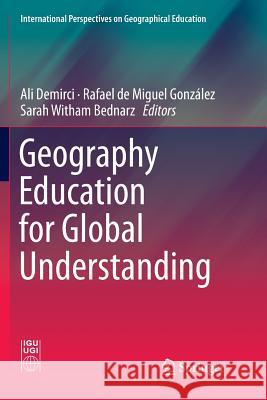
Geography Education for Global Understanding
ISBN-13: 9783030084004 / Angielski / Miękka / 2019 / 252 str.
(netto: 427,64 VAT: 5%)
Najniższa cena z 30 dni: 424,07
ok. 16-18 dni roboczych.
Darmowa dostawa!
"It is ... principally a book for an academic audience but would be of interest to secondary Geography teachers with a passion for Global Education and the potential of Geography Education in a contemporary geopolitical context. ... The strength of this book is the manner in which it focuses on the way geography can be used to promote global understanding in what is an increasingly fractious and fraught geopolitical context." (Grant Kleeman, Geographical Education, Vol. 32, 2019)
Chapter 1. Introduction: Why geography education matters for global understanding? (Ali Demirci, Rafael de Miguel González, and Sarah W. Bednarz).- Part I: Framework of global understanding.- Chapter 2. Conceptual framework: What is global understanding? (Benno Werlen).- Chapter 3. Issues alarming the world for global action: Why the world needs global understanding? (Chew-Hung Chang).- Chapter 4. International charters and declarations for global understanding: A historical overview from CGE-IGU (Joseph Stoltman).- Chapter 5. Global citizenship as an approach for global understanding (Inga Gryl).- Part II: Geography education for global understanding.- Chapter 6. The role of geography education for global understanding (Michael Solem).- Chapter 7. Geography education around the world: The current situation and trends (Joop van der Schee and John Lidstone).- Chapter 8. How international our national geography curriculums are to tackle global issues? ( David Lambert).- Chapter 9. From classroom practices to global actions: A critical overview of the current geography education to provide global understanding (Margaret Robertson).- Chapter 10. Geospatial technologies for global understanding education (Karl Donert).- Part III: Global understanding in geography education.- Chapter 11. Chile (Fabian Araya).- Chapter 12. China (Yushan Duan).- Chapter13. Finland (Sirpa Tani).- Chapter 14. Japan (Minori Yuda).- Chapter 15. New Zealand (Lex Chalmers).- Chapter 16. South Africa (Aubrey Golightly).- Chapter 17. South Korea (Jongwon Lee).- Chapter 18. Spain (Rafael de Miguel & Maria Luisa de Lázaro).- Chapter 19. The UK (Simon Catling).- Chapter 20. The US (Osvaldo Muniz).- Chapter 21. Turkey (Ali Demirci).- Chapter 22. Conclusion: A road map to empower geography education for global understanding (Ali Demirci, Rafael de Miguel González, and Sarah W. Bednarz).
Ali Demirci received his BA from the Department of Geography, Marmara University, Turkey, in 1997; MA from the Department of Geography, Fatih University, Turkey, in 2001; and PhD from the Department of Geography, Marmara University, in 2004. He worked at the department of geography as a professor and chair of the department and also Associate Dean for Art and Science Faculty at Fatih University. He is a member of the Steering Committee for the International Geographical Union Commission on Geographical Education. His major research interests published in over hundred scientific journals, books, book chapters, and conference proceedings are geospatial technologies, curriculums, and teacher training in geography education. He is the coeditor of the books International Perspectives on Teaching and Learning with GIS in Secondary Schools and Geospatial Technologies and Geography Education in a Changing World, both published by Springer.
Rafael de Miguel González received his BA in Geography (magna cum laude) from the University of Zaragoza, Spain, in 1994; MA in Urban Geography and Planning from the University of Paris (France), in 1996; and PhD in Urban and Regional Planning from the same university in 1999. He received his second PhD in Geography Education from the University of Valladolid (Spain).
He is an associate professor of Geography at the University of Zaragoza, and the coordinator of geography education program, and is also the Executive Associate Dean of the Faculty of Education. He is a member of the board of the Royal Geographical Society of Spain and the Vice-President of EUROGEO (European Association of Geographers). He serves as the regional contact for Spain and is a member of the International Geographical Union Commission on Geographical Education.
He has been involved in more than 100 publications on urban geography and geographical education: books, book chapters, journals. He is the coeditor of the book Innovative Learning Geography in Europe, published by Cambridge Scholars Publishing. He is the author of a chapter in the book Learning Progressions in Geography Education, published by Springer. Member of the Editorial Board of International Research in Geographical and Environmental Education. Director of the EUROGEO-Springer book Series Key Challenges in Geography. Director of several research funded projects, including Digital Atlas for School Education. Member of the General Assembly of Partners, III United Nations Conference on Housing and Sustainable Urban Development.
She is the author of chapters in two books (International Handbook on Geographical Education and Learning with GIS in Secondary Schools and Geospatial Technologies and Geography Education in a Changing World), both published by Springer. She is the recipient of Gilbert H. Grosvenor Honors for Geographic Education, Association of American Geographers, in 2007 and George J. Miller Award, National Council for Geographic Education, in 2005.
This book presents the core concepts of geographical education as a means of understanding global issues from a spatial perspective. It treats education, supported by high standards, approaches, methodologies, and resources, as essential in exploring the interactions of the world’s human and environmental systems at local, regional, and global scales embedded in the nature of the discipline of geography. It covers topics such as climate change, sustainable development goals, geopolitics in an uncertain world, global crisis, and population flows, which are of great interest to geography researchers and social sciences educators who want to explore the complexity of contemporary societies.
Highly respected scholars in geography education answer questions on key topics and explain how global understanding is considered in K-12 education in significant countries around the globe. The book discusses factors such as the Internet, social media, virtual globes and other technological developments that provide insights into and visualization – in real time – of the intensity of relationships between different countries and regions of the earth. It also examines how this does not always lead to empathy with other political, cultural, social and religious values: terrorism threats and armed conflicts are also essential features of the global world. This book opens the dialogue for global understanding as a great opportunity for teachers, educators, scholars and policy makers to better equip students and future citizens to deal with global issues.




Czytaj nas na:
1997-2026 DolnySlask.com Agencja Internetowa
KrainaKsiazek.PL - Księgarnia Internetowa


