• Wyszukiwanie zaawansowane
  • Kategorie
  • Kategorie BISAC
  • Książki na zamówienie
  • Promocje
  • Granty
  • Książka na prezent
  • Opinie
  • Pomoc
  • Załóż konto
  • Zaloguj się

General Principles and Procedures » książka


zaloguj się | załóż konto
Logo Krainaksiazek.pl

koszyk

konto

szukaj
topmenu
Księgarnia internetowa
Szukaj
Książki na zamówienie
Promocje
Granty
Książka na prezent
Moje konto
Pomoc
 
 
Wyszukiwanie zaawansowane
Pusty koszyk
Bezpłatna dostawa dla zamówień powyżej 20 złBezpłatna dostawa dla zamówień powyżej 20 zł

Kategorie główne

• Nauka
 [2946600]
• Literatura piękna
 [1856966]

  więcej...
• Turystyka
 [72221]
• Informatyka
 [151456]
• Komiksy
 [35826]
• Encyklopedie
 [23190]
• Dziecięca
 [619653]
• Hobby
 [140543]
• AudioBooki
 [1577]
• Literatura faktu
 [228355]
• Muzyka CD
 [410]
• Słowniki
 [2874]
• Inne
 [445822]
• Kalendarze
 [1744]
• Podręczniki
 [167141]
• Poradniki
 [482898]
• Religia
 [510455]
• Czasopisma
 [526]
• Sport
 [61590]
• Sztuka
 [243598]
• CD, DVD, Video
 [3423]
• Technologie
 [219201]
• Zdrowie
 [101638]
• Książkowe Klimaty
 [124]
• Zabawki
 [2473]
• Puzzle, gry
 [3898]
• Literatura w języku ukraińskim
 [254]
• Art. papiernicze i szkolne
 [8170]
Kategorie szczegółowe BISAC

General Principles and Procedures

ISBN-13: 9781468409819 / Angielski / Miękka / 2012 / 345 str.
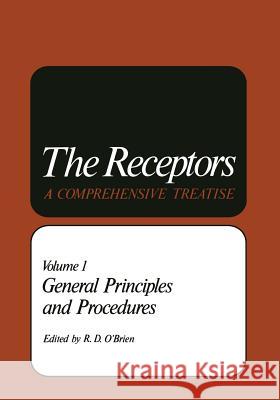
R. D. O'Brien
General Principles and Procedures R. D. O'Brien 9781468409819 Springer - książkaWidoczna okładka, to zdjęcie poglądowe, a rzeczywista szata graficzna może różnić się od prezentowanej.

General Principles and Procedures

ISBN-13: 9781468409819 / Angielski / Miękka / 2012 / 345 str.

R. D. O'Brien
cena 201,72 zł
(netto: 192,11 VAT:  5%)

Najniższa cena z 30 dni: 192,74 zł
Termin realizacji zamówienia:
ok. 22 dni roboczych
Bez gwarancji dostawy przed świętami

Darmowa dostawa!

The following remarks are intended to serve as an introduction to this particular volume as well as to the whole series of volumes of which this is the first. The intent of the series is to provide an authentic and relatively complete statement about the status of our understanding of the receptors. The models we had in mind while developing this series are The Enzymes, The Proteins, and comparable groups of books. The receptors have received a degree of importance and richness of understanding that makes them deserving of comprehensive and complete coverage. The study of these molecules, which may well include such diverse items as the receptors for hormones, neurohumors, pheromones, taste, and many other chemical signals, have a great deal in common, so that the student of any one of them will wish to know the status of research about the others. This com- monality is in part substantive, and in part practical and procedural. Substantively, the receptors are all macromolecules whose function is to re- ceive some form of chemical signal and transduce it to a form which is usable by the receiving cell. In this way, a chemical signal may lead to a neural response, to the turning-on of a cell's chromosomes, or to the activation of some enzymic apparatus to produce or release a substance. Because most of these processes are noncatalytic, special techniques not previously commonplace in biochemistry have been developed in order to study the receptors.


Kategorie:
Nauka, Biologia i przyroda
Kategorie BISAC:
Science > Biochemia
Wydawca:
Springer
Seria wydawnicza:
Receptors
Język:
Angielski
ISBN-13:
9781468409819
Rok wydania:
2012
Wydanie:
Softcover Repri
Numer serii:
000032580
Ilość stron:
345
Waga:
0.63 kg
Wymiary:
25.4 x 17.78 x 1.91
Oprawa:
Miękka
Wolumenów:
01

1 Reconstitution of Membrane Transport Functions.- 1. Introduction.- 2. Reconstitution of Active and Passive Transport Systems.- 3. General Techniques of Reconstitution.- 3.1. Liposomes: Test Tubes with a Difference.- 3.1.1. Multilamellar Liposomes.- 3.1.2. Unilamellar Liposomes.- 3.2. Methods for Inserting Proteins into Liposomes.- 3.2.1. Cholate Dialysis.- 3.2.2. Sonication.- 3.2.3. Incorporation.- 3.2.4. The Use of Superstable Membrane Proteins.- 4. What We Can Learn from Reconstitution.- 4.1. Oxidative Phosphorylation.- 4.2. Ca2+-ATPase.- 4.3. (Na+ + K+)-ATPase.- 4.4. Acetylcholine Receptor.- 4.5. The Problem of Orientation.- 5. Reconstitution in Planar Bilayer Membranes.- 5.1. Sucrase-Isomaltase Complex.- 5.2. Acetylcholine Receptor in Planar Bilayers.- 5.3. Insertion of Whole Membrane Vesicles.- 5.4. Proton Pumps.- References.- 2 The Pharmacon-Receptor-Effector Concept: A Basis for Understanding the Transmission of Information in Biological Systems.- 1. Introduction.- 2. Biological Action.- 3. Receptors and Receptor Sites.- 4. Pharmacon-Receptor Interaction.- 5. Spare Receptors.- 6. Structure and Action.- 7. Accessory Receptor Sites.- 8. Steric Structure and Action.- 9. Selectivity in Action.- 10. Differentiation in Closely Related Receptor Types.- 11. Receptor Binding and Receptor Isolation.- 12. Dualism in Receptors for Agonists and Their Competitive Antagonists.- 13. The Aggregation-Segregation Concept.- 14. Dual Receptor Model.- 15. Combination of Pharmaca.- 16. The Slope of the Concentration-Effect Curves.- 17. The Allosteric Receptor Model.- 18. Binding and Displacement on Two or More Independent Classes of Receptor Sites.- 19. Two-Site Model.- 20. Reflection.- References.- 3 The Link between Drug Binding and Response: Theories and Observations.- 1. The Response to Acetylcholine-Like Drugs.- 1.1. Methods of Investigation of the Response.- 1.2. The Nature of the Response to Acetylcholine.- 1.3. The Response-Concentration Curve at Equilibrium.- 1.4. The Kinetics of the Response.- 1.4.1. Relationship between Methods of Studying Kinetics.- 1.4.2. Concentration-Jump Studies.- 1.4.3. Fluctuation Analysis.- 1.4.4. Voltage-Jump Relaxation Studies.- 1.5. Anesthetics, Local Anesthetics, and Channel Blocking.- 2. The Binding of Drugs to Acetylcholine Receptors.- 2.1. Methods for Investigation of Binding.- 2.2. Binding at Equilibrium.- 2.2.1. Cooperativity in Binding.- 2.2.2. Is There a Single Sort of Binding Site?.- 2.2.3. Binding to Junctional and Extrajunctional Receptors in Muscle.- 2.3. The Kinetics of Acetylcholine Binding.- 3. The Link between Drug Binding and Response.- 3.1. What Should a Mechanism Explain?.- 3.2. Some Mechanisms.- 3.3. The Concentration Dependence of Binding and Response at Equilibrium.- 3.4. The Nature of Efficacy, Partial Agonists, and Desensitization….- 3.5. Kinetics and Mechanism.- 3.5.1. What Does the Observation of a Single Time Constant Imply?.- 3.5.2. What Is the Rate-Limiting Step?.- 3.5.3. Concentration Dependence of Time Constants from Kinetic Studies.- 3.6. What Is the Origin of Voltage Dependence?.- 3.7. High Affinity Versus High Speed.- References.- 4 Kinetics of Cooperative Binding.- 1. Overview.- 2. General Introduction.- 3. Model I: koff as a Linear Function of Occupancy.- 3.1. Assumptions.- 3.2. Properties of the Model.- 3.2.1. Equilibrium.- 3.2.2. Association Curves.- 3.2.3. Dissociation Curves.- 3.3. Discussion.- 4. Application to the Insulin-Receptor System.- 4.1. The Controversy.- 4.2. Experimental Design.- 4.3. Simulation Results.- 4.4. Discussion.- 5. Model II: kon as a Linear Function of Occupancy.- 5.1. Introduction.- 5.2. The Model.- 5.3. Properties of the Model.- 5.3.1. Equilibrium.- 5.3.2. Association Curves.- 5.3.3. Dissociation Curves.- 5.4. Testing for Positive Cooperativity.- 6. General Discussion.- 7. A Guide to the Experimentalist.- Appendix A: Model I: Differential Equations and Solutions.- Appendix B: Addition of Fresh (Empty) Receptors.- Appendix C: Model II: Labeled Ligand Only.- Appendix D: Model II: Labeled and Unlabeled Ligands.- Appendix E: Optimization of Testing for Model II with ? > 0.- References.- 5 Distinction of Receptor from Nonreceptor Interactions in Binding Studies.- 1. Defining a Pharmacologic Receptor.- 2. Criteria for Receptor Interactions.- 3. The Problem of Relating Binding to Biological Responsiveness.- 4. Nonspecific Binding: Definition and Examples of Complications of Binding Data Analysis.- 5. Estimating the Affinity of the Unlabeled Ligand.- 6. Examples of Receptor-Like Nonreceptor Interactions.- 7. Conclusion.- References.- 6 Incorporation of Transport Molecules into Black Lipid Membranes.- 1. Introduction.- 2. Methodology.- 2.1. Formation and Composition of BLMs.- 2.2. Electrical Properties of BLMs.- 3. Mechanisms of Ion Permeability.- 3.1. Carriers.- 3.2. Channel Formers.- 4. Models of Interactions of Proteins with BLMs.- 5. Ionophorous Properties in BLMs of Functional Transport Molecules.- 5.1. Ca2+-ATPase: Dissection of a Transport System.- 5.2. (Na+ + K+)-ATPase.- 5.3. The Acetylcholine Receptor.- 6. The BLM as a Test System for Ionophorous Function of Isolated Membrane Proteins.- 6.1. Mitochondrial Membrane Proteins.- 6.2. Red Blood Cell Membrane Proteins.- 6.3. Gastric Mucosal Membrane Proteins.- 6.4. Dopamine-?-Hydroxylase.- 6.5. Rhodopsin.- 6.6. Immune Cytotoxic Factors.- 7. Coda.- References.- 7 Visualization and Counting of Receptors at the Light and Electron Microscope Levels.- 1. Receptors at the Cell Membrane.- 1.1. Introduction.- 1.2. Information Required on the Distribution of Receptors.- 2. The Labeling of Receptors for Localization.- 2.1. Approaches.- 2.2. Methods of Labeling and Visualizing Receptors.- 2.2.1. Autoradiography.- 2.2.2. Electron-Dense Label Attachment.- 2.2.3. Enzymatic Reaction Product Markers.- 2.2.4. Fluorescent Markers.- 2.2.5. X-Ray Microanalysis.- 2.3. Ligands for Receptor Labeling.- 2.3.1. Selection of Primary Ligands.- 2.3.2. Ligands Available for Receptor Tracing.- 3. Cell and Tissue Autoradiography.- 3.1. Problems of Application of a Labeled Ligand.- 3.1.1. Mode of Application.- 3.1.2. Nonspecific Labeling.- 3.1.3. Tissue Processing for Autoradiography of Receptors.- 3.1.4. Application to a Pseudo-Irreversible Reaction at a Receptor.- 3.2. Autoradiographic Methods.- 3.2.1. Treatments in Aqueous Media.- 3.2.2. Dry-Mount Methods.- 3.3. Interpretation of EM Autoradiographic Data on Receptors.- 3.3.1. Assignment of Silver Grains in Autoradiographs to Most Probable Locations of the Labeled Receptors.- 3.3.2. Calculation of Receptor Density.- 3.3.3. Isotopes and Resolution.- 3.4. Applications to Synaptic Receptors.- 4. Counting Receptors per Cell or per Synapse.- 4.1. Light Microscope Autoradiography of Receptors.- 4.2. Absolute Enumeration of Total Receptors.- 4.3. Direct Determination of Receptor Occupancy Relations.- 5. Electron Microscope Methods for Visualization of Receptors.- 5.1. Peroxidase Cytochemistry of Receptors.- 5.1.1. Peroxidase Methods.- 5.1.2. Applications of Peroxidase Cytochemistry to Receptors.- 5.2. Tissue Preservation for Immunocytochemistry of Receptors.- 5.3. Ferritin Labeling.- 5.4. Other Labels Applicable for Transmission and Scanning EM Studies of Receptors.- 6. Fluorescence Marker Methods.- 6.1. Fluorescence Labeling.- 6.2. Application of Fluorescent Labeling to Receptors.- 7. Possibilities of Quantitation of Receptors in Immunocytochemical and Other Nonradioisotopic Techniques.- 7.1. Quantitation in Electron-Dense Marker Techniques.- 8. Conclusions.- References.- 8 Problems and Approaches in Noncatalytic Biochemistry.- 1. Introduction.- 2. Measurement.- 2.1. Histological Techniques.- 2.2. Physical Separation: General Considerations.- 2.3. Equilibrium Dialysis.- 2.4. Other Physical Separations.- 2.5. Negative Binding.- 2.6. The Magnitude of the Off-Time.- 3. Relation of in Vivo to in Vitro Properties.- 3.1. Reversibility.- 3.2. Location.- 3.3. Specificity.- 3.4. Dissociation Constants.- 3.5. Detergents.- References.


Udostępnij

Facebook - konto krainaksiazek.pl


Opinie o Krainaksiazek.pl na Opineo.pl

Partner Mybenefit

Krainaksiazek.pl w programie rzetelna firma Krainaksiaze.pl - płatności przez paypal

Czytaj nas na:

Facebook - krainaksiazek.pl
  • książki na zamówienie
  • granty
  • książka na prezent
  • kontakt
  • pomoc
  • opinie
  • regulamin
  • polityka prywatności

Zobacz:

  • Księgarnia czeska

  • Wydawnictwo Książkowe Klimaty

1997-2025 DolnySlask.com Agencja Internetowa

© 1997-2022 krainaksiazek.pl
     
KONTAKT | REGULAMIN | POLITYKA PRYWATNOŚCI | USTAWIENIA PRYWATNOŚCI
Zobacz: Księgarnia Czeska | Wydawnictwo Książkowe Klimaty | Mapa strony | Lista autorów
KrainaKsiazek.PL - Księgarnia Internetowa

Polityka prywatnosci - link
Krainaksiazek.pl - płatnośc Przelewy24
Przechowalnia Przechowalnia





