• Wyszukiwanie zaawansowane
  • Kategorie
  • Kategorie BISAC
  • Książki na zamówienie
  • Promocje
  • Granty
  • Książka na prezent
  • Opinie
  • Pomoc
  • Załóż konto
  • Zaloguj się

Fundamentals of Three-Dimensional Digital Image Processing » książka


zaloguj się | załóż konto
Logo Krainaksiazek.pl

koszyk

konto

szukaj
topmenu
Księgarnia internetowa
Szukaj
Książki na zamówienie
Promocje
Granty
Książka na prezent
Moje konto
Pomoc
 
 
Wyszukiwanie zaawansowane
Pusty koszyk
Bezpłatna dostawa dla zamówień powyżej 20 złBezpłatna dostawa dla zamówień powyżej 20 zł

Kategorie główne

• Nauka
 [2946600]
• Literatura piękna
 [1856966]

  więcej...
• Turystyka
 [72221]
• Informatyka
 [151456]
• Komiksy
 [35826]
• Encyklopedie
 [23190]
• Dziecięca
 [619653]
• Hobby
 [140543]
• AudioBooki
 [1577]
• Literatura faktu
 [228355]
• Muzyka CD
 [410]
• Słowniki
 [2874]
• Inne
 [445822]
• Kalendarze
 [1744]
• Podręczniki
 [167141]
• Poradniki
 [482898]
• Religia
 [510455]
• Czasopisma
 [526]
• Sport
 [61590]
• Sztuka
 [243598]
• CD, DVD, Video
 [3423]
• Technologie
 [219201]
• Zdrowie
 [101638]
• Książkowe Klimaty
 [124]
• Zabawki
 [2473]
• Puzzle, gry
 [3898]
• Literatura w języku ukraińskim
 [254]
• Art. papiernicze i szkolne
 [8170]
Kategorie szczegółowe BISAC

Fundamentals of Three-Dimensional Digital Image Processing

ISBN-13: 9781848001725 / Angielski / Twarda / 2009 / 288 str.
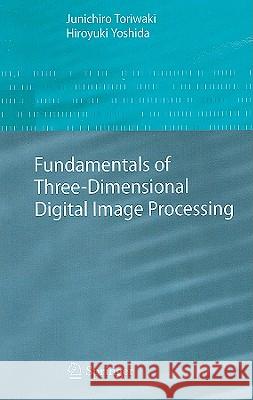
Junichiro Toriwaki; Hiro Yoshida
Fundamentals of Three-Dimensional Digital Image Processing Toriwaki, Junichiro 9781848001725 Not Avail - książkaWidoczna okładka, to zdjęcie poglądowe, a rzeczywista szata graficzna może różnić się od prezentowanej.

Fundamentals of Three-Dimensional Digital Image Processing

ISBN-13: 9781848001725 / Angielski / Twarda / 2009 / 288 str.

Junichiro Toriwaki; Hiro Yoshida
cena 201,72 zł
(netto: 192,11 VAT:  5%)

Najniższa cena z 30 dni: 192,74 zł
Termin realizacji zamówienia:
ok. 22 dni roboczych
Bez gwarancji dostawy przed świętami

Darmowa dostawa!
inne wydania

This book is a detailed description of the basics of three-dimensional digital image processing. A 3D digital image (abbreviated as 3D image below) is a digitalized representation of a 3D object or an entire 3D space, stored in a computer as a 3D array. Whereas normal digital image processing is concerned with screens that are a collection of square shapes called pixels and their corresponding density levels, the image plane in three dimensions is represented by a division into cubical graphical elements (called voxels ) that represent corresponding density levels. Inthecontextofimageprocessing, in manycases3Dimageprocessingwill refer to the input of multiple 2D images and performing processing in order to understand the 3D space (or scene ) that they depict. This is a result of research into how to use input from image sensors such as television cameras as a basis for learning about a 3D scene, thereby replicating the sense of vision for humans or intelligent robots, and this has been the central problem in image processing research since the 1970s. However, a completely di?erent type of image with its own new problems, the 3D digital image discussed in this book, rapidly took prominence in the 1980s, particularly in the ?eld of medical imaging. These were recordings of human bodies obtained through computed (or computerized ) tomography (CT), imagesthatrecordednotonlytheexternal, visiblesurfaceofthesubject but also, to some degree of resolution, its internal structure. This was a type of image that no one had experienced before."


Kategorie:
Informatyka
Kategorie BISAC:
Computers > Image Processing
Medical > Radiologia
Computers > Computer Science
Wydawca:
Not Avail
Język:
Angielski
ISBN-13:
9781848001725
Rok wydania:
2009
Ilość stron:
288
Waga:
0.65 kg
Wymiary:
23.88 x 16.26 x 2.29
Oprawa:
Twarda
Wolumenów:
01
Dodatkowe informacje:
Bibliografia
Wydanie ilustrowane

From the reviews:

"This book is a detailed description of the basics of 3-dimensional (3D) digital image processing, in particular the processing of images from techniques such as CT, MRI, and nuclear emission tomography. ... The targeted audience is primarily graduate students and scientists in biomedical engineering and medical physics. ... I would like to congratulate the authors for making available this book detailing the steps of filtering, processing, and rendering medical images." (Tinsu Pan, The Journal of Nuclear Medicine, June, 2010)

"Fundamentals of Three-Dimensional Digital Image Processing ... is an informative thought-provoking publication that unveils some mysteries of computing 3D images that are contemporary used medicine industry. It presents insight not only into the data structures that are used in 3D imaging but also some most important algorithms for 3D image processing. ... The proposed graph-based data structure has excellent properties. ... My personal recommendation is that the book is worth reading and the reader gets insight in how it should be done professionally." (Cad Cam Development, March, 2011)

Introduction.- Models of Images and Image Operations.- Introduction.- Continuous and Digitized Images.- Continuous Images.- Digitized Images.- Three-dimensional Images.- 3D Line Figures and Digitization.- Crosse Section and Projection.- Relations among Images.- Model of Image Operations.- Formulation of Image Operations.- Relations between Image Operators.- Binary Operators between Images.- Composition if Image Operations.- Basic Operators.- Algorithm of Image Operators.- General Form of Image Operations.- Important Types of Algorithms.- Local Processing of 3D Images.- Classification of Local Operations.- General Form.- Classification by Functions of Filters.- Classification by the Form of a Local Function.- Smoothing Filter.- Linear Smoothing Filter.- Median Filter and Order Statistics Filter.- Edge Preserving Smoothing.- Morphology Filter.- Difference Filter.- Significance.- Differentials in Continuous Space.- Derivatives in Digitized Space.- Basic Characteristics of Difference Filter.- Omnidirectionalization.- 1-D Difference Filters and their Combinations.- 3D Laplacian.- 2D Difference Filters and their Combination.- Differential Features of Curved Surface.- Region Growing (Region Merging).- Outline.- Region Expansion.- Geometrical Property of Three-Dimensional Digitized Images.- Neighborhood and Connectivity.- Neighborhood.- Connectivity and Connected Component.- Simplex and Simplicious Decomposition.- Euler Number.- Local Feature of a Connected Component and Topology of a Figure.- Local Patterns and their Characterization.- 2 x 2 x 2 Local Patterns.- 3 x 3 x 3 Local Patterns.- Classification of the Voxel State.- Voxel State and Connectivity Index.- Calculation of Connectivity Index and Connectivity Number.- Basic Ideas.- Calculation of the Connectivity Index.- Calculation of the Connectivity Number.- Calculation of the Euler Number.- Triangulation Method.- Simplex Counting Method.- Algorithm of Deletability Test.- Path.- Distance Function.- Distance Function in Applications.- Improvement in Distance Metric.- Border Surface.- Algorithms of Binary Image Processing.- Introduction.- Labeling of a Connected Component.- Shrinking.- Surface Thinning and Axis Thinning.- Definition.- Requirements to Thinning.- Realization-the Sequential Type.- Examples of Surface/Axis Thinning Algorithms (Sequential Type).- Surface Thinning Algorithm Accompanying the Euclidean Distance Transformation.- Use of One-dimensional List for Auxiliary Information.- Examples of Surface/Axis Thinning Algorithm (Parallel Type).- Experimental Results.- Points in Algorithm Construction.- Distance Transformation and Skeleton.- Definition.- Significance of DT and Skeleton.- Classification of Algorithms.- Example of an Algorithm (1) – Squared Euclidean DT.- Example of Algorithms (2) – Variable Neighborhood DT (Parallel Type).- Supplementary Comments on Algorithms of DT.- Skeleton.- Reverse Distance Transformation.- Example of RDT Algorithms – (i) Euclidean Squared RDT.- Example of RDT Algorithm (ii) Fixed Neighborhood (6, 18, or26-Neighborhood) RDT (Sequential Type).- Extraction of Skeleton.- Distance Transformation of a Line Figure.- Border Surface Following.- Outline.- Examples of Algorithm.- Restoration of a Figure.- Knot and Link.- Outline.- Reduction of a Digital Knot.- Voronoi Division of a Digitized Image.- Algorithms for Processing Connected Components with Grey Values.- Distance Transformation of a Gray-Tone Image.- Definition.- An Example of Algorithm.- Thinning of a Gray-Tone Image.- Basic Idea.- Requirements.- Principles of Thinning.- Examples of Algorithms – (1) Integration of Information concerning Density Values.- Algorithm.- Experimental Results.- Examples of Algorithms – (2) Ridge Line following.- Meanings of a Ridge Lien.- Algorithm.- Experiments.- Visualization of a 3D Gray-Tone Images.- Formulation of Visualization Problem .- Voxel Data and Polygon Model.- Marching Cubes Algorithm.- Cross Section, Surface, and Projection.- Cross Section.- Surface.- Projection.- Idea of Visualization Basing upon Ray Casting (1) – Projection of a Point.- Display of a Point.- Display of Line.- Display of Surface.- Idea of Visualization Based on Ray Casting (2) – Manipulation of Density Values.- Rendering Surface Based on Ray Casting – Surface Rendering.- Calculation of the Brightness of Surface.- Smooth Shading.- Depth Coding.- Ray Tracing.- Photorealistic Rendering and Rendering for Visualization.- Display of Density Values Basing upon Ray Casting – Volume Rendering.- Algorithm of Volume Rendering.- Selection of Parameters.- Front-to-back Algorithm.- Properties of Volume Rendering and Surface Rendering.- Gradient Shading.- References.-

There are many areas of science and engineering where three-dimensional (3-D) discrete data are collected and analyzed, such as medical imaging and geoscience. To design and to prove the validity of computational procedures for processing and analysis of such data, the need for a mathematical theory and algorithms for image processing is essential.

Self-contained, accessible, and mathematically precise, this book serves as an introduction to the field of 3-D digital image processing, providing information that can be used immediately in practical algorithms for the analysis of 3-D data sets. By presenting problems of processing and analysis of practical 3-D data sets, readers will find the descriptions clear and accessible as concepts and methods are carefully introduced, defined, and illustrated with examples.

A key textbook for graduates and resource for all working in areas of multidimensional image processing and analysis, this book is also excellent for self-study for practitioners in the field of 3-D digital image processing.


Udostępnij

Facebook - konto krainaksiazek.pl


Opinie o Krainaksiazek.pl na Opineo.pl

Partner Mybenefit

Krainaksiazek.pl w programie rzetelna firma Krainaksiaze.pl - płatności przez paypal

Czytaj nas na:

Facebook - krainaksiazek.pl
  • książki na zamówienie
  • granty
  • książka na prezent
  • kontakt
  • pomoc
  • opinie
  • regulamin
  • polityka prywatności

Zobacz:

  • Księgarnia czeska

  • Wydawnictwo Książkowe Klimaty

1997-2025 DolnySlask.com Agencja Internetowa

© 1997-2022 krainaksiazek.pl
     
KONTAKT | REGULAMIN | POLITYKA PRYWATNOŚCI | USTAWIENIA PRYWATNOŚCI
Zobacz: Księgarnia Czeska | Wydawnictwo Książkowe Klimaty | Mapa strony | Lista autorów
KrainaKsiazek.PL - Księgarnia Internetowa

Polityka prywatnosci - link
Krainaksiazek.pl - płatnośc Przelewy24
Przechowalnia Przechowalnia





