• Wyszukiwanie zaawansowane
  • Kategorie
  • Kategorie BISAC
  • Książki na zamówienie
  • Promocje
  • Granty
  • Książka na prezent
  • Opinie
  • Pomoc
  • Załóż konto
  • Zaloguj się

Foundation Models for Natural Language Processing: Pre-trained Language Models Integrating Media » książka


zaloguj się | załóż konto
Logo Krainaksiazek.pl

koszyk

konto

szukaj
topmenu
Księgarnia internetowa
Szukaj
Książki na zamówienie
Promocje
Granty
Książka na prezent
Moje konto
Pomoc
 
 
Wyszukiwanie zaawansowane
Pusty koszyk
Bezpłatna dostawa dla zamówień powyżej 20 złBezpłatna dostawa dla zamówień powyżej 20 zł

Kategorie główne

• Nauka
 [2946600]
• Literatura piękna
 [1856966]

  więcej...
• Turystyka
 [72221]
• Informatyka
 [151456]
• Komiksy
 [35826]
• Encyklopedie
 [23190]
• Dziecięca
 [619653]
• Hobby
 [140543]
• AudioBooki
 [1577]
• Literatura faktu
 [228355]
• Muzyka CD
 [410]
• Słowniki
 [2874]
• Inne
 [445822]
• Kalendarze
 [1744]
• Podręczniki
 [167141]
• Poradniki
 [482898]
• Religia
 [510455]
• Czasopisma
 [526]
• Sport
 [61590]
• Sztuka
 [243598]
• CD, DVD, Video
 [3423]
• Technologie
 [219201]
• Zdrowie
 [101638]
• Książkowe Klimaty
 [124]
• Zabawki
 [2473]
• Puzzle, gry
 [3898]
• Literatura w języku ukraińskim
 [254]
• Art. papiernicze i szkolne
 [8170]
Kategorie szczegółowe BISAC

Foundation Models for Natural Language Processing: Pre-trained Language Models Integrating Media

ISBN-13: 9783031231926 / Angielski / Miękka / 2023
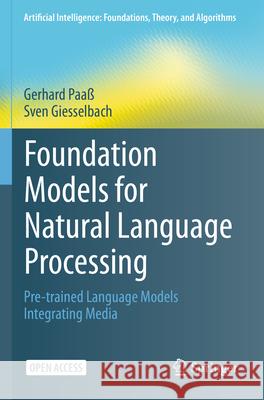
Gerhard Paaß; Sven Giesselbach
Foundation Models for Natural Language Processing: Pre-trained Language Models Integrating Media Gerhard Paa? Sven Giesselbach 9783031231926 Springer - książkaWidoczna okładka, to zdjęcie poglądowe, a rzeczywista szata graficzna może różnić się od prezentowanej.

Foundation Models for Natural Language Processing: Pre-trained Language Models Integrating Media

ISBN-13: 9783031231926 / Angielski / Miękka / 2023

Gerhard Paaß; Sven Giesselbach
cena 161,36 zł
(netto: 153,68 VAT:  5%)

Najniższa cena z 30 dni: 154,18 zł
Termin realizacji zamówienia:
ok. 22 dni roboczych
Bez gwarancji dostawy przed świętami

Darmowa dostawa!
inne wydania

This open access book provides a comprehensive overview of the state of the art in research and applications of Foundation Models and is intended for readers familiar with basic Natural Language Processing (NLP) concepts.Over the recent years, a revolutionary new paradigm has been developed for training models for NLP. These models are first pre-trained on large collections of text documents to acquire general syntactic knowledge and semantic information. Then, they are fine-tuned for specific tasks, which they can often solve with superhuman accuracy. When the models are large enough, they can be instructed by prompts to solve new tasks without any fine-tuning. Moreover, they can be applied to a wide range of different media and problem domains, ranging from image and video processing to robot control learning. Because they provide a blueprint for solving many tasks in artificial intelligence, they have been called Foundation Models.After a brief introduction to basic NLP models the main pre-trained language models BERT, GPT and sequence-to-sequence transformer are described, as well as the concepts of self-attention and context-sensitive embedding. Then, different approaches to improving these models are discussed, such as expanding the pre-training criteria, increasing the length of input texts, or including extra knowledge. An overview of the best-performing models for about twenty application areas is then presented, e.g., question answering, translation, story generation, dialog systems, generating images from text, etc. For each application area, the strengths and weaknesses of current models are discussed, and an outlook on further developments is given. In addition, links are provided to freely available program code. A concluding chapter summarizes the economic opportunities, mitigation of risks, and potential developments of AI.


This open access book provides a comprehensive overview of the state of the art in research and applications of Foundation Models and is intended for readers familiar with basic Natural Language Processing (NLP) concepts. Over the recent years, a revolutionary new paradigm has been developed for training models for NLP. These models are first pre-trained on large collections of text documents to acquire general syntactic knowledge and semantic information. Then, they are fine-tuned for specific tasks, which they can often solve with superhuman accuracy. When the models are large enough, they can be instructed by prompts to solve new tasks without any fine-tuning. Moreover, they can be applied to a wide range of different media and problem domains, ranging from image and video processing to robot control learning. Because they provide a blueprint for solving many tasks in artificial intelligence, they have been called Foundation Models. After a brief introduction to basic NLP models the main pre-trained language models BERT, GPT and sequence-to-sequence transformer are described, as well as the concepts of self-attention and context-sensitive embedding. Then, different approaches to improving these models are discussed, such as expanding the pre-training criteria, increasing the length of input texts, or including extra knowledge. An overview of the best-performing models for about twenty application areas is then presented, e.g., question answering, translation, story generation, dialog systems, generating images from text, etc. For each application area, the strengths and weaknesses of current models are discussed, and an outlook on further developments is given. In addition, links are provided to freely available program code. A concluding chapter summarizes the economic opportunities, mitigation of risks, and potential developments of AI.

Kategorie:
Informatyka, Bazy danych
Kategorie BISAC:
Computers > Speech & Audio Processing
Language Arts & Disciplines > Linguistics - General
Computers > Artificial Intelligence - Expert Systems
Wydawca:
Springer
Seria wydawnicza:
Artificial Intelligence: Foundations, Theory, and Algorithms
Język:
Angielski
ISBN-13:
9783031231926
Rok wydania:
2023
Dostępne języki:
Numer serii:
000781778
Oprawa:
Miękka
Dodatkowe informacje:
Wydanie ilustrowane

1 Introduction 
1.1 Scope of the Book 
1.2 Preprocessing of Text 
1.3 Vector Space Models and Document Classification 
1.4 Nonlinear Classifiers 
1.5 Generating Static Word Embeddings 
1.6 Recurrent Neural Networks 
1.7 Convolutional Neural Networks 
1.8 Summary 
2 Pre-trained Language Models
2.1 BERT: Self-Attention and Contextual Embeddings 
2.2 GPT: Autoregressive Language Models
2.3 Transformer: Sequence-to-Sequence Translation 
2.4 Training and Assessment of Pre-trained Language Models 
3 Improving Pre-trained Language Models
3.2 Capturing Longer Dependencies 
3.3 Multilingual Pre-trained Language Models
3.4 Additional Knowledge for Pre-trained Language Models 
3.5 Changing Model Size 
3.6 Fine-tuning for Specific Applications 
4. Knowledge Acquired by Foundation Models 
4.1 Benchmark Collections 
4.2 Evaluating Knowledge by Probing Classifiers 
4.3 Transferability and Reproducibility of Benchmarks 
5 Foundation Models for Information Extraction 
5.1 Text Classification
5.2 Word Sense Disambiguation
5.3 Named Entity Recognition 
5.4 Relation Extraction 
6 Foundation Models for Text Generation 
6.1 Document Retrieval
6.2 Question Answering 
6.3 Neural Machine Translation 
6.4 Text Summarization 
6.5 Story Generation 
6.6 Dialog Systems 
7 Foundation Models for Speech, Images, Videos, and Control 
7.1 Speech Recognition and Generation
7.2 Image Processing and Generation 
7.3 Video Interpretation and Generation 
7.4 Controlling Dynamic Systems 
8 Summary and Outlook 
8.1 Foundation Models are a New Paradigm 
8.2 Potential Harm from Foundation Models 
8.3 Advanced Artificial Intelligence Systems 
Appendix

Dr. Gerhard Paaß is a Lead Scientist at the Fraunhofer Institute for Intelligent Analysis and Information Systems (IAIS). With a background in Mathematics, he is a recognized expert in the field of Artificial Intelligence, particularly in the area of Natural Language Processing. Dr. Paaß has previously worked at UC Berkeley in California and the University of Technology in Brisbane. He has served as reviewer and conference chair at various international conferences, including NeurIPS, CIKM, ECML/PKDD, ICDM, and KDD, where he regularly is a member of the program committee. Dr. Paaß has received a “best paper” award on probabilistic logic and is the author of about 70 publications for international conferences and journals. Recently, he authored the book “Artificial Intelligence: What's Behind the Technology of the Future?” (in German). He is currently involved in the creation of a computer center for Foundation Models. Besides experimental research on Foundation Models, he holds lectures for Deep Learning and Natural Language Understanding at the University of Bonn and in industry. 


Sven Giesselbach is the leader of the Natural Language Understanding (NLU) team at the Fraunhofer Institute for Intelligent Analysis and Information Systems (IAIS), where he has specialized in Artificial Intelligence and Natural Language Processing. He and his team develop solutions in the areas of medical, legal and general document understanding, which in their core build upon Foundation Models. Sven Giesselbach is also part of the Competence Center for Machine Learning Rhine-Ruhr (ML2R), where he works as a research scientist and investigates Informed Machine Learning, a paradigm in which knowledge is injected into machine learning models, in conjunction with language modeling. He has published more than 10 papers on Natural Language Processing and Understanding, which focus on the creation of application-ready NLU systems and the integration of expert knowledge in various stages of the solution design. He led the development of the Natural Language Understanding Showroom, a platform for showcasing state-of-the-art Natural Language Understanding models. He regularly gives talks about NLU at summer schools, conferences and AI-Meetups.

This open access book provides a comprehensive overview of the state of the art in research and applications of Foundation Models and is intended for readers familiar with basic Natural Language Processing (NLP) concepts. 

Over the recent years, a revolutionary new paradigm has been developed for training models for NLP. These models are first pre-trained on large collections of text documents to acquire general syntactic knowledge and semantic information. Then, they are fine-tuned for specific tasks, which they can often solve with superhuman accuracy. When the models are large enough, they can be instructed by prompts to solve new tasks without any fine-tuning. Moreover, they can be applied to a wide range of different media and problem domains, ranging from image and video processing to robot control learning. Because they provide a blueprint for solving many tasks in artificial intelligence, they have been called Foundation Models.

After a brief introduction to basic NLP models the main pre-trained language models BERT, GPT and sequence-to-sequence transformer are described, as well as the concepts of self-attention and context-sensitive embedding. Then, different approaches to improving these models are discussed, such as expanding the pre-training criteria, increasing the length of input texts, or including extra knowledge. An overview of the best-performing models for about twenty application areas is then presented, e.g., question answering, translation, story generation, dialog systems, generating images from text, etc. For each application area, the strengths and weaknesses of current models are discussed, and an outlook on further developments is given. In addition, links are provided to freely available program code. A concluding chapter summarizes the economic opportunities, mitigation of risks, and potential developments of AI.




Udostępnij

Facebook - konto krainaksiazek.pl


Opinie o Krainaksiazek.pl na Opineo.pl

Partner Mybenefit

Krainaksiazek.pl w programie rzetelna firma Krainaksiaze.pl - płatności przez paypal

Czytaj nas na:

Facebook - krainaksiazek.pl
  • książki na zamówienie
  • granty
  • książka na prezent
  • kontakt
  • pomoc
  • opinie
  • regulamin
  • polityka prywatności

Zobacz:

  • Księgarnia czeska

  • Wydawnictwo Książkowe Klimaty

1997-2025 DolnySlask.com Agencja Internetowa

© 1997-2022 krainaksiazek.pl
     
KONTAKT | REGULAMIN | POLITYKA PRYWATNOŚCI | USTAWIENIA PRYWATNOŚCI
Zobacz: Księgarnia Czeska | Wydawnictwo Książkowe Klimaty | Mapa strony | Lista autorów
KrainaKsiazek.PL - Księgarnia Internetowa

Polityka prywatnosci - link
Krainaksiazek.pl - płatnośc Przelewy24
Przechowalnia Przechowalnia




