• Wyszukiwanie zaawansowane
  • Kategorie
  • Kategorie BISAC
  • Książki na zamówienie
  • Promocje
  • Granty
  • Książka na prezent
  • Opinie
  • Pomoc
  • Załóż konto
  • Zaloguj się

Fostering Collateral Creativity in School Mathematics » książka


zaloguj się | załóż konto
Logo Krainaksiazek.pl

koszyk

konto

szukaj
topmenu
Księgarnia internetowa
Szukaj
Książki na zamówienie
Promocje
Granty
Książka na prezent
Moje konto
Pomoc
 
 
Wyszukiwanie zaawansowane
Pusty koszyk
Bezpłatna dostawa dla zamówień powyżej 20 złBezpłatna dostawa dla zamówień powyżej 20 zł

Kategorie główne

• Nauka
 [2949965]
• Literatura piękna
 [1857847]

  więcej...
• Turystyka
 [70818]
• Informatyka
 [151303]
• Komiksy
 [35733]
• Encyklopedie
 [23180]
• Dziecięca
 [617748]
• Hobby
 [139972]
• AudioBooki
 [1650]
• Literatura faktu
 [228361]
• Muzyka CD
 [398]
• Słowniki
 [2862]
• Inne
 [444732]
• Kalendarze
 [1620]
• Podręczniki
 [167233]
• Poradniki
 [482388]
• Religia
 [509867]
• Czasopisma
 [533]
• Sport
 [61361]
• Sztuka
 [243125]
• CD, DVD, Video
 [3451]
• Technologie
 [219309]
• Zdrowie
 [101347]
• Książkowe Klimaty
 [123]
• Zabawki
 [2362]
• Puzzle, gry
 [3791]
• Literatura w języku ukraińskim
 [253]
• Art. papiernicze i szkolne
 [7933]
Kategorie szczegółowe BISAC

Fostering Collateral Creativity in School Mathematics

ISBN-13: 9783031406386 / Angielski / Twarda / 2023
Sergei Abramovich;Viktor Freiman
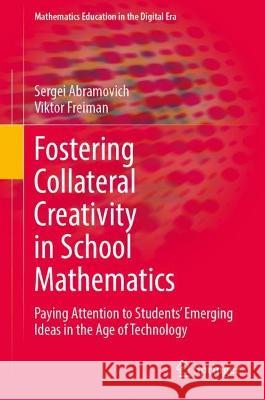
Fostering Collateral Creativity in School Mathematics Sergei Abramovich, Viktor Freiman 9783031406386 Springer International Publishing - książkaWidoczna okładka, to zdjęcie poglądowe, a rzeczywista szata graficzna może różnić się od prezentowanej.

Fostering Collateral Creativity in School Mathematics

ISBN-13: 9783031406386 / Angielski / Twarda / 2023

Sergei Abramovich;Viktor Freiman
cena 564,88
(netto: 537,98 VAT:  5%)

Najniższa cena z 30 dni: 501,19
Termin realizacji zamówienia:
ok. 22 dni roboczych
Bez gwarancji dostawy przed świętami

Darmowa dostawa!
inne wydania

This book explores the topic of using technology, both physical and digital, to motivate creative mathematical thinking among students who are not considered ‘mathematically advanced.’ The book reflects the authors’ experience of teaching mathematics to Canadian and American teacher candidates and supervising several field-based activities by the candidates. It consists of eight chapters and an Appendix which includes details of constructing computational learning environments.Specifically, the book demonstrates how the appropriate use of technology in the teaching of mathematics can create conditions for the emergence of what may be called ‘collateral creativity,’ a notion similar to Dewey’s notion of collateral learning. Just as collateral learning does not result from the immediate goal of the traditional curriculum, collateral creativity does not result from the immediate goal of traditional problem solving. Rather, mathematical creativity emerges as a collateral outcome of thinking afforded by the use of technology.  Furthermore, collateral creativity is an educative outcome of one’s learning experience with pedagogy that motivates students to ask questions about computer-generated or tactile-derived information and assists them in finding answers to their own or the teacher’s questions. This book intends to provide guidance to teachers for fostering collateral creativity in their classrooms.


Kategorie:
Nauka, Pedagogika i oświata
Wydawca:
Springer International Publishing
Seria wydawnicza:
Mathematics Education in the Digital Era
Język:
Angielski
ISBN-13:
9783031406386
Rok wydania:
2023
Waga:
0.41 kg
Wymiary:
23.5 x 15.5
Oprawa:
Twarda

​Chapter 1. Theoretical Foundation And Examples Of Collateral Creativity
1.1  Introduction .
1.2  Theories associated with collateral creativity.
1.3  Collateral creativity and the instrumental act
1.4 Three more examples of collateral creativity
1.4.1 A 2nd grade example of collateral creativity
1.4.2 A 4th grade example of collateral creativity
1.4.3 Collateral creativity in a classroom of secondary mathematics teacher candidates
1.5 Collateral creativity as problem posing in the zone of proximal development
1.6 Forthcoming examples of collateral creativity included in the book .

Chapter 2. From Additive Decompositions Of Integers To Probability Experiments .
2.1 Introduction .
2.2 Artificial creatures as a context inspiring collateral creativity
2.3 Iterative nature of questions and investigations supported by the instrumental act .
2.4 The joint use of tactile and digital tools within an instrumental act .
2.5 Tactile activities as a window to the basic ideas of number theory.
2.6 Historical account of additive decomposition of integers

Chapter 3. From Number Sieves To Difference Equations
3.1 Introduction .
3.2 On the notion of a number sieve
3.3 Theoretical value of practical outcome of an instrumental act
3.4 On the equivalence of two approaches to even and odd numbers
3.5 Developing new sieves from even and odd numbers
3.6 Polygonal number sieves
3.7 Connecting arithmetic to geometry explains mathematical terminology
3.8 Polygonal numbers and collateral creativity

Chapter 4. Explorations With The Sums Of Digits.
4.1 Introduction .
4.2 About the sums of digits
4.3 Years with the difference nine.
4.4 Calculating the century number to which a year belongs.
4.5 Finding the number of years with the given sum of digits throughout centuries
4.6 Partitioning n into ordered sums of two positive integer.
4.7 Interpreting the results of spreadsheet modeling

Chapter 5. Collateral Creativity And Prime Numbers.
5.1 Low-level questions require high-level thinking.
5.2 Twin primes explorations motivated by activities with the number 2021
5.3 Students’ confusion as a teaching moment and a source of collateral creativity
5.4 Different definitions of a prime number.
5.5 Tests of divisibility and collateral creativity.
5.6 Historically significant contributions to the theory of prime numbers.
5.6.1 The sieve of Eratosthenes.
5.6.2 Is there a formula for prime numbers? .

Chapter 6. From Square Tiles To Algebraic Inequalities.
6.1 Introduction . .
6.2 Comparing fractions using parts-within-whole scheme.
6.3 Collateral creativity: calls for generalization
6.4 Collaterally creative question leads to the discovery of “jumping fractions”
6.5 Algebraic generalization
6.6 Seeking new algorithms for the development of “jumping fractions” .

Chapter 7. Collateral Creativity And Exploring Unsolved Problems
7.1 Exploring Palindromic number conjecture in the middle grades
7.2 The 196-problem as a possible counterexample to Palindromic number conjecture
7.3 Formulation of Collatz conjecture and its history
7.4 Introducing the rule: initial steps in conjecturing
7.5 Deepening investigation: some possible paths using a spreadsheet.
7.6 Fibonacci numbers emerge .
7.7 More on the role of a teacher in supporting problem posing by students

Chapter 8. Egyptian Fractions: From Pragmatic Uses Of Technology To Epistemic Development And Collateral Creativity.
8.1 Introduction
8.2 Brief history of Egyptian fractions.
8.3 Egyptian fractions as a context for conceptualizations of fractional arithmetic
8.4 The Greedy algorithm and some practice in proving fractional inequalities
8.5 Pizza as a context for introducing Egyptian fractions.
8.6 Semi-fair division of pizzas
8.7 The joint use of Wolfram Alpha and a spreadsheet

BIBLIOGRAPHY

APPENDIX

PART 1: ANSWERS TO CHALLENGING QUESTIONS INTRODUCED IN THE CHAPTERS OF THE BOOK

Chapter 2, section 2.2
Chapter 5, Section 5.6.2
Chapter 7, Section 7.7

PART 2: CONSTRUCTING FRACTION CIRCLES USING THE GEOMETER’S SKETCHPAD

PART 3: PROGRAMMING OF SPREADSHEETS
1. Programming of the spreadsheet of Figure 2.7 (Chapter 2).
2. Programming of the spreadsheet of Figure 2.12 (Chapter 2)
3. Programming of the spreadsheet of Figure 3.10 (Chapter 3)
4. Programming of the spreadsheet of Figure 3.14 (Chapter 3)
5. Programming of the spreadsheet of Figure 7.1 (Chapter 7)
6. Programming of the spreadsheet of Figure 7.4 (Chapter 7).
7. Programming of the spreadsheets of Figures 8.12 and 8.13 (Chapter 8).

Sergei Abramovich is a professor at the State University of New York School of Education and Professional Studies. He is an author/co-author/editor of eleven books and 240 articles on mathematics education, differential equations, and control theory. His service to educational community includes two founding editor-in-chief appointments (Open Mathematical Education Notes, Advances in Educational Research and Evaluation) and membership on editorial boards of another six professional journals.


Viktor Freiman, Ph.D., is a full professor at Université de Moncton, NB, Canada, and teaches courses in elementary mathematics education, new trends in education, and talent development. His research interests are in challenging mathematics, creativity, interdisciplinary connections (STEAM), ICT literacy, computational thinking, and history of mathematics education.  He is a co-editor of the Springer Series Mathematics Education in the Digital Era. He is the director of the Partnership Network CompeTI.CA (ICT competencies in the Atlantic Canada) and president of the International Group on Mathematical Creativity and Giftedness. 

This book explores the topic of using technology, both physical and digital, to motivate creative mathematical thinking among students who are not considered ‘mathematically advanced.’ The book reflects the authors’ experience of teaching mathematics to Canadian and American teacher candidates and supervising several field-based activities by the candidates. It consists of eight chapters and an Appendix which includes details of constructing computational learning environments.

Specifically, the book demonstrates how the appropriate use of technology in the teaching of mathematics can create conditions for the emergence of what may be called ‘collateral creativity,’ a notion similar to Dewey’s notion of collateral learning. Just as collateral learning does not result from the immediate goal of the traditional curriculum, collateral creativity does not result from the immediate goal of traditional problem solving. Rather, mathematical creativity emerges as a collateral outcome of thinking afforded by the use of technology.  Furthermore, collateral creativity is an educative outcome of one’s learning experience with pedagogy that motivates students to ask questions about computer-generated or tactile-derived information and assists them in finding answers to their own or the teacher’s questions. This book intends to provide guidance to teachers for fostering collateral creativity in their classrooms.




Udostępnij

Facebook - konto krainaksiazek.pl


Opinie o Krainaksiazek.pl na Opineo.pl

Partner Mybenefit

Krainaksiazek.pl w programie rzetelna firma Krainaksiaze.pl - płatności przez paypal

Czytaj nas na:

Facebook - krainaksiazek.pl
  • książki na zamówienie
  • granty
  • książka na prezent
  • kontakt
  • pomoc
  • opinie
  • regulamin
  • polityka prywatności

Zobacz:

  • Księgarnia czeska

  • Wydawnictwo Książkowe Klimaty

1997-2025 DolnySlask.com Agencja Internetowa

© 1997-2022 krainaksiazek.pl
     
KONTAKT | REGULAMIN | POLITYKA PRYWATNOŚCI | USTAWIENIA PRYWATNOŚCI
Zobacz: Księgarnia Czeska | Wydawnictwo Książkowe Klimaty | Mapa strony | Lista autorów
KrainaKsiazek.PL - Księgarnia Internetowa

Polityka prywatnosci - link
Krainaksiazek.pl - płatnośc Przelewy24
Przechowalnia Przechowalnia




