• Wyszukiwanie zaawansowane
  • Kategorie
  • Kategorie BISAC
  • Książki na zamówienie
  • Promocje
  • Granty
  • Książka na prezent
  • Opinie
  • Pomoc
  • Załóż konto
  • Zaloguj się

Energy Scalable Radio Design: For Pulsed Uwb Communication and Ranging » książka


zaloguj się | załóż konto
Logo Krainaksiazek.pl

koszyk

konto

szukaj
topmenu
Księgarnia internetowa
Szukaj
Książki na zamówienie
Promocje
Granty
Książka na prezent
Moje konto
Pomoc
 
 
Wyszukiwanie zaawansowane
Pusty koszyk
Bezpłatna dostawa dla zamówień powyżej 20 złBezpłatna dostawa dla zamówień powyżej 20 zł

Kategorie główne

• Nauka
 [2946600]
• Literatura piękna
 [1856966]

  więcej...
• Turystyka
 [72221]
• Informatyka
 [151456]
• Komiksy
 [35826]
• Encyklopedie
 [23190]
• Dziecięca
 [619653]
• Hobby
 [140543]
• AudioBooki
 [1577]
• Literatura faktu
 [228355]
• Muzyka CD
 [410]
• Słowniki
 [2874]
• Inne
 [445822]
• Kalendarze
 [1744]
• Podręczniki
 [167141]
• Poradniki
 [482898]
• Religia
 [510455]
• Czasopisma
 [526]
• Sport
 [61590]
• Sztuka
 [243598]
• CD, DVD, Video
 [3423]
• Technologie
 [219201]
• Zdrowie
 [101638]
• Książkowe Klimaty
 [124]
• Zabawki
 [2473]
• Puzzle, gry
 [3898]
• Literatura w języku ukraińskim
 [254]
• Art. papiernicze i szkolne
 [8170]
Kategorie szczegółowe BISAC

Energy Scalable Radio Design: For Pulsed Uwb Communication and Ranging

ISBN-13: 9789048126934 / Angielski / Twarda / 2009 / 243 str.
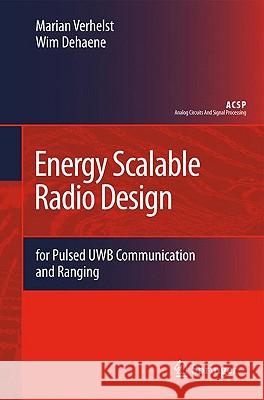
Marian Verhelst; Wim Dehaene
Energy Scalable Radio Design: For Pulsed Uwb Communication and Ranging Verhelst, Marian 9789048126934 Springer - książkaWidoczna okładka, to zdjęcie poglądowe, a rzeczywista szata graficzna może różnić się od prezentowanej.

Energy Scalable Radio Design: For Pulsed Uwb Communication and Ranging

ISBN-13: 9789048126934 / Angielski / Twarda / 2009 / 243 str.

Marian Verhelst; Wim Dehaene
cena 605,23 zł
(netto: 576,41 VAT:  5%)

Najniższa cena z 30 dni: 578,30 zł
Termin realizacji zamówienia:
ok. 22 dni roboczych
Bez gwarancji dostawy przed świętami

Darmowa dostawa!
inne wydania

Smart energy management, both at design time and at run time, is indispensable in modern radios. It requires a careful trade-off between the system s performance, and its power consumption. Moreover, the design has to be dynamically reconfigurable to optimally balance these parameters at run time, depending on the current operating conditions. Energy Scalable Radio Design describes and applies an energy-driven design strategy to the design of an energy-efficient, highly scalable, pulsed UWB receiver, suitable for low data rate communication and sub-cm ranging. This book meticulously covers the different design steps and the adopted optimizations: System level air interface selection, architectural/algorithmic design space exploration, algorithmic refinement (acquisition, synchronization and ranging algorithms) and circuit level (RTL) implementation based on the FLEXmodule-concept. Measurement results demonstrate the effectiveness and necessity of the energy-driven design strategy."


Kategorie:
Technologie
Kategorie BISAC:
Technology & Engineering > Power Resources - General
Technology & Engineering > Microwaves
Business & Economics > Industries - Energy
Wydawca:
Springer
Seria wydawnicza:
Analog Circuits and Signal Processing
Język:
Angielski
ISBN-13:
9789048126934
Rok wydania:
2009
Wydanie:
2009
Numer serii:
000108233
Ilość stron:
243
Waga:
0.54 kg
Wymiary:
23.39 x 15.6 x 1.6
Oprawa:
Twarda
Wolumenów:
01
Dodatkowe informacje:
Bibliografia
Wydanie ilustrowane

Preface. 1 Introduction and motivation. 1.1 Dreaming of a smart environment. 1.2 Limited energy resources and the energy gap. 1.3 Strategies to bridge the energy gap. 1.4 Book scope and organizational overview. 2 Adaptation of classical design flow for energy-driven system-to-circuit design. 2.1 Introduction. 2.2 Classical (digital) top-down design flow: Gajski-Kuhn. 2.3 Need for energy-driven cross-layer scalable system-to-circuit design. 2.4 Proposed adaptations of the classical design flow. 2.5 Conclusion. 3 System level specifications and design. 3.1 Introduction. 3.2 System specifications. 3.3 Selection of the air interface. 3.4 Conclusion. 4 Algorithmic/architectural design space exploration. 4.1 Introduction. 4.2 UWB communication and receiver framework. 4.3 Receiver alternatives. 4.4 Receiver comparison: power, performance, EPUB. 4.5 Algorithmic/architectural DSE summary. 4.6 Further considerations. 4.7 Conclusion. 5 Algorithmic/architectural level refinement. 5.1 Introduction. 5.2 Algorithm refinement. 5.3 Architecture refinement. 5.4 Conclusion. 6 Digital RT level design: flexibility to save energy. 6.1 Introduction. 6.2 Design based on nested FLEXmodules. 6.3 Measuring and weighing flexibility. 6.4 Energy-optimal design through flexibility. 6.5 Intermediate conclusion on the flexibility-power-performance trade-off. 6.6 Detailed back-end architecture and design. 6.7 Conclusion. 7 Chip and system measurements. 7.1 Introduction. 7.2 Back-end measurements. 7.3 System measurements: 3-5 GHz band. 7.4 System measurements: 0-960 MHz band. 7.5 Receiver comparison. 7.6 Conclusion. 8 Conclusions. Bibliography. Index.

Smart energy management, both at design time and at run time, is indispensable in modern radios. It requires a careful trade-off between the system’s performance, and its power consumption. Moreover, the design has to be dynamically reconfigurable to optimally balance these parameters at run time, depending on the current operating conditions.

Energy Scalable Radio Design starts by describing an energy-driven design strategy, tackling these implementation challenges for wireless communication systems. The strategy minimizes energy consumption and optimizes reconfigurability at all consecutive design steps, from system level down to circuit level. In addition, a novel implementation concept of "nested FLEXmodules" is introduced at digital RT-level, enabling highly scalable implementations, with minimal energy overhead.

Energy Scalable Radio Design continues by applying this design strategy to the design of an energy-efficient, highly scalable, pulsed UWB receiver, suitable for low data rate communication and sub-cm ranging. This book meticulously covers the different design steps and the adopted optimizations: System level air interface selection, architectural/algorithmic design space exploration, algorithmic refinement (acquisition, synchronization and ranging algorithms) and circuit level (RTL) implementation based on the FLEXmodule-concept. Measurement results demonstrate the effectiveness and necessity of the energy-driven design strategy.

Dehaene, Wim Wim Dehaene is a professor at the Katholieke Unive... więcej >


Udostępnij

Facebook - konto krainaksiazek.pl


Opinie o Krainaksiazek.pl na Opineo.pl

Partner Mybenefit

Krainaksiazek.pl w programie rzetelna firma Krainaksiaze.pl - płatności przez paypal

Czytaj nas na:

Facebook - krainaksiazek.pl
  • książki na zamówienie
  • granty
  • książka na prezent
  • kontakt
  • pomoc
  • opinie
  • regulamin
  • polityka prywatności

Zobacz:

  • Księgarnia czeska

  • Wydawnictwo Książkowe Klimaty

1997-2025 DolnySlask.com Agencja Internetowa

© 1997-2022 krainaksiazek.pl
     
KONTAKT | REGULAMIN | POLITYKA PRYWATNOŚCI | USTAWIENIA PRYWATNOŚCI
Zobacz: Księgarnia Czeska | Wydawnictwo Książkowe Klimaty | Mapa strony | Lista autorów
KrainaKsiazek.PL - Księgarnia Internetowa

Polityka prywatnosci - link
Krainaksiazek.pl - płatnośc Przelewy24
Przechowalnia Przechowalnia





