• Wyszukiwanie zaawansowane
  • Kategorie
  • Kategorie BISAC
  • Książki na zamówienie
  • Promocje
  • Granty
  • Książka na prezent
  • Opinie
  • Pomoc
  • Załóż konto
  • Zaloguj się

Elements of Finite Model Theory » książka


zaloguj się | załóż konto
Logo Krainaksiazek.pl

koszyk

konto

szukaj
topmenu
Księgarnia internetowa
Szukaj
Książki na zamówienie
Promocje
Granty
Książka na prezent
Moje konto
Pomoc
 
 
Wyszukiwanie zaawansowane
Pusty koszyk
Bezpłatna dostawa dla zamówień powyżej 20 złBezpłatna dostawa dla zamówień powyżej 20 zł

Kategorie główne

• Nauka
 [2949965]
• Literatura piękna
 [1857847]

  więcej...
• Turystyka
 [70818]
• Informatyka
 [151303]
• Komiksy
 [35733]
• Encyklopedie
 [23180]
• Dziecięca
 [617748]
• Hobby
 [139972]
• AudioBooki
 [1650]
• Literatura faktu
 [228361]
• Muzyka CD
 [398]
• Słowniki
 [2862]
• Inne
 [444732]
• Kalendarze
 [1620]
• Podręczniki
 [167233]
• Poradniki
 [482388]
• Religia
 [509867]
• Czasopisma
 [533]
• Sport
 [61361]
• Sztuka
 [243125]
• CD, DVD, Video
 [3451]
• Technologie
 [219309]
• Zdrowie
 [101347]
• Książkowe Klimaty
 [123]
• Zabawki
 [2362]
• Puzzle, gry
 [3791]
• Literatura w języku ukraińskim
 [253]
• Art. papiernicze i szkolne
 [7933]
Kategorie szczegółowe BISAC

Elements of Finite Model Theory

ISBN-13: 9783642059483 / Angielski / Miękka / 2010 / 318 str.
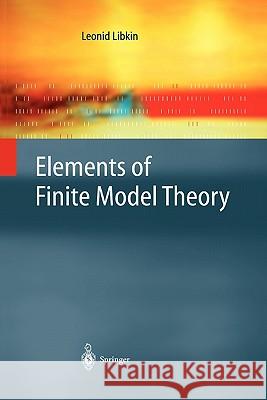
Leonid Libkin
Elements of Finite Model Theory Leonid Libkin 9783642059483 Springer-Verlag Berlin and Heidelberg GmbH &  - książkaWidoczna okładka, to zdjęcie poglądowe, a rzeczywista szata graficzna może różnić się od prezentowanej.

Elements of Finite Model Theory

ISBN-13: 9783642059483 / Angielski / Miękka / 2010 / 318 str.

Leonid Libkin
cena 363,12 zł
(netto: 345,83 VAT:  5%)

Najniższa cena z 30 dni: 346,96 zł
Termin realizacji zamówienia:
ok. 22 dni roboczych
Bez gwarancji dostawy przed świętami

Darmowa dostawa!

Finite model theory is an area of mathematical logic that grew out of computer science applications. The main sources of motivational examples for finite model theory are found in database theory, computational complexity, and formal languages, although in recent years connections with other areas, such as formal methods and verification, and artificial intelligence, have been discovered. The birth of finite model theory is often identified with Trakhtenbrot's result from 1950 stating that validity over finite models is not recursively enumerable; in other words, completeness fails over finite models. The tech- nique of the proof, based on encoding Turing machine computations as finite structures, was reused by Fagin almost a quarter century later to prove his cel- ebrated result that put the equality sign between the class NP and existential second-order logic, thereby providing a machine-independent characterization of an important complexity class. In 1982, Immerman and Vardi showed that over ordered structures, a fixed point extension of first-order logic captures the complexity class PTIME of polynomial time computable propertiE s. Shortly thereafter, logical characterizations of other important complexity classes were obtained. This line of work is often referred to as descriptive complexity. A different line of finite model theory research is associated with the de- velopment of relational databases. By the late 1970s, the relational database model had replaced others, and all the basic query languages for it were es- sentially first-order predicate calculus or its minor extensions.


Kategorie:
Nauka, Matematyka
Kategorie BISAC:
Mathematics > Logic
Computers > Machine Theory
Computers > Programming - Algorithms
Wydawca:
Springer-Verlag Berlin and Heidelberg GmbH &
Seria wydawnicza:
Texts in Theoretical Computer Science. An EATCS Series
Język:
Angielski
ISBN-13:
9783642059483
Rok wydania:
2010
Dostępne języki:
Angielski
Numer serii:
000304237
Ilość stron:
318
Waga:
0.52 kg
Wymiary:
23.523.5 x 15.5
Oprawa:
Miękka
Wolumenów:
01

From the reviews:

Model theory is the study of the logical properties of mathematical structures. Finite model theory arises when we focus our attention on finite structures, such as finite graphs (graphs with a finite number of nodes). This book presents the most important results of finite model theory in an extremely readable, yet careful and precise manner. Libkin himself is a master of the art, and this shows in his beautiful presentation of the material.

Ronald Fagin Manager, Foundations of Computer Science, IBM Almaden Research Center, San Jose, CA

"This book is an introduction to finite model theory which stresses the computer science origins of the area. ... In addition to presenting the main techniques ... the book deals extensively with applications in databases, complexity theory, and formal languages, as well as other branches of computer science. ... This book can be used both as an introduction to the subject, suitable for a one- or two-semester graduate course, or as reference for researchers who apply techniques from logic in computer science." (PHINEWS, Vol. (7), 2005)

"Libkin has managed to produce an interesting treatment, in spite of the competition ... . I particularly liked the chapter on the locality of first order (FO) logic ... . there is an excellent chapter on FO model checking. I liked the careful distinction between data, expression, and combined and fixed parameter complexity. ... In summary, I welcome Libkin's book as an interesting text from the database point of view." (K. Lodaya, Computing Reviews, April, 2005)

"Connections have emerged between finite model theory and various areas in combinatorics and computer science ... . Leonid Libkin's new book ... is a beautiful introduction to these developments ... . The exposition is lucid throughout ... . The book is self-contained and makes an ideal text for self-study or for a 'topics in logic course' ... . A noteworthy feature of the book from this perspective is its wealth of exercises ... . Elements of Finite Model Theory is a wonderful text ... ." (Steven Lindell and Scott Weinstein, Journal of Logic, Language and Information, Vol. 16 (2), 2007)

"The present book stands out by its broadness of topics (while staying within the confines of finite model theory), its detailed exposition (with great attention to the relationships between the different topics), and its inclusion of more recent results and trends. This book provides the best overview of the field to date. ... Every chapter ends with a set of exercises ... . The book can be used as a research reference as well as for teaching at the advanced graduate level." (Jan G. Van den Bussche, Mathematical Reviews, Issue 2007 a)

"Finite model theory is the study of the expressive power and, more generally, the behaviour of logics on finite structures. ... The audience of the book, as intended by the author, is formed by theoretical computer scientists. ... This excellent book will be a great help for teachers and students of finite model theory, but also for researchers in other fields of mathematics or computer science that want to gain familiarity with the most important concepts and results from finite model theory." (Heribert Vollmer, Zentralblatt MATH, Vol. 1060, 2006)

1 Introduction.- 2 Preliminaries.- 3 Ehrenfeucht-Fraïssé Games.- 4 Locality and Winning Games.- 5 Ordered Structures.- 6 Complexity of First-Order Logic.- 7 Monadic Second-Order Logic and Automata.- 8 Logics with Counting.- 9 Turing Machines and Finite Models.- 10 Fixed Point Logics and Complexity Classes.- 11 Finite Variable Logics.- 12 Zero-One Laws.- 13 Embedded Finite Models.- 14 Other Applications of Finite Model Theory.- References.- List of Notation.- Name Index.

The author has been with the department of computer science at the University of Toronto since 2000. Prior to that, he was a researcher at Bell Laboratories, and he spent two years visiting INRIA in France. His research interests are in the areas of database theory and applications of logic in computer science.

He is coauthor/editor of:

Constraint Databases
Kuper, G., Libkin, L., Paredaens, J. (Eds.), 12.04.2000, ISBN 3-540-66151-4

Finite-Model Theory and Its Applications
Grädel, E., Kolaitis, P.G. (et al.), 07.2004, ISBN 3-540-00428-9

Semantics in Databases
Thalheim, B., Libkin, L. (Eds.), Vol. 1358, 25.02.1998, ISBN 3-540-64199-8

This book is an introduction to finite model theory which stresses the computer science origins of the area. In addition to presenting the main techniques for analyzing logics over finite models, the book deals extensively with applications in databases, complexity theory, and formal languages, as well as other branches of computer science. It covers Ehrenfeucht-Fraïssé games, locality-based techniques, complexity analysis of logics, including the basics of descriptive complexity, second-order logic and its fragments, connections with finite automata, fixed point logics, finite variable logics, zero-one laws, and embedded finite models, and gives a brief tour of recently discovered applications of finite model theory.

This book can be used both as an introduction to the subject, suitable for a one- or two-semester graduate course, or as reference for researchers who apply techniques from logic in computer science.


Udostępnij

Facebook - konto krainaksiazek.pl


Opinie o Krainaksiazek.pl na Opineo.pl

Partner Mybenefit

Krainaksiazek.pl w programie rzetelna firma Krainaksiaze.pl - płatności przez paypal

Czytaj nas na:

Facebook - krainaksiazek.pl
  • książki na zamówienie
  • granty
  • książka na prezent
  • kontakt
  • pomoc
  • opinie
  • regulamin
  • polityka prywatności

Zobacz:

  • Księgarnia czeska

  • Wydawnictwo Książkowe Klimaty

1997-2025 DolnySlask.com Agencja Internetowa

© 1997-2022 krainaksiazek.pl
     
KONTAKT | REGULAMIN | POLITYKA PRYWATNOŚCI | USTAWIENIA PRYWATNOŚCI
Zobacz: Księgarnia Czeska | Wydawnictwo Książkowe Klimaty | Mapa strony | Lista autorów
KrainaKsiazek.PL - Księgarnia Internetowa

Polityka prywatnosci - link
Krainaksiazek.pl - płatnośc Przelewy24
Przechowalnia Przechowalnia





