• Wyszukiwanie zaawansowane
  • Kategorie
  • Kategorie BISAC
  • Książki na zamówienie
  • Promocje
  • Granty
  • Książka na prezent
  • Opinie
  • Pomoc
  • Załóż konto
  • Zaloguj się

Electron-Molecule Collisions » książka


zaloguj się | załóż konto
Logo Krainaksiazek.pl

koszyk

konto

szukaj
topmenu
Księgarnia internetowa
Szukaj
Książki na zamówienie
Promocje
Granty
Książka na prezent
Moje konto
Pomoc
 
 
Wyszukiwanie zaawansowane
Pusty koszyk
Bezpłatna dostawa dla zamówień powyżej 20 złBezpłatna dostawa dla zamówień powyżej 20 zł

Kategorie główne

• Nauka
 [2946600]
• Literatura piękna
 [1856966]

  więcej...
• Turystyka
 [72221]
• Informatyka
 [151456]
• Komiksy
 [35826]
• Encyklopedie
 [23190]
• Dziecięca
 [619653]
• Hobby
 [140543]
• AudioBooki
 [1577]
• Literatura faktu
 [228355]
• Muzyka CD
 [410]
• Słowniki
 [2874]
• Inne
 [445822]
• Kalendarze
 [1744]
• Podręczniki
 [167141]
• Poradniki
 [482898]
• Religia
 [510455]
• Czasopisma
 [526]
• Sport
 [61590]
• Sztuka
 [243598]
• CD, DVD, Video
 [3423]
• Technologie
 [219201]
• Zdrowie
 [101638]
• Książkowe Klimaty
 [124]
• Zabawki
 [2473]
• Puzzle, gry
 [3898]
• Literatura w języku ukraińskim
 [254]
• Art. papiernicze i szkolne
 [8170]
Kategorie szczegółowe BISAC

Electron-Molecule Collisions

ISBN-13: 9780306415319 / Angielski / Twarda / 1984 / 570 str.
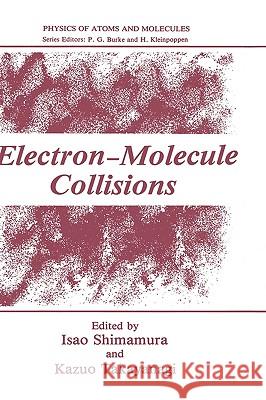
Isao Shimamura; Kazuo Takayanagi; I. Shimamura
Electron-Molecule Collisions Isao Shimamura Kazuo Takayanagi I. Shimamura 9780306415319 Plenum Publishing Corporation - książkaWidoczna okładka, to zdjęcie poglądowe, a rzeczywista szata graficzna może różnić się od prezentowanej.

Electron-Molecule Collisions

ISBN-13: 9780306415319 / Angielski / Twarda / 1984 / 570 str.

Isao Shimamura; Kazuo Takayanagi; I. Shimamura
cena 806,99 zł
(netto: 768,56 VAT:  5%)

Najniższa cena z 30 dni: 771,08 zł
Termin realizacji zamówienia:
ok. 22 dni roboczych
Bez gwarancji dostawy przed świętami

Darmowa dostawa!
inne wydania

Scattering phenomena play an important role in modern physics. Many significant discoveries have been made through collision experiments. Amongst diverse kinds of collision systems, this book sheds light on the collision of an electron with a molecule. The electron-molecule collision provides a basic scattering problem. It is scattering by a nonspherical, multicentered composite particle with its centers having degrees of freedom of motion. The molecule can even disintegrate, Le., dissociate or ionize into fragments, some or all of which may also be molecules. Although it is a difficult problem, the recent theoretical, experimental, and computational progress has been so significant as to warrant publication of a book that specializes in this field. The progress owes partly to technical develop ments in measurements and computations. No less important has been the great and continuing stimulus from such fields of application as astrophysics, the physics of the earth's upper atmosphere, laser physics, radiation physics, the physics of gas discharges, magnetohydrodynamic power generation, and so on. This book aims at introducing the reader to the problem of electron molecule collisions, elucidating the physics behind the phenomena, and review ing, to some extent, up-to-date important results. This book should be appropri ate for graduate reading in physics and chemistry. We also believe that investi gators in atomic and molecular physics will benefit much from this book."


Kategorie:
Nauka, Chemia
Kategorie BISAC:
Science > Fizyka kwantowa
Science > Chemia - Fizyczna
Science > Fizyka jądrowa
Wydawca:
Plenum Publishing Corporation
Seria wydawnicza:
Physics of Atoms and Molecules
Język:
Angielski
ISBN-13:
9780306415319
Rok wydania:
1984
Wydanie:
1984
Numer serii:
000052861
Ilość stron:
570
Waga:
2.20 kg
Wymiary:
23.5 x 15.5
Oprawa:
Twarda
Wolumenów:
01

1. Introduction to Electron-Molecule Collisions.- 1. Introduction.- 2. Cross Sections.- 2.1. Concept of Cross Sections.- 2.2. Experimental Arrangements.- 2.3. Theoretical Studies of Electron-Molecule Collisions.- 2.4. Examples of the Electron-Molecule Collision Cross Sections.- 3. Electron-Molecule Interactions.- 3.1. Long-Range Interactions.- 3.2. Short-Range Interactions.- 4. Resonance Effect.- 5. Calculation of the Total Cross Section as a Potential Scattering Problem.- 5.1. Summary of the Theory for Scattering from a Central Field.- 5.2. Independent-Atom Model.- 5.3. One-Center Expansion of Nonspherical Potential.- 5.4. Separable Potentials.- 5.5. Polyatomic Molecules.- 6. Theoretical Formulation of Inelastic Scattering Processes.- 6.1. Outline of the General Theory.- 6.2. Born Approximation.- 6.3. Some Consequences of the Born Approximation. I: Elastic Collisions and Rotational Transitions.- 6.4. Some Consequences of the Born Approximation. II: Vibrational Transitions.- 6.5. Some Consequences of the Born Approximation. III: Electronic Transitions.- 6.6. Electron Exchange.- 6.7. Distorted-Wave Approximations.- 6.8. Adiabatic Approximations.- References and Notes.- 2. Rotational Excitation of Molecules by Slow Electrons.- 1. Introduction.- 2. Classical Sudden Collisions and Angular-Momentum Transfer.- 2.1. Linear Rotators.- 2.2. Nonlinear Rotators.- 3. Quantum-Mechanical Sudden Collisions and Angular-Momentum Transfer.- 3.1. Elementary Theory of Angular Momentum.- 3.2. Sudden Approximation.- 3.3. General Relations for the Cross Sections.- 4. Division of the Configuration Space.- 4.1. Dynamics in Different Regions.- 4.2. Frame Transformation.- 4.3. R-Matrix Theory.- 5. Physics in the Potential Scattering Region.- 5.1. General Trend of the Cross Sections.- 5.2. Single-Center Expansion of the Interaction Potential.- 5.3. Charge-Dipole Interaction.- 5.4. Charge-Quadrupole Interaction.- 5.5. Interaction of Shorter Range.- 6. Physics in the Compound-System Region.- 6.1. Multicenter Electrostatic Field.- 6.2. Indistinguishability of All Electrons.- 6.3. Representation in Terms of Adiabatic Angular Basis Set.- Appendix: Summary of Formulas.- References and Notes.- 3. Vibrational Excitation of Molecules by Slow Electrons.- 1. Introduction.- 2. Virtual States and Resonances.- 2.1. Introduction.- 2.2. Potential Well Scattering with l = 0.- 2.3. Potential Well Scattering with l > 0.- 2.4. Singularities in Potential-Well Scattering.- 2.5. Time Delay.- 2.6. General Resonances.- 3. Vibrational Excitation. I: Wave-Function Enhancement without Trapping.- 4. Vibrational Excitation. II: Electron Scattering at a Shape Resonance; Impulse Limit.- 5. Vibrational Excitation. III: Long-Lived Resonances and Nuclear Relaxation.- 5.1. The Nuclear Wave Equation.- 5.2. Solutions of the Nuclear Wave Equation-Qualitative Features.- 5.3. The Complex Potential Surface.- 5.4. Semiempirical Calculations.- 5.5. Ab Initio Calculations in the Born-Oppenheimer Approximation.- 5.6. Other Calculations.- 6. Current Developments.- 6.1. Electronic Excitation.- 6.2. High Excitation Energies.- 6.3. More Complicated Targets.- 6.4. Rotational Effects.- Appendix A: Resonance Scattering of Electrons by a Target with Fixed Nuclei.- Appendix B: Resonance Scattering of an Electron by a Molecule with Relaxing Nuclei.- Appendix C: The Impulse Approximation.- Appendix D: Wave Packets.- References and Notes.- 4. Dissociation of Molecules by Slow Electrons.- 1. Introduction.- 2. Dissociation of Molecules into Ground Electronic State Fragments.- 3. Dissociation into Excited Fragments.- 3.1. Dissociation of Molecules into Fragments Which Emit Radiation.- 3.2. Metastable Fragments.- 3.3. High Rydberg Fragments.- 4. Dissociative Ionization.- 5. Dissociative Attachment.- 5.1. H2 and D2.- 5.2. N2 and NO.- 5.3. O2.- 5.4. F2, C12, Br2, and I2.- 5.5. Hydrogen Halides.- 5.6. Triatomic Molecules.- 5.7. Halogenated Methanes.- 6. Dissociative Attachment to Ultracold Molecules and Molecular Clusters.- 7. Dissociative Recombination.- 7.1. Plasmas.- 7.2. Colliding Beams.- 7.3. Ion Trap.- 7.4. Theoretical Calculations and Experimental Results.- References and Notes.- 5. Molecular Spectroscopy By Electron Scattering.- 1. Introduction.- 2. Resonance Spectroscopy of Molecules.- 2.1. The Grandparent Model and Feshbach Resonances.- 2.2. Coupling Mechanisms of Feshbach Resonances. I: Electronic Coupling.- 2.3. Coupling Mechanisms of Feshbach Resonances. II: Dynamic Coupling.- 2.4. Potential Curves of Feshbach Resonances in H2.- 2.5. Resonance Symmetry and Differential Cross Sections.- 2.6. Resonance Symmetry and Rotational Structure.- 2.7. Core-Excited Shape Resonances. I: Valence States.- 2.8. Core-Excited Shape Resonances. II: Rydberg States.- 3. Electron Energy-Loss Spectroscopy.- 3.1. Molecular Outer-Shell Spectroscopy at High Incident Electron Energies.- 3.2. Inner-Shell Excitation.- 3.3. Electron Scattering Spectroscopy at Intermediate Energies.- 3.4. Electron Scattering Spectroscopy at Near-Threshold Energies.- References.- 6. Experimental Techniques for Cross-Section Measurements.- 1. Introduction.- 2. Definition of Cross Sections.- 3. Measurement of Total, Integral, and Momentum-Transfer Cross Sections.- 3.1. Total Cross Sections.- 3.2. Integral Cross Sections.- 3.3. Momentum-Transfer Cross Sections.- 4. Measurement of Differential Cross Sections.- 4.1. Instrumentation.- 4.2. Relation between Cross Section and Scattering Signal Intensity in Beam-Beam Experiments.- 4.3. Normalization Procedures.- 4.4. Experimental Techniques and Procedures.- 4.5. Discussion of Experimental Uncertainties.- 5. Electron Collision Measurements at High Energies; Generation of Optical Data.- 6. Electron Scattering in Electromagnetic Fields.- 7. Closing Remarks.- References.- 7. Computational Methods for Low-Energy Electron-Molecule Collisions.- 1. Introduction.- 2. Derivation of the Radial Equations.- 2.1. Electronic and Rotational Degrees of Freedom.- 2.2. The Vibrational Motion.- 3. Numerical Solution of the Fixed-Nuclei Equations.- 3.1. Single-Center Expansion Methods.- 3.2. Expansion in Prolate Spheroidal Coordinates.- 3.3. Separable Exchange Potentials.- 3.4. Model Exchange Potentials.- 3.5. Polarization Potentials.- 3.6. Continuum Multiple-Scattering Method.- 3.7. L2 Methods.- 3.8. R-Matrix Method.- 3.9. T-Matrix Method.- 4. Vibrational Excitation and Dissociative Attachment.- 4.1. Adiabatic Nuclei Approximation.- 4.2. Hybrid Theory.- 4.3. Resonance Theory.- 4.4. R-Matrix Method.- 5. Electronic Excitation.- 5.1. Excitation of H+2.- 5.2. Excitation of H2.- 5.3. Excitation of N2.- 6. Conclusions.- References.


Udostępnij

Facebook - konto krainaksiazek.pl


Opinie o Krainaksiazek.pl na Opineo.pl

Partner Mybenefit

Krainaksiazek.pl w programie rzetelna firma Krainaksiaze.pl - płatności przez paypal

Czytaj nas na:

Facebook - krainaksiazek.pl
  • książki na zamówienie
  • granty
  • książka na prezent
  • kontakt
  • pomoc
  • opinie
  • regulamin
  • polityka prywatności

Zobacz:

  • Księgarnia czeska

  • Wydawnictwo Książkowe Klimaty

1997-2025 DolnySlask.com Agencja Internetowa

© 1997-2022 krainaksiazek.pl
     
KONTAKT | REGULAMIN | POLITYKA PRYWATNOŚCI | USTAWIENIA PRYWATNOŚCI
Zobacz: Księgarnia Czeska | Wydawnictwo Książkowe Klimaty | Mapa strony | Lista autorów
KrainaKsiazek.PL - Księgarnia Internetowa

Polityka prywatnosci - link
Krainaksiazek.pl - płatnośc Przelewy24
Przechowalnia Przechowalnia





