• Wyszukiwanie zaawansowane
  • Kategorie
  • Kategorie BISAC
  • Książki na zamówienie
  • Promocje
  • Granty
  • Książka na prezent
  • Opinie
  • Pomoc
  • Załóż konto
  • Zaloguj się

Electrochemistry at Semiconductor and Oxidized Metal Electrodes » książka


zaloguj się | załóż konto
Logo Krainaksiazek.pl

koszyk

konto

szukaj
topmenu
Księgarnia internetowa
Szukaj
Książki na zamówienie
Promocje
Granty
Książka na prezent
Moje konto
Pomoc
 
 
Wyszukiwanie zaawansowane
Pusty koszyk
Bezpłatna dostawa dla zamówień powyżej 20 złBezpłatna dostawa dla zamówień powyżej 20 zł

Kategorie główne

• Nauka
 [2944077]
• Literatura piękna
 [1814251]

  więcej...
• Turystyka
 [70679]
• Informatyka
 [151074]
• Komiksy
 [35590]
• Encyklopedie
 [23169]
• Dziecięca
 [611005]
• Hobby
 [136031]
• AudioBooki
 [1718]
• Literatura faktu
 [225599]
• Muzyka CD
 [379]
• Słowniki
 [2916]
• Inne
 [443741]
• Kalendarze
 [1187]
• Podręczniki
 [166463]
• Poradniki
 [469211]
• Religia
 [506887]
• Czasopisma
 [481]
• Sport
 [61343]
• Sztuka
 [242115]
• CD, DVD, Video
 [3348]
• Technologie
 [219293]
• Zdrowie
 [98602]
• Książkowe Klimaty
 [124]
• Zabawki
 [2385]
• Puzzle, gry
 [3504]
• Literatura w języku ukraińskim
 [260]
• Art. papiernicze i szkolne
 [7151]
Kategorie szczegółowe BISAC

Electrochemistry at Semiconductor and Oxidized Metal Electrodes

ISBN-13: 9781461331469 / Angielski / Miękka / 2011 / 416 str.
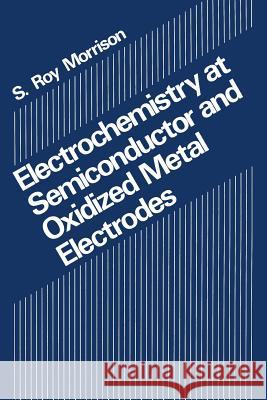
S. R. Morrison
Electrochemistry at Semiconductor and Oxidized Metal Electrodes S. R. Morrison 9781461331469 Springer - książkaWidoczna okładka, to zdjęcie poglądowe, a rzeczywista szata graficzna może różnić się od prezentowanej.

Electrochemistry at Semiconductor and Oxidized Metal Electrodes

ISBN-13: 9781461331469 / Angielski / Miękka / 2011 / 416 str.

S. R. Morrison
cena 563,56
(netto: 536,72 VAT:  5%)

Najniższa cena z 30 dni: 501,19
Termin realizacji zamówienia:
ok. 22 dni roboczych.

Darmowa dostawa!

The objective of the present volume is to develop the theory and practice of nonmetal electrochemistry from first principles, emphasizing energy level models, in particular the fluctuating energy level model of Marcus and Gerischer. A single volume emphasizing these models. and the in- terpretation of experiments based on these models, has not been available. Yet this area of electrochemical technology, where the use of such models is required, has developed a great deal of interest. This is not only because of the interest in photoelectrochemical solar cells, but also because of the importance of the concepts in corrosion, sensors, coated metal electrodes, and, indeed, to the general theory of electrode reactions. This book is an attempt to fill the void-to develop in a single volume the basic description of electrode reactions on nonmetallic electrodes and oxide-covered metal electrodes. The development of the fluctuating energy level model to describe electrode reactions on nonmetals (as described in Chapters I through 3) has permitted a significant forward step in the understanding of such re- actions. The power of the model is illustrated by the simple methods available to determine the energy levels of interest-the conduction and valence bands of the nonmetals (Chapter 5), and their relation to the energy levels of oxidizing or reducing agents in solution. In Chapter 6, we illustrate the ability of the simple models. based on these parameters, to describe successfully electrode reactions at an inert electrode.


Kategorie:
Nauka, Chemia
Kategorie BISAC:
Science > Chemia - Fizyczna
Science > Physics - Condensed Matter
Science > Spectroscopy & Spectrum Analysis
Wydawca:
Springer
Język:
Angielski
ISBN-13:
9781461331469
Rok wydania:
2011
Wydanie:
1980
Ilość stron:
416
Waga:
0.61 kg
Wymiary:
15.4 x 22.8 x 3.1
Oprawa:
Miękka
Wolumenów:
01

1. The Solid and the Solution.- 1.1. The Solid.- 1.1.1. Donors, Acceptors, and Traps.- 1.1.2. Energy Levels at the Surface.- 1.1.3. Conductance in Solids.- 1.2. The Solution.- 1.2.1. Introduction.- 1.2.2. The Electrode Fermi Energy as a Function of the Redox Couples in Solution.- 1.2.3. The Relation between the Hydrogen and the Vacuum Scales of Energy.- 1.2.4. Fluctuating Energy Levels in Solution.- 1.2.5. The Energy Levels Associated with Two-Equivalent Ions.- 1.2.6. Conductance in Liquids.- 2. The Solid/Liquid Interface.- 2.1. Surface Ions and Their Energy Levels.- 2.1.1. Adsorption.- 2.1.2. Surface States at the Solid/Liquid Interface.- 2.2. Double Layers at the Solid/Liquid Interface.- 2.2.1. General.- 2.2.2. The Gouy Layer.- 2.2.3. The Helmholtz Double Layer.- 2.2.4. The Space Charge Double Layer in the Semiconductor.- 2.3. Theoretical Predictions of the Energy Levels of Band Edges.- 2.4. The Band Model of the Solid/Solution Interface.- 3. Theory of Electron and Hole Transfer.- 3.1. Introduction.- 3.1.1. General.- 3.1.2. The Activation Energy in Electrode Reactions.- 3.2. Classical Model.- 3.3. The Energy Level Model of Charge Transfer.- 3.3.1. General.- 3.3.2. The Metal Electrode.- 3.3.3. The Semiconductor Electrode.- 3.4. Qualitative Description of Electrode Processes Using the Band Model.- 3.4.1. The Behavior of the Metal Electrode.- 3.4.2. The Behavior of the Semiconductor Electrode.- 3.4.3. The Transition between Semiconductor and Metallic Behavior.- 4. Measurement Techniques.- 4.1. Capacity Measurements.- 4.1.1. Introduction.- 4.1.2. Measurement Theory.- 4.1.3. Analysis.- 4.1.4. Complex Mott—Schottky Plots.- 4.1.5. Determination of Band Edges.- 4.2. Measurements of the Current/Voltage Characteristics.- 4.2.1. General Techniques; Voltammetry.- 4.2.2. Rotating Electrodes.- 4.2.3. Illumination.- 4.3. Other Techniques.- 4.3.1. Techniques for Vs Measurement.- 4.3.2. Techniques to Determine Surface Species or Phases.- 4.3.3. Techniques to Study Electrode Reactions.- 5. The Properties of the Electrode and Their Effect on Electrochemical Measurements.- 5.1. The Behavior of the Perfect Crystal.- 5.1.1. The Helmholtz Double Layer: The Surface Charges on the Electrode.- 5.1.2. The Space Charge Region of the Perfect Crystal.- 5.2. The Behavior of Electrode Defects.- 5.2.1. Introduction.- 5.2.2. Deviations of Mott—Schottky Plots Due to Bulk Flaws.- 5.2.3. Current Flow Associated with Bulk Flaws.- 5.3. Observed Flat Band Potentials for Various Semiconductors.- 6. Observations of Charge Transfer at an Inert Semiconductor Electrode.- 6.1. Introduction.- 6.2. Majority Carrier Capture.- 6.2.1. Direct Carrier Transfer to Ions in Solution.- 6.2.2. Indirect Electron Transfer to Ions in Solution.- 6.3. Minority Carrier Capture.- 6.3.1. Minority Carrier Capture on Two-Equivalent Species: Radical Formation and Current Doubling.- 6.3.2. Minority Carrier Capture by One-Equivalent Ions.- 6.3.3. Photocatalysis.- 6.4. Intrinsic Surface States and Recombination Centers.- 6.4.1. Intrinsic Surface States as Carrier Transfer Centers.- 6.4.2. Intrinsic Surface States and Ions in Solution as Recombination Centers.- 6.5. Carrier Injection.- 6.5.1. Direct Electron and Hole Injection.- 6.5.2. Injection by Tunneling.- 6.5.3. Injection by Optically Excited Ions: Dye Injection.- 6.6. High-Current, High-Voltage Processes.- 6.6.1. Introduction.- 6.6.2. High Currents with Accumulation Layers.- 6.6.3. Tunneling and Breakdown on Non-Transition-Metal Semiconductors.- 6.6.4. Practical Electrodes.- 6.7. Analysis of Complicated Electrode Reactions using the Tools of Semiconductor Electrochemistry.- 6.7.1. The Photocatalytic Oxidation of Formic Acid.- 6.7.2. Analysis of the Energy Levels of Two-Equivalent Species.- 6.7.3. The Reduction of Iodine on CdS.- 7. Chemical Transformation in the Electrode Reaction.- 7.1. Introduction.- 7.2. Inner Sphere Changes during Redox Reactions at an Inert Electrode.- 7.3. Adsorption onto and Absorption into the Electrode.- 7.3.1. Adsorption of Water, Hydrogen, and Oxygen.- 7.3.2. Adsorption of Electrolyte Ions.- 7.3.3. Action of Deposited Species.- 7.3.4. Movement of Impurities and Defects into the Electrode.- 7.4. Corrosion.- 7.4.1. Introduction.- 7.4.2. Theory and Observations of Semiconductor Corrosion.- 7.4.3. Stabilizing Agents to Prevent Corrosion.- 8. Coated Electrodes.- 8.1. Introduction.- 8.1.1. The Band Model for Oxide Films.- 8.1.2. Thin Films.- 8.1.3. The Structure of Thick Films.- 8.2. Current Transport through Oxide Films.- 8.2.1. Thin Oxide Layers.- 8.2.2. Model of Electronic Conduction through Thick Coherent Layers.- 8.2.3. Semiconducting Oxide Layers on Metal Electrodes.- 8.2.4. Insulating Layers on Metal and Semiconductor Electrodes.- 8.3. Deposition of Reaction Products on Semiconductor Electrodes.- 9. Applications of Semiconductor Electrodes.- 9.1. Solar Energy Conversion.- 9.1.1. Introduction.- 9.1.2. Photovoltaic Cells.- 9.1.3. Conversion of Optical to Chemical Energy.- 9.1.4. Corrosion of PEC Cells.- 9.1.5. The Future Potential of PEC Solar Cells.- 9.2. Electrocatalysis on Semiconductors.- 9.2.1. General.- 9.2.2. Surface State Additives and Narrow Bands in Electrocatalysis.- 9.3. New Devices.- 9.4. Electropolishing of Semiconductors.- References.- References to Review Articles and Books.- Author Index.


Udostępnij

Facebook - konto krainaksiazek.pl


Opinie o Krainaksiazek.pl na Opineo.pl

Partner Mybenefit

Krainaksiazek.pl w programie rzetelna firma Krainaksiaze.pl - płatności przez paypal

Czytaj nas na:

Facebook - krainaksiazek.pl
  • książki na zamówienie
  • granty
  • książka na prezent
  • kontakt
  • pomoc
  • opinie
  • regulamin
  • polityka prywatności

Zobacz:

  • Księgarnia czeska

  • Wydawnictwo Książkowe Klimaty

1997-2026 DolnySlask.com Agencja Internetowa

© 1997-2022 krainaksiazek.pl
     
KONTAKT | REGULAMIN | POLITYKA PRYWATNOŚCI | USTAWIENIA PRYWATNOŚCI
Zobacz: Księgarnia Czeska | Wydawnictwo Książkowe Klimaty | Mapa strony | Lista autorów
KrainaKsiazek.PL - Księgarnia Internetowa

Polityka prywatnosci - link
Krainaksiazek.pl - płatnośc Przelewy24
Przechowalnia Przechowalnia






