• Wyszukiwanie zaawansowane
  • Kategorie
  • Kategorie BISAC
  • Książki na zamówienie
  • Promocje
  • Granty
  • Książka na prezent
  • Opinie
  • Pomoc
  • Załóż konto
  • Zaloguj się

Discrete Systems: Analysis, Control and Optimization » książka


zaloguj się | załóż konto
Logo Krainaksiazek.pl

koszyk

konto

szukaj
topmenu
Księgarnia internetowa
Szukaj
Książki na zamówienie
Promocje
Granty
Książka na prezent
Moje konto
Pomoc
 
 
Wyszukiwanie zaawansowane
Pusty koszyk
Bezpłatna dostawa dla zamówień powyżej 20 złBezpłatna dostawa dla zamówień powyżej 20 zł

Kategorie główne

• Nauka
 [2949965]
• Literatura piękna
 [1857847]

  więcej...
• Turystyka
 [70818]
• Informatyka
 [151303]
• Komiksy
 [35733]
• Encyklopedie
 [23180]
• Dziecięca
 [617748]
• Hobby
 [139972]
• AudioBooki
 [1650]
• Literatura faktu
 [228361]
• Muzyka CD
 [398]
• Słowniki
 [2862]
• Inne
 [444732]
• Kalendarze
 [1620]
• Podręczniki
 [167233]
• Poradniki
 [482388]
• Religia
 [509867]
• Czasopisma
 [533]
• Sport
 [61361]
• Sztuka
 [243125]
• CD, DVD, Video
 [3451]
• Technologie
 [219309]
• Zdrowie
 [101347]
• Książkowe Klimaty
 [123]
• Zabawki
 [2362]
• Puzzle, gry
 [3791]
• Literatura w języku ukraińskim
 [253]
• Art. papiernicze i szkolne
 [7933]
Kategorie szczegółowe BISAC

Discrete Systems: Analysis, Control and Optimization

ISBN-13: 9783642823299 / Angielski / Miękka / 2011 / 670 str.
M. S. Mahmoud; M. G. Singh
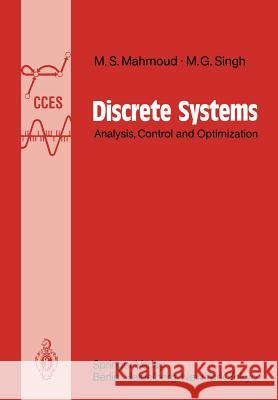
Discrete Systems: Analysis, Control and Optimization Mahmoud, Magdi S. 9783642823299 Springer - książkaWidoczna okładka, to zdjęcie poglądowe, a rzeczywista szata graficzna może różnić się od prezentowanej.

Discrete Systems: Analysis, Control and Optimization

ISBN-13: 9783642823299 / Angielski / Miękka / 2011 / 670 str.

M. S. Mahmoud; M. G. Singh
cena 403,47 zł
(netto: 384,26 VAT:  5%)

Najniższa cena z 30 dni: 385,52 zł
Termin realizacji zamówienia:
ok. 22 dni roboczych
Bez gwarancji dostawy przed świętami

Darmowa dostawa!

More and more digital devices are being used for informa tion processing and control purposes in a variety of systems applications, including industrial processes, power networks, biological systems and communication networks. This trend has been helped by the advent of microprocessors and the consequent availability of cheap distributed computing power. For those applications, where digital devices are used, it is reasonable to model the system in discrete-time. In addition there are other application areas, e.g. econometric systems, business systems, certain command and control systems, environmental systems, where the underlying models are in discrete-time and here discrete-time approaches to analysis and control are the most appropriate. In order to deal with these two situations, there has been a lot of interest in developing techLiques which allow us to do analysis, design and control of discrete-time systems. This book provides a comprehensive treatment of discrete time dynamical systems. It covers the topics of modelling, optimization techniques and control design. The book is designed to serve as a text for teaching at the first year graduate level. The material included is organized into eight chapters.


Kategorie:
Technologie
Kategorie BISAC:
Technology & Engineering > Electrical
Technology & Engineering > Robotics
Computers > Hardware - Personal Computers - General
Wydawca:
Springer
Seria wydawnicza:
Communications and Control Engineering (Paperback)
Język:
Angielski
ISBN-13:
9783642823299
Rok wydania:
2011
Wydanie:
Softcover Repri
Numer serii:
000383647
Ilość stron:
670
Waga:
1.17 kg
Wymiary:
24.4 x 17.0
Oprawa:
Miękka
Wolumenów:
01

1 Discrete Models in Systems Engineering.- 1.1 Introduction.- 1.2 Some Illustrative Examples.- 1.2.1 Direct Digital Control of a Thermal Process.- 1.2.2 An Inventory Holding Problem.- 1.2.3 Measurement and Control of Liquid Level.- 1.2.4 An Aggregate National Econometric Model.- 1.3 Objectives and Outline of the Book.- 1.4 References.- 2 Representation of Discrete Control Systems.- 2.1 Introduction.- 2.2 Transfer Functions.- 2.2.1 Review of Z-Transforms.- 2.2.2 Effect of Pole Locations.- 2.2.3 Stability Analysis.- 2.2.4 Simplification by Continued-Fraction Expansions.- 2.2.5 Examples.- 2.3 Difference Equations.- 2.3.1 The Nature of Solutions.- 2.3.2 The Free Response.- 2.3.3 The Forced Response.- 2.3.4 Examples.- 2.3.5 Relationship to Transfer Functions.- 2.4. Discrete State Equations.- 2.4.1 Introduction.- 2.4.2 Obtaining the State Equations.- A. From Difference Equations.- B. From Transfer Functions.- 2.4.3 Solution Procedure.- 2.4.4 Examples.- 2.5 Modal Decomposition.- 2.5.1 Eigen-Structure.- 2.5.2 System Modes.- 2.5.3 Some Important Properties.- 2.5.4 Examples.- 2.6 Concluding Remarks.- 2.7 Problems.- 2.8 References.- 3 Structural Properties.- 3.1 Introduction.- 3.2 Controllability.- 3.2.1 Basic Definitions.- 3.2.2 Mode-Controllability Structure.- 3.2.3 Modal Analysis of State-Reachability.- 3.2.4 Some Geometrical Aspects.- 3.2.5 Examples.- 3.3 Observability.- 3.3.1 Basic Definitions.- 3.3.2 Principle of Duality.- 3.3.3 Mode-Observability Structure.- 3.3.4 Concept of Detectability.- 3.3.5 Examples.- 3.4. Stability.- 3.4.1 Introduction.- 3.4.2 Definitions of Stability.- 3.4.3 Linear System Stability.- 3.4.4 Lyapunov Analysis.- 3.4.5 Solution and Properties of the Lyapunov Equation.- 3.4.6 Examples.- 3.5 Remarks.- 3.6 Problems.- 3.7 References.- 4 Design of Feedback Systems.- 4.1 Introduction.- 4.2 The Concept of Linear Feedback.- 4.2.1 State Feedback.- 4.2.2 Output Feedback.- 4.2.3 Computational Algorithms.- 4.2.4 Eigen-Structure Assignment.- 4.2.5 Remarks.- 4.2.6 Example.- 4.3 Deadbeat Controllers.- 4.3.1 Preliminaries.- 4.3.2 The Multi-Input Deadbeat Controller.- 4.3.3 Basic Properties.- 4.3.4 Other Approaches.- 4.3.5 Examples.- 4.4 Development of Reduced-Order Models.- 4.4.1 Analysis.- 4.4.2 Two Simplification Schemes.- 4.4.3 Output Modelling Approach.- 4.4.4 Control Design.- 4.4.5 Examples.- 4.5 Control Systems with Slow and Fast Modes.- 4.5.1 Time-Separation Property.- 4.5.2 Fast and Slow Subsystems.- 4.5.3 A Frequency Domain Interpretation.- 4.5.4 Two-Stage Control Design.- 4.5.5 Examples.- 4.6 Concluding Remarks.- 4.7 Problems.- 4.8 References.- 5 Control of Systems with Inaccessible States.- 5.1 Introduction.- 5.2 State Reconstruction Schemes.- 5.2.1 Full-Order State Reconstructors.- 5.2.2 Reduced-Order State Reconstructors.- 5.2.3 Discussion.- 5.2.4 Deadbeat State Reconstructors.- 5.2.5 Examples.- 5.3 Observer-Based Controllers.- 5.3.1 Structure of Closed-Loop Systems.- 5.3.2 The Separation Principle.- 5.3.3 Deadbeat Type Controllers.- 5.3.4 Example.- 5.4 Two-Level Observation Structures.- 5.4.1 Full-Order Local State Reconstructors.- 5.4.2 Modifications to Ensure Overall Asymptotic Reconstruction.- 5.4.3 Examples.- 5.5 Discrete Two-Time-Scale Systems.- 5.5.1 Introduction.- 5.5.2 Two-Stage Observer Design.- 5.5.3 Dynamic State Feedback Control.- 5.5.4 Example.- 5.6 Concluding Remarks.- 5.7 Problems.- 5.8 References.- 6 State and Parameter Estimation.- 6.1 Introduction.- 6.2 Random Variables and Gauss-Markov Processes.- 6.2.1 Basic Concepts of Probability Theory.- 6.2.2 Mathematical Properties of Random Variables.- A. Distribution Functions.- B. Mathematical Expectation.- C. Two Random Variables.- 6.2.3 Stochastic Processes.- A. Definitions and Properties.- B. Gauss and Markov Processes.- 6.3 Linear Discrete Models with Random Inputs.- 6.3.1 Model Description.- 6.3.2 Some Useful Properties.- 6.3.3 Propagation of Means and Covariances.- 6.3.4 Examples.- 6.4 The Kalman Filter.- 6.4.1 The Estimation Problem.- A. The Filtering Problem.- B. The Smoothing Problem.- C. The Prediction Problem.- 6.4.2 Principal Methods of Obtaining Estimates.- A. Minimum Variance Estimate.- B. Maximum Likelihood Estimate.- C. Maximum A Posteriori Estimate.- 6.4.3 Development of the Kalman Filter Equations.- A. The Optimal Filtering Problem.- B. Solution Procedure.- C. Some Important Properties.- 6.4.4 Examples.- 6.5 Decentralised Computation of the Kalman Fikter.- 6.5.1 Linear Interconnected Dynamical Systems.- 6.5.2 The Basis of the Decentralised Filter Structure.- 6.5.3 The Recursive Equations of the Filter.- 6.5.4 A Computation Comparison.- 6.5.5 Example.- 6.6 Parameter Estimation.- 6.6.1 Least Squares Estimation.- A. Linear Static Models.- B. Standard Least Squares Method and Properties.- C. Application to Parameter Estimation of Dynamic Models.- D. Recursive Least Squares.- E. The Generalised Least Squares Method.- 6.6.2 Two-Level Computational Algorithms.- A. Linear Static Models.- B. A Two-Level Multiple Projection Algorithm.- C. The Recursive Version.- D. Linear Dynamical Models.- E. The Maximum A Posteriori Approach.- F. A Two-Level Structure.- 6.6.3 Examples.- 6.7 Problems.- 6.8 References.- 7 Adaptive Control Systems.- 7.1 Introduction.- 7.2 Basic Concepts of Model Reference Adaptive Systems.- 7.2.1 The Reference Model.- 7.2.2 The Adaptation Mechanism.- 7.2.3 Notations and Some Definitions.- 7.2.4 Design Considerations.- 7.3 Design Techniques.- 7.3.1 Techniques Based on Lyapunov Analysis.- 7.3.2 Techniques Based on Hyperstability and Positivity Concepts.- A. Popov Inequality and Related Results.- B. Systematic Procedure.- C. Parametric Adaptation Schemes.- D. Adaptive Model-Following Schemes.- 7.3.3 Examples.- 7.4 Self-Tuning Regulators.- 7.4.1 Introduction.- 7.4.2 Description of the System.- 7.4.3 Parameter Estimators.- A. The Least Squares Method.- B. The Extended Least Squares Method.- 7.4.4 Control Strategies.- A. Controllers Based on Linear Quadratic Theory.- B. Controllers Based on Minimum Variance Criteria.- 7.4.5 Other Approaches.- A. Pole/Zero Placement Approach.- B. Implicit Identification Approach.- C. State Space Approach.- D. Multivariable Approach.- 7.4.6 Discussion.- 7.4.7 Examples.- 7.5 Concluding Remarks.- 7.6 Problems.- 7.7 References.- 8 Dynamic Optimisation.- 8.1 Introduction.- 8.2 The Dynamic Optimisation Problem.- 8.2.1 Formulation of the Problem.- 8.2.2 Conditions of Optimality.- 8.2.3 The Optimal Return Function.- 8.3 Linear-Quadratic Discrete Regulators.- 8.3.1 Derivation of the Optimal Sequences.- 8.3.2 Steady-State Solution.- 8.3.3 Asymptotic Properties of Optimal Control.- 8.4 Numerical Algorithms for the Discrete Riccati Equation.- 8.4.1 Successive Approximation Methods.- 8.4.2 Hamiltonian Methods.- 8.4.3 Discussion.- 8.4.4 Examples.- 8.5 Hierarchical Optimization Methodology.- 8.5.1 Problem Decomposition.- 8.5.2 Open-Loop Computation Structures.- A. The Goal Coordination Method.- B. The Method of Tamura.- C. The Interaction Prediction Method.- 8.5.3 Closed-Loop Control Structures.- 8.5.4 Examples.- 8.6 Decomposition-Decentralisation Approach.- 8.6.1 Statement of the Problem.- 8.6.2 The Decoupled Subsystems.- 8.6.3 Multi-Controller Structure.- 8.6.4 Examples.- 8.7 Concluding Remarks.- 8.8 Problems.- 8.9 References.


Udostępnij

Facebook - konto krainaksiazek.pl


Opinie o Krainaksiazek.pl na Opineo.pl

Partner Mybenefit

Krainaksiazek.pl w programie rzetelna firma Krainaksiaze.pl - płatności przez paypal

Czytaj nas na:

Facebook - krainaksiazek.pl
  • książki na zamówienie
  • granty
  • książka na prezent
  • kontakt
  • pomoc
  • opinie
  • regulamin
  • polityka prywatności

Zobacz:

  • Księgarnia czeska

  • Wydawnictwo Książkowe Klimaty

1997-2025 DolnySlask.com Agencja Internetowa

© 1997-2022 krainaksiazek.pl
     
KONTAKT | REGULAMIN | POLITYKA PRYWATNOŚCI | USTAWIENIA PRYWATNOŚCI
Zobacz: Księgarnia Czeska | Wydawnictwo Książkowe Klimaty | Mapa strony | Lista autorów
KrainaKsiazek.PL - Księgarnia Internetowa

Polityka prywatnosci - link
Krainaksiazek.pl - płatnośc Przelewy24
Przechowalnia Przechowalnia





