Democracy and Decency: What Does Education Have to Do With It? (HC) » książka





Democracy and Decency: What Does Education Have to Do With It? (HC)
ISBN-13: 9781681233253 / Angielski / Twarda / 2016 / 352 str.
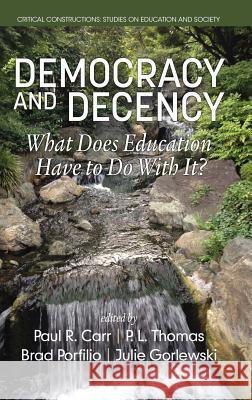
A volume in Critical Constructions: Studies on Education and Society Series Editors: Curry Stephenson Malott, West Chester University of Pennsylvania; Brad J. Porfilio, California State University, East Bay; Marc Pruyn, Monash University; and Derek R. Ford, Syracuse University Democracy can mean a range of concepts, covering everything from freedoms, rights, elections, governments, processes, philosophies and a panoply of abstract and concrete notions that can be mediated by power, positionality, culture, time and space. Democracy can also be translated into brute force, hegemony, docility, compliance and conformity, as in wars will be decided on the basis of the needs of elites, or major decisions about spending finite resources will be the domain of the few over the masses, or people will be divided along the lines of race, ethnicity, class, religion, etc. because it is advantageous for maintaining exploitative political systems in place to do so. Often, these frameworks are developed and reified based on the notion that elections give the right to societies, or segments of societies, to install regimes, institutions and operating systems that are then supposedly legitimated and rendered infinitely just because formal power resides in the hands of those dominating forces. This book is interested in advancing a critical analysis of the hegemonic paradigm described above, one that seeks higher levels of political literacy and consciousness, and one that makes the connection with education. What does education have to do with democracy? How does education shape, influence, impinge on, impact, negate, facilitate and/or change the context, contours and realities of democracy? How can we teach for and about democracy to alter and transform the essence of what democracy is, and, importantly, what it should be? This book advances the notion of decency in relation to democracy, and is underpinned by an analysis of meaningful, critically-engaged education. Is it enough to be kind, nice, generous and hopeful when we can also see signs of rampant, entrenched and debilitating racism, sexism, poverty, violence, injustice, war and other social inequalities? If democracy is intended to be a legitimating force for good, how does education inform democracy? What types of knowledge, experience, analysis and being are helpful to bring about newer, more meaningful and socially just forms of democracy? Throughout some twenty chapters from a range of international scholars, this book includes three sections: Constructing Meanings for Democracy and Decency; Justice for All as Praxis; and Social Justice in Action for Democracy, Decency, and Diversity: International Perspectives. The underlying thread that is interwoven through the texts is a critical reappraisal of normative, hegemonic interpretations of how power is infused into the educational realm, and, importantly, how democracy can be re-situated and re-formulated so as to more meaningfully engage society and education.
A volume in Critical Constructions: Studies on Education and SocietySeries Editors: Curry Stephenson Malott, West Chester University of Pennsylvania; Brad J. Porfilio, California State University, East Bay; Marc Pruyn, Monash University; and Derek R. Ford, Syracuse University Democracy can mean a range of concepts, covering everything from freedoms, rights, elections, governments, processes, philosophies and a panoply of abstract and concrete notions that can be mediated by power, positionality, culture, time and space. Democracy can also be translated into brute force, hegemony, docility, compliance and conformity, as in wars will be decided on the basis of the needs of elites, or major decisions about spending finite resources will be the domain of the few over the masses, or people will be divided along the lines of race, ethnicity, class, religion, etc. because it is advantageous for maintaining exploitative political systems in place to do so. Often, these frameworks are developed and reified based on the notion that elections give the right to societies, or segments of societies, to install regimes, institutions and operating systems that are then supposedly legitimated and rendered infinitely just because formal power resides in the hands of those dominating forces.This book is interested in advancing a critical analysis of the hegemonic paradigm described above, one that seeks higher levels of political literacy and consciousness, and one that makes the connection with education. What does education have to do with democracy? How does education shape, influence, impinge on, impact, negate, facilitate and/or change the context, contours and realities of democracy? How can we teach for and about democracy to alter and transform the essence of what democracy is, and, importantly, what it should be?This book advances the notion of decency in relation to democracy, and is underpinned by an analysis of meaningful, critically-engaged education. Is it enough to be kind, nice, generous and hopeful when we can also see signs of rampant, entrenched and debilitating racism, sexism, poverty, violence, injustice, war and other social inequalities? If democracy is intended to be a legitimating force for good, how does education inform democracy? What types of knowledge, experience, analysis and being are helpful to bring about newer, more meaningful and socially just forms of democracy?Throughout some twenty chapters from a range of international scholars, this book includes three sections: Constructing Meanings for Democracy and Decency; Justice for All as Praxis; and Social Justice in Action for Democracy, Decency, and Diversity: International Perspectives. The underlying thread that is interwoven through the texts is a critical reappraisal of normative, hegemonic interpretations of how power is infused into the educational realm, and, importantly, how democracy can be re-situated and re-formulated so as to more meaningfully engage society and education.




Czytaj nas na:
KrainaKsiazek.PL - Księgarnia Internetowa


