• Wyszukiwanie zaawansowane
  • Kategorie
  • Kategorie BISAC
  • Książki na zamówienie
  • Promocje
  • Granty
  • Książka na prezent
  • Opinie
  • Pomoc
  • Załóż konto
  • Zaloguj się

Data Ethics Management: Emerging Models for the Governance of Advanced Analytics and AI » książka


zaloguj się | załóż konto
Logo Krainaksiazek.pl

koszyk

konto

szukaj
topmenu
Księgarnia internetowa
Szukaj
Książki na zamówienie
Promocje
Granty
Książka na prezent
Moje konto
Pomoc
 
 
Wyszukiwanie zaawansowane
Pusty koszyk
Bezpłatna dostawa dla zamówień powyżej 20 złBezpłatna dostawa dla zamówień powyżej 20 zł

Kategorie główne

• Nauka
 [2948695]
• Literatura piękna
 [1824038]

  więcej...
• Turystyka
 [70868]
• Informatyka
 [151073]
• Komiksy
 [35227]
• Encyklopedie
 [23181]
• Dziecięca
 [621575]
• Hobby
 [138961]
• AudioBooki
 [1642]
• Literatura faktu
 [228651]
• Muzyka CD
 [371]
• Słowniki
 [2933]
• Inne
 [445341]
• Kalendarze
 [1243]
• Podręczniki
 [164416]
• Poradniki
 [479493]
• Religia
 [510449]
• Czasopisma
 [502]
• Sport
 [61384]
• Sztuka
 [243086]
• CD, DVD, Video
 [3417]
• Technologie
 [219673]
• Zdrowie
 [100865]
• Książkowe Klimaty
 [124]
• Zabawki
 [2168]
• Puzzle, gry
 [3372]
• Literatura w języku ukraińskim
 [260]
• Art. papiernicze i szkolne
 [7838]
Kategorie szczegółowe BISAC

Data Ethics Management: Emerging Models for the Governance of Advanced Analytics and AI

ISBN-13: 9783031214905 / Angielski
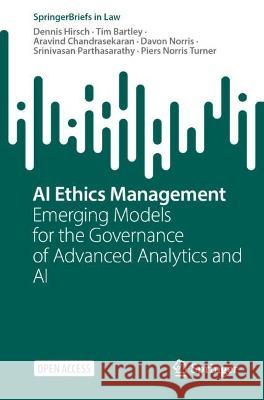
Dennis Hirsch; Tim Bartley; Aravind Chandrasekaran
Data Ethics Management: Emerging Models for the Governance of Advanced Analytics and AI Dennis Hirsch Tim Bartley Aravind Chandrasekaran 9783031214905 Springer - książkaWidoczna okładka, to zdjęcie poglądowe, a rzeczywista szata graficzna może różnić się od prezentowanej.

Data Ethics Management: Emerging Models for the Governance of Advanced Analytics and AI

ISBN-13: 9783031214905 / Angielski

Dennis Hirsch; Tim Bartley; Aravind Chandrasekaran
cena 120,45
(netto: 114,71 VAT:  5%)

Najniższa cena z 30 dni: 115,63
Termin realizacji zamówienia:
ok. 22 dni roboczych.

Darmowa dostawa!

This open access book explains why, in today's economy, companies need to implement artificial intelligence (AI) in a responsible and ethical way and how they can go about doing so. Business use of AI can produce tremendous insights and benefits. But it can also invade privacy, perpetuate bias, and produce other harms that injure people and damage business reputation.The authors interviewed and surveyed AI ethics managers at leading companies. They asked why these experts see AI ethics as important, and how they seek to achieve it. This book conveys the results of that research on a concise, accessible way that readers should be able to apply to their own organizations.Much of the existing writing on AI ethics focuses either on macro-level AI ethics principles, or on micro-level product design and tooling. The interviews showed that companies need a third component: AI ethics management. This third component consists of the management structures, processes, training and substantive benchmarks that companies use to operationalize their high-level AI ethics principles and to guide and hold accountable their developers.  AI ethics management is the connective tissue that makes AI ethics principles real. It is the focus of this book.This book provides a “snapshot” of AI ethics management at an array of highly sophisticated, AI-enabled companies. Other organizations, at an earlier stage in their AI journeys, should be able to draw from it useful lessons on how they, too, can pursue ethical and responsible AI and so succeed in the AI-driven economy.


This open access book explains why, in today's economy, companies need to implement artificial intelligence (AI) in a responsible and ethical way and how they can go about doing so. Business use of AI can produce tremendous insights and benefits. But it can also invade privacy, perpetuate bias, and produce other harms that injure people and damage business reputation.The authors interviewed and surveyed AI ethics managers at leading companies. They asked why these experts see AI ethics as important, and how they seek to achieve it. This book conveys the results of that research on a concise, accessible way that readers should be able to apply to their own organizations.Much of the existing writing on AI ethics focuses either on macro-level AI ethics principles, or on micro-level product design and tooling. The interviews showed that companies need a third component: AI ethics management. This third component consists of the management structures, processes, training and substantive benchmarks that companies use to operationalize their high-level AI ethics principles and to guide and hold accountable their developers.  AI ethics management is the connective tissue that makes AI ethics principles real. It is the focus of this book.This book provides a “snapshot” of AI ethics management at an array of highly sophisticated, AI-enabled companies. Other organizations, at an earlier stage in their AI journeys, should be able to draw from it useful lessons on how they, too, can pursue ethical and responsible AI and so succeed in the AI-driven economy.



Kategorie:
Nauka, Prawo i administracja
Kategorie BISAC:
Law > International
Computers > Artificial Intelligence - General
Business & Economics > Etyka w biznesie i odpowiedzialność społeczna
Wydawca:
Springer
Seria wydawnicza:
Springerbriefs in Law
Język:
Angielski
ISBN-13:
9783031214905

1. What is AI Ethics Management and Why Does it Matter?.- 2. AI Can Injure People and Damage Business Reputation.- 3. Why Companies Pursue AI Ethics Management.- 4. How to Draw Substantive Lines Between Ethical, and Unethical, Uses of AI.- 5. Management Structures and Processes for Achieving Responsible and Ethical AI.- 6. The Next Stage: AI for the Social Good.- 7. Conclusion.

Dennis Hirsch is Professor of Law and of Computer Science at The Ohio State University where he also serves as Director of the Program on Data and Governance and as a core faculty member of the Translational Data Analytics Institute (TDAI). His research and teaching, and the program that he directs, focus on the law, policy, ethics, and management of advanced analytics and AI. The author of numerous articles and an award-winning book, Professor Hirsch is the co-editor of the SSRN eJournal on Artificial Intelligence – Law, Policy, and Ethics, the founding Chair of TDAI’s Responsible Data Science Community of Practice, the founder of the Ohio Data Ethics Working Group, and a member of the Advisory Board for the International Association of Privacy Professionals’ (IAPP) AI Governance Center. In 2010, he served as a Fulbright Senior Professor at the University of Amsterdam where he studied Dutch privacy regulation. He received his J.D. from Yale Law School.

Tim Bartley is a Professor in the Earth Commons Institute and Department of Sociology at Georgetown University. He previously held positions at Washington University in St. Louis, Stockholm University, Ohio State University, and Indiana University. He is an organizational, political, and economic sociologist, whose research focuses largely on private forms of regulation and questions of fairness and sustainability in global industries. His previous work includes the book Rules without Rights: Land, Labor, and Private Authority in the Global Economy (Oxford University Press, 2018) and articles such as “Global Markets, Corporate Assurances, and the Legitimacy of State Intervention” (American Sociological Review, 2022), “Transnational Corporations and Global Governance” (Annual Review of Sociology, 2018), “Shaming the Corporation” (American Sociological Review, 2014), and “The Digital Surveillance Society” (Contemporary Sociology, 2019). He received his PhD from the University of Arizona and has been lucky to spend time as a visiting scholar at the University of Konstanz, University of St. Gallen, Max Planck Institute for the Study of Societies, MIT, Princeton, and Sun Yat-sen University.

Aravind Chandrasekaran (AC) is the Fisher Distinguished Professor in Operations and Business Analytics at the Fisher College of Business, The Ohio State University. He received his PhD in Operations and Management Sciences from the University of Minnesota. Dr. Chandrasekaran’s research investigates innovation, learning and knowledge creation issues in a variety of industries including high-tech R&D, manufacturing and health-care. His research has been published in all top OM journals. Dr. Chandrasekaran currently serves as the Associate Dean for Graduate Programs and Executive Education at the Fisher College of Business. He oversees all the graduate programs including Full-time MBA, Working Professional MBA, Specialized Master’s as well as executive master’s programs including EMBA, the Master of Business in Operational Excellence (MBOE) and non-degree executive education. He has developed several custom teaching and research programs for organizations such as Tata Consultancy Services (TCS), Ford Motor Company and Zimmer. He has won several teaching awards including the 2016 & 2012 Best Outstanding Core Professor Award (WPMBA), as well as the 2013 Pace Setter Award for Teaching Excellence.

Davon Norris, Assistant Professor of Organizational Studies at the University of Michigan, is an economic sociologist who tries to understand how our tools for determining what is valuable, worthwhile, or good are implicated in patterns of inequality with an acute concern for racial inequality. Generally, this empirically manifests in work that studies credit, debt, and finance. However, he more specifically investigates the functioning and consequences of a range of scores or ratings, from state and municipal government credit ratings to algorithmic consumer credit scores. By centering questions of valuation, his research speaks across an array of disciplines and brings into relief normative questions about the nature and possibility of ameliorating (racial) inequality and nurturing economic justice in the contemporary United States. His research has been published in outlets such as Social Forces, Socio-Economic Review, Social Problems, and Sociological Forum, and has received awards from the Future of Privacy Forum and American Sociological Association. He is a three-time Buckeye receiving his BS in Accounting (2014), his MA in Sociology (2018), and his PhD (2022) in Sociology all from THE Ohio State University.

Srinivasan Parthasarathy received his PhD in Computer Science from the University of Rochester, New York, USA. He is a Professor in the Computer Science and Engineering Department at the Ohio State University (OSU). He directs the data mining research laboratory at OSU and co-directs the university-wide undergraduate program in Data analytics as well as the Community of Practice in Responsible Data Science. His research interests are broadly in the areas of Data Mining Machine Learning, Databases, and Bioinformatics. He is a recipient of an Ameritech Faculty fellowship in 2001, an NSF CAREER award in 2003, a DOE Early Career Award in 2004, and multiple grants or fellowships from IBM, Google and Microsoft. His papers have received fifteen best paper awards or similar honors (best of conference selection) and many of his works have transitioned to practice, ranging from commercial implementations to widespread use in clinical practice for disease diagnosis. He is a frequent distinguished and keynote speaker at various conferences and recently completed his final term as chair (elected) of the steering committee for the SIAM data mining conference series. He is a fellow of the Institute of Electrical and Electronics Engineers (IEEE) for contributions to high performance data mining and network science, a fellow of the Asia-Pacific AI Association for contributions to scalable data mining and graph representation learning and a Distinguished Fellow at the Robert Bosch Center of Data Science and AI for his work in data science and AI.

Piers Norris Turner is Associate Professor of Philosophy and Director of the Center for Ethics and Human Values at Ohio State University. His research on utilitarianism and liberal political thought, especially in the moral and political philosophy of John Stuart Mill, has appeared in leading journals including Ethics, Utilitas, and the Journal of the History of Philosophy. He has co-edited Public Reason in Political Philosophy: Classic Sources and Contemporary Commentaries (Routledge) and a collection of unpublished writings by Karl Popper called After The Open Society (Routledge). Currently he is working on a manuscript entitled Mill’s Ethics (CUP).


Udostępnij

Facebook - konto krainaksiazek.pl


Opinie o Krainaksiazek.pl na Opineo.pl

Partner Mybenefit

Krainaksiazek.pl w programie rzetelna firma Krainaksiaze.pl - płatności przez paypal

Czytaj nas na:

Facebook - krainaksiazek.pl
  • książki na zamówienie
  • granty
  • książka na prezent
  • kontakt
  • pomoc
  • opinie
  • regulamin
  • polityka prywatności

Zobacz:

  • Księgarnia czeska

  • Wydawnictwo Książkowe Klimaty

1997-2026 DolnySlask.com Agencja Internetowa

© 1997-2022 krainaksiazek.pl
     
KONTAKT | REGULAMIN | POLITYKA PRYWATNOŚCI | USTAWIENIA PRYWATNOŚCI
Zobacz: Księgarnia Czeska | Wydawnictwo Książkowe Klimaty | Mapa strony | Lista autorów
KrainaKsiazek.PL - Księgarnia Internetowa

Polityka prywatnosci - link
Krainaksiazek.pl - płatnośc Przelewy24
Przechowalnia Przechowalnia




