• Wyszukiwanie zaawansowane
  • Kategorie
  • Kategorie BISAC
  • Książki na zamówienie
  • Promocje
  • Granty
  • Książka na prezent
  • Opinie
  • Pomoc
  • Załóż konto
  • Zaloguj się

Cytochromes C: Evolutionary, Structural and Physicochemical Aspects » książka


zaloguj się | załóż konto
Logo Krainaksiazek.pl

koszyk

konto

szukaj
topmenu
Księgarnia internetowa
Szukaj
Książki na zamówienie
Promocje
Granty
Książka na prezent
Moje konto
Pomoc
 
 
Wyszukiwanie zaawansowane
Pusty koszyk
Bezpłatna dostawa dla zamówień powyżej 20 złBezpłatna dostawa dla zamówień powyżej 20 zł

Kategorie główne

• Nauka
 [2946912]
• Literatura piękna
 [1852311]

  więcej...
• Turystyka
 [71421]
• Informatyka
 [150889]
• Komiksy
 [35717]
• Encyklopedie
 [23177]
• Dziecięca
 [617324]
• Hobby
 [138808]
• AudioBooki
 [1671]
• Literatura faktu
 [228371]
• Muzyka CD
 [400]
• Słowniki
 [2841]
• Inne
 [445428]
• Kalendarze
 [1545]
• Podręczniki
 [166819]
• Poradniki
 [480180]
• Religia
 [510412]
• Czasopisma
 [525]
• Sport
 [61271]
• Sztuka
 [242929]
• CD, DVD, Video
 [3371]
• Technologie
 [219258]
• Zdrowie
 [100961]
• Książkowe Klimaty
 [124]
• Zabawki
 [2341]
• Puzzle, gry
 [3766]
• Literatura w języku ukraińskim
 [255]
• Art. papiernicze i szkolne
 [7810]
Kategorie szczegółowe BISAC

Cytochromes C: Evolutionary, Structural and Physicochemical Aspects

ISBN-13: 9783642745386 / Angielski / Miękka / 2011 / 478 str.
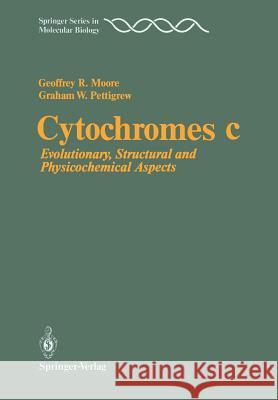
Geoffrey R. Moore; Graham W. Pettigrew
Cytochromes C: Evolutionary, Structural and Physicochemical Aspects Moore, Geoffrey R. 9783642745386 Springer - książkaWidoczna okładka, to zdjęcie poglądowe, a rzeczywista szata graficzna może różnić się od prezentowanej.

Cytochromes C: Evolutionary, Structural and Physicochemical Aspects

ISBN-13: 9783642745386 / Angielski / Miękka / 2011 / 478 str.

Geoffrey R. Moore; Graham W. Pettigrew
cena 403,47
(netto: 384,26 VAT:  5%)

Najniższa cena z 30 dni: 385,52
Termin realizacji zamówienia:
ok. 22 dni roboczych
Bez gwarancji dostawy przed świętami

Darmowa dostawa!

Cytochromes c are haemoproteins which carry out electron transfer in a wide variety of biological systems, necessitating different kinds of cytochrome c to fulfill different biological roles. The evolutionary relationship between cytochromes c and their host organisms are described, as well as their structural, spectroscopic and redox properties, including both electron-transfer rates and redox potentials. The treatment is aimed at the non-specialist so that both the techniques described and their application to cytochromes c can be understood. All classes of cytochrome c are dealt with to provide a comprehensive account of the field. No other text provides such a broad survey. Similar to the earlier volume "Cytochromes c: Biological Aspects" which deals with the classification, biosynthesis and biological role of cytochromes c, the present book is aimed at research workers and advanced students.


Kategorie:
Nauka, Biologia i przyroda
Kategorie BISAC:
Science > Biochemia
Science > Biologia i przyroda
Science > Biologia molekularna
Wydawca:
Springer
Seria wydawnicza:
Springer Series in Molecular and Cell Biology
Język:
Angielski
ISBN-13:
9783642745386
Rok wydania:
2011
Wydanie:
Softcover Repri
Numer serii:
000402050
Ilość stron:
478
Waga:
0.85 kg
Wymiary:
24.2 x 17.0
Oprawa:
Miękka
Wolumenów:
01

1 Stereochemical and Physicochemical Properties of Hernes.- 1.1 Introduction.- 1.2 Electronic Structure of Iron.- 1.3 Stereochemistry of Metalloporphyrins.- 1.4 Properties of Ligands.- 1.5 Metal-free and Metal-substituted Cytochrome c.- 2 Spectroscopic Studies of Cytochromes.- 2.1 Introduction.- 2.2 Spectroscopic Methods.- 2.2.1 General Aspects of Spectroscopy.- 2.2.2 Spectroscopic Parameters.- 2.2.3 Magnetic Resonance Spectroscopies.- 2.2.3.1NMR Spectroscopy.- 2.2.3.2EPR Spectroscopy.- 2.2.4 Vibrational Spectroscopies.- 2.2.5 Electronic Spectroscopies.- 2.2.5.1 CD Spectroscopy.- 2.2.5.2MCD Spectroscopy.- 2.2.5.3Fluorescence and Phosphorescence Spectroscopies.- 2.2.6 Mössbauer Spectroscopy.- 2.2.7 X-Ray Absorption Spectroscopy.- 2.2.8 The Problems of Assignment and Interpretation.- 2.2.9 Spectroscopic Studies and the Variation of Temperature.- 2.3 Selected Applications of Spectroscopy to Cytochromes c.- 2.3.1 The Type of Heme, its Oxidation State and its Spin-State.- 2.3.1.1 Optical Spectra of Cytochromes.- 2.3.1.2The Spin-State of Iron.- 2.3.1.3The Oxidation State of Iron.- 2.3.2 The Identity and Stereochemistry of Axial Ligands.- 2.3.2.1Histidine-Methionine Axial Ligation.- 2.3.2.2 The EPR-MCD Approach to Identifying Axial Ligands.- 2.3.2.3Axial Ligation of Cytochrome f and Cytochrome c1.- 2.3.2.4The Alkaline Isomer of Mitochondrial Cytochrome c.- 2.3.2.5 Axial Ligation of Cytochromes c?.- 2.3.3 The Protein Structure.- 2.3.3.1Determination of Protein Tertiary Structure.- 2.3.3.2Dynamic Aspects of Protein Structure.- 2.3.3.3Interprotein Complexes.- 2.3.3.4Group Ionisation Constants.- 3 Amino Acid Sequences of Cytochromes c.- 3.1 Introduction.- 3.2 Amino Acid Sequences of Mitochondrial Cytochromes c.- 3.3 Amino Acid Sequences of Cytochromes c1 and Cytochromes f.- 3.4 Amino Acid Sequences of Cytochromes c2.- 3.5 Amino Acid Sequences of Cytochromes c3.- 3.6 Amino Acid Sequences of Cytochromes c4.- 3.7 Amino Acid Sequences of Cytochromes c5.- 3.8 Amino Acid Sequences of Cytochromes c-555.- 3.9 Amino Acid Sequences of Cytochromes c6 (algal cytochrome ‘c-553’).- 3.10 Amino Acid Sequences of Cytochromes c-551 (Cytochromes c7).- 3.11 Amino Acid Sequences of Class II Cytochromes c (Cytochromes c8).- 3.12 Cytochrome c Peroxidase.- 3.13 The Reaction Centre Cytochrome from Rhodopseudomonas viridis.- 3.14 Amino Acid Sequences of Cytochromes c Which Do Not Fall Into the Established Sequence Classes.- 4 The Structures of Class I Cytochromes c.- 4.1 Introduction.- 4.2 General Features of the Structure of Mitochondrial Cytochrome c.- 4.2.1 A General Mitochondrial Cytochrome c Structure.- 4.2.2 The Polypeptide Fold and Internal Structure.- 4.2.3 The Protein Surface.- 4.3 The Cytochrome Fold and Bacterial Class I Cytochromes.- 4.3.1 A General Class I Cytochrome c Structure.- 4.3.2 The Polypeptide Fold and Internal Structure.- 4.3.3 Protein Surfaces.- 4.3.4 Two Domain Cytochrome c4.- 4.3.5 Dimeric Cytochrome c5.- 4.3.6 Class I Cytochrome c as Part of Larger Proteins.- 4.4 pH Dependent Transitions of Cytochromes c.- 4.4.1 pH Dependent States of Cytochrome c.- 4.4.2 Ionisation of Herne Propionates.- 4.4.3 Side Chain Ionisation Constants.- 4.4.4 The Alkaline Transition of Ferricytochrome c.- 4.5 Differences in Conformation and Dynamics between Reduced and Oxidised Cytochrome c.- 4.5.1 Differences in Properties of the Two Redox States.- 4.5.2 Conformational Differences between the Two Redox States.- 4.5.3 Conformational Differences between Site-Directed Mutants of 5. cerevisiae iso-1 Cytochrome c.- 4.5.4 Dynamic Fluctuations in the Cytochrome c Structure.- 4.5.5 The Physiological Relevance of Conformational Transitions in Cytochrome c.- 4.6 Structural and Functional Effects of Chemical Modifications on Mitochondrial Cytochrome c.- 4.6.1 General Aspects of Chemical Modifications.- 4.6.2 Modification of the Herne.- 4.6.3 Modifications of the Main Chain.- 4.6.4 Modifications of Aromatic Amino Acids.- 4.6.5 Modifications of Aliphatic Amino Acids.- 5 The Structures of Class II, Class III and Class IV Cytochromes c.- 5.1 Introduction.- 5.2 Class II Cytochromes c.- 5.2.1 Introduction.- 5.2.2 Cytochromes c?.- 5.2.3 Structure of Cytochrome c?.- 5.2.4 Class IIb Cytochromes c.- 5.3 Class III Cytochromes c.- 5.3.1 Introduction.- 5.3.2 Cytochromes c3(4 heme).- 5.3.3 Cytochrome c3(3 heme).- 5.4 Class IV Cytochromes c.- 5.4.1 Introduction.- 5.4.2 Rps. viridis PRC Cytochrome c.- 5.4.3 Chr. vinosum PRC Cytochrome c.- 6 Evolution.- 6.1 Introduction.- 6.2 Aspects of Taxonomy.- 6.3 The Construction of Phylogenetic Trees.- 6.4 The Problems and Successes of Molecular Phylogeny.- 6.5 Neutral Mutation and Natural Selection in the Evolution of Cytochrome c.- 6.5.1 The Molecular Clock and the Theory of Random Genetic Drift.- 6.5.2 Covarions.- 6.5.3 The Dimension of Time in Neutral Mutation Theory.- 6.5.4 Changes in the Rate of Evolution — Are They Due to Natural Selection or Neutral Mutation?.- 6.6 Gene Duplication, Gene Fusion and Pseudogenes.- 6.6.1 Gene Duplication in Mitochondrial Cytochromes c.- 6.6.2 Gene Duplication and Gene Fusion in Bacterial Cytochrome c.- 6.7 Lateral Gene Transfer.- 6.8 The Concepts of Genus and Species in Bacteria.- 6.9 Endosymbiotic Origin for Eukaryotic Organelles.- 6.9.1 The Endosymbiotic and Autogenic Theories.- 6.9.2 Cytochrome c-553 (c6) and the Origins of the Chloroplast.- 6.9.3 Cytochrome c and the Origins of the Mitochondrion.- 6.9.4 The Present Status of the Endosymbiotic Theory.- 6.10 Remote Relationships.- 6.10.1 The Evolution of Energy Metabolism.- 6.10.2 The Relationships between Cytochrome c Subclasses and the Problem of Convergence.- 7 Redox Potentials.- 7.1 Introduction.- 7.2 Ligand Binding.- 7.3 The Coordination Structure of the Metal Ion.- 7.3.1 Porphyrin as an Fe Ligand.- 7.3.2 Effects of Porphyrin Substituents.- 7.3.3 Effects of Axial Ligands.- 7.3.4 Geometry of Coordination.- 7.4 Electrostatic Influences on Redox Potential.- 7.4.1 The Influence of Ions in Solution.- 7.4.2 The Influence of Surface Charge.- 7.4.3 The Influence of Redox Centre Burial within the Protein.- 7.4.4 The Influence of Buried Charge.- 7.4.5 Electrostatic Models for Redox Proteins — Recent Developments.- 7.5 Multiple Redox Centres.- 7.6 Proton Binding.- 7.6.1 Theoretical Considerations.- 7.6.2 Structural Basis for the pH Dependence of Redox Potential.- 7.6.3 pH Dependence of Redox Potential and Proton Translocation.- 7.7 Conformational Stabilisation.- 8 Electron-Transfer Mechanisms.- 8.1 Introduction.- 8.2 General Aspects of Electron Transfer.- 8.2.1 Classification of Electron-Transfer Reactions in Metal Complexes.- 8.2.2 What is an Electron?.- 8.2.3 Electron-Transfer Reactions of Inorganic Compounds.- 8.2.4 General Features of Electron-Transfer Proteins.- 8.2.4.1Spin-State and Conformational Changes in Electron-Transfer Proteins.- 8.2.4.2Electron Transmission in Proteins.- 8.2.5 Summary of Reactivity Determinants.- 8.3 Theoretical Considerations of Electron Transfer.- 8.3.1 Classical Description of Electron Transfer.- 8.3.2 Tunnelling in Electron Transfer.- 8.3.3 The Photoinduced Mechanism.- 8.3.4 Summary and Comparison of Theory with Experimental Data.- 8.4 Self-Exchange Reactions of Cytochromes c.- 8.5 Cross-Reactions of Cytochromes c.- 8.5.1 Bimolecular Reactions with Non-Physiological Small Molecules.- 8.5.2 Reactions of Cytochromes c Covalently Labelled with Non-Physiological Redox Reactions.- 8.5.3 Protein:Protein Reactions in Aqueous Solution.- 8.5.4 Bacterial Photosynthetic Reactions.- References.

Cytochromes c are haemoproteins which carry out electron transfer in biological systems. The evolutionary relationships between cytochromes c and their host organisms are described, as well as their structural, spectroscopic and redox properties, including both electron-transfer rates and redox potentials.


Udostępnij

Facebook - konto krainaksiazek.pl


Opinie o Krainaksiazek.pl na Opineo.pl

Partner Mybenefit

Krainaksiazek.pl w programie rzetelna firma Krainaksiaze.pl - płatności przez paypal

Czytaj nas na:

Facebook - krainaksiazek.pl
  • książki na zamówienie
  • granty
  • książka na prezent
  • kontakt
  • pomoc
  • opinie
  • regulamin
  • polityka prywatności

Zobacz:

  • Księgarnia czeska

  • Wydawnictwo Książkowe Klimaty

1997-2025 DolnySlask.com Agencja Internetowa

© 1997-2022 krainaksiazek.pl
     
KONTAKT | REGULAMIN | POLITYKA PRYWATNOŚCI | USTAWIENIA PRYWATNOŚCI
Zobacz: Księgarnia Czeska | Wydawnictwo Książkowe Klimaty | Mapa strony | Lista autorów
KrainaKsiazek.PL - Księgarnia Internetowa

Polityka prywatnosci - link
Krainaksiazek.pl - płatnośc Przelewy24
Przechowalnia Przechowalnia





