• Wyszukiwanie zaawansowane
  • Kategorie
  • Kategorie BISAC
  • Książki na zamówienie
  • Promocje
  • Granty
  • Książka na prezent
  • Opinie
  • Pomoc
  • Załóż konto
  • Zaloguj się

Curiosity: How Science Became Interested in Everything » książka


zaloguj się | załóż konto
Logo Krainaksiazek.pl

koszyk

konto

szukaj
topmenu
Księgarnia internetowa
Szukaj
Książki na zamówienie
Promocje
Granty
Książka na prezent
Moje konto
Pomoc
 
 
Wyszukiwanie zaawansowane
Pusty koszyk
Bezpłatna dostawa dla zamówień powyżej 20 złBezpłatna dostawa dla zamówień powyżej 20 zł

Kategorie główne

• Nauka
 [2952079]
• Literatura piękna
 [1850969]

  więcej...
• Turystyka
 [71058]
• Informatyka
 [151066]
• Komiksy
 [35579]
• Encyklopedie
 [23181]
• Dziecięca
 [620496]
• Hobby
 [139036]
• AudioBooki
 [1646]
• Literatura faktu
 [228729]
• Muzyka CD
 [379]
• Słowniki
 [2932]
• Inne
 [445708]
• Kalendarze
 [1409]
• Podręczniki
 [164793]
• Poradniki
 [480107]
• Religia
 [510956]
• Czasopisma
 [511]
• Sport
 [61267]
• Sztuka
 [243299]
• CD, DVD, Video
 [3411]
• Technologie
 [219640]
• Zdrowie
 [100984]
• Książkowe Klimaty
 [124]
• Zabawki
 [2281]
• Puzzle, gry
 [3363]
• Literatura w języku ukraińskim
 [258]
• Art. papiernicze i szkolne
 [8020]
Kategorie szczegółowe BISAC

Curiosity: How Science Became Interested in Everything

ISBN-13: 9780226211695 / Angielski / Miękka / 2014 / 480 str.
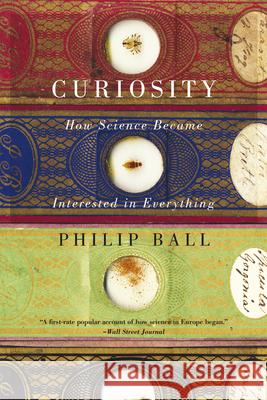
Philip Ball
Curiosity: How Science Became Interested in Everything Ball, Philip 9780226211695 University of Chicago Press - książkaWidoczna okładka, to zdjęcie poglądowe, a rzeczywista szata graficzna może różnić się od prezentowanej.

Curiosity: How Science Became Interested in Everything

ISBN-13: 9780226211695 / Angielski / Miękka / 2014 / 480 str.

Philip Ball
cena 97,56
(netto: 92,91 VAT:  5%)

Najniższa cena z 30 dni: 96,56
Termin realizacji zamówienia:
ok. 30 dni roboczych
Dostawa w 2026 r.

Darmowa dostawa!
inne wydania

With the recent landing of the Mars rover Curiosity, it seems safe to assume that the idea of being curious is alive and well in modern science--that it's not merely encouraged but is seen as an essential component of the scientific mission. Yet there was a time when curiosity was condemned. Neither Pandora nor Eve could resist the dangerous allure of unanswered questions, and all knowledge wasn't equal--for millennia it was believed that there were some things we should not try to know. In the late sixteenth century this attitude began to change dramatically, and in Curiosity: How Science Became Interested in Everything, Philip Ball investigates how curiosity first became sanctioned--when it changed from a vice to a virtue and how it became permissible to ask any and every question about the world. Looking closely at the sixteenth through eighteenth centuries, Ball vividly brings to life the age when modern science began, a time that spans the lives of Galileo and Isaac Newton. In this entertaining and illuminating account of the rise of science as we know it, Ball tells of scientists both legendary and lesser known, from Copernicus and Kepler to Robert Boyle, as well as the inventions and technologies that were inspired by curiosity itself, such as the telescope and the microscope. The so-called Scientific Revolution is often told as a story of great geniuses illuminating the world with flashes of inspiration. But Curiosity reveals a more complex story, in which the liberation--and subsequent taming--of curiosity was linked to magic, religion, literature, travel, trade, and empire. Ball also asks what has become of curiosity today: how it functions in science, how it is spun and packaged for consumption, how well it is being sustained, and how the changing shape of science influences the kinds of questions it may continue to ask. Though proverbial wisdom tell us that it was through curiosity that our innocence was lost, that has not deterred us. Instead, it has been completely the contrary: today we spend vast sums trying to reconstruct the first instants of creation in particle accelerators, out of a pure desire to know. Ball refuses to let us take this desire for granted, and this book is a perfect homage to such an inquisitive attitude.


Kategorie:
Nauka, Historia
Kategorie BISAC:
Science > History
Science > Philosophy & Social Aspects
Technology & Engineering > History
Wydawca:
University of Chicago Press
Język:
Angielski
ISBN-13:
9780226211695
Rok wydania:
2014
Ilość stron:
480
Waga:
0.65 kg
Wymiary:
22.61 x 15.24 x 2.79
Oprawa:
Miękka
Wolumenów:
01
Dodatkowe informacje:
Bibliografia
Wydanie ilustrowane

Philip Ball, geboren 1962 in Newport / Isle of Wight, studierte Chemie und Physik in Oxford und Bristol, promovierte 1988. Er war zehn Jahre leitender Redakteur bei Nature, ist heute freier Publizist für Zeitungen und Zeitschriften wie "Nature" und "New Scientist". Ball hat vier Bücher geschrieben, darunter "Chemie der Zukunft", er lebt in London.


Udostępnij

Facebook - konto krainaksiazek.pl


Opinie o Krainaksiazek.pl na Opineo.pl

Partner Mybenefit

Krainaksiazek.pl w programie rzetelna firma Krainaksiaze.pl - płatności przez paypal

Czytaj nas na:

Facebook - krainaksiazek.pl
  • książki na zamówienie
  • granty
  • książka na prezent
  • kontakt
  • pomoc
  • opinie
  • regulamin
  • polityka prywatności

Zobacz:

  • Księgarnia czeska

  • Wydawnictwo Książkowe Klimaty

1997-2025 DolnySlask.com Agencja Internetowa

© 1997-2022 krainaksiazek.pl
     
KONTAKT | REGULAMIN | POLITYKA PRYWATNOŚCI | USTAWIENIA PRYWATNOŚCI
Zobacz: Księgarnia Czeska | Wydawnictwo Książkowe Klimaty | Mapa strony | Lista autorów
KrainaKsiazek.PL - Księgarnia Internetowa

Polityka prywatnosci - link
Krainaksiazek.pl - płatnośc Przelewy24
Przechowalnia Przechowalnia






