• Wyszukiwanie zaawansowane
  • Kategorie
  • Kategorie BISAC
  • Książki na zamówienie
  • Promocje
  • Granty
  • Książka na prezent
  • Opinie
  • Pomoc
  • Załóż konto
  • Zaloguj się

Coordination Chemistry of Macrocyclic Compounds » książka


zaloguj się | załóż konto
Logo Krainaksiazek.pl

koszyk

konto

szukaj
topmenu
Księgarnia internetowa
Szukaj
Książki na zamówienie
Promocje
Granty
Książka na prezent
Moje konto
Pomoc
 
 
Wyszukiwanie zaawansowane
Pusty koszyk
Bezpłatna dostawa dla zamówień powyżej 20 złBezpłatna dostawa dla zamówień powyżej 20 zł

Kategorie główne

• Nauka
 [2944077]
• Literatura piękna
 [1814251]

  więcej...
• Turystyka
 [70679]
• Informatyka
 [151074]
• Komiksy
 [35590]
• Encyklopedie
 [23169]
• Dziecięca
 [611005]
• Hobby
 [136031]
• AudioBooki
 [1718]
• Literatura faktu
 [225599]
• Muzyka CD
 [379]
• Słowniki
 [2916]
• Inne
 [443741]
• Kalendarze
 [1187]
• Podręczniki
 [166463]
• Poradniki
 [469211]
• Religia
 [506887]
• Czasopisma
 [481]
• Sport
 [61343]
• Sztuka
 [242115]
• CD, DVD, Video
 [3348]
• Technologie
 [219293]
• Zdrowie
 [98602]
• Książkowe Klimaty
 [124]
• Zabawki
 [2385]
• Puzzle, gry
 [3504]
• Literatura w języku ukraińskim
 [260]
• Art. papiernicze i szkolne
 [7151]
Kategorie szczegółowe BISAC

Coordination Chemistry of Macrocyclic Compounds

ISBN-13: 9781461329305 / Angielski / Miękka / 2011 / 664 str.
Gordon Melson
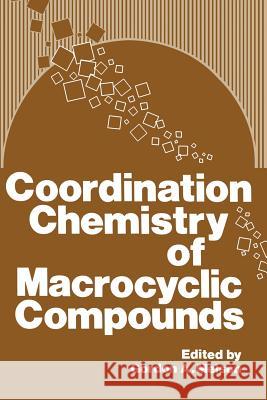
Coordination Chemistry of Macrocyclic Compounds Gordon Melson 9781461329305 Springer - książkaWidoczna okładka, to zdjęcie poglądowe, a rzeczywista szata graficzna może różnić się od prezentowanej.

Coordination Chemistry of Macrocyclic Compounds

ISBN-13: 9781461329305 / Angielski / Miękka / 2011 / 664 str.

Gordon Melson
cena 402,53
(netto: 383,36 VAT:  5%)

Najniższa cena z 30 dni: 385,52
Termin realizacji zamówienia:
ok. 22 dni roboczych.

Darmowa dostawa!

Chemists have been aware of the existence of coordination compounds con taining organic macrocyclic ligands since the first part of this century; however, only during the past few years have they expanded research into the chemistry of these compounds. The expansion was initiated in the early 1960s by the synthesis and characterization of compounds containing some new macrocyclic ligands. The synthesis of compounds which may serve as model systems for some natural products containing large rings as ligands provided the main goal for the early expansion of research effort; indeed, a recurrent theme behind much of the reported chemistry has been the analogy between synthetic macrocyclic compounds and many natural-product systems. More recently, the emphases of reported research have ranged over the whole spectrum of chemistry, and the number of publications that discuss macrocyclic chemistry has increased at a dramatic rate. The completed research has been reported in a variety of journals throughout the world but there has been no previous attempt to bring the major developments together under one cover. This book, therefore, attempts to satisfy the need for a single source in which there is both a collection and a correlation of information concerning the coordination chemistry of macrocyclic compounds. The chapters in this book discuss various aspects of macrocyclic chemistry, and while these chapters as a whole constitute an in-depth survey of the state-of the-art of the field, each chapter is written as a complete unit."


Kategorie:
Nauka, Chemia
Kategorie BISAC:
Science > Chemia - Fizyczna
Science > Chemia - Nieorganiczna
Wydawca:
Springer
Język:
Angielski
ISBN-13:
9781461329305
Rok wydania:
2011
Wydanie:
Softcover Repri
Ilość stron:
664
Waga:
1.03 kg
Wymiary:
23.5 x 15.5
Oprawa:
Miękka
Wolumenów:
01
Dodatkowe informacje:
Wydanie ilustrowane

1. General Introduction.- 1. Introductory Comments.- 2. General Comments.- 2.1. Definition of a Macrocyclic Compound.- 2.2. Historical Background.- 2.3. Abbreviations of Macrocyclic Compounds.- 2.4. Units.- 2.5. Chapter Layout.- References.- 2. Synthesis of Macrocyclic Complexes.- 1. Introduction.- 2. Tridentate Ligands.- 3. Tetradentate Ligands.- 3.1. N4 Donor Atoms.- 3.2. N2O2 Donor Atoms.- 3.3. N2S2 Donor Atoms.- 3.4. S4 Donor Atoms.- 3.5. P4 and P2S2 Donor Atoms.- 4. Pentadentate Ligands.- 5. Sexadentate Ligands.- 6. Binucleating Ligands.- 7. Clathrochelates.- 8. Conclusions.- References.- 3. Thermodynamics and Kinetics of Cation-Macrocycle Interaction.- 1. Introduction.- 2. Parameters Determining Cation Selectivity and Complex Stability.- 2.1. Relative Sizes of Cation and Ligand Cavity.- 2.2. Arrangement of Ligand Binding Sites.- 2.3. Type and Charge of Cation.- 2.4. Type of Donor Atom.- 2.5. Number of Donor Atoms.- 2.6. Substitution on the Macrocyclic Ring.- 2.7. Solvent.- 3. Macrocyclic Effect.- 3.1. Tetramines.- 3.2. Cyclic Polyethers.- 3.3. Solvation Effects.- 3.4. Mixed Donor Groups.- 3.5. Multiple Juxtapositional Fixedness.- 3.6. Cryptate Effect.- 3.7. Summary.- 4. Table of Thermodynamic Data.- 5. Kinetics.- 5.1. Antibiotic Macrocycles.- 5.2. Cyclic Polyethers.- 5.3. Macrobicyclic Ligands.- References.- 4. Structural Aspects.- 1. Introduction.- 1.1. Scope and Organization.- 1.2. Order of Tabulation.- 2. Class 1: Cyclic Amines-Saturated Polyaza Macrocycles.- 2.1. Introduction.- 2.2. Configurations and Conformations of Coordination Cyclic Tetramines.- 2.3. Metal-Ion-Nitrogen Distances.- 2.4. Substituents on the Macrocycle.- 2.5. Chelate Angles.- 2.6. Listing of Structures of Compounds of Cyclic Amines.- 3. Class 2: Cyclic Imines and Cyclic Amine-Imines (Unsaturated Polyaza Macrocycles with all Nitrogen Atoms Coordinated).- 3.1. Discussion of Structures.- 3.2. Conformation of Macrocycles.- 3.3. Substituents on the Macrocycle.- 3.4. Metal Ion-Nitrogen Distances.- 3.5. Listing of Reported Structures of Cyclic Imine and Cyclic Amine-Imine Compounds.- 4. Class 3: Macrocycles Including a 2,6-Pyridyl Group.- 4.1. Discussion of Structures.- 4.2. Listing of Reported Structures of Compounds of Macrocycles Including a 2,6-Pyridyl Group.- 5. Class 4: Tetraazamacrocycles with 2-Imino(or 2-amido)-benzaldimine Chelate Rings.- 5.1. Discussion of Structures.- 5.2. Listing of Structures of Tetraazamacrocycles with l-Imino(or l-amido)-2-aldiminobenzene Chelate Rings (o-Iminobenzaldimine and o-Amidobenzaldimine Derivatives).- 6. Class 5: Dibenzo[b,i]-l,4,8,11-tetraazacyclotetradec-2,4,6,9,11-hexaenato(2–) Compounds.- 6.1. Discussion of Structures.- 6.2. Listing of Structures of Bzo2[14]hexaenato(2-)N4 Compounds.- 7. Class 6: Cyclic Hydrazines and Hydrazones.- 7.1. Discussion of Structures.- 7.2. Listing of Structures of Cyclic Hydrazine and Hydrazone Compounds.- 8. Class 7: Cyclic Tetraethers and Tetrathiaethers (Tetraoxo- and Tetrathiamacrocycles).- 8.1. Discussion of Structures.- 8.2. Listing of Structures of Tetraoxa- and Tetrathiamacrocycles.- 9. Class 8: Macrocycles with More Than One Type of Heteroatom.- 9.1. Discussion of Structures.- 9.2. Listing of Structures of Compounds.- 10. Class 9: Binucleating Macrocycles.- 10.1. Discussion of Structures.- 10.2. Listing of Structures of Binucleating Macrocycles.- 11. Class 10: Cyclic Phosphazenes.- 11.1. Discussion of Structures.- 11.2. Listing of Structures of Cyclic Phosphazene Compounds.- 12. Class 11: Clathrochelates.- 12.1. Discussion of Structures.- 12.2. Listing of Structures of Clathrochelate Compounds.- 13. Conclusion.- References.- 5. Ligand Field Spectra and Magnetic Properties of Synthetic Macrocyclic Complexes.- 1. Introduction.- 2. Nickel Complexes.- 2.1. Nickel(II) Macrocyclic Complexes.- 2.2. Macrocyclic Complexes of Nickel(I) and Nickel(III).- 3. Copper Complexes.- 3.1. Macrocyclic Copper(II) Complexes.- 3.2. Magnetic Interactions in Binuclear Macrocyclic Copper Complexes.- 3.3. Macrocyclic Complexes of Copper(I) and Copper(III).- 4. Cobalt Complexes.- 4.1. Cobalt(II) Macrocyclic Complexes.- 4.2. Macrocyclic Cobalt(III) Complexes.- 4.3. Cobalt(I) Macrocyclic Complexes.- 5. Iron Complexes.- 5.1. Low-Spin (S = 0) Iron(II) Macrocycles.- 5.2. High-Spin (S = 2) Iron(II) Macrocycles.- 5.3. Intermediate Spin (S = 1) Iron(II) Macrocycles.- 5.4. Low-Spin (S = 1/2) Iron(III) Macrocycles.- 5.5. High-Spin (5 = 5/2) and Intermediate-Spin (S = 3/2) Iron(III) Macrocycles.- 5.6. Other Iron-Containing Macrocycles.- 6. Manganese Complexes.- 6.1. Macrocyclic Complexes of Manganese(II).- 6.2. Macrocyclic Complexes of Manganese(III).- References.- 6. Chemical Reactivity in Constrained Systems.- 1. Introduction.- 2. Predominantly Metal-Centered Reactions.- 2.1. Coordinative Lability.- 2.2. Oxidation-Reduction Reactions of Simple Stoichiometry.- 3. Reactions of the Macrocyclic Ligands.- 3.1. Oxidative Dehydrogenations..- 3.2. Hydrogenation.- 3.3. Substitutions into the Macrocyclic Ligand.- 3.4. N-Alkylations.- 3.5. Additions.- 4. Reactions Involving Free Radicals, Unusual Oxidation States, and Excited States.- 4.1. Free Radical Reactions.- 4.2. Complexes Containing Metals in Unusual Oxidation States.- 4.3. Photochemical Reactions.- 4.4. Photochemistry of Cobalt-Alkyl Complexes.- References.- 7. Metal Complexes of Phthalocyanines.- 1. Introduction.- 2. Molecular Structure.- 3. Electronic Structure.- 4. Spectral Properties.- 5. Synthesis of New Derivatives.- 6. Redox Reactions.- 7. Aggregation of Complexes.- 8. Chromium Complexes.- 9. Manganese Complexes.- 10. Iron Complexes.- 11. Cobalt Complexes.- 12. Group IV Metal Complexes.- 13. Catalytic Activity.- 14. Comparison of Chemistry of Chromium, Manganese, Iron, and Cobalt Complexes.- References.- 8. Coordination Chemistry of Porphyrins.- 1. Introduction.- 2. Synthesis.- 3. Structure.- 4. Reactions.- 5. Chlorins and Corrins.- References.- 9. Physicochemical Studies of Crown and Cryptate Complexes.- 1. Introduction.- 2. Synthetic Methods.- 2.1. Crown Polyethers.- 2.2. [2]-Cryptands.- 2.3. [3]- and [4]-Cryptands.- 3. Metal-Cation Complexes: Preparation and Structure.- 3.1. Monocyclic Ligands (Crowns).- 3.2. Macropolycyclic Ligands (Cryptands).- 4. Complexes in Solutions: Experimental Techniques.- 4.1. General Considerations.- 4.2. Electrochemical Techniques.- 4.3. Spectroscopic Techniques.- 4.4. Extraction Studies.- 4.5. Calorimetric Techniques.- 4.6. Relaxation Techniques.- 5. Conclusion.- References.- 10. Natural-Product Model Systems.- 1. Introduction.- 1.1. Model Systems—Criticisms, Objectives, and Definitions.- 1.2. Importance of X-Ray Structural Analyses.- 1.3. Evolution of Models.- 2. Macrocyclic Complexes as Models.- 2.1. Macrocyclic Ethers and Thiaethers in Model Systems.- 2.2. Synthetic Tetraazamacrocyclic Systems.- 2.3. Fundamental Studies of Synthetic Macrocyclic Ligand Complexes.- 3. Modeling of Heme Proteins.- 3.1. Studies Involving Metals Other than Iron.- 3.2. Iron(II) Carbon Monoxide Complexes.- 3.3. Dioxygen Complexes.- 3.4. Cytochromes.- 4. Binuclear Systems.- 4.1. Cofacial Diporphyrins.- 4.2. Unsymmetrical Binuclear Systems.- 5. Comments on Vitamin B12 and Related Inorganic Systems.- References.


Udostępnij

Facebook - konto krainaksiazek.pl


Opinie o Krainaksiazek.pl na Opineo.pl

Partner Mybenefit

Krainaksiazek.pl w programie rzetelna firma Krainaksiaze.pl - płatności przez paypal

Czytaj nas na:

Facebook - krainaksiazek.pl
  • książki na zamówienie
  • granty
  • książka na prezent
  • kontakt
  • pomoc
  • opinie
  • regulamin
  • polityka prywatności

Zobacz:

  • Księgarnia czeska

  • Wydawnictwo Książkowe Klimaty

1997-2026 DolnySlask.com Agencja Internetowa

© 1997-2022 krainaksiazek.pl
     
KONTAKT | REGULAMIN | POLITYKA PRYWATNOŚCI | USTAWIENIA PRYWATNOŚCI
Zobacz: Księgarnia Czeska | Wydawnictwo Książkowe Klimaty | Mapa strony | Lista autorów
KrainaKsiazek.PL - Księgarnia Internetowa

Polityka prywatnosci - link
Krainaksiazek.pl - płatnośc Przelewy24
Przechowalnia Przechowalnia






