Computational Visualization: Graphics, Abstraction and Interactivity » książka





Computational Visualization: Graphics, Abstraction and Interactivity
ISBN-13: 9783642641497 / Angielski / Miękka / 2011 / 459 str.
Computational Visualization: Graphics, Abstraction and Interactivity
ISBN-13: 9783642641497 / Angielski / Miękka / 2011 / 459 str.
(netto: 192,56 VAT: 5%)
Najniższa cena z 30 dni: 192,74
ok. 16-18 dni roboczych.
Darmowa dostawa!
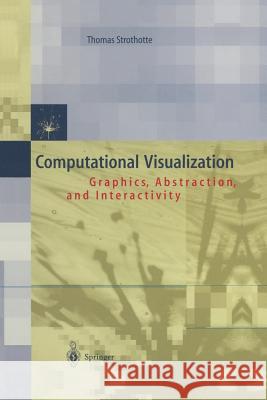
A unified and coherent introduction to the notion of abstraction in interactive computer graphics is provided by this book. Abstraction entails refinement of images based on geometric models so as to reflect the importance of the features of the model for the dialog context and the visualization goal. This may require leaving out irrelevant details or accentuating significant features by adding details or enlarging or deforming parts. Such modifications are routine by hand but are at the leading edge of research in 2D and 3D computer graphics. The authors see the abstraction process as an interactive exploration of complex information spaces, and report especially on zooming and rendering techniques. Benefits are discussed for applications in medical illustration and technical documentation.
I Introduction.- 1 New Challenges for Computer Visualization.- 1.1 Non-Computer Visualizations.- 1.1.1 Examples.- 1.1.2 Features.- 1.1.3 Observation.- 1.2 Computer Visualization: Exploring Complex Information Spaces.- 1.2.1 Information Spaces.- 1.2.2 Requirements for Dialog Systems.- 1.3 Abstraction in Interactive Computer Visualization.- 1.3.1 Abstraction.- 1.3.2 Abstraction in the Exploration of Complex Information Spaces.- 1.4 Research Topics.- 2 Exploration of Complex Information Spaces.- 2.1 Orientation in Complex Information Spaces.- 2.2 Fisheye Views: A Step Towards Abstraction.- 2.3 Applications of Fisheye Views.- 2.3.1 Filtered Views on Source Code.- 2.3.2 Distorting Views of Graphs and Maps.- 2.3.3 Multiple Foci.- 2.3.4 Fisheye Views of Hypertext Structures.- 2.3.5 Fisheye Views for Supervisory Control Systems.- 2.3.6 Zooming Windows.- 2.4 Comprehensible Fisheye Views.- 2.5 Fisheye Views for 3D Data.- 2.5.1 Implicit 3D Fisheye Views.- 2.5.2 Explicit 3D Fisheye Views.- 2.6 Nonlinear Magnification.- 2.7 Comparing Visualizations of Information Spaces.- 2.8 Abstraction in Computer Graphics.- 2.9 Abstraction in User Interfaces.- 2.10 Summary.- 3 Enrichment and Reuse of Geometric Models.- 3.1 Requirement Analysis.- 3.1.1 Basic Terms.- 3.1.2 Information Visualization.- 3.1.3 Interaction Facilities to Explore and Enrich Geometric Models.- 3.2 Related Work.- 3.2.1 Integration of Geometry and Structure View.- 3.2.2 Visualization and Interaction in Hierarchical Structures.- 3.2.3 Observations in Graphics Editors.- 3.3 An Approach to Reuse and Enrich Models.- 3.3.1 Design of an Enrichment Tool.- 3.3.2 Modification of the Object Structure.- 3.3.3 Navigating in the Structure View.- 3.3.4 Navigating in the Geometry View.- 3.3.5 Tight Coupling of Structure View and Geometry View.- 3.3.6 Implementation.- 3.4 Concluding Remarks.- II Controlling Detail.- 4 Rendering Line Drawings for Illustrative Purposes.- 4.1 Related Work.- 4.2 An Analytic Rendering Pipeline.- 4.3 Hidden Line Elimination.- 4.3.1 Method I: Quad Tree Based Algorithm.- 4.3.2 Method II: Scan-Line Based Algorithm.- 4.4 Drawing the Lines — Shading.- 4.4.1 Line Selection and Chaining.- 4.4.2 Special Line Drawing Techniques.- 4.5 Illustrating with Lines.- 4.5.1 Drawing the Contour.- 4.5.2 Shading Techniques.- 4.6 Applications and Open Problems.- 5 Rendering Line Drawings of Curved Surfaces.- 5.1 Generation of Meshes.- 5.1.1 Conventional Line Drawings of Freeform Surfaces Versus Evenly Spread Meshes.- 5.1.2 Mathematical Background.- 5.2 Analytic Freeform Surface Rendering Pipeline.- 5.2.1 Outline Generation.- 5.2.2 Texture Generation.- 5.3 How to Add Shadow.- 5.4 Examples.- 5.5 Conclusions and Future Work.- 6 Pixel-Oriented Rendering of Line Drawings.- 6.1 Previous Work.- 6.2 A Pixel-Oriented Graphics Pipeline.- 6.2.1 Basic G-Buffers.- 6.2.2 G-Buffer Operators.- 6.2.3 Half-Toning Using Short Hatching Lines.- 6.2.4 Generating Long Hatching Lines by Intersections.- 6.2.5 Half-Toning Using Long Hatching Lines.- 6.2.6 Computer Generated Copper Plates.- 6.3 Concluding Remarks.- 7 Measuring and Highlighting in Graphics.- 7.1 Related Work.- 7.2 Approaches and Techniques in Paintings.- 7.3 Theoretical Background.- 7.4 Measuring Color Contrasts.- 7.5 Animation Analysis.- 7.6 Color Discontinuity.- 7.7 Discontinuity in Motion.- 7.8 Emphasizing Objects.- 7.9 Results.- III Adaptive Zooming and Distorting Graphics.- 8 Distortions and Displacements in 2D.- 8.1 Methods for Distortions.- 8.2 Distortions Along Linear Features.- 8.3 The Focus Line Distortion.- 8.3.1 Defining the Shape of the Distortion.- 8.3.2 Defining the Amount of Distortion.- 8.4 The Interactive Focus Line.- 8.5 Concluding Remarks.- 9 Zooming in 1, 2, arid 3 Dimensions.- 9.1 Fisheye Zoom Technique.- 9.1.1 The Continuous Zoom Approach.- 9.1.2 Dimension Independent Zoom.- 9.2 Visual Constraints.- 9.2.1 Recognition Constraints.- 9.2.2 Shape Constraints.- 9.2.3 Transition Constraints.- 9.2.4 Connectivity Constraints.- 9.3 Conclusions.- 10 Zoom Navigation.- 10.1 Zoom Navigation.- 10.1.1 Degree of Interest.- 10.1.2 Representation.- 10.2 Aspect of Interest.- 10.3 The Pluggable Zoom.- 10.4 The ZoomNavigator.- 10.5 The ZoomIllustrator.- 10.5.1 API, DOI, and AOI in the ZoomIllustrator.- 10.5.2 Selection Using the AOI.- 10.6 Conclusion and Future Work.- IV Textual Methods of Abstraction.- 11 From Graphics to Pure Text.- 11.1 Giving Blind People Access to Graphics.- 11.1.1 Blind People’s Understanding of Graphical Concepts.- 11.1.2 Text Versus Tactile Graphics.- 11.2 Graphics Versus Text.- 11.2.1 Fundamental Differences Between Graphics and Text.- 11.2.2 What to Translate, What to Ignore.- 11.3 Translating Graphics to Text — Technical Issues.- 11.4 Presenting the Text.- 11.5 Conclusions.- 12 Figure Captions in Visual Interfaces.- 12.1 Figure Captions in Print Media.- 12.1.1 Figure Captions in Anatomical Atlases.- 12.1.2 Figure Captions and Legends for Maps.- 12.1.3 Generalized Structure of Figure Captions.- 12.2 Related Work.- 12.3 Dynamic Figure Captions.- 12.3.1 Layout Considerations.- 12.3.2 Adaptable Figure Captions.- 12.3.3 Updating Figure Captions.- 12.4 Interactive Figure Captions.- 12.5 Integration of Figure Captions in Interactive Systems.- 12.5.1 Template-Based Generation.- 12.5.2 An Architecture for Figure Captions in Visual Interfaces.- 12.5.3 Basic Scheme.- 12.5.4 Representation of Events.- 12.6 Concluding Remarks.- 13 Interactive 3D Illustrations with Images and Text.- 13.1 Related Work.- 13.1.1 Generating Illustrated Documents.- 13.1.2 Interactive Anatomical Illustrations.- 13.1.3 Fisheye Techniques to Explore 3D Models and Related Text.- 13.1.4 3D Fisheye Zoom.- 13.2 Consistency of Rendered Images and Their Textual Labels.- 13.3 Architecture.- 13.4 Zoom Techniques for Illustration Purposes.- 13.4.1 Zoom Techniques for Navigation in Textual Information.- 13.4.2 Zoom Techniques for the Exploration of a 3D Model.- 13.4.3 Adaptive Graphical Zoom.- 13.4.4 Enhancing Navigation in Textual Information.- 13.5 Interactive Handling of Images and Text.- 13.5.1 Managing Consistency when Geometric Transformations Occur.- 13.5.2 Implementation Issues.- 13.6 Figure Captions for Anatomical Illustrations.- 13.6.1 Important Parameters of Visualizations.- 13.6.2 Examples.- 13.7 Concluding Remarks.- V Abstraction in Time.- 14 Animating Non-photorealistic Computer Graphics.- 14.1 A Brief Introduction.- 14.1.1 Traditional Animation.- 14.1.2 Computer Animation.- 14.1.3 Principles of Animation.- 14.2 Non-photorealistic Computer Animation.- 14.2.1 Why Use Non-photorealistic Computer Animation?.- 14.2.2 Problems Using Existing Concepts.- 14.2.3 Rendering Non-photorealistic Computer Animation.- 14.3 Animating Paintings.- 14.4 Animating Line Drawings.- 14.4.1 Animating Polygonal Models.- 14.4.2 Animating Curved Surfaces.- 14.4.3 Animating Line Styles.- 14.5 Future Work.- 15 Interaction Facilities and High-Level Support for Animation Design.- 15.1 Related Work.- 15.2 Creating Animations from High-Level Specifications.- 15.3 Theoretical Foundations.- 15.4 Animation for Educational Purposes.- 15.4.1 Design of Animation Techniques.- 15.4.2 Data Structures.- 15.4.3 Script Language.- 15.4.4 Architecture.- 15.4.5 Implementation and Examples.- 15.5 Film Techniques in Technical Animation.- 15.5.1 Design of Animation Techniques for Technical Animation.- 15.5.2 Creating Animation Sequences.- 15.6 Concluding Remarks.- VI Abstractions in Interactive Systems.- 16 Zoom Navigation in User Interfaces.- 16.1 Prior and Related Work.- 16.2 The Zoom Navigator.- 16.3 Zooming Windows.- 16.4 User Study.- 16.4.1 General Setting.- 16.4.2 Hypotheses.- 16.4.3 Variables.- 16.4.4 Subjects.- 16.4.5 Overall Experiment Structure.- 16.4.6 Experiment Tasks.- 16.4.7 Collection of Data.- 16.4.8 Results.- 16.4.9 Interview.- 16.5 Conclusion and Future Work.- 17 Interactive Medical Illustrations.- 17.1 Interactive Medical Illustration.- 17.2 A Text-Driven Illustration System.- 17.2.1 The Information Space.- 17.2.2 Coupling of Graphics and Text.- 17.2.3 Interaction Support.- 17.3 Comparison to Other Approaches.- 17.3.1 The Zoom Illustrator.- 17.3.2 VoxelMan.- 17.3.3 Other Graphics-Driven Systems.- 17.3.4 Knowledge-Based Systems.- 17.4 The Road Ahead.- 18 Rendering Gestural Expressions.- 18.1 The Problem of Visualizing Human Bodies.- 18.2 Drawing Optimization for Gestures.- 18.2.1 Representing the Hand and Its Movement.- 18.2.2 Temporal Control.- 18.3 Animation of Gestures for the Manual Alphabet.- 18.3.1 Interactive Dialogs for Library Maintenance.- 18.3.2 Building Gesture Sequences.- 18.4 Generating Line Drawings of Freeform Surfaces.- 18.4.1 The Rendering Process.- 18.4.2 Demonstration of Drawing Styles.- 18.5 Conclusions and Future Work.- 19 Animation Design for Simulation.- 19.1 Using Simulation to Create Animation Models.- 19.2 Problems in Generating Animations.- 19.3 Plugins for Visualization Modeling.- 19.4 Trace Conversion in a Plugin Based Framework.- 19.5 Future Work.- VII Abstraction for Specialized Output.- 20 Tactile Maps for Blind People.- 20.1 Customized Maps.- 20.2 Map Creation.- 20.2.1 Data Sources.- 20.2.2 Map Layout.- 20.3 Symbol Displacement.- 20.3.1 Overview.- 20.3.2 Requirements.- 20.3.3 Detection and Analysis of Conflicts.- 20.3.4 Displacement.- 20.4 Communicating the Map Fidelity.- 20.5 Concluding Remarks.- 21 Synthetic Holography.- 21.1 Holography as a 3D Visualization Technique.- 21.1.1 Optical Holography.- 21.1.2 Synthetic Holography.- 21.1.3 3D Display Techniques to Provide Depth Cues.- 21.2 Methods of Synthetic Holography.- 21.3 Where Holography and Common Computer Graphics Meet.- 21.3.1 Holograms of Objects Composed of Line Segments.- 21.3.2 Implementation.- 21.3.3 A New Approach to Holographic Imaging of Lines.- 21.3.4 Results.- 21.4 Future Work.- VIII Epilog.- 22 Abstraction Versus Realism: Not the Real Question.- 22.1 The Naïve Opposition of Abstraction and Realism.- 22.2 Three Examples of Functional Pictures.- 22.3 Several Kinds of Realism.- 22.4 Images as Signs: Considerations from Communication Theory.- 22.5 Abstraction in Realism.- 22.6 Realism in Abstraction.- 22.7 Abstraction and Realism: Conclusions.- 23 Integrating Spatial and Nonspatial Data.- 23.1 Pictures, Lies, and Abstract Data Types.- 23.2 Spatial and Nonspatial Data.- 23.3 Continuity and Discontinuity in Abstraction.- 23.3.1 Continuity.- 23.3.2 Discontinuity.- 23.3.3 A Comparison Between Image and Language Generation.- 23.4 Conveying Allowable Operations to Viewers of Images.- 23.4.1 Graphical Comprehension Cues.- 23.4.2 Linguistic Comprehension Cues.- 23.4.3 Comparison.- 23.5 The Bottom Line.- Copyrights.- Index of Names.- Contributors.




Czytaj nas na:
1997-2026 DolnySlask.com Agencja Internetowa
KrainaKsiazek.PL - Księgarnia Internetowa


