• Wyszukiwanie zaawansowane
  • Kategorie
  • Kategorie BISAC
  • Książki na zamówienie
  • Promocje
  • Granty
  • Książka na prezent
  • Opinie
  • Pomoc
  • Załóż konto
  • Zaloguj się

Computational Methods for the Determination of Formation Constants » książka


zaloguj się | załóż konto
Logo Krainaksiazek.pl

koszyk

konto

szukaj
topmenu
Księgarnia internetowa
Szukaj
Książki na zamówienie
Promocje
Granty
Książka na prezent
Moje konto
Pomoc
 
 
Wyszukiwanie zaawansowane
Pusty koszyk
Bezpłatna dostawa dla zamówień powyżej 20 złBezpłatna dostawa dla zamówień powyżej 20 zł

Kategorie główne

• Nauka
 [2950560]
• Literatura piękna
 [1849509]

  więcej...
• Turystyka
 [71097]
• Informatyka
 [151150]
• Komiksy
 [35848]
• Encyklopedie
 [23178]
• Dziecięca
 [617388]
• Hobby
 [139064]
• AudioBooki
 [1657]
• Literatura faktu
 [228597]
• Muzyka CD
 [383]
• Słowniki
 [2855]
• Inne
 [445295]
• Kalendarze
 [1464]
• Podręczniki
 [167547]
• Poradniki
 [480102]
• Religia
 [510749]
• Czasopisma
 [516]
• Sport
 [61293]
• Sztuka
 [243352]
• CD, DVD, Video
 [3414]
• Technologie
 [219456]
• Zdrowie
 [101002]
• Książkowe Klimaty
 [124]
• Zabawki
 [2311]
• Puzzle, gry
 [3459]
• Literatura w języku ukraińskim
 [254]
• Art. papiernicze i szkolne
 [8079]
Kategorie szczegółowe BISAC

Computational Methods for the Determination of Formation Constants

ISBN-13: 9781468449365 / Angielski / Miękka / 2012 / 494 str.
David J. Leggett
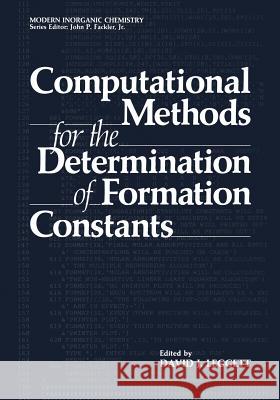
Computational Methods for the Determination of Formation Constants David J. Leggett 9781468449365 Springer - książkaWidoczna okładka, to zdjęcie poglądowe, a rzeczywista szata graficzna może różnić się od prezentowanej.

Computational Methods for the Determination of Formation Constants

ISBN-13: 9781468449365 / Angielski / Miękka / 2012 / 494 str.

David J. Leggett
cena 201,24
(netto: 191,66 VAT:  5%)

Najniższa cena z 30 dni: 192,74
Termin realizacji zamówienia:
ok. 22 dni roboczych
Dostawa w 2026 r.

Darmowa dostawa!

This volume is concerned with methods that are available for the calculation of for- mation constants, in particular computational procedures. Although graphical meth- ods have considerable value in the exploration of primary (raw) data they have been overtaken by computational methods, which, for the most part, take primary data and return the refined formation constants. Graphical methods are now considered com- plementary to these general computational procedures. This volume brings together programs that span the lifetime of computer-assisted determination of formation constants. On one hand the reader will find listings of programs that are derived from LETAGROP (b.l961) and the GAUSS-G/SCOGS (b. 1962) families. On the other hand programs are presented that are the newest mem- bers of the SCOGS lineage and from the on-going MINIQUAD series. One program is presented that describes a computational approach to the classical Hedstrom- Osterberg methods; another that takes care of electrode calibration in a simple yet rigorous manner. Potentiometry and spectrophotometry are the most popular experimental tech- niques for equilibrium studies, and the programs in this volume reflect this. Four programs handle potentiometric data, two will process spectrophotometric data, and one makes use of both types of data separately or in combination.


Kategorie:
Nauka, Chemia
Kategorie BISAC:
Science > Chemia - Fizyczna
Science > Chemia - Analityczna
Wydawca:
Springer
Seria wydawnicza:
Modern Inorganic Chemistry
Język:
Angielski
ISBN-13:
9781468449365
Rok wydania:
2012
Wydanie:
Softcover Repri
Numer serii:
000033409
Ilość stron:
494
Waga:
0.94 kg
Wymiary:
25.4 x 17.8
Oprawa:
Miękka
Wolumenów:
01
Dodatkowe informacje:
Wydanie ilustrowane

1 The Determination of Formation Constants: An Overview of Computational Methods for Data Processing.- 1. Introduction.- 2. Direct Search and Univariate Methods.- 2.1. Grid, Star, and Composite Designs.- 2.2. Fibonacci and Golden Section.- 2.3. Hooke and Jeeves, Simplex.- 2.4. Quadratic and Cubic Interpolation Methods.- 2.5. Summary.- 3. Least-Squares Methods.- 3.1. Newton-Raphson.- 3.2. Gauss-Newton.- 3.3. Levenberg and Marquardt.- 3.4. Objective Function Differentiation.- 4. Other Methods.- 4.1. Curve Fitting.- 4.2. HOSK Method.- 5. Summary.- 6. References.- 2 Strategies for Solution Equilibria Studies with Specific Reference to Spectrophotometry.- 1. Elucidation of the Equilibrium Model.- 1.1. Introduction.- 1.2. Experimental Techniques.- 1.3. Data Analysis.- 1.4. Adequacy of the Selected Model.- 2. Determination of pKa’s from Absorbance pH Studies.- 2.1. Introduction.- 2.2. Measurement of Absorbance vs. pH Data.- 2.3. Preliminary Data Handling.- 2.4. Curve-Fitting Analysis of the Absorbance vs. pH Curve.- 2.5. Matrix Regression Analysis.- 2.6. Thermodynamic Dissociation Constants.- 3. Initial Methods for Investigating Complex Equlibria.- 3.1. Introduction.- 3.2. Graphical Analysis of Absorbance vs. pH Curves.- 3.3 Analysis of Absorbance vs. pH Curves Using PRCEK.- 3.4. Continuous Variation Techniques.- 3.5. Mole Ratio Techniques.- 3.6. Method of Corresponding Solutions.- 4. Conclusions.- 5. References.- 3 MAGEC: A Program for the Definite Calibration of the Glass Electrode.- 1. Introduction.- 2. Descrition of the Program MAGEC.- 2.1. Theory.- 2.2. Use of MAGEC for Electrode Calibration.- 2.3. Conclusions.- 3. References.- 4. Instructions for the Use of MAGEC.- 4.1. Basic Principles.- 4.2. Data Input Requirements.- 5. Presentation of the Program.- 5.1. Listing of MAGEC.- 5.2. Input Data.- 4 SCOGS2: A Nonlinear Least-Squares Program for the Evaluation of Formation Constants of Metal Complexes.- 1. Introduction.- 2. Description of the Program SCOGS2.- 2.1. General.- 2.2. MAIN Program of SCOGS2—SCOGSH Option.- 2.3. SCOGSM Option.- 2.4. Subroutine COGSNR.- 2.5. Limits of SCOGS2.- 2.6. Some Examples of the Use of SCOGS.- 2.7. Using SCOGS2 to Build an Equilibrium-Model.- 3. References.- 4. Instructions for SCOGS2.- 5. Presentation of the Program.- 5.1. Listing of SCOGS2.- 5.2. Input Data.- 5.2.1. Data for the System Copper(II)-Phosphonoacetate.- 5.2.2. Data for the System Copper(II)-Histidine (3-hydroxo-1-methylpyridin-4-(1H)-one).- 5.2.3. Data for the System Copper-p-Sulfonatobenzaldehyde thiosemicarbazone.- 5 MINIQUAD and MIQUV: Two Approaches for the Computation of Formation Constants from Potentiometric Data.- 1. Introduction.- 2. Description of the Programs.- 2.1. Program MINIQUAD.- 2.2. Program MIQUV.- 2.3. Comments.- 3. References.- 4. Instructions for the Programs.- 4.1. Details of the Input File.- 4.2. Description of the Output.- 5. Presentation of the Programs.- 5.1. Listing of the MINIQUAD.- 5.1.1. Input Data.- 5.2. Listing of MIQUV.- 5.2.1. Input Data.- 6 SQUAD: Stability Quotients from Absorbance Data.- 1. Introduction.- 2. Description of the Program SQUAD.- 2.1. Mathematical Algorithms.- 2.2. Principles of Data Input.- 2.3. Suggestions for the Use of SQUAD.- 2.4. Modifications to SQUAD.- 3. References.- 4. Instructions for SQUAD.- 4.1. Introduction.- 4.2. Details of the Data Input.- 5. Presentation of the Program.- 5.1. Listing of SQUAD.- 5.2. Input Data.- 7 General Computer Programs for the Determination of Formation Constants from Various Types of Data.- 1. Multiparametric Curve Fitting Using ABLET.- 1.1. Introduction.- 1.2. The “Pit-Mapping” Technique.- 1.3. Description of the Program ABLET.- 1.3.1. Routines Specific to the Model.- 1.3.2. Basic Routines of the ABLET Family.- 1.4. Data Input Instructions.- 1.4.1. Introduction.- 1.4.2. Data Input Requirements.- 1.4.3. Algorithmic and Heuristic Strategies.- 1.5. Listing of ABLET.- 2. MRLET: Formation Constants of MmLn from Mole Ratio Data.- 2.1. Model Formulation.- 2.2. Description of MRLET.- 2.3. Data Input Requirements.- 2.4. Presentation of MRLET.- 2.4.1. Listing of MRLET.- 2.4.2. InputData.- 3. POLET: Formation Constants from Potentiometric Data.- 3.1. Model Formulation.- 3.2. Description of POLET.- 3.3. Data Input Requirements.- 3.4. Presentation of POLET.- 3.4.1. Listing of POLET.- 3.4.2. Input Data.- 4. EXLET: Formation Constants and Related Parameters from Spectrophotometric Extraction Data.- 4.1. Model Formulation.- 4.2. Description of EXLET.- 4.3. Data Input Requirements.- 4.4. Presentation of EXLET.- 4.4.1. Listing of EXLET.- 4.4.2. InputData.- 5. Other Programs of the ABLET Family.- 5.1. DHLET: Estimation of Thermodynamic Dissociation Constants and Extended Debye-Huckel Parameters.- 5.2. DCLET: Estimation of Successive Dissociation Constants from pH-Absorbance Data.- 5.3. NCLET: Evaluation of Competitive Equilibria in a Chelatometric Titration.- 5.3.1. Listing of MAIN, DATA, VBBE, and SKRIK for NCLET.- 6. References.- 8 PSEQUAD: A Comprehensive Program for the Evaluation of Potentiometric and/or Spectrophotometric Equilibrium Data Using Analytical Derivatives.- 1. Introduction.- 2. Description of the Program PSEQUAD.- 2.1. Calculation of the Free Concentrations.- 2.2. Refinement of the Formation Constants and/or the Molar Absorptivities.- 2.3. Model Selection by PSEQUAD.- 2.4. Estimation of Parameter Correlation.- 2.5. Program Limits.- 3. References.- 4. Program Instructions.- 4.1. Introduction.- 4.2. Input of Potentiometric and/or Photometric Data.- 4.3. Data Processing Options and Instructions.- 5. Presentation of the Program.- 5.1. Listing of PSEQUAD.- 5.2. Input Data.- 5.2.1. Experimental Details.- 5.2.2. Data for the System Copper(II)-Nitriloacetic Acid.- 5.3. Output from PSEQUAD.- 9 STBLTY: Methods for Construction and Refinement of Equilibrium Models.- 1. Introduction.- 2. Program Description.- 2.1. Computer Generation of Potentiometric Data and Distribution of Species.- 2.2. Data Reduction and Bjerrum Analysis.- 2.3. Free-Ion Concentration in Solution (FICS) Methodology.- 2.4. Average Composition of Species in Solution (ACSS) Methodology.- 2.5. Linear Least-Squares Refinement of Constants.- 2.6. Nonlinear Least-Squares Refinement of Constants: pH Data.- 2.7. Nonlinear Least-Squares of Constants: pM, pL, and pH Data.- 2.8. Nonlinear Least-Squares Refinement of the Total Concentrations.- 2.9. Analysis of Variance.- 2.10. Acknowledgments.- 3. References.- 4. Description of Batch Input Protocol.- 4.1. Fantasy Calculation.- 4.1.1. Instructions for Data Input.- 4.1.2. Input Data for Fantasy Calculation.- 4.2. Data Reduction.- 4.2.1. Instructions for Data Input.- 4.2.2. Input Data for Data Reduction.- 4.3. Variation.- 4.4 PX From Variation.- 4.5 Stoichiometric Coefs.- 4.5.1. Instructions for Data Input.- 4.5.2. Input Data for Variation, PX From Variation, and Stoichiometric COEFS.- 4.6. Linear LS Refine.- 4.7. Nonlinear LS Refine.- 4.7.1. Instructions for Data Input.- 4.7.2. Input Data for Nonlinear LS Refine.- 4.8. Analysis of Variance.- 4.8.1. Instructions for Data Input.- 4.8.2. Input Data for Analysis Variance.- 5. Source Listing of Stblty.


Udostępnij

Facebook - konto krainaksiazek.pl


Opinie o Krainaksiazek.pl na Opineo.pl

Partner Mybenefit

Krainaksiazek.pl w programie rzetelna firma Krainaksiaze.pl - płatności przez paypal

Czytaj nas na:

Facebook - krainaksiazek.pl
  • książki na zamówienie
  • granty
  • książka na prezent
  • kontakt
  • pomoc
  • opinie
  • regulamin
  • polityka prywatności

Zobacz:

  • Księgarnia czeska

  • Wydawnictwo Książkowe Klimaty

1997-2025 DolnySlask.com Agencja Internetowa

© 1997-2022 krainaksiazek.pl
     
KONTAKT | REGULAMIN | POLITYKA PRYWATNOŚCI | USTAWIENIA PRYWATNOŚCI
Zobacz: Księgarnia Czeska | Wydawnictwo Książkowe Klimaty | Mapa strony | Lista autorów
KrainaKsiazek.PL - Księgarnia Internetowa

Polityka prywatnosci - link
Krainaksiazek.pl - płatnośc Przelewy24
Przechowalnia Przechowalnia





