Compendium of Hydrogen Energy: Hydrogen Use, Safety and the Hydrogen Economy » książka





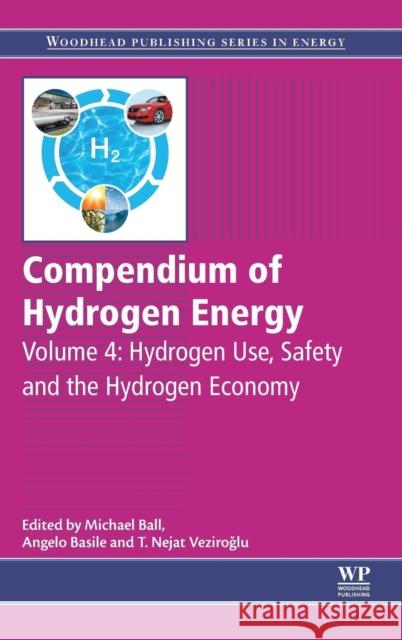
Compendium of Hydrogen Energy: Hydrogen Use, Safety and the Hydrogen Economy
ISBN-13: 9781782423645 / Angielski / Twarda / 2015 / 386 str.
Compendium of Hydrogen Energy: Hydrogen Use, Safety and the Hydrogen Economy
ISBN-13: 9781782423645 / Angielski / Twarda / 2015 / 386 str.
(netto: 760,31 VAT: 5%)
Najniższa cena z 30 dni: 788,57
ok. 30 dni roboczych.
Darmowa dostawa!
Compendium of Hydrogen Energy Volume 4: Hydrogen Use, Safety and the Hydrogen Economy focuses on the uses of hydrogen. As many experts believe the hydrogen economy will, at some point, replace the fossil fuel economy as the primary source of the world's energy, this book investigates the uses of this energy, from transport, to stationary and portable applications, with final sections discussing the difficulties and possibilities of the widespread adoption of the hydrogen economy.
- Written by both leading academics in the fields of sustainable energy and experts from the world of industry
- Part of a very comprehensive compendium which across four volumes looks at the entirety of the hydrogen energy economy
- Covers a wide array of hydrogen uses, and details safety tactics, hydrogen applications in transport, and the hydrogen economy as a whole
- List of contributors
- Part One: Hydrogen applications in transport and industry
- 1: Hydrogen-fueled road automobiles - Passenger cars and buses
- Abstract
- 1.1 Introduction
- 1.2 Comparison of different hydrogen-fueled drive systems
- 1.3 Technical solutions for FCEVs
- 1.4 Technical approaches for the main components of FCEVs
- 1.5 Challenges for FCEVs - Consideration of main markets
- 1.6 Summary and future trends
- 1.7 Sources of further information and advice
- 2: Hydrogen-fueled motorcycles, bicycles, and industrial trucks
- Abstract
- 2.1 Introduction
- 2.2 Hydrogen motorcycles and bicycles
- 2.3 Hydrogen industrial trucks
- 2.4 Conclusions
- 3: Hydrogen-fueled marine transportation
- Abstract
- 3.1 Market environment
- 3.2 Requirements for marine FCs
- 3.3 Suitable FC systems
- 3.4 FC integration in ships
- 3.5 Marine FC projects
- 3.6 Future trends
- 4: Hydrogen-fueled aeroplanes
- Abstract
- 4.1 Introduction to hydrogen vs. traditional technologies: Differences and similarities, advantages, and disadvantages
- 4.2 Hydrogen fuel on aircraft-Challenges and requirements
- 4.3 Advantages and disadvantages of hydrogen storage methods in aeronautics
- 4.4 Available energy conversion technologies
- 4.5 Available infrastructure (production, airport)
- 4.6 Operational aspects (turn around)
- 4.7 Safety aspects (layout, design, and strategy)
- 4.8 Safety strategy
- 4.9 Certification aspects
- 4.10 Environmental and economic aspects and public acceptance
- 4.11 Future trends
- 4.12 Summary
- 5: Hydrogen-fueled spacecraft and other space applications of hydrogen
- Abstract
- 5.1 Introduction: The potential of hydrogen-powered spacecraft
- 5.2 Advantages and disadvantages of hydrogen-fueled spacecraft
- 5.3 Principles: Suitable hydrogen power sources for spacecraft
- 5.4 Advantages and disadvantages of the power sources
- 5.5 Challenges for hydrogen-fueled spacecraft
- 5.6 Other space applications of hydrogen
- 5.7 Market trends
- 5.8 Hydrogen storage in spacecraft
- 5.9 Advantages and disadvantages of the various potential storage methods
- 5.10 Safety concerns regarding the storage of hydrogen in these vehicles
- 5.11 Future trends
- 1: Hydrogen-fueled road automobiles - Passenger cars and buses
- Part Two: Other applications of hydrogen
- 6: Hydrogen fuel cells for portable applications
- Abstract
- Acknowledgments
- 6.1 Introduction
- 6.2 Drawbacks of hydrogen fuel cells regarding application in portable devices
- 6.3 Present status
- 6.4 Market penetration
- 6.5 Future perspectives and conclusion
- 7: Large-scale underground storage of hydrogen for the grid integration of renewable energy and other applications
- Abstract
- 7.1 Hydrogen and the need for energy storage in Europe
- 7.2 Markets for hydrogen
- 7.3 Technology for large-scale hydrogen storage
- 7.4 Potential for hydrogen underground storage
- 7.5 Hydrogen storage economics in energy systems with increasing share of intermittent renewable energy
- 7.6 State-of-discussion and development perspectives
- 8: Hydrogen admixture to the natural gas grid
- Abstract
- Acknowledgments
- 8.1 Introduction
- 8.2 Reasons for adding hydrogen to the natural gas grid
- 8.3 Potential benefits and problems associated with adding hydrogen to the natural gas grid
- 8.4 State of the art
- 8.5 The bottlenecks-Considering a 10 vol% admixture
- 8.6 R&D necessary to overcome the bottlenecks
- 8.7 Additional requirements
- 8.8 Key technologies
- 8.9 Future trends: The methanation option
- 8.10 Economic considerations
- 8.11 Regulatory issues
- 8.12 Practical recommendations for hydrogen injection
- 8.13 Conclusions
- 8.14 Sources of further information
- Recommended further reading
- 6: Hydrogen fuel cells for portable applications
- Part Three: Hydrogen safety
- 9: Hydrogen safety: An overview
- Abstract
- 9.1 Introduction
- 9.2 Properties of hydrogen and their implications for safety
- 9.3 Hazards of hydrogen
- 9.4 Management for accident prevention
- 9.5 Future trends
- 9.6 Conclusions
- 9.7 Sources of further information
- 10: Hydrogen sensors and detectors
- Abstract
- 10.1 Introduction
- 10.2 Terms and definitions
- 10.3 Requirements of hydrogen sensors and detectors
- 10.4 Current hydrogen sensors and detectors on the market: Technologies and operation principles
- 10.5 Current research and development in hydrogen sensors and detectors
- 10.6 Detection layout and maintenance of detectors
- 10.7 Conclusions
- 10.8 Sources of further information
- 9: Hydrogen safety: An overview
- Part Four: The hydrogen economy
- 11: The hydrogen economy-Vision or reality?
- Abstract
- Acknowledgments
- 11.1 Setting the context-The global energy challenge
- 11.2 Options for the road transport sector
- 11.3 A short history of hydrogen
- 11.4 The status of hydrogen fuel cell vehicles
- 11.5 Building a hydrogen delivery infrastructure for the transport sector
- 11.6 The hydrogen infrastructure challenge and how to overcome it
- 11.7 The role of hydrogen for renewables' integration
- 11.8 Perspectives and outlook
- 12: Building a hydrogen infrastructure in the EU
- Abstract
- 12.1 Introduction: which hydrogen infrastructure(s) is/are required?
- 12.2 Current status of hydrogen infrastructure
- 12.3 Costs for setting up the hydrogen infrastructure
- 12.4 Status and outlook of EU hydrogen infrastructure initiatives
- 12.5 Moving toward full deployment
- 12.6 Conclusions
- 13: Building a hydrogen infrastructure in the United States
- Abstract
- 13.1 Introduction
- 13.2 Current status of hydrogen infrastructure in the United States
- 13.3 Initial costs of deploying hydrogen infrastructure
- 13.4 Market trends
- 13.5 Hydrogen refueling infrastructure
- 13.6 Hydrogen production, transmission, and distribution
- 13.7 Hydrogen transmission and distribution barriers
- 13.8 Material
- 14: Building a hydrogen infrastructure in Japan
- Abstract
- 14.1 Introduction
- 14.2 The new strategic energy plan (Strategic Energy Plan, 2014)
- 14.3 Strategic Road Map For Hydrogen and FCs (Strategic Road Map for Hydrogen et al., 2014)
- 14.4 Off-site (centralized) versus on-site (distributed) hydrogen production
- 14.5 Novel hydrogen production methods
- 14.6 Hydrogen distribution and storage
- 14.7 Initial current cost of hydrogen stations
- 14.8 Residential use FC system (The Japan Gas Association, n.d.)
- 14.9 FC vehicle
- 14.10 Current situation in Japan as regards hydrogen infrastructure
- 14.11 Conclusions
- 15: Environmental impacts of hydrogen use in vehicles
- Abstract
- 15.1 Introduction
- 15.2 Environmental assessment
- 15.3 Reference systems
- 15.4 Results and discussion
- 15.5 Final considerations
- 11: The hydrogen economy-Vision or reality?
- Index
Angelo Basile, a chemical engineer, is the author of hundreds of papers, books, chapter books, and special issues, with also various Italian, European, and worldwide patents. Basile is an associate editor of various international journals (IJHE, APCEJ, etc.), editor-in-chief of the International Journal of Membrane Science and Technology, and a member of the editorial board of more than 25 international journals. Today Basile is an R&D manager at both ECO2Energy (Rome) and Hydrogenia (Genoa) and is collaborating with the Department of Engineering at the University Campus Bio-medical of Rome (Italy).
Dr. Veziroglu, a native of Turkey, graduated from the City and Guilds College, the Imperial College of Science and Technology, University of London, with degrees in Mechanical Engineering (A.C.G.I., B.Sc.), Advanced Studies in Engineering (D.I.C.) and Heat Transfer (Ph.D.).
In 1962 - after doing his military service in the Ordnance Section, serving in some Turkish government agencies and heading a private company - Dr. Veziroglu joined the University of Miami Engineering Faculty. In 1965, he became the Director of Graduate Studies and initiated the first Ph.D. Program in the School of Engineering and Architecture. He served as Chairman of the Department of Mechanical Engineering 1971 through 1975, in 1973 established the Clean Energy Research Institute, and was the Associate Dean for Research 1975 through 1979. He took a three years Leave of Absence (2004 through 2007) and founded UNIDO-ICHET (United Nations Industrial Development Organization - International Centre for Hydrogen Energy Technologies) in Istanbul, Turkey. On 15 May 2009, he attained the status of Professor Emeritus at the University of Miami.
Dr. Veziroglu organized the first major conference on Hydrogen Energy: The Hydrogen Economy Miami Energy (THEME) Conference, Miami Beach, 18-20 March 1974. At the opening of this conference, Dr. Veziroglu proposed the Hydrogen Energy System as a permanent solution for the depletion of the fossil fuels and the environmental problems caused by their utilization. Soon after, the International Association for Hydrogen Energy (IAHE) was established, and Dr. Veziroglu was elected president. As President of IAHE, in 1976 he initiated the biennial World Hydrogen Energy Conferences (WHECs), and in 2005 the biennial World Hydrogen Technologies Conventions (WHTCs).
In 1976, Dr. Veziroglu started publication of the International Journal of Hydrogen Energy (IJHE) as its Founding Editor-in-Chief, in order to publish and disseminate Hydrogen Energy related research and development results from around the world. IJHE has continuously grew; now it publishes twenty-four issues a year. He has published some 350 papers and scientific reports, edited 160 volumes of books and proceedings, and has co-authored the book "Solar Hydrogen Energy: The Power to Save the Earth.
Dr. Veziroglu has memberships in eighteen scientific organizations, has been elected to the Grade of Fellow in the British Institution of Mechanical Engineers, American Society of Mechanical Engineers and the American Association for the Advancement of Science, and is the Founding President of the International Association for Hydrogen Energy.
Dr. Veziroglu has been the recipient of several international awards. He was presented the Turkish Presidential Science Award in 1974, made an Honorary Professor in Xian Jiaotong University of China in 1981, awarded the I. V. Kurchatov Medal by the Kurchatov Institute of Atomic Energy of U.S.S.R. in 1982, the Energy for Mankind Award by the Global Energy Society in 1986, and elected to the Argentinean Academy of Sciences in 1988. In 2000, he was nominated for Nobel Prize in Economics, for conceiving the Hydrogen Economy and striving towards its establishment.




Czytaj nas na:
1997-2026 DolnySlask.com Agencja Internetowa
KrainaKsiazek.PL - Księgarnia Internetowa


