• Wyszukiwanie zaawansowane
  • Kategorie
  • Kategorie BISAC
  • Książki na zamówienie
  • Promocje
  • Granty
  • Książka na prezent
  • Opinie
  • Pomoc
  • Załóż konto
  • Zaloguj się

Collision Theory and Statistical Theory of Chemical Reactions » książka


zaloguj się | załóż konto
Logo Krainaksiazek.pl

koszyk

konto

szukaj
topmenu
Księgarnia internetowa
Szukaj
Książki na zamówienie
Promocje
Granty
Książka na prezent
Moje konto
Pomoc
 
 
Wyszukiwanie zaawansowane
Pusty koszyk
Bezpłatna dostawa dla zamówień powyżej 20 złBezpłatna dostawa dla zamówień powyżej 20 zł

Kategorie główne

• Nauka
 [2946600]
• Literatura piękna
 [1856966]

  więcej...
• Turystyka
 [72221]
• Informatyka
 [151456]
• Komiksy
 [35826]
• Encyklopedie
 [23190]
• Dziecięca
 [619653]
• Hobby
 [140543]
• AudioBooki
 [1577]
• Literatura faktu
 [228355]
• Muzyka CD
 [410]
• Słowniki
 [2874]
• Inne
 [445822]
• Kalendarze
 [1744]
• Podręczniki
 [167141]
• Poradniki
 [482898]
• Religia
 [510455]
• Czasopisma
 [526]
• Sport
 [61590]
• Sztuka
 [243598]
• CD, DVD, Video
 [3423]
• Technologie
 [219201]
• Zdrowie
 [101638]
• Książkowe Klimaty
 [124]
• Zabawki
 [2473]
• Puzzle, gry
 [3898]
• Literatura w języku ukraińskim
 [254]
• Art. papiernicze i szkolne
 [8170]
Kategorie szczegółowe BISAC

Collision Theory and Statistical Theory of Chemical Reactions

ISBN-13: 9783540100126 / Angielski / Miękka / 1980 / 322 str.
S. G. Christov
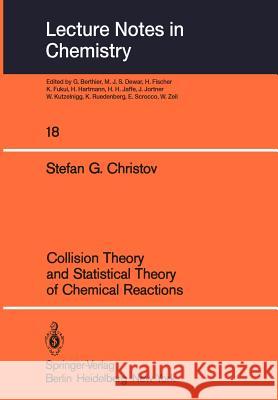
Collision Theory and Statistical Theory of Chemical Reactions S. G. Christov 9783540100126 Springer-Verlag Berlin and Heidelberg GmbH &  - książkaWidoczna okładka, to zdjęcie poglądowe, a rzeczywista szata graficzna może różnić się od prezentowanej.

Collision Theory and Statistical Theory of Chemical Reactions

ISBN-13: 9783540100126 / Angielski / Miękka / 1980 / 322 str.

S. G. Christov
cena 201,72 zł
(netto: 192,11 VAT:  5%)

Najniższa cena z 30 dni: 192,74 zł
Termin realizacji zamówienia:
ok. 22 dni roboczych
Bez gwarancji dostawy przed świętami

Darmowa dostawa!

Since the discovery of quantum mechanics, more than fifty years ago, the theory of chemical reactivity has taken the first steps of its development. The knowledge of the electronic structure and the properties of atoms and molecules is the basis for an un- derstanding of their interactions in the elementary act of any chemical process. The increasing information in this field during the last decades has stimulated the elaboration of the methods for evaluating the potential energy of the reacting systems as well as the creation of new methods for calculation of reaction probabili- ties (or cross sections) and rate constants. An exact solution to these fundamental problems of theoretical chemistry based on quan- tum mechanics and statistical physics, however, is still impossible even for the simplest chemical reactions. Therefore, different ap- proximations have to be used in order to simplify one or the other side of the problem. At present, the basic approach in the theory of chemical reactivity consists in separating the motions of electrons and nu- clei by making use of the Born-Oppenheimer adiabatic approximation to obtain electronic energy as an effective potential for nuclear motion. If the potential energy surface is known, one can calculate, in principle, the reaction probability for any given initial state of the system. The reaction rate is then obtained as an average of the reaction probabilities over all possible initial states of the reacting artic1es. In the different stages of this calculational scheme additional approximations are usually introduced.


Kategorie:
Nauka, Chemia
Kategorie BISAC:
Science > Chemia - Fizyczna
Wydawca:
Springer-Verlag Berlin and Heidelberg GmbH &
Seria wydawnicza:
Lecture Notes in Chemistry
Język:
Angielski
ISBN-13:
9783540100126
Rok wydania:
1980
Dostępne języki:
Angielski
Numer serii:
000070482
Ilość stron:
322
Waga:
0.59 kg
Wymiary:
24.424.4 x 17.0
Oprawa:
Miękka
Wolumenów:
01

Historical Introduction.- I The Potential Energy of Reactive Systems.- 1. The Adiabatic Approximation.- 2. Corrections to the Adiabatic Approximation.- 3. Potential Energy Surfaces.- 3.1. Calculation of the Electronic Surfaces.- 3.2. Correlation between Chemical Reactivity and Electronic Structure (or Electronic State).- II Dynamics of Molecular Collisions.- 1. General Considerations.- 1.1. Separation of Nuclear Motions.- 1.2. Time-Dependent and Time-Independent Collision Theory.- 2. Transition Probability and Cross Section.- 3. Classical Trajectory Calculations.- 4. Quantum-Mechanical Calculations.- 4.1. One-Dimensional Consideration.- 4.2. Many-Dimensional Consideration.- 5. Quasi-Classical Calculations.- 6. Non-Adiabatic Transitions in Chemical Reactions.- 6.1. Semiclassical Consideration.- 6.2. Quantum-Mechanical Consideration.- III General Theory of Reaction Rates.- 1. Basic Assumptions.- 2. Collision Theory Formulation of Reaction Rates.- 3. “Statistical” Formulation of Reaction Rates.- 4. Classical and Semiclassical Approximations to the Rate Equations.- 4.1. Collision Theory Treatment.- 4.2. Statistical Theory Treatment.- 5. Adiabatic Statistical Theory of Reaction Rates.- 5.1. Exact Formulation of the Adiabatic Theory.- 5.2. Approximate Equations of the Adiabatic Theory.- 6. Evaluation of the Transmission Coefficient and the Tunneling Correction.- 6.1. General Remarks.- 6.2. Evaluation of the Transmission Coefficient.- 6.3. Evaluation of the Tunneling Correction.- 6.3.1. One-Dimensional Treatment.- 6.3.2. Many-Dimensional Treatment.- 7. General Consequences from the Rate Equations.- 7.1. Basic Relations.- 7.2. Effective Activation Energy and Collision (Frequency) Factor.- 7.3. Effective Activation Energy, Rate Constant and Reaction Heat.- 7.4. Kinetic Isotope Effects.- IV Applications of Reaction Rate Theory.- 1. General Considerations.- 2. Gas Phase Reactions.- 2.1. Unimolecular Reactions.- 2.1.1. General Remarks.- 2.1.2. Collision Theory Treatment.- 2.1.3. Statistical Treatment.- 2.2. Bimolecular Reactions.- 2.2.1. General Remarks.- 2.2.2. Collision Theory Treatment.- 2.2.3. Statistical Treatment.- 2.2.4. Calculations of the Correction Factors H and Hac for the Isotopic H + H2 Reactions.- 2.2.5. Calculations of the Rate Constants and Arrhenius Parameters of the Isotopic H2+ H Reactions.- 3. Dense Phase Reactions.- 3.1. General Remarks.- 3.2. Redox Reactions.- 3.3. Proton-Transfer Reactions in Solution.- 3.4. Electrode Reactions.- 3.5. Biochemical Reactions.- Concluding Remarks.- References.


Udostępnij

Facebook - konto krainaksiazek.pl


Opinie o Krainaksiazek.pl na Opineo.pl

Partner Mybenefit

Krainaksiazek.pl w programie rzetelna firma Krainaksiaze.pl - płatności przez paypal

Czytaj nas na:

Facebook - krainaksiazek.pl
  • książki na zamówienie
  • granty
  • książka na prezent
  • kontakt
  • pomoc
  • opinie
  • regulamin
  • polityka prywatności

Zobacz:

  • Księgarnia czeska

  • Wydawnictwo Książkowe Klimaty

1997-2025 DolnySlask.com Agencja Internetowa

© 1997-2022 krainaksiazek.pl
     
KONTAKT | REGULAMIN | POLITYKA PRYWATNOŚCI | USTAWIENIA PRYWATNOŚCI
Zobacz: Księgarnia Czeska | Wydawnictwo Książkowe Klimaty | Mapa strony | Lista autorów
KrainaKsiazek.PL - Księgarnia Internetowa

Polityka prywatnosci - link
Krainaksiazek.pl - płatnośc Przelewy24
Przechowalnia Przechowalnia





