• Wyszukiwanie zaawansowane
  • Kategorie
  • Kategorie BISAC
  • Książki na zamówienie
  • Promocje
  • Granty
  • Książka na prezent
  • Opinie
  • Pomoc
  • Załóż konto
  • Zaloguj się

Chlorine, Bromine and Iodine NMR: Physico-Chemical and Biological Applications » książka


zaloguj się | załóż konto
Logo Krainaksiazek.pl

koszyk

konto

szukaj
topmenu
Księgarnia internetowa
Szukaj
Książki na zamówienie
Promocje
Granty
Książka na prezent
Moje konto
Pomoc
 
 
Wyszukiwanie zaawansowane
Pusty koszyk
Bezpłatna dostawa dla zamówień powyżej 20 złBezpłatna dostawa dla zamówień powyżej 20 zł

Kategorie główne

• Nauka
 [2946600]
• Literatura piękna
 [1856966]

  więcej...
• Turystyka
 [72221]
• Informatyka
 [151456]
• Komiksy
 [35826]
• Encyklopedie
 [23190]
• Dziecięca
 [619653]
• Hobby
 [140543]
• AudioBooki
 [1577]
• Literatura faktu
 [228355]
• Muzyka CD
 [410]
• Słowniki
 [2874]
• Inne
 [445822]
• Kalendarze
 [1744]
• Podręczniki
 [167141]
• Poradniki
 [482898]
• Religia
 [510455]
• Czasopisma
 [526]
• Sport
 [61590]
• Sztuka
 [243598]
• CD, DVD, Video
 [3423]
• Technologie
 [219201]
• Zdrowie
 [101638]
• Książkowe Klimaty
 [124]
• Zabawki
 [2473]
• Puzzle, gry
 [3898]
• Literatura w języku ukraińskim
 [254]
• Art. papiernicze i szkolne
 [8170]
Kategorie szczegółowe BISAC

Chlorine, Bromine and Iodine NMR: Physico-Chemical and Biological Applications

ISBN-13: 9783642663659 / Angielski / Miękka / 2012 / 372 str.
B. Lindman; S. Forsen
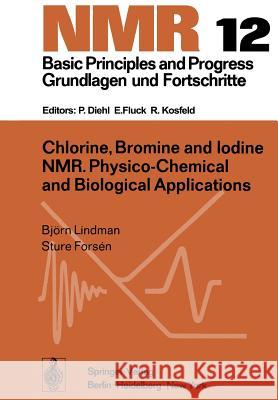
Chlorine, Bromine and Iodine NMR: Physico-Chemical and Biological Applications Lindman, B. 9783642663659 Springer - książkaWidoczna okładka, to zdjęcie poglądowe, a rzeczywista szata graficzna może różnić się od prezentowanej.

Chlorine, Bromine and Iodine NMR: Physico-Chemical and Biological Applications

ISBN-13: 9783642663659 / Angielski / Miękka / 2012 / 372 str.

B. Lindman; S. Forsen
cena 605,23 zł
(netto: 576,41 VAT:  5%)

Najniższa cena z 30 dni: 578,30 zł
Termin realizacji zamówienia:
ok. 22 dni roboczych
Bez gwarancji dostawy przed świętami

Darmowa dostawa!

The increasing interest in NMR spectroscopy of what in some confer ences in this field is commonly termed "other nuclei" is unmistakable. Chemists and biologists who employ NMR spectroscopy to study their problems have, however, been somewhat reluctant to study nuclei with electric quadrupole moments. These nuclei frequently give rise to broad NMR signals, sometimes too broad to be detectable with ordinary high resolution NMR spectrometers. Spectrometers that could cope with broad NMR signals of low intensity, "wide-line" spectrometers, have been available since the mid 1950: s but it appears that most of these instruments ended up in physical laboratories where the research was primarily directed towards solid state problems. The study of quadrupolar nuclei can provide unique and very valuable information on a variety of physico-chemical and biological systems. For one thing the relaxation of quadrupolar nuclei is in many ways easier to interpret than the relaxation of non-quadrupolar nuclei, since the former is in many cases caused by purely intramolecular interactions modulated by the molecular motion. Studies of quadrupolar relaxation have therefore furnished important information about molec ular reorientation and association in liquids and have played - and will certainly play for many years - an important role in testing new theoretical models of molecular motion in liquids."


Kategorie:
Nauka, Chemia
Kategorie BISAC:
Science > Chemia - Analityczna
Science > Chemia - Organiczna
Science > Fizyka jądrowa
Wydawca:
Springer
Seria wydawnicza:
NMR Basic Principles and Progress
Język:
Angielski
ISBN-13:
9783642663659
Rok wydania:
2012
Wydanie:
Softcover Repri
Numer serii:
000221393
Ilość stron:
372
Waga:
0.67 kg
Wymiary:
24.4 x 17.0
Oprawa:
Miękka
Wolumenów:
01

1. Introductory Aspects.- 1.1 General Properties of Halogens.- 1.2 Static Parameters.- 1.2.1 Quadrupole Splittings.- 1.2.2 Nuclear Shielding.- 1.2.3 Spin-Spin Couplings.- 1.3 Dynamic Parameters.- 1.3.1 Quadrupolar Relaxation.- 1.3.2 Other Relaxation Mechanisms.- 1.4 Chemical Exchange Effects.- 1.5 Experimental Aspects.- 2. Relaxation in Molecules or Ions With Covalently Bonded Halogens.- 2.1 Quadrupole Relaxation.- 2.1.1 General Aspects.- 2.1.2 On the Evaluation of the Correlation Time.- 2.1.3 Models for Molecular Rotation in Liquids.- 2.1.4 Survey of Experimental Results and Their Interpretation.- 2.2 Other Relaxation Mechanisms.- 3. Shielding Effects in Covalent Halogen Compounds.- 3.1 Theoretical Aspects.- 3.1.1 General Considerations.- 3.1.2 Approximate Calculations of Nuclear Shielding.- 3.1.3 Correlations Between Electronic Shielding and Quadrupolar Coupling Constants.- 3.1.4 Halide Ion Shielding in Crystals and Aqueous Solutions.- 3.2 Experimental Data.- 3.3 Medium Effects on Halogen Shielding Constants.- 3.3.1 General Considerations.- 3.3.2 Medium Effects on Chlorine Shielding Values.- 4. Scalar Spin Couplings.- 4.1 General Considerations.- 4.2 Experimental Data on Cl, Br and I Spin Couplings.- 5. Relaxation of Chloride, Bromide and Iodide Ions.- 5.1 Quadrupole Relaxation.- 5.1.1 General Aspects.- 5.1.2 Halide Ion Quadrupole Relaxation in Infinitely Dilute Aqueous Solutions.- 5.1.2.1 Experimental Results.- 5.1.2.2 Electrostatic Models.- 5.1.2.3 Electronic Distortion Model.- 5.1.3 Aqueous Solutions of Alkali Halides.- 5.1.3.1 Experimental Concentration Dependences.- 5.1.3.2 Electrostatic Model.- 5.1.3.3 Electronic Distortion Model.- 5.1.3.4 Water Isotope Effect.- 5.1.3.5 Mixed Alkali Halide Solutions.- 5.1.3.6 Temperature Dependence.- 5.1.4 Aqueous Solutions of Other Inorganic Halides.- 5.1.4.1 Hydrogen Halides.- 5.1.4.2 Ammonium Halides.- 5.1.4.3 Alkaline Earth Halides.- 5.1.4.4 Other Metal Halides.- 5.1.5 Aqueous Solutions Containing Small Hydrophobic Ions or Molecules.- 5.1.6 Halide Ions in Surfactant Systems.- 5.1.7 Halide Ions in Mixed Solvent and Non-Aqueous Solutions.- 5.2 Relaxation Rates and Chemical Shifts in Paramagnetic Systems.- 5.2.1 General Comments.- 5.2.2 Experimental Studies.- 5.3 Chemical Exchange of Halide Ions.- 5.3.1 General Considerations.- 5.3.2 Effects of Different Isotopes.- 5.3.3 Exchange Rates Accessible for Study.- 5.3.4 Ligand Exchange Mechanisms in Inorganic Halide Complexes.- 5.3.5 Experimental Studies of Halide Ion Exchange: Systems Involving Halogen Molecules.- 5.3.6 Experimental Studies of Halide Ion Exchange: Metal-Halide Complexes.- 6. Shielding of Halide Ions.- 6.1 Absolute Shielding Values of Ions in Aqueous Solutions.- 6.1.1 Theoretical Calculations of Shieldings in Alkali Halide Crystals.- 6.1.2 Estimates of Absolute Ion Shieldings from Relaxation Rates and Solvent Isotope Shifts.- 6.1.3 Molecular Beam and Atomic Beam Data.- 6.1.4 Discussion of the Absolute Shielding Values in Table 6.1.- 6.2 Shielding in Aqueous Alkali Halide Solutions.- 6.3 Shielding in Other Aqueous Solutions.- 6.4 Shielding in Mixed Solvent and Non-Aqueous Solution.- 6.5 Water Solvent Isotope Effect on Shielding.- 7. Quadrupole Splittings in Liquid Crystals.- 7.1 General Aspects on Static Quadrupole Effects of Mesomorphous Systems.- 7.2 Halogen Quadrupole Splittings of Covalent Compounds in Liquid Crystals.- 7.3 Quadrupole Splittings of Halide Ions in Amphiphilic Mesophases.- 8. Halide Ions in Biological Systems.- 8.1 General Principles.- 8.1.1 Introduction.- 8.1.2 Quadrupolar Relaxation of I = 3/2 Nuclei.- 8.1.3 Chemical Exchange of a Spin I = 3/2 Nucleus.- 8.1.4 The Influence of Chemical Exchange on the Correlation Time ?C.- 8.1.5 Effects of Internal Motion at the Macromolecular Binding Site.- 8.1.6 Halide Exchange in Multi-Site Systems.- 8.1.7 General Types of Biological Halide NMR Studies and Parameters Attainable.- 8.1.8 Evaluation of Rate Parameters.- 8.1.9 Determination of Binding Constants and Related Parameters.- 8.1.10 Competition Experiments Between Different Ligands.- 8.1.11 Evaluation of Rotational Correlation Times.- 8.2 Small Molecules or Ions of Biological Interest.- 8.3 Polypeptides.- 8.4 Proteins.- 8.4.1 Carbonic Anhydrase.- 8.4.2 Alcohol Dehydrogenase.- 8.4.3 Alkaline Phosphates.- 8.4.4 Serum Albumin.- 8.4.5 Hemoglobin.- 8.4.6 Other Proteins.- 8.5 Miscellaneous Systems.- 9. Studies of the Perchlorate Ion.- 9.1 Introduction.- 9.2 Shielding.- 9.3 Quadrupole Effects.- 10. Recent Work.- 11. References.- 12. Subject Index.


Udostępnij

Facebook - konto krainaksiazek.pl


Opinie o Krainaksiazek.pl na Opineo.pl

Partner Mybenefit

Krainaksiazek.pl w programie rzetelna firma Krainaksiaze.pl - płatności przez paypal

Czytaj nas na:

Facebook - krainaksiazek.pl
  • książki na zamówienie
  • granty
  • książka na prezent
  • kontakt
  • pomoc
  • opinie
  • regulamin
  • polityka prywatności

Zobacz:

  • Księgarnia czeska

  • Wydawnictwo Książkowe Klimaty

1997-2025 DolnySlask.com Agencja Internetowa

© 1997-2022 krainaksiazek.pl
     
KONTAKT | REGULAMIN | POLITYKA PRYWATNOŚCI | USTAWIENIA PRYWATNOŚCI
Zobacz: Księgarnia Czeska | Wydawnictwo Książkowe Klimaty | Mapa strony | Lista autorów
KrainaKsiazek.PL - Księgarnia Internetowa

Polityka prywatnosci - link
Krainaksiazek.pl - płatnośc Przelewy24
Przechowalnia Przechowalnia





