• Wyszukiwanie zaawansowane
  • Kategorie
  • Kategorie BISAC
  • Książki na zamówienie
  • Promocje
  • Granty
  • Książka na prezent
  • Opinie
  • Pomoc
  • Załóż konto
  • Zaloguj się

Chemistry and Physics of Solid Surfaces VII » książka


zaloguj się | załóż konto
Logo Krainaksiazek.pl

koszyk

konto

szukaj
topmenu
Księgarnia internetowa
Szukaj
Książki na zamówienie
Promocje
Granty
Książka na prezent
Moje konto
Pomoc
 
 
Wyszukiwanie zaawansowane
Pusty koszyk
Bezpłatna dostawa dla zamówień powyżej 20 złBezpłatna dostawa dla zamówień powyżej 20 zł

Kategorie główne

• Nauka
 [2944077]
• Literatura piękna
 [1814251]

  więcej...
• Turystyka
 [70679]
• Informatyka
 [151074]
• Komiksy
 [35590]
• Encyklopedie
 [23169]
• Dziecięca
 [611005]
• Hobby
 [136031]
• AudioBooki
 [1718]
• Literatura faktu
 [225599]
• Muzyka CD
 [379]
• Słowniki
 [2916]
• Inne
 [443741]
• Kalendarze
 [1187]
• Podręczniki
 [166463]
• Poradniki
 [469211]
• Religia
 [506887]
• Czasopisma
 [481]
• Sport
 [61343]
• Sztuka
 [242115]
• CD, DVD, Video
 [3348]
• Technologie
 [219293]
• Zdrowie
 [98602]
• Książkowe Klimaty
 [124]
• Zabawki
 [2385]
• Puzzle, gry
 [3504]
• Literatura w języku ukraińskim
 [260]
• Art. papiernicze i szkolne
 [7151]
Kategorie szczegółowe BISAC

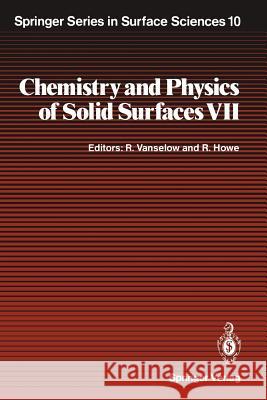
Chemistry and Physics of Solid Surfaces VII

ISBN-13: 9783642739040 / Angielski / Miękka / 2011 / 616 str.
Ralf Vanselow;Russell F. Howe
Chemistry and Physics of Solid Surfaces VII Ralf Vanselow, Russell F. Howe 9783642739040 Springer-Verlag Berlin and Heidelberg GmbH &  - książkaWidoczna okładka, to zdjęcie poglądowe, a rzeczywista szata graficzna może różnić się od prezentowanej.

Chemistry and Physics of Solid Surfaces VII

ISBN-13: 9783642739040 / Angielski / Miękka / 2011 / 616 str.

Ralf Vanselow;Russell F. Howe
cena 201,24
(netto: 191,66 VAT:  5%)

Najniższa cena z 30 dni: 192,74
Termin realizacji zamówienia:
ok. 22 dni roboczych.

Darmowa dostawa!

This volume contains review articles written by the invited speakers at the eighth International Summer Institute in Surface Science (ISISS 1987), held at the University of Wisconsin-Milwaukee in August of 1987. During the course of ISISS, invited speakers, all internationally recognized experts in the various fields of surface science, present tutorial review lectures. In addition, these experts are asked to write review articles on their lecture topic. Former ISISS speakers serve as advisors concerning the selection of speakers and lecture topics. Em phasis is given to those areas which have not been covered in depth by recent Summer Institutes, as well as to areas which have recently gained in significance and in which important progress has been made. Because of space limitations, no individual volume of Chemistry and Physics of Solid Surfaces can possibly cover the whole area of modem surface science, or even give a complete survey of recent pro gress in the field. However, an attempt is made to present a balanced overview in the series as a whole. With its comprehensive literature references and extensive subject indices, this series has become a valu able resource for experts and students alike. The collected articles, which stress particularly the gas-solid interface, have been published under the following titles: Surface Science: Recent Progress and Perspectives, Crit. Rev. Solid State Sci. 4, 125-559 (1974) Chemistry and Physics of Solid Surfaces, Vols. I, II, and III (CRC Press Boca Raton, FL 1976, 1979, and 1982); Vols."


Kategorie:
Technologie
Kategorie BISAC:
Science > Physics - Condensed Matter
Technology & Engineering > Materials Science - Thin Films, Surfaces & Interfaces
Science > Chemia - Fizyczna
Wydawca:
Springer-Verlag Berlin and Heidelberg GmbH &
Seria wydawnicza:
Springer Series in Surface Sciences
Język:
Angielski
ISBN-13:
9783642739040
Rok wydania:
2011
Dostępne języki:
Angielski
Wydanie:
Softcover Repri
Numer serii:
000022131
Ilość stron:
616
Waga:
0.95 kg
Wymiary:
23.523.5 x 15.5
Oprawa:
Miękka
Wolumenów:
01

1. Activated Chemisorption.- 1.1 A Brief History.- 1.2 Classification of Activated Chemisorption.- 1.2.1 Molecular Structure.- 1.2.2 Electronic Structure of the Gas.- 1.2.3 Electronic Structure of the Solid.- 1.2.4 Atomic Arrangement of the Solid.- 1.2.5 Strength of Chemisorption Bonding.- 1.2.6 Surprises.- 1.3 Formal Kinetics.- 1.3.1 Concentration Dependence of Chemisorption Rates.- 1.3.2 Temperature Dependencies.- 1.3.3 Angular and Mass Dependence.- 1.4 Case Studies in Activated Adsorption.- 1.4.1 Methane and Other Alkanes on Metal Surfaces.- 1.4.2 Hydrogen on Copper.- 1.4.3 Hydrogen on Elemental Semiconductors.- 1.4.4 Activated Adsorption on Densely Packed Planes.- a) Hydrogen and Nitrogen on W, Re, and Ru.- b) Hydrogen on Platinum .- c) Hydrogen on Nickel and .- 1.4.5 Slow Chemisorption of Nitrogen.- a) Nitrogen on Platinum Group Metals.- b) Chemisorption of Nitrogen on Iron.- 1.4.6 A Surprise: Oxygen on W.- 1.5 Summary.- References.- 2. Physisorbed Rare Gas Adlayers.- 2.1 Experimental Techniques.- 2.1.1 General Remarks.- 2.1.2 Probe Particles.- a) Electrons.- b) Neutrons.- c) X-Ray Photons.- d) Helium Atoms.- 2.2 Solid-Solid Transitions in Two Dimensions.- 2.2.1 Commensurability.- 2.2.2 Fundamentals of the Theory Describing the Commensurate-Incommensurate Transition in 2D.- 2.2.3 The C-I Transition of Monolayer Xe on Pt.- 2.2.4 Can High Order Commensurate Adlayers be Distinguished from Incommensurate Ones?.- i) Thermal expansion.- ii) Commensurate buckling.- iii) Lattice dynamical criterion.- iv) Bragg peak singularities.- 2.2.5 The I-HOC Phase Transition of Monolayer Kr on Pt.- 2.2.6 Rotational Epitaxy of Monolayers.- 2.3 Multilayer Growth of Rare Gases.- 2.3.1 Dynamical Coupling Between Adlayer and Substrate.- 2.3.2 Layer-by-Layer Evolution of the Lattice Dynamics.- 2.3.3 Growth Mode and the Scale of Substrate Strength.- 2.3.4 Epitaxial Layer Growth of Xe on Pt.- 2.4 Conclusion.- References.- 3. Infrared Spectroscopy of Semiconductor Surfaces.- 3.1 Theoretical Framework.- 3.1.1 Macroscopic Theory (Three-Layer Model).- 3.1.2 Microscopic Model of the Active Layer.- 3.1.3 Model for Electronic Absorption.- 3.1.4 Discussion of the Assumption of Sharp Boundaries.- 3.1.5 First-Principle Calculations.- 3.2. Experimental Geometries and Techniques.- 3.2.1 Vibrational Modes in Substrate Optical Gap.- 3.2.2 Vibrational Modes in Substrate Absorption Region.- 3.2.3 Experimental Apparatus.- a) Surface Infrared Spectrometer.- b) Sample Geometry.- c) Other Techniques.- 3.3 Selected Examples.- 3.3.1 Structure of the Si-(2x1)H System.- 3.3.2 H-saturated Si and Ge Surfaces.- 3.3.3 Dynamics of H on Si.- 3.3.4 H2O on Si.- 3.3.5 Electronic Absorption of Si and Si.- a) Si.- b) Si.- 3.3.6 Chemistry at Semiconductor Surfaces.- 3.4 Problems and Future Directions.- 3.5 Conclusions.- References.- 4. Surface Phonons — Theory.- 4.1 Discoveries and Advances.- 4.1.1 Advances in Experimental Studies of Surface Phonons.- 4.1.2 New Computational Methods.- A) Clean Surfaces.- a) Spectral Densities.- b) Surface Phonons and Resonances.- c) Anharmonic Effects.- d) First Principles Calculations of Surface Phonon Dispersion Curves.- B) Adsorbate Covered Surfaces.- a) A Single Adparticle.- b) A Periodic Array of Adatoms.- 4.2 Surface Phonons on Complex Crystals and Structures.- 4.2.1 Surface Phonon Anomalies Caused by the Electron-Phonon Interaction.- 4.2.2 Surface Phonon Kohn Anomalies.- 4.2.3 Molecular Crystals.- 4.2.4 Crystal Surfaces with High Miller Indices.- 4.2.5 Reconstructed Surfaces.- 4.2.6 Amorphous Media.- 4.2.7 An Incommensurate Array of Adatoms.- 4.3 Some Directions for Future Research.- References.- 5. Interpretation of the NEXAFS Spectra of Adsorbates Using Multiple Scattering Calculations.- 5.1 Multiple Scattering Calculations of Near Edge Spectra of Molecules.- 5.2 Atomic and Diatomic Adsorbates.- 5.3 Computational Method for Complex Molecules and Clusters.- 5.4 More Complex Adsorbates.- 5.4.1 Ethylene and Ethylidyne on Pt.- 5.4.2 Benzene on Pt.- 5.4.3 Saturated Cyclic Hydrocarbons.- 5.4.4 Thiophene and Platinum Metallacycle.- 5.5 Conclusions.- References.- 6. Near-Edge X-Ray Absorption Fine Structure Spectroscopy: A Probe of Local Bonding for Organic Gases, Solids, Adsorbates, and Polymers.- 6.1 Development of NEXAFS: An Overview.- 6.2 Experimental Details.- 6.3 Results and Analysis.- 6.3.1 The Signatures of Individual Bonds.- 6.3.2 Assembly of Diatomics to Functional Groups.- 6.3.3 The Fingerprints of Functional Groups.- 6.3.4 Assembly of Functional Groups to Macromolecules.- 6.3.5 Limitations of the Building Block Approach.- 6.4 Conclusions and Future Prospects.- References.- 7. Surface Kinetics with Near Edge X-Ray Absorption Fine Structure.- 7.1 An Overview of Methods for Characterizing Surface Reactions.- 7.2 Transient Near-Edge X-ray Absorption Fine Structure (NEXAFS) as a Probe of Surface Reactions.- 7.2.1 Soft X-ray Absorption Using Electron Detection.- 7.2.2 CO Desorption from the Pt Surface.- 7.2.3 Pyridine Reorientation of the Ag Surface.- 7.2.4 Ethylene Conversion to Ethylidyne on the Pt Surface.- 7.2.5 Summary: Transient NEXAFS Using Electron Detection.- 7.3 Fluorescence Yield Near-Edge Structure (FYNES).- in the Soft X-ray Region.- 7.3.1 Apparatus.- 7.3.2 Summary: Soft X-ray Absorption Using Fluorescence Detection.- 7.4 Future Opportunities.- References.- 8. Overview of Electron Microscopy Studies of the So-Called “Strong Metal-Support Interaction” (SMSI).- 8.1 Experimental.- 8.2 Results and Discussion.- 8.3 Summary.- References.- 9. Theory of Desorption Kinetics.- 9.1 Nonequilibrium Thermodynamics of a Two-Phase Adsorbate.- 9.1.1 Preliminary Comments.- 9.1.2 General Formulation.- a) Adsorption.- b) Desorption.- c) Two-Dimensional Condensation and Evaporation.- d) Equilibration of the 2D Gas Phases.- e) Equilibrium Properties.- 9.1.3 Results.- 9.1.4 A Simplified Model.- 9.2 Microscopic Approaches.- 9.3. Outlook.- References.- 10. Fractals in Surface Science: Scattering and Thermodynamics of Adsorbed Films.- 10.1 Fundamentals of Fractal Geometry.- 10.1.1 Definition 1.- 10.1.2 Definition 2.- 10.2 Small-Angle Scattering from Fractal Surfaces.- 10.2.1 Theorem 1.- 10.2.2 Theorem 2.- 10.2.3 Theorem 3.- 10.3 Application: Small-Angle He Scattering from Adsorbate Islands on an Ordered Surface.- 10.4 Scattering from a Diffusing Adsorbate on a Fractal Surface.- 10.5 Henry’s Law of Adsorption on a Fractal Surface.- 10.6 BET Condensation of a Gas on a Fractal Surface.- 10.7 Bose-Einstein Condensation in Nonintegral Dimensions.- 10.8 Conclusion.- References.- 11. Critical Phenomena of Chemisorbed Atoms and Reconstruction — Revisited.- 11.1 Brief Recap.- 11.2 Results from Computed Structure Factors.- 11.2.1 General Features.- 11.2.2 Diffraction-Limit Results.- 11.2.3 Energy-Like Limit.- 11.2.4 Melting to an Incommensurate Disordered Phase.- 11.2.5 Critical Behavior at Temperature-Driven First-Order Transitions.- 11.2.6 Effects of Defects.- 11.3 Experimental Progress Since ISISS-1981.- 11.3.1 4-State Potts Systems: O/Ru.- 11.3.2 Ising Systems.- 11.3.3 XY with Cubic Anisotropy.- 11.3.4 Se/Ni: Realization of the Ashkin-Teller Model?.- 11.4 Conclusions.- References.- 12. Surface Electronic Interactions of Slow Ions and Metastable Atoms.- 12.1 Electron Ejection by Auger Neutralization (AN) and Auger De-excitation (AD).- 12.2 Resonance Tunneling Makes Two-Stage Processes Possible.- 12.3 Matrix Elements, Transition Rates, and Related Probability Functions.- 12.4 Variation of Atomic Energy Levels Near a Solid Surface.- 12.5 Excitation Conversion of He*(1S) to He*(3S).- 12.6 What Determines the Ultimate Mode of Electron Ejection?.- 12.7 A Selective Listing of Investigations with Some Comments.- 12.8 Summary.- References.- 13. Equilibrium Crystal Shapes and Interfacial Phase Transitions.- 13.1 Introduction.- 13.2 The Crystal Shape as a Free Energy.- 13.3 The Wulff Construction as Legendre Transformation.- 13.4 Applications.- 13.4.1 Facets, Cusps, and Roughening.- 13.4.2 Sharp Edges, Thermal Faceting, and Forbidden Regions of the Wulff Plot.- 13.4.3 T=0 Roughening and the Degeneracy of Corners and Edges.- 13.4.4 The Statistical Mechanics of Crystal Shapes.- 13.4.5 Critical Behavior of the Equilibrium Crystal Shape.- 13.4.6 Calculating the Shapes of Real Crystals.- 13.5 Open Questions.- References.- 14. Experimental Aspects of Surface Roughening.- 14.1 Equilibrium Crystal Shapes and Surface Roughening.- 14.2 The Detection of Steps on Surfaces.- 14.3 Energetics of Step Formation and Surface Diffusion.- 14.4 Diffraction Studies of the Roughening Transition.- 14.5 The Dependence of TR on Crystal Orientation.- 14.6 Conclusions.- References.- 15. Relationship Between Anisotropy of Specific Surface Free Energy and Surface Reconstruction.- 15.1 Introduction.- 15.2 Anisotropics of Specific Surface Free Energy, ?(?).- 15.2.1 Experiment.- 15.2.2 Theory.- 15.3 Reconstruction of Pt — Surface Self-Diffusion Measurements.- 15.4 Surface-Atom Core Level Shifts of Pt.- 15.5 Adsorbate-Induced Reconstruction.- 15.6 Reconstruction and Faceting — a Comparison.- References.- 16. Surface Melting.- 16.1 Melting and the Role of the Surface.- 16.2 Thermodynamics of Surface Melting.- 16.2.1 Driving Force.- 16.2.2 Which Surfaces Do Melt?.- 16.2.3 Crystal-Face Dependence of Surface Melting.- 16.2.4 Molecular Dynamics Simulations and Phenomenological Theories.- 16.3 Observations of Surface Melting.- 16.3.1 Calorimetry.- 16.3.2 Optical Measurements.- 16.3.3 Rutherford Backscattering of Ions.- a) Shadowing and Blocking.- b) Backscattering from a Melted Surface.- c) Melting of Pb.- d) Melting or Non-Melting of Pb.- 16.3.4 Diffraction.- 16.3.5 Neutron and He Scattering.- 16.4 Summary and Outlook.- References.- 17. The Surface of Solid Helium.- 17.1 Review of the Properties of Helium-4.- 17.2 Growth of Solid Helium-4.- 17.2.1 Melting-Freezing Waves.- 17.2.2 Boundary Conditions at a Moving Interface.- 17.2.3 Kapitza Resistance.- 17.2.4 Growth Coefficient.- 17.2.5 High Velocity Growth.- 17.3 Facets and Facetting Transitions.- 17.3.1 Roughening Temperatures.- 17.3.2 Theoretical Situation.- 17.3.3 Experimental Results Near Roughening Transitions.- 17.4 Helium-3.- 17.5 Summary.- References.- 18. Solving Complex and Disordered Surface Structures with Electron Diffraction.- 18.1 Introduction.- 18.1.1 The Past.- 18.1.2 The Objective.- 18.2 Towards Diffraction from Complex and Disordered Surfaces.- 18.2.1 The Problem.- 18.2.2 Basic LEED Methods.- 18.2.3 Theoretical Solutions.- a) Cluster Methods.- b) Reducing Multiple-Scattering Paths.- c) Kinematic Sublayer Addition.- d) Forward Focusing.- e) Beam Set Neglect.- f) Tensor LEED.- g) Combinations.- 18.3 Order vs Disorder and Diffraction.- 18.4 Cluster-Oriented Approaches.- 18.4.1 Kinematic Cluster Addition.- 18.4.2 Near-Field Expansion in Clusters.- 18.5 Beam-Oriented Approaches.- 18.5.1 Plane Waves Despite Large Unit Cells and Disorder.- 18.5.2 Beam Set Neglect.- a) Two Important Beam Sets.- b) Accuracy of Beam Set Neglect.- c) Surface Reconstruction.- d) Disorder.- e) Incommensurate Overlayers.- f) Combination with Other Methods.- g) Advantages and Disadvantages of BSN.- 18.5.3 Kinematic Sublayer Addition.- 18.6 Experimental Requirements.- 18.7 Conclusions.- References.- 19. Recent Developments in Scanning Tunneling Microscopy and Related Techniques.- 19.1 Scanning Tunneling Microscopy.- 19.1.1 Study of Surface Atomic and Electronic Structure.- 19.1.2 Other Applications of STM.- 19.2 The Atomic Force Microscope.- 19.3 Related Microscopies.- References.- 20. Growth Kinetics of Silicon Molecular Beam Epitaxy.- 20.1 Two Dimensional Growth of the Matrix.- 20.1.1 Vertical Growth by Lateral Motion of Surface Steps.- 20.1.2 Burton-Cabrera-Frank (BCF) Theory.- 20.1.3 LEED/RHEED Oscillations.- 20.2 Impurity Incorporation into Si-MBE Layers.- 20.2.1 Secondary Implantation.- 20.3 Limits of the Two-Dimensional (2D) Growth Mode.- 20.3.1 Surface Contamination.- 20.3.2 Heteroepitaxy.- 20.3.3 The SiGe/Si System.- 20.4 Conclusion.- References.


Udostępnij

Facebook - konto krainaksiazek.pl


Opinie o Krainaksiazek.pl na Opineo.pl

Partner Mybenefit

Krainaksiazek.pl w programie rzetelna firma Krainaksiaze.pl - płatności przez paypal

Czytaj nas na:

Facebook - krainaksiazek.pl
  • książki na zamówienie
  • granty
  • książka na prezent
  • kontakt
  • pomoc
  • opinie
  • regulamin
  • polityka prywatności

Zobacz:

  • Księgarnia czeska

  • Wydawnictwo Książkowe Klimaty

1997-2026 DolnySlask.com Agencja Internetowa

© 1997-2022 krainaksiazek.pl
     
KONTAKT | REGULAMIN | POLITYKA PRYWATNOŚCI | USTAWIENIA PRYWATNOŚCI
Zobacz: Księgarnia Czeska | Wydawnictwo Książkowe Klimaty | Mapa strony | Lista autorów
KrainaKsiazek.PL - Księgarnia Internetowa

Polityka prywatnosci - link
Krainaksiazek.pl - płatnośc Przelewy24
Przechowalnia Przechowalnia






