• Wyszukiwanie zaawansowane
  • Kategorie
  • Kategorie BISAC
  • Książki na zamówienie
  • Promocje
  • Granty
  • Książka na prezent
  • Opinie
  • Pomoc
  • Załóż konto
  • Zaloguj się

Chemically Induced Dynamic Nuclear and Electron Polarizations-Cidnp and Cidep » książka


zaloguj się | załóż konto
Logo Krainaksiazek.pl

koszyk

konto

szukaj
topmenu
Księgarnia internetowa
Szukaj
Książki na zamówienie
Promocje
Granty
Książka na prezent
Moje konto
Pomoc
 
 
Wyszukiwanie zaawansowane
Pusty koszyk
Bezpłatna dostawa dla zamówień powyżej 20 złBezpłatna dostawa dla zamówień powyżej 20 zł

Kategorie główne

• Nauka
 [2946600]
• Literatura piękna
 [1856966]

  więcej...
• Turystyka
 [72221]
• Informatyka
 [151456]
• Komiksy
 [35826]
• Encyklopedie
 [23190]
• Dziecięca
 [619653]
• Hobby
 [140543]
• AudioBooki
 [1577]
• Literatura faktu
 [228355]
• Muzyka CD
 [410]
• Słowniki
 [2874]
• Inne
 [445822]
• Kalendarze
 [1744]
• Podręczniki
 [167141]
• Poradniki
 [482898]
• Religia
 [510455]
• Czasopisma
 [526]
• Sport
 [61590]
• Sztuka
 [243598]
• CD, DVD, Video
 [3423]
• Technologie
 [219201]
• Zdrowie
 [101638]
• Książkowe Klimaty
 [124]
• Zabawki
 [2473]
• Puzzle, gry
 [3898]
• Literatura w języku ukraińskim
 [254]
• Art. papiernicze i szkolne
 [8170]
Kategorie szczegółowe BISAC

Chemically Induced Dynamic Nuclear and Electron Polarizations-Cidnp and Cidep

ISBN-13: 9783642657955 / Angielski / Miękka / 2011 / 130 str.
C. Richard; P. Granger
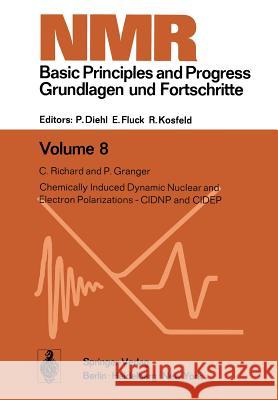
Chemically Induced Dynamic Nuclear and Electron Polarizations-Cidnp and Cidep Richard, C. 9783642657955 Springer - książkaWidoczna okładka, to zdjęcie poglądowe, a rzeczywista szata graficzna może różnić się od prezentowanej.

Chemically Induced Dynamic Nuclear and Electron Polarizations-Cidnp and Cidep

ISBN-13: 9783642657955 / Angielski / Miękka / 2011 / 130 str.

C. Richard; P. Granger
cena 403,47 zł
(netto: 384,26 VAT:  5%)

Najniższa cena z 30 dni: 385,52 zł
Termin realizacji zamówienia:
ok. 22 dni roboczych
Bez gwarancji dostawy przed świętami

Darmowa dostawa!

Anomalous electron-spin state populations in the Electron Paramagnetic Re sonance (EPR) spectra of radicals formed during radio lysis experiments were observed in 1963 by FESSENDEN and SCHULER 170a]. This phenomenon did not receive much attention at the time. In 1967, BARGON, FISCHER, and JOHNSEN 5] and independently WARD and LAWLER 7,8] reported a similar phenomenon for Nuclear Magnetic Resonance (NMR) spectra taken during radical reactions: emission or enhanced absorption, or both. The earliest attempts to explain this new NMR phenomenon treated these effects in a way similar to that of Dynamic Nuclear Polarization (DNP) or the Overhauser effect. Although the polarization has a completely different origin, DNP gave its name to this effect: Chemically Induced Dynamic Nuclear Polariza tion (CIDNP). The name Chemically Induced Dynamic Electron Polarization (CIDEP) was introduced later by analogy with CIDNP]. After the initial publica tions, all the new data demonstrated that the first theory could not be correct. In 1969, a new theory was proposed by CLOSS 18] and independently by KAPTEIN and OOSTERHOFF 23] and called the radical-pair theory. This mechanism was proposed to account for the observations of polarization in both NMR and EPR. The radical-pair theory is based on weak interactions in a pair of radicals: the strength of interaction between the electronic states of the radicals depends in particular on the nuclear-spin states."


Kategorie:
Nauka, Chemia
Kategorie BISAC:
Science > Chemia - Fizyczna
Science > Chemia - Organiczna
Wydawca:
Springer
Seria wydawnicza:
NMR Basic Principles and Progress
Język:
Angielski
ISBN-13:
9783642657955
Rok wydania:
2011
Wydanie:
Softcover Repri
Numer serii:
000221393
Ilość stron:
130
Waga:
0.25 kg
Wymiary:
24.4 x 17.0
Oprawa:
Miękka
Wolumenów:
01

I. Origin of the CIDNP Effect.- I. Introduction.- II. The Phenomenon.- 1. Examples.- 2. Polarized NMR Spectra.- III. First Interpretations of the CIDNP Effect.- 1. Interpretation by Dynamic Nuclear Polarization (DNP).- 2. Criticisms of the DNP Theory.- 3. Other Interpretations.- IV. The Radical-Pair Theory.- 1. Radical-Pair Model.- 2. Parameters of the Radical-Pair Theory.- V. Applications of the CIDNP Effect.- 1. Determination of the Magnetic Properties of Free Radicals and Molecules.- 2. Studies of Radical Reactions.- VI. Experimental Procedures.- 1. Thermal Reactions.- 2. Photochemical Reactions.- 3. Other Nuclei.- II. The Theory of the CIDNP Effect.- I. Basic Principles.- 1. Spin Functions.- 2. Influence of a Magnetic Field on a Particle with a Spiny.- 3. Interactions between Spins in a Molecule or a Radical.- 4. Other Interactions.- 5. NMR Line Intensities.- 6. The Diffusion Theory for Radicals.- II. The Radical-Pair Model.- 1. Concept of the Radical Pair.- 2. Radical-Pair Generation.- 3. The Disappearance of the Radical Pair.- 4. Energy of a Radical Pair in a Magnetic Field.- 5. The Hamiltonian of the Radical Pair.- 6. Spin Evolution of the Radical Pair with Time.- III. Theoretical Calculation of the CIDNP Effect (CKO).- 1. Reaction Probability.- 2. Calculation of Enhancement Factors.- 3. Forms of the Spectrum. Kaptein’s Rules.- 4. Example.- IV. Kinetic Formulation of the Radical-Pair Mechanism.- 1. Principle.- 2. Application.- 3. kij? Calculation.- V. The Influence of the Magnetic Field H0 on the CIDNP Spectra.- 1. Introduction.- 2. Extension of the CKO Theory.- 3. The Density-Matrix Formulation (GCKO Theory).- 4. Kaptein’s Theory for Low Field.- 5. Glarum’s Theory.- VI. Relaxation and other Effects.- 1. Relaxation.- 2. Sample Form.- 3. Isotopic Substitutions.- III. Applications to the Study of Chemical Reactions and Magnetic Properties.- I. Applications to the Study of Chemical Reactions.- 1. Reaction Types Studied by CIDNP.- 2. Thermal or Photochemical Decompositions of Peroxides.- 3. Photochemical Reactions.- 4. Application of CIDNP to Chemical Kinetics.- 5. Rearrangements.- 6. CIDNP of 13C.- 7. CIDNP of 19F.- 8. CIDNP of 31P and 15N.- II. Determination of the Magnetic Properties of Radicals and Molecules.- 1. Sign Determination.- 2. Hyperfine Coupling Constant A.- 3. Spectroscopic Splitting Factor g or ? g.- 4. J Determination (Overlap Integral).- 5. Relaxation Times.- IV. The Chemically Induced Dynamic Electron Polarization (CIDEP Effect).- I. Introduction.- II. Experimental Procedures.- 1. Electron Irradiation.- 2. UV Irradiation.- 3. Other Methods.- III. Experimental Results.- IV. The Theory of the CIDEP Effect.- 1. Kaptein-Adrian Theory.- 2. Glarum-Marshall Model.- 3. Simple Theory for the H Atom.- Conclusion.- References.- Subject-Index.


Udostępnij

Facebook - konto krainaksiazek.pl


Opinie o Krainaksiazek.pl na Opineo.pl

Partner Mybenefit

Krainaksiazek.pl w programie rzetelna firma Krainaksiaze.pl - płatności przez paypal

Czytaj nas na:

Facebook - krainaksiazek.pl
  • książki na zamówienie
  • granty
  • książka na prezent
  • kontakt
  • pomoc
  • opinie
  • regulamin
  • polityka prywatności

Zobacz:

  • Księgarnia czeska

  • Wydawnictwo Książkowe Klimaty

1997-2025 DolnySlask.com Agencja Internetowa

© 1997-2022 krainaksiazek.pl
     
KONTAKT | REGULAMIN | POLITYKA PRYWATNOŚCI | USTAWIENIA PRYWATNOŚCI
Zobacz: Księgarnia Czeska | Wydawnictwo Książkowe Klimaty | Mapa strony | Lista autorów
KrainaKsiazek.PL - Księgarnia Internetowa

Polityka prywatnosci - link
Krainaksiazek.pl - płatnośc Przelewy24
Przechowalnia Przechowalnia





