• Wyszukiwanie zaawansowane
  • Kategorie
  • Kategorie BISAC
  • Książki na zamówienie
  • Promocje
  • Granty
  • Książka na prezent
  • Opinie
  • Pomoc
  • Załóż konto
  • Zaloguj się

Carbosilanes: Syntheses and Reactions » książka


zaloguj się | załóż konto
Logo Krainaksiazek.pl

koszyk

konto

szukaj
topmenu
Księgarnia internetowa
Szukaj
Książki na zamówienie
Promocje
Granty
Książka na prezent
Moje konto
Pomoc
 
 
Wyszukiwanie zaawansowane
Pusty koszyk
Bezpłatna dostawa dla zamówień powyżej 20 złBezpłatna dostawa dla zamówień powyżej 20 zł

Kategorie główne

• Nauka
 [2946350]
• Literatura piękna
 [1816154]

  więcej...
• Turystyka
 [70666]
• Informatyka
 [151172]
• Komiksy
 [35576]
• Encyklopedie
 [23172]
• Dziecięca
 [611458]
• Hobby
 [135995]
• AudioBooki
 [1726]
• Literatura faktu
 [225763]
• Muzyka CD
 [378]
• Słowniki
 [2917]
• Inne
 [444280]
• Kalendarze
 [1179]
• Podręczniki
 [166508]
• Poradniki
 [469467]
• Religia
 [507199]
• Czasopisma
 [496]
• Sport
 [61352]
• Sztuka
 [242330]
• CD, DVD, Video
 [3348]
• Technologie
 [219391]
• Zdrowie
 [98638]
• Książkowe Klimaty
 [124]
• Zabawki
 [2382]
• Puzzle, gry
 [3525]
• Literatura w języku ukraińskim
 [259]
• Art. papiernicze i szkolne
 [7107]
Kategorie szczegółowe BISAC

Carbosilanes: Syntheses and Reactions

ISBN-13: 9783642708022 / Angielski / Miękka / 2011 / 258 str.
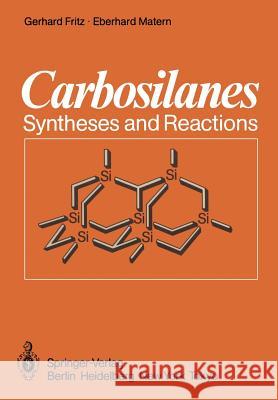
Gerhard Fritz; Eberhard Matern
Carbosilanes: Syntheses and Reactions Fritz, Gerhard 9783642708022 Springer - książkaWidoczna okładka, to zdjęcie poglądowe, a rzeczywista szata graficzna może różnić się od prezentowanej.

Carbosilanes: Syntheses and Reactions

ISBN-13: 9783642708022 / Angielski / Miękka / 2011 / 258 str.

Gerhard Fritz; Eberhard Matern
cena 201,24
(netto: 191,66 VAT:  5%)

Najniższa cena z 30 dni: 192,74
Termin realizacji zamówienia:
ok. 22 dni roboczych.

Darmowa dostawa!

Carbosilanes are compounds in which the elements silicon and carbon alternate in the molecular skeleton 1]. Just as the alkanes are formally derived from the diamond lattice and the aromatics from the graphite lattice, the carbosilanes are structurally derived from silicon carbide. Because of the tetravalent nature of silicon and carbon we can expect stable linear, cyclic and polycyclic compounds to occur. However, carbosilanes do not exist in nature. This book is an attempt to give a summarized presentation. Carbosilanes are, of course, part" of organosilicon chemistry, but their behavior differentiates them distinctly from other organosilicon compounds. The differences result primarily from the alternating Si-C-Si arrangements in the molecular skeleton, and especially the various methylene bridges (CH, CHX, CX; X = halogen) cause changes in z z Si-C bond polarization and hence influence the reaction possibilities. It is convenient to regard carbosilanes as similar to silicones except that the oxygen bridges of silicones are replaced by methylene units. However, this does not accurately account for all the chemical properties of these compounds. Carbosilanes are related more directly to silicon carbide, as shown occasionally by the reactive behavior of polycyclic car bosilanes. Therefore, in view of the present interest shown for thermally stable cera mics of unusual character, interesting possibilities arise for further development. Most cyclic carbosilanes can be classified in two groups: the carborundanes and the Si-scaphanes. Compounds belonging to the carborundane class maintain Si-C six-membered rings in the boat conformation."


Kategorie:
Nauka, Chemia
Kategorie BISAC:
Science > Chemia - Organiczna
Science > Chemia - Nieorganiczna
Wydawca:
Springer
Język:
Angielski
ISBN-13:
9783642708022
Rok wydania:
2011
Wydanie:
Softcover Repri
Ilość stron:
258
Waga:
0.48 kg
Wymiary:
24.4 x 17.0
Oprawa:
Miękka
Wolumenów:
01

I. Introduction.- 1. Characteristic Differences between the Elements Silicon and Carbon.- 2. Functional Groups in the Chemistry of Silicon.- II. The Formation of Carbosilanes.- 1. The Formation of Carbosilanes by Thermal Decomposition of Methylsilanes.- 1.1 The Homolytic Cleavage of Silanes.- 1.2 Continous Flow Pyrolysis.- 1.3 The Thermal Decomposition of SiMe4.- 1.3.1 The Separation of Pyrolysis Products.- 1.3.2 Compounds of Low Boiling Point Containing up to Four Si Atoms.- 1.3.3 Compounds with Polycyclic Molecular Structures.- 1.3.4 Influence of Distillation Temperature on the Composition of the Pyrolysis Products.- 1.4 Formation of Si-Chlorinated Carbosilanes by Pyrolysis of Methylchlorosilanes.- 1.5 Pyrolysis of the Methylsilanes Me3SiH, Me2SiH2 and MeSiH3.- 1.6 Reactions of Methylsilanes by Gas Discharge.- 1.6.1 Reactions of SiMe4, Me2SiH2 and MeSiH3.- 1.6.2 Comparison of the Products Obtained from Reactions in Cold Plasma with those from Pyrolysis.- 1.7 Mechanism of the Formation of Carbosilanes by Pyrolysis in the Gas Phase.- 1.7.1 The Mechanism of Formation via Radical Reactions.- 1.7.2 Insertion of CH2 Groups into Si—Si Bonds.- 1.7.3 Participation of Volatile Cyclic Compounds in the Pyrolysis Reaction.- 1.7.4 Comments on the Formation of SiCl-Containing Carbosilanes from Methylchlorosilanes.- 1.7.5 Pyrolysis Products Obtained from EtSiCl3 in Comparison to those from Me2SiCl2.- 1.8 Comparative Summary of the Carbosilanes Synthesized.- 1.9 A Possible Chemical Pathway to the Synthesis of Polycyclic Molecular Skeletons.- 2. Formation of Carbosilanes by Direct Reaction of Halogenomethanes with Silicon.- 2.1 Reactions of Silicon with Chloromethanes.- 2.1.1 The Reaction with CH2Cl2.- 2.1.2 The Reaction with CHCl3.- 2.1.3 The Reaction with CCl4.- 2.2 Advantages Associated with Forming Carbosilanes in a Fluid Bed.- 2.3 Comments on Mechanism of Formation.- 2.4 The Reaction with (Cl3Si)2CCl2.- 3. Formation of Polycyclic Molecular Skeletons through Rearrangement of Carbosilanes with AlBr3 or AlCl3.- 3.1 Introduction.- 3.2 The Reactions of Structurally Different Carbosilanes.- 3.2.1 The Effect of the Length of Skeletal C-Bonded Side Chains on Ring Formation.- 3.2.2 Reactions of Carbosilanes Containing Side Chains Bonded to Si-Atoms in the Molecular Skeleton.- 3.2.3 Ring Closure by Elimination of Methane.- 3.2.4 Rearrangements Leading to the Formation of Larger Scaphanes or Carborundanes.- 3.2.5 Rearrangement of Larger Rings.- 3.3 Investigation into Ring Closure Reactions During Rearrangement Reactions of Carbosilanes.- 3.4 Investigations into the Stability of Carbosilane Skeletons Towards AlBr3 and AlCl3.- 3.4.1 The Formation of CH2-Linked 1,3,5,7-Tetrasilaadamantanes.- 3.4.2 Reactions of 1,3,5,7-Tetrasilaadamantanes with AlCl3.- 3.4.3 The Behavior of Heptasiladiadamantanes Towards AlBr3.- 3.4.4 The Behavior of Tetrasilatriscaphanes Towards AlBr3.- 3.4.5 The Effect of the Lewis Acids BCl3, PCl3 and SbCl3 on Unstrained Carbosilanes.- 3.4.6 The Behavior of Si-Halogenated Carbosilanes Towards AlBr3.- 3.4.7 Summary.- 4. Organometallic Syntheses of Carbosilanes.- 4.1 SiPh Groups as Important Protecting Groups in the Organometallic Synthesis of Carbosilanes.- 4.1.1 Synthesis of Pentasiladecalin.- 4.1.2 Synthesis of Hexasilaperhydrophenalene.- 4.1.3 Synthesis of Heptasila[4.4.4]propellane.- 4.2 Investigations into the Synthesis of Tetrasilaadamantanes.- 4.2.1 Investigations of 1,3,5-Trisilacyclohexanes.- 4.2.1.1 Synthesis of (t-BuHSi—CH2)3.- 4.2.1.2 Synthesis of (PhHSi—CH2)3.- 4.2.1.3 Formation of (RBrSi—CH2)3 through Bromination.- 4.2.1.4 Synthesis of (PhHSi—CH2)3 via (Ph2Si—CH2)3.- 4.2.1.5 The Cleavage of Si—Ph Bonds in (Ph2Si—CH2)3.- 4.2.2 Attempts to Synthesize Tetrasilaadamantanes.- 4.3 Synthesis of Si-Substituted 1,3,5,7-Tetrasilaadamantane Me3(Me3Si—CH2—SiMe2—CH2—SiMe2—CH2)Ad.- 4.4 Synthesis of C-Bridged Cyclic Carbosilanes.- 4.4.1 Syntheses via Metallation of CBr2 Groups.- 4.4.1.1 C-Metallation and Reactions of 2,2-Dibromo-1,1,3,3,5,5-hexamethyl-1,3,5-trisilacyclohexane.- 4.4.1.2 Synthesis of C-Bridged Spiro Carbosilanes.- 4.4.2 Syntheses via Metallation of CH2 or CH Groups.- 4.4.2.1 Synthesis of Me4Ad(—SiMe2—CH2—SiMe2Ph) and of Me4Ad(—SiMe2—CH2—SiMe2—CH2—SiMe3).- 4.4.2.2 Synthesis of (Me3Si)2CH—SiMe2—CH2—SiMe2—CH2—SiMe3.- 4.4.2.3 Synthesis of (Me3Si)2CH—SiMe(CH2—SiMe2—CH2—SiMe3)2.- 4.4.2.4 Synthesis of (Me3Si)3C—SiMe2—CH2—SiMe2—CH2—SiMe3.- 4.4.3 Synthesis of C-Substituted Carbosilanes through Metallation of CH2 or CH Groups.- 4.4.3.1 2-Trimethylsilyl-2-dimethyl(phenyl)silyl-1,1,3,3,5,5-hexamethyl-1,3,5-trisilacyclohexane and 2,2-Bis(trimethylsilyl)-1,1,3,3,5,5-hexamethyl-1,3,5-trisilacyclohexane.- 4.4.3.2 Synthesis of C-Silylated 6-Trimethylsilyl-1,3,5,7,9-pentasiladecalin.- 4.4.3.3 Synthesis of C-Bridgehead Silylated Tetrasilatriscaphanes.- 4.5 Synthesis of 1,3-Disilapropanes.- 4.5.1 Synthesis of 2,2-Dichloro-1,3-disilapropanes.- 4.5.2 Synthesis of 2-Methyl-2-chloro-1,3-disilapropanes.- III. Reactions of Carbosilanes.- 1. Introduction.- 2. The Introduction of New Functional Groups on the Carbosilane Molecular Skeleton.- 2.1 C-Halogenation of Carbosilanes.- 2.1.1 C-Chlorinated Carbosilanes.- 2.1.2 C-Brominated Carbosilanes.- 2.1.3 Photobromination of Si-Methylated Carbosilanes.- 2.2 Formation and Reactions of Si-Hydrogenated Carbosilanes.- 2.2.1 Hydrogenation of SiCl- and CH-Containing Carbosilanes.- 2.2.2 SiH-Bromination of Carbosilanes.- 2.2.2.1 (H3Si)2CH2.- 2.2.2.2 (H3Si—CH2)2SiH2.- 2.2.2.3 (H2Si—CH2)3.- 2.2.3 C-Chlorinated, SiH-Containing Carbosilanes.- 2.2.4 Reaction of (Cl3Si)2CBr2 with LiAlH4.- 2.2.5 Partly C-Chlorinated, SiH-Containing Carbosilanes.- 2.2.6 Reactions of Perchlorinated Carbosilanes with Perhydrogenated Carbosilanes.- 2.3 Si-Fluorinated Carbosilanes.- 2.3.1 Fluorination of SiCl-Containing Carbosilanes.- 2.3.2 Cyclic Carbosilanes Containing SiF and CCl Groups.- 2.3.3 Partly C-Halogenated, Si-Fluorinated Carbosilanes.- 3. Reactions with MeMgCl and MeLi.- 3.1 SiH-Containing Carbosilanes.- 3.1.1 Reactions of (H3Si—CH2)2SiH2 and (H2Si—CH2)3.- 3.1.2 Linear CCl-, SiH-Containing Carbosilanes.- 3.1.3 (H3Si)2CHCl, H3Si—CClH2, H3Si—CCl2H and H3Si—CCl3.- 3.1.4 H3Si—CCl2—SiH2—CH2—SiH3.- 3.1.5 (H3Si—CCl2)2SiH2.- 3.2 Si- and C-Chlorinated Carbosilanes.- 3.2.1 Reaction of (Cl3Si)2CCl2.- 3.2.2 Mechanism of Formation of Methylidene Groups.- 3.2.2.1 (Me3Si)2CMeCl.- 3.2.2.2 Varying Si-Chlorinated 2-Methyl-2-chloro-1,3-disilapropanes.- 3.2.2.3 Reactions of 2,2-Dichloro-1,3-disilapropanes.- 3.2.3 Reaction Pathways Taken by (Cl3Si)2CCl2.- 3.2.4 Reactions of 1,3,5-Trisilapentanes.- 3.2.4.1 (Cl3Si—CCl2)2SiCl2 and MeMgCl.- 3.2.4.2 (Cl3Si—CCl2)2SiCl2 and MeLi.- 3.3 Reactions of 1,3,5-Trisilacyclohexanes.- 3.3.1 Reactions of (Cl2Si—CCl2)3 with MeMgCl.- 3.3.2 Reactions of Partly Chlorinated 1,3,5-Trisilacyclohexanes with MeMgCl.- 3.3.3 Si-Hydrogenated 1,3,5-Trisilacyclohexanes.- 3.3.4 Reactions of Si-Methylated, Partly C-Brominated 1,3,5-Trisilacyclohexanes wit BuLi and EtMgBr.- 3.3.5 Consideration of Chemical Behavior and NMR Chemical Shift of 1,3,5-Trisilacyclohexanes.- 3.4 SiF-, CCl-Containing Carbosilanes.- 3.4.1 (F3Si)2CCl2.- 3.4.2 F3Si—CCl2—SiF2—CH2—SiF3 and F3Si—CCl2—SiF2—CHCl—SiF3.- 3.4.3 (F3Si—CCl2)2SiF2.- 3.4.4 Reactions of Si-Fluorinated 1,3,5-Trisilacyclohexanes.- 3.4.4.1 Reactions with MeMgCl and MeLi.- 3.4.4.2 Reactions with Phenyllithium and PhMgBr.- 3.4.5 Summary of the Behavior of SiH- and SiF-Containing C-Chlorinated Carbosilanes.- 3.4.6 CF2-Containing 1,3-Disilapropanes.- 3.4.6.1 Formation of Si—CF2—Si Groups by Insertion of a CF2 Carbene into the Si—Si Bond.- 3.4.6.2 Reactions of CF2-Containing Carbosilanes.- 4. Metallation of Carbosilanes.- 4.1 Metallation of Skeletal C-Atoms in Si-Methylated Carbosilanes.- 4.1.1 (Me2Si—CH2)3.- 4.1.2 Me4Ad.- 4.1.3 Summary.- 4.2 Metallation of Bridging C Atoms in CCl- and SiCl-Containing 1,3-Disilapropanes.- 4.2.1 Evidence of CCl2-Lithiation in the Presence of SiCl Groups.- 4.2.2 Metallation of Me3Si-CCl2—SiMe2Cl.- 4.2.3 Formation of 2,2,4,4-Tetramethyl-1,3-bis(trimethylsilyl)-2,4-disilabicyclo[1.1.0]butane.- 4.2.4 The Reactive Behavior of 2,2,4,4-Tetramethyl-1,3-bis(trimethylsilyl)-2,4-disilabicyclo[1.1.0]butane.- 4.2.5 Lithiation of Me3Si—CCl2—SiMeCl2.- 4.3 The Si-Metallation of 1,3,5-Trisilacyclohexanes with Transition Metal Complexes.- 4.3.1 Si-Metallation via Salt Elimination.- 4.3.1.1 Singly Metallated Trisilacyclohexanes.- 4.3.1.2 Doubly Metallated Trisilacyclohexanes.- 4.3.1.3 Triply Metallated Trisilacyclohexanes.- 4.3.1.4 Reaction of (Cl2Si—CH2)3 with KFe(CO)2cp.- 4.3.2 Cobalt-Substituted 1,3,5-Trisilacyclohexane Complexes.- 4.3.2.1 Multiply Cobalt-Carbonylate-Substituted Trisilacyclohexanes.- 4.3.2.2 Reactions of (H2Si—CH2)3 with Co2(CO)8.- 4.3.3 Influence of cp(CO)2Fe Groups on the Reactive Behavior of Trisilacyclohexanes.- 5. Reactions of C-Chlorinated Carbosilanes with Silylphosphanes.- 5.1 Formation and Reactions of the Ylide (Cl3Si)2CPMe2Cl and the Effect of Substituents on Ylide Formation.- 5.2 The Triylide (Cl2Si—CPMe2Cl)3.- 5.3 Influence of Si-Substitution on the Formation, Structure and Rearrangement of Ylides.- 6. The Reactive Behavior of Further Cyclic Carbosilanes.- 6.1 1,3-Disilacyclobutanes.- 6.2 1,3-Disilacyclobutane Rings in Hexasilaasteranes.- 6.3 1,3-Disilacyclopentenes.- 6.3.1 Tetramethyl-1,3-disilacyclopentenes.- 6.3.2 4-Trimethylsilyl-tetramethyl-1,3-disilacyclopentene.- 6.4 Tetrachloro-l,3-disilacyclopentane.- 6.4.1 Stepwise Photochlorination.- 6.4.2 Reaction of 1,3-Disilacyclopentanes with MeMgCl.- 6.5 Tetrasilabicyclo[3.3.0]oct-1(5)ene.- 7. Investigations into the Cleavage of Si —Me Bonds in Carbosilanes.- 7.1 Si-Chlorination of (Me2Si-CH2)3 with HSiCl3/H2PtCl6.- 7.2 Cleavage with ICl.- 7.2.1 Hexamethyl-1,3,5-trisilacyclohexane.- 7.2.2 Linear Carbosilanes.- 7.2.3 1,3,5-Trisilacyclohexanes with Side Chains.- 7.2.4 Adamantanes.- 7.2.5 Adamantanes with Side Chains.- 8. Substituent Effects in Carbosilanes.- 9. Hydrosilylation in Carbosilane Chemistry.- 9.1 Formation of Cyclic Carbosilanes Through Hydrosilylation.- 9.2 Linking of Linear SiH-Containing Carbosilane Units Over HC ? CH.- IV. Results of Structural Investigations of Carbosilanes.- 1. X-Ray Investigations of Crystal Structures.- 1.1 1,3,5-Trisilacyclohexanes with Different Substituents.- 1.1.1 (Cl2Si—CH2)3 and (Cl2Si—CH2)3.- 1.1.2 (Ph2Si—CH2)3.- 1.1.3 1-Cyclopentadienyl dicarbonyl-iron-1,3,3,5,5-pentachloro-1,3,5-trisilacyclohexane and 1,3-Bis(cyclopentadienyldicarbonyl-iron)-1,3,5,5-tetrachloro-1,3,5-trisilacyclohexane.- 1.1.4 The Ylides (Cl3Si)2CPMe2Cl, (Cl3Si)2CPMe3 and (Cl2Si—CPMe2Cl)3, as well as Cl2Si(CH2—SiCl2)2CPMe2Cl and Me2Si(CH2—SiMe2)2PMe2Br.- 1.2 Structures of Si-Adamantanes.- 1.2.1 1,3,5,7-Tetrasilaadamantane, Si4C10H24.- 1.2.2 Hexamethyl-heptasila-hexacyclo-heptadecane, Si7C16H36.- 1.2.3 Octamethyl-octasila-heptacyclo-octadecane, Si8C18H40.- 1.3 Structures of Si-Scaphanes.- 1.3.1 Heptamethyl-tetrasila[2.2.2]barrelane, Si4C11H28.- 1.3.2 Octamethyl-hexasila-hexascaphane, Si6C15H36.- 1.3.3 Tetramethyl-octasila-dodecascaphane, Si8C17H36.- 1.4 Dodecamethyl-heptasila[4.4.4]propellane, Si7C19H48.- 1.5 trans-trans-1,3,3,5,7,7,9,11,11-Nonamethyl-l,3,5,7,9,11-hexasilatricyclo[7.3.1.05,13]tridecane, Si6C16H36.- 1.6 Structures of Carbosilanes with Small Rings.- 1.6.1 Hexadecamethyl-octasila-dispiro[5.1.5.1]tetradecane, Si8C22H56.- 1.6.2 cis-2,4-Dichloro-2,4-bis(trimethylsilyl)-1,1,3,3-tetramethyl-1,3-disilacyclobutane, Si4C12H30Cl2.- 1.6.3 2,2,4,4-Tetramethyl-1,3-bis(trimethylsilyl)-2,4-disilabicyclo[1. 1.0]butane, Si4C12H30.- 1.6.4 Octachloro-hexasila-asterane, Si6C6H8Cl8.- 1.6.5 Tetrasilabicyclo[3.3.0]oct-l(5)ene, Si4C12H28.- 1.7 Octamethyl-tetrasila-cyclooctane, Si5C12H32.- 2. Electron Diffraction Studies.- V. References.


Udostępnij

Facebook - konto krainaksiazek.pl


Opinie o Krainaksiazek.pl na Opineo.pl

Partner Mybenefit

Krainaksiazek.pl w programie rzetelna firma Krainaksiaze.pl - płatności przez paypal

Czytaj nas na:

Facebook - krainaksiazek.pl
  • książki na zamówienie
  • granty
  • książka na prezent
  • kontakt
  • pomoc
  • opinie
  • regulamin
  • polityka prywatności

Zobacz:

  • Księgarnia czeska

  • Wydawnictwo Książkowe Klimaty

1997-2026 DolnySlask.com Agencja Internetowa

© 1997-2022 krainaksiazek.pl
     
KONTAKT | REGULAMIN | POLITYKA PRYWATNOŚCI | USTAWIENIA PRYWATNOŚCI
Zobacz: Księgarnia Czeska | Wydawnictwo Książkowe Klimaty | Mapa strony | Lista autorów
KrainaKsiazek.PL - Księgarnia Internetowa

Polityka prywatnosci - link
Krainaksiazek.pl - płatnośc Przelewy24
Przechowalnia Przechowalnia






