• Wyszukiwanie zaawansowane
  • Kategorie
  • Kategorie BISAC
  • Książki na zamówienie
  • Promocje
  • Granty
  • Książka na prezent
  • Opinie
  • Pomoc
  • Załóż konto
  • Zaloguj się

Cancer Cell Signaling: Methods and Protocols » książka


zaloguj się | załóż konto
Logo Krainaksiazek.pl

koszyk

konto

szukaj
topmenu
Księgarnia internetowa
Szukaj
Książki na zamówienie
Promocje
Granty
Książka na prezent
Moje konto
Pomoc
 
 
Wyszukiwanie zaawansowane
Pusty koszyk
Bezpłatna dostawa dla zamówień powyżej 20 złBezpłatna dostawa dla zamówień powyżej 20 zł

Kategorie główne

• Nauka
 [2950560]
• Literatura piękna
 [1849509]

  więcej...
• Turystyka
 [71097]
• Informatyka
 [151150]
• Komiksy
 [35848]
• Encyklopedie
 [23178]
• Dziecięca
 [617388]
• Hobby
 [139064]
• AudioBooki
 [1657]
• Literatura faktu
 [228597]
• Muzyka CD
 [383]
• Słowniki
 [2855]
• Inne
 [445295]
• Kalendarze
 [1464]
• Podręczniki
 [167547]
• Poradniki
 [480102]
• Religia
 [510749]
• Czasopisma
 [516]
• Sport
 [61293]
• Sztuka
 [243352]
• CD, DVD, Video
 [3414]
• Technologie
 [219456]
• Zdrowie
 [101002]
• Książkowe Klimaty
 [124]
• Zabawki
 [2311]
• Puzzle, gry
 [3459]
• Literatura w języku ukraińskim
 [254]
• Art. papiernicze i szkolne
 [8079]
Kategorie szczegółowe BISAC

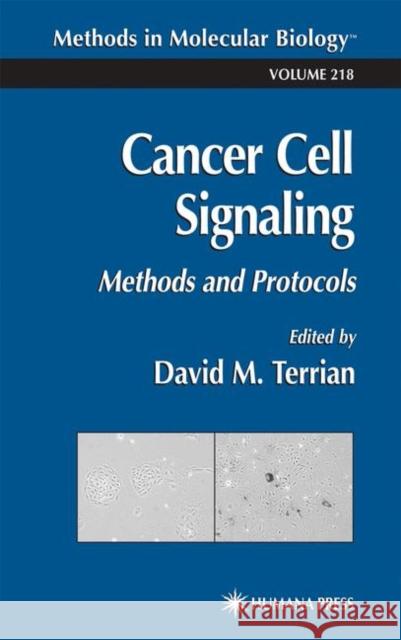
Cancer Cell Signaling: Methods and Protocols

ISBN-13: 9781617373411 / Angielski / Miękka / 2010 / 333 str.
David M. Terrian
Cancer Cell Signaling: Methods and Protocols Terrian, David M. 9781617373411 Springer - książkaWidoczna okładka, to zdjęcie poglądowe, a rzeczywista szata graficzna może różnić się od prezentowanej.

Cancer Cell Signaling: Methods and Protocols

ISBN-13: 9781617373411 / Angielski / Miękka / 2010 / 333 str.

David M. Terrian
cena 582,32
(netto: 554,59 VAT:  5%)

Najniższa cena z 30 dni: 559,02
Termin realizacji zamówienia:
ok. 22 dni roboczych
Dostawa w 2026 r.

Darmowa dostawa!

Cells respond to environmental cues through a complex and dynamic network of signaling pathways that normally maintain a critical balance between cellular proliferation, differentiation, senescence, and death. One current research challenge is to identify those aberrations in signal transd- tion that directly contribute to a loss of this division-limited equilibrium and the progression to malignant transformation. The study of cell-signaling m- ecules in this context is a central component of cancer research. From the knowledge of such targets, investigators have been able to productively advance many insightful hypotheses about how a particular cancer cell may misinterpret, or respond inappropriately to, growth regulatory cues in their environment. Despite these key insights, the rapidly evolving nature of cell signaling research in cancer has necessitated a continuous revision of these theoretical constructs and the updating of methods used in their study. One contemporary example of the evolution of this field is provided by an analysis of the Human Genome Project data, which reveal a previously unsuspected diversity in the multigene families encoding for most signaling pathway int- mediates. In assessing the usefulness of a particular methodological approach, therefore, we will need to keep in mind that there is a premium on those p- tocols that can be easily adapted for the analysis of multiple members within a gene family. Cancer Cell Signaling: Methods and Protocols brings together several such methods in cell signaling research that are scientifically grounded within the cancer biology field.


Kategorie:
Nauka, Medycyna
Kategorie BISAC:
Medical > Oncology - General
Medical > Nursing - Oncology & Cancer
Wydawca:
Springer
Seria wydawnicza:
Methods in Molecular Biology (Paperback)
Język:
Angielski
ISBN-13:
9781617373411
Rok wydania:
2010
Numer serii:
000203440
Ilość stron:
333
Waga:
0.50 kg
Wymiary:
22.86 x 15.24 x 1.98
Oprawa:
Miękka
Wolumenów:
01

"...this volume is a very useful source for signal transduction protocols...This text should offer readers an excellent starting point for many important techniques in cancer signal transduction. Its ease of use and reasonable cost only add to its attraction." - Neuro-Oncology

Part I. Manipulation and Detection of Survival Signals. Functional Analysis of the Antimitogenic Activity of Tumor Suppressors, Erik S. Knudsen and Steven P. Angus. Rescue and Isolation of Rb-deficient Prostate Epithelium by Tissue Recombination, Simon W. Hayward, Yuzhuo Wang, and Mark L. Day. Signal Transduction Study Using Gene-Targeted Embryonic Stem Cells, Hideki Kawasome, Takashi Hamazaki, Tetsuo Minamino, and Naohiro Terada. The Use of the Yeast Two-Hybrid System to Measure Protein-Protein Interactions that Occur Following Oxidative Stress, Richard A. Franklin. Differential Screening of cDNA Libraries for Analysis of Gene Expression During Tumor Progression, Christopher W. Gregory. Mitogen-Activated Protein Kinase Signaling in Drug-Resistant Neuroblastoma Cells, Raymond R. Mattingly. TUNEL and Immunofluorescence Double-Labeling Assay for Apoptotic Cells with Specific Antigen(s), Stephanie M. Oberhaus. Part II. Manipulation and Detection of Oncogenic Signals. KinetworksTM Protein Kinase Multiblot Analysis, Steven Pelech, Catherine Sutter, and Hong Zhang. Protein Tyrosine Kinase and Phosphatase Expression Profiling in Human Cancers, Wen-Chang Lin. Association of Nonreceptor Tyrosine Kinase c-Yes with Tight Junction Protein Occludin by Coimmunoprecipitation Assay, Yan-Hua Chen and Qun Lu. Isolation of Novel Substrates Using a Tyrosine Kinase Overlay/In Situ Assay, Irwin H. Gelman. Manipulating Expression of Endogenous Oncogenic Proteins Using an Antisense Oligonucleotide Approach in Prostate Cancer Cells, Daqing Wu, Ginger G. Wescott, and David M. Terrian. Measurements of Phospholipases A2, C, and D (PLA2, PLC, and PLD): In Vitro Microassays, Analysis of Enzyme Isoforms, and Intact-Cell Assays, Julian Gomez-Cambronero, Joel Horwitz, and Ramadan I. Sha'afi. Detection of the Content and Activity of the Transcription Factor AP-1 in a Multistage Skin Carcinogenesis Model, Yunfeng Zhao and Daret K. St. Clair. Fibroblastic, Hematopoietic, and Hormone Responsive Epithelial Cell Lines and Culture Conditions for Elucidation of Signal Transduction and Drug Resistance Pathways by Gene Transfer, Linda S. Steelman, William L. Blalock, Xiao-Yang Wang, Phillip W. Moye, John T. Lee, John G. Shelton, Patrick M. Navolanic, Julianne M. Davis, Steven L. Knapp, Richard A. Franklin, Martyn K. White, and James A. McCubrey. Elucidation of Signal Transduction Pathways by Transfection of Cells with Modified Oncogenes, Linda S. Steelman, William L. Blalock, Xiao-Yang Wang, Phillip W. Moye, John T. Lee, John G. Shelton, Patrick M. Navolanic, Julianne M. Davis, Steven L. Knapp, Richard A. Franklin, Martyn K. White, and James A. McCubrey. Elucidation of Signal Transduction Pathways by Retroviral Infection of Cells with Modified Oncogenes, Linda S. Steelman, William L. Blalock, Xiao-Yang Wang, Phillip W. Moye, John T. Lee, John G. Shelton, Patrick M. Navolanic, Julianne M. Davis, Steven L. Knapp, Richard A. Franklin, Martyn K. White, and James A. McCubrey. Part III. Protein Interactions. Methods for the Study of Protein-Protein Interactions in Cancer Cell Biology, Daniel Price, Iha Park, and Hava Avraham. Production of Ligand-Specific Mutants Using a Yeast Two-Hybrid Mating Assay, André Nantel. Coimmunoprecipitation Assay for the Detection of Kinase-Substrate Interactions, Lucio Comai. Part IV. Genomic Rearrangements. Mutational Analysis of the Androgen Receptor Using Laser Capture Microdissection and Direct Sequencing, Sheila Greene, Patricia Stockton, Olga G. Kozyreva, Kris E. Gaston, Gordon P. Flake, and James L. Mohler. Clonality Analysis by T-Cell Receptor g PCR and High-Resolution Electrophoresis in the Diagnosis of Cutaneous T-Cell Lymphoma (CTCL), Ansgar Lukowsky. Index.

The rapidly evolving nature of cell signaling research in cancer has necessitated a continuous updating of the methods used in its study, most recently to take into account the analysis of multiple members within a gene family. Cancer Cell Signaling: Methods and Protocols brings together all the major methods of cell research that are scientifically grounded within the cancer biology field. Presented in step-by-step detail to ensure successful results, the methods include proven techniques for the investigation of apoptosis and cell death, complementary protocols for manipulating and/or monitoring oncogenic signals in cancer cells, and techniques for studying protein-protein interactions. Finally, there is a detailed protocol for capturing pure samples of malignant cells from frozen tissue specimens and two alternative techniques for analyzing their genomic DNA. Each method is described by a hands-on master of the technique and includes invaluable notes on troubleshooting and pitfalls to avoid.

Cutting-edge and highly practical, Cancer Cell Signaling: Methods and Protocols provides today's cancer researchers with new, but well-proven, strategies and procedures for investigating how the signaling cascades essential to normal cell life are corrupted, as well as for developing new molecular tools for cancer therapy.


Udostępnij

Facebook - konto krainaksiazek.pl


Opinie o Krainaksiazek.pl na Opineo.pl

Partner Mybenefit

Krainaksiazek.pl w programie rzetelna firma Krainaksiaze.pl - płatności przez paypal

Czytaj nas na:

Facebook - krainaksiazek.pl
  • książki na zamówienie
  • granty
  • książka na prezent
  • kontakt
  • pomoc
  • opinie
  • regulamin
  • polityka prywatności

Zobacz:

  • Księgarnia czeska

  • Wydawnictwo Książkowe Klimaty

1997-2025 DolnySlask.com Agencja Internetowa

© 1997-2022 krainaksiazek.pl
     
KONTAKT | REGULAMIN | POLITYKA PRYWATNOŚCI | USTAWIENIA PRYWATNOŚCI
Zobacz: Księgarnia Czeska | Wydawnictwo Książkowe Klimaty | Mapa strony | Lista autorów
KrainaKsiazek.PL - Księgarnia Internetowa

Polityka prywatnosci - link
Krainaksiazek.pl - płatnośc Przelewy24
Przechowalnia Przechowalnia





