• Wyszukiwanie zaawansowane
  • Kategorie
  • Kategorie BISAC
  • Książki na zamówienie
  • Promocje
  • Granty
  • Książka na prezent
  • Opinie
  • Pomoc
  • Załóż konto
  • Zaloguj się

Business Rule-Oriented Conceptual Modeling » książka


zaloguj się | załóż konto
Logo Krainaksiazek.pl

koszyk

konto

szukaj
topmenu
Księgarnia internetowa
Szukaj
Książki na zamówienie
Promocje
Granty
Książka na prezent
Moje konto
Pomoc
 
 
Wyszukiwanie zaawansowane
Pusty koszyk
Bezpłatna dostawa dla zamówień powyżej 20 złBezpłatna dostawa dla zamówień powyżej 20 zł

Kategorie główne

• Nauka
 [2946350]
• Literatura piękna
 [1816154]

  więcej...
• Turystyka
 [70666]
• Informatyka
 [151172]
• Komiksy
 [35576]
• Encyklopedie
 [23172]
• Dziecięca
 [611458]
• Hobby
 [135995]
• AudioBooki
 [1726]
• Literatura faktu
 [225763]
• Muzyka CD
 [378]
• Słowniki
 [2917]
• Inne
 [444280]
• Kalendarze
 [1179]
• Podręczniki
 [166508]
• Poradniki
 [469467]
• Religia
 [507199]
• Czasopisma
 [496]
• Sport
 [61352]
• Sztuka
 [242330]
• CD, DVD, Video
 [3348]
• Technologie
 [219391]
• Zdrowie
 [98638]
• Książkowe Klimaty
 [124]
• Zabawki
 [2382]
• Puzzle, gry
 [3525]
• Literatura w języku ukraińskim
 [259]
• Art. papiernicze i szkolne
 [7107]
Kategorie szczegółowe BISAC

Business Rule-Oriented Conceptual Modeling

ISBN-13: 9783790810042 / Angielski / Miękka / 1997 / 246 str.
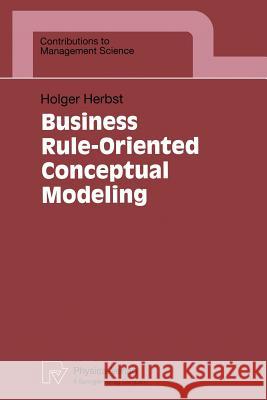
Holger Herbst
Business Rule-Oriented Conceptual Modeling Holger Herbst 9783790810042 Physica-Verlag - książkaWidoczna okładka, to zdjęcie poglądowe, a rzeczywista szata graficzna może różnić się od prezentowanej.

Business Rule-Oriented Conceptual Modeling

ISBN-13: 9783790810042 / Angielski / Miękka / 1997 / 246 str.

Holger Herbst
cena 201,24
(netto: 191,66 VAT:  5%)

Najniższa cena z 30 dni: 192,74
Termin realizacji zamówienia:
ok. 16-18 dni roboczych.

Darmowa dostawa!

This book is based on a PhD dissertation which was accepted by the faculty of Law and Economics at the University of Bern, Switzerland. The ideas presented were partially developed in a research project founded by the Swiss National Sci ence Foundation in 1993 and 1994. This research project was concerned with evaluating the application of database triggers and active databases for the im plementation of business rules. We recognized among other things the lack of a methodology for modeling such business rules on the conceptual level. Therefore, this became the focus of the follow-up research which resulted in this book. All this work would not have been possible without the help of several people. First of all, I would like to give special thanks to my thesis supervisor Prof. Dr. Gerhard Knolmayer. He not only initiated the research project and found an in dustry partner, but also provided very valuable ideas, and critically reviewed and discussed the resulting publications. Furthermore, I would like to express my thanks to the second thesis supervisor Prof. Dr. Sham Navathe from Georgia In stitute of Technology who influenced my work with results from a former re search project and who agreed to evaluate the resulting PhD Dissertation."


Kategorie:
Nauka, Ekonomia i biznes
Kategorie BISAC:
Business & Economics > Decision Making & Problem Solving
Computers > Management Information Systems
Business & Economics > Management Science
Wydawca:
Physica-Verlag
Seria wydawnicza:
Contributions to Management Science (Hardcover)
Język:
Angielski
ISBN-13:
9783790810042
Rok wydania:
1997
Wydanie:
Softcover Repri
Numer serii:
000094207
Ilość stron:
246
Waga:
0.41 kg
Wymiary:
23.5 x 15.5
Oprawa:
Miękka
Wolumenów:
01
Dodatkowe informacje:
Bibliografia
Wydanie ilustrowane

"Das Buch ist gut strukturiert und folgt einer klaren Argumentationsfolge. Die Ausführungen werden durch eine Vielzahl an Abbildungen unterstützt. Empfehlenswert ist dieses Buch für diejenigen, die regelbasiert Geschäftsprozesse beschreiben möchten und einen Ansatz zur Komplexitätsbewältigung suchen.

Wirtschaftsinformatik, Bd. 40, Heft 4, 1998

1 Introduction.- 2 Rules In Organizations And Information Systems.- 2.1 Rules in Organizational Theory.- 2.1.1 Introduction.- 2.1.2 Selected Organizational Approaches.- 2.1.2.1 Bureaucracy Model of Max Weber.- 2.1.2.2 Approach of Management Theory and Organizational Theories of Business Administration.- 2.1.2.2.1’ scientific’ Management.- 2.1.2.2.2 Business Process Reengineering.- 2.1.2.3 Human Relations Approach and Theory of Motivation.- 2.1.2.4 Approaches of the Behavioral Scientific Decision Theory.- 2.1.2.5 Comparison of the Selected Organizational Approaches.- 2.1.3 Formalization of Organizational Facts.- 2.2 Implementation of Rules in Information Systems.- 2.2.1 Rules in Program Code.- 2.2.1.1 Third Generation Languages.- 2.2.1.2 Fourth Generation Languages.- 2.2.1.3 Fifth Generation Languages.- 2.2.2 Rules in Database Management Systems.- 2.2.2.1 Overview on Current Research.- 2.2.2.2 Deductive Database Management Systems.- 2.2.2.3 Active Database Management Systems.- 2.2.2.3.1 Introduction.- 2.2.2.3.2 Rule Syntax.- 2.2.2.3.3 Open Research Questions in Active DBMS.- 2.2.2.4 Practical Relevance of Deductive and Active Database Management Systems.- 2.2.3 Comparison of the Implementation Alternatives.- 2.3 Summary.- 3 Business Rules.- 3.1 Case Studies.- 3.1.1 Overview.- 3.1.2 Case Study ‘DOM-2’.- 3.1.3 Examples of Business Rules.- 3.2 Classification of Integrity Constraints and Business Rules.- 3.2.1 Types of Integrity Constraints.- 3.2.1.1 Number of Database States Involved.- 3.2.1.2 Number of Referred Database Constructs.- 3.2.1.3 Time Point of Evaluation.- 3.2.1.4 Relation to the Data Model.- 3.2.1.5 Type of (Re)Action.- 3.2.1.6 Database Schema.- 3.2.1.7 Interdependencies between the Classification Criteria.- 3.2.2 Types of Business Rules.- 3.2.2.1 Event Types.- 3.2.2.2 Condition Types.- 3.2.2.3 Action Types.- 3.3 Business Rules in their Organizational Environment.- 3.3.1 Origins of Business Rules.- 3.3.1.1 External Origins.- 3.3.1.2 Internal Origins.- 3.3.1.3 Conflict Situations.- 3.3.1.4 Origin Owner.- 3.3.2 Processors of Business Rules.- 3.3.2.1 Processor Types.- 3.3.2.2 View on Single Business Rules.- 3.3.2.3 Assignment of Business Rules to Specific Processors.- 3.3.2.4 View on Processes Specified Using Business Rules.- 3.3.3 Assignment of Business Rules to Organizational Units.- 3.4 Summary.- 4 Brocom: A Business Rule-Oriented Conceptual Modeling Approach.- 4.1 The Meta Model of the BROCOM Approach.- 4.1.1 Introduction.- 4.1.2 The Core of the Meta Model.- 4.1.2.1 Submodel ‘Business Rule’.- 4.1.2.2 Submodel ‘Process’.- 4.1.2.3 Submodel ‘Data Model Components’.- 4.1.3 The Environment of Business Rules.- 4.1.3.1 Submodel ‘Processor’.- 4.1.3.2 Submodel’Origin’.- 4.1.3.3 Submodel ‘Organizational Unit’.- 4.1.4 Selected Meta Models.- 4.1.4.1 Description of the Selected Meta Models.- 4.1.4.1.1 IFIPWG 8.1.- 4.1.4.1.2 ESPRIT: CIM Open Systems Architecture.- 4.1.4.1.3 ARIS.- 4.1.4.1.4 RIM.- 4.1.4.2 Comparison of the Selected Meta Models.- 4.2 Steps of the BROCOM Approach.- 4.2.1 Step 1: Process Structure.- 4.2.1.1 Deliverables.- 4.2.1.2 Procedure.- 4.2.1.3 Application to DOM-2.- 4.2.2 Step 2: Process Specification.- 4.2.2.1 Deliverables.- 4.2.2.2 Procedure.- 4.2.2.3 Application to DOM-2.- 4.2.3 Step 3: Data Model.- 4.2.3.1 Deliverables.- 4.2.3.2 Procedure.- 4.2.3.3 Application to DOM-2.- 4.2.4 Step 4: Integrity Constraints.- 4.2.4.1 Deliverables.- 4.2.4.2 Procedure.- 4.2.4.3 Application to DOM-2.- 4.2.5 Step 5: Validation.- 4.3 Summary.- 5 Views on the Meta Model.- 5.1 Introduction.- 5.2 Process View.- 5.2.1 Petri Net.- 5.2.1.1 Introduction.- 5.2.1.2 Application.- 5.2.1.2.1 ECA2 Net.- 5.2.1.2.2 Simplified ECA2 Net.- 5.2.2 Conceptual Processing Model.- 5.2.2.1 Introduction.- 5.2.2.2 Application.- 5.3 View on the Data Model.- 5.3.1 Entity-Relationship Model.- 5.3.1.1 Introduction.- 5.3.1.2 Application.- 5.3.2 NIAM.- 5.3.2.1 Introduction.- 5.3.2.2 Application.- 5.4 View on the Relationship between Data Structure and Processes.- 5.4.1 Data Flow Diagrams.- 5.4.1.1 Introduction.- 5.4.1.2 Application.- 5.4.2 Entity-Relationship-Event-Rule Model.- 5.4.2.1 Introduction.- 5.4.2.2 Application.- 5.5 Data Object Behavior View.- 5.5.1 Petri Net and Entity Relationship Model.- 5.5.1.1 Introduction.- 5.5.1.2 Application.- 5.6 Summary.- 6 Burro: A Repository System for a Business Rule-Oriented Conceptual Modeling.- 6.1 Implementation of BURRO.- 6.1.1 Implementation of the Meta Model.- 6.1.1.1 Meta Meta Model.- 6.1.1.2 Physical Data Model.- 6.1.2 Implementation of the User Interface.- 6.1.3 Implementation of Graphical Views.- 6.2 Application of the Repository System to the Case Study “D0M-2”.- 6.2.1 Process Structure.- 6.2.2 Process Specification.- 6.2.2.1 Process DOM-2-Damage-Administration.- 6.2.2.2 Subprocess Damage-Reception.- 6.2.2.3 Subprocess Damage-Registration.- 6.2.2.4 Subprocess Damage-Treatment.- 6.2.2.5 Subprocess Damage-Archiving.- 6.2.2.6 Final Process Structure.- 6.2.3 Data Model.- 6.2.3.1 Entity-Relationship Model.- 6.2.3.2 Entity-Relationship Event-Rules Model.- 6.2.4 Integrity Constraints.- 6.3 Summary.- 7 Summary and Outlook.- References.- Appendixes.- Appendix A: Syntax for Business Rules.- Appendix B: Document Types of BURRO.


Udostępnij

Facebook - konto krainaksiazek.pl


Opinie o Krainaksiazek.pl na Opineo.pl

Partner Mybenefit

Krainaksiazek.pl w programie rzetelna firma Krainaksiaze.pl - płatności przez paypal

Czytaj nas na:

Facebook - krainaksiazek.pl
  • książki na zamówienie
  • granty
  • książka na prezent
  • kontakt
  • pomoc
  • opinie
  • regulamin
  • polityka prywatności

Zobacz:

  • Księgarnia czeska

  • Wydawnictwo Książkowe Klimaty

1997-2026 DolnySlask.com Agencja Internetowa

© 1997-2022 krainaksiazek.pl
     
KONTAKT | REGULAMIN | POLITYKA PRYWATNOŚCI | USTAWIENIA PRYWATNOŚCI
Zobacz: Księgarnia Czeska | Wydawnictwo Książkowe Klimaty | Mapa strony | Lista autorów
KrainaKsiazek.PL - Księgarnia Internetowa

Polityka prywatnosci - link
Krainaksiazek.pl - płatnośc Przelewy24
Przechowalnia Przechowalnia






