• Wyszukiwanie zaawansowane
  • Kategorie
  • Kategorie BISAC
  • Książki na zamówienie
  • Promocje
  • Granty
  • Książka na prezent
  • Opinie
  • Pomoc
  • Załóż konto
  • Zaloguj się

Building Quality Shaders for Unity®: Using Shader Graphs and HLSL Shaders » książka

zaloguj się | załóż konto
Logo Krainaksiazek.pl

koszyk

konto

szukaj
topmenu
Księgarnia internetowa
Szukaj
Książki na zamówienie
Promocje
Granty
Książka na prezent
Moje konto
Pomoc
 
 
Wyszukiwanie zaawansowane
Pusty koszyk
Bezpłatna dostawa dla zamówień powyżej 20 złBezpłatna dostawa dla zamówień powyżej 20 zł

Kategorie główne

• Nauka
 [2944077]
• Literatura piękna
 [1814251]

  więcej...
• Turystyka
 [70679]
• Informatyka
 [151074]
• Komiksy
 [35590]
• Encyklopedie
 [23169]
• Dziecięca
 [611005]
• Hobby
 [136031]
• AudioBooki
 [1718]
• Literatura faktu
 [225599]
• Muzyka CD
 [379]
• Słowniki
 [2916]
• Inne
 [443741]
• Kalendarze
 [1187]
• Podręczniki
 [166463]
• Poradniki
 [469211]
• Religia
 [506887]
• Czasopisma
 [481]
• Sport
 [61343]
• Sztuka
 [242115]
• CD, DVD, Video
 [3348]
• Technologie
 [219293]
• Zdrowie
 [98602]
• Książkowe Klimaty
 [124]
• Zabawki
 [2385]
• Puzzle, gry
 [3504]
• Literatura w języku ukraińskim
 [260]
• Art. papiernicze i szkolne
 [7151]
Kategorie szczegółowe BISAC

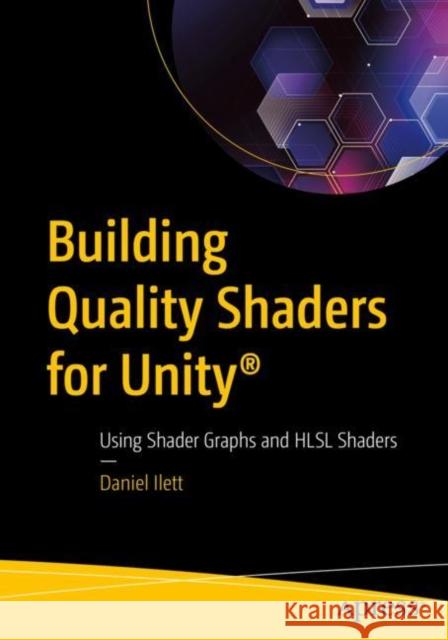
Building Quality Shaders for Unity®: Using Shader Graphs and HLSL Shaders

ISBN-13: 9781484286517 / Angielski / Miękka / 2022 / 346 str.

Daniel Ilett
Building Quality Shaders for Unity®: Using Shader Graphs and HLSL Shaders Daniel Ilett 9781484286517 APress - książkaWidoczna okładka, to zdjęcie poglądowe, a rzeczywista szata graficzna może różnić się od prezentowanej.

Building Quality Shaders for Unity®: Using Shader Graphs and HLSL Shaders

ISBN-13: 9781484286517 / Angielski / Miękka / 2022 / 346 str.

Daniel Ilett
cena 241,50
(netto: 230,00 VAT:  5%)

Najniższa cena z 30 dni: 231,29
Termin realizacji zamówienia:
ok. 22 dni roboczych.

Darmowa dostawa!

Beginning to Intermediate

Kategorie:
Informatyka, Bazy danych
Kategorie BISAC:
Computers > Programming - Games
Computers > Software Development & Engineering - Computer Graphics
Wydawca:
APress
Język:
Angielski
ISBN-13:
9781484286517
Rok wydania:
2022
Ilość stron:
346
Wymiary:
25.4 x 17.8
Oprawa:
Miękka

Chapter 1: Introduction to Shaders in Unity

Sub-topics:
• Brief overview of shader fundamentals
• Unity’s built-in pipeline
• URP (Universal Render Pipeline)
• HDRP (High Definition Render Pipeline)

Chapter 2: Maths for Shader Development
Sub-topics:
• Vectors in 2D and 3D
• Dot product, cross product, and other vector operations
• Matrices
• Multiplication, transpose, inverse, and common matrix operations
• Important spaces in computer graphics
• Homogeneous coordinate systems
• Transformation between spaces

Chapter 3: Your Very First Shader
Sub-topics:
• The shader pipeline, and data flow
• ShaderLab, SubShaders and Fallbacks
• Shader Tags
• The appdata struct: Input to the vertex shader
• The vertex shader
• The v2f struct: Data passed between the vertex and fragment shader
• The fragment shader

Chapter 4: Shader Graph
Sub-topics:
• The argument for node-based editors
• The vertex and fragment stages
• Shader nodes & properties
• Your first Shader Graph

Chapter 5: Textures, UV Coordinates & Normal Mapping
Sub-topics:
• What is texture mapping?
• What are UV coordinates?
• Scaling, rotating and offsetting UVs
• Sampler states
• Normal mapping & tangent space

Chapter 6: Transparency
Sub-topics:
• Transparency vs opacity
• Alpha-blended transparency
• Sorting
• Screen-door (“dithered”) transparency

Chapter 7: The Depth Buffer
• What is the depth buffer?
• Depth-testing and culling
• Depth-based shader effects

Chapter 8: More Shader Fundamentals
Sub-topics:
• Shader keywords and variants
• Single- and multi-pass shaders
• GrabPass and UsePass
• Unity’s standard shader libraries

Chapter 9: Lighting & Shadows
Sub-topics:
• Lighting theory: Diffuse, specular, ambient, and Fresnel light
• Phong shading
• Physically based rendering
• Shadow casting

Chapter 10: Image Effects & Post Processing
Sub-topics:
• Post Processing in the Built-in pipeline, URP and HDRP
• Convolution kernels, Gaussian blur and multi-pass effects.
• Edge detection with a Sobel kernel
• Better edge detection using the depth texture and normal texture

Chapter 11: Advanced Shaders
Sub-topics:
• Geometry shaders: adding or modifying vertices
• Tessellation shaders: subdividing a mesh
• Building an LOD system with tessellation shaders
• Compute shaders: arbitrary computation on the GPU

Chapter 12: Profiling & Optimization
Sub-topics:
• The Unity Profiler and Frame Debugger
• Branching in shaders
• Avoiding overdraw
• Multi-material objects
• Batching

Chapter 13: Shader Recipes For Your Games
Sub-topics:
• World-space reconstruction in post processing shaders
• Custom lighting: cel-shading (toon shading)
• Vertex displacement – realistic water (Gerstner waves)
• Refraction by modifying the framebuffer
• Interactive snow layers (modifying the height of a mesh based on gameplay actions)
• Holograms using emissive colour
• Using Voronoi noise to make marble

Daniel Ilett is an ambitious and motivated PhD student at the University of Warwick. He is a passionate game developer, specialising in shaders and technical art. He publishes a range of educational and tutorial content, including videos and written work, aimed at beginners and intermediate developers. He also does freelance work on shaders and visual effects for games.

Understand what shaders are and what they’re used for: Shaders are often seen as mystical and difficult to develop, even by skilled programmers, artists, and developers from other game design disciplines. This book dispels that idea by building up your shader knowledge in stages, starting with fundamental shader mathematics and how shader development mindset differs from other types of art and programming, and slowly delves into topics such as vertex and fragment shaders, lighting, depth-based effects, texture mapping, and Shader Graph.

This book presents each of these topics with a comprehensive breakdown, the required theory, and some practical applications for the techniques learned during each chapter. The HLSL (High Level Shading Language) code and Shader Graphs will be provided for each relevant section, as well as plenty of screenshots.

By the end of this book, you will have a good understanding of the shader development pipeline and you will be fully equipped to start making your own aesthetic and performant shader effects for your own games!

You Will Learn To
• Use shaders across Unity’s rendering pipelines
• Write shaders and modify their behavior with C# scripting
• Use Shader Graph for codeless development
• Understand the important math behind shaders, particularly space transformations
• Profile the performance of shaders to identify optimization targets


Udostępnij

Facebook - konto krainaksiazek.pl


Opinie o Krainaksiazek.pl na Opineo.pl

Partner Mybenefit

Krainaksiazek.pl w programie rzetelna firma Krainaksiaze.pl - płatności przez paypal

Czytaj nas na:

Facebook - krainaksiazek.pl
  • książki na zamówienie
  • granty
  • książka na prezent
  • kontakt
  • pomoc
  • opinie
  • regulamin
  • polityka prywatności

Zobacz:

  • Księgarnia czeska

  • Wydawnictwo Książkowe Klimaty

1997-2026 DolnySlask.com Agencja Internetowa

© 1997-2022 krainaksiazek.pl
     
KONTAKT | REGULAMIN | POLITYKA PRYWATNOŚCI | USTAWIENIA PRYWATNOŚCI
Zobacz: Księgarnia Czeska | Wydawnictwo Książkowe Klimaty | Mapa strony | Lista autorów
KrainaKsiazek.PL - Księgarnia Internetowa

Polityka prywatnosci - link
Krainaksiazek.pl - płatnośc Przelewy24
Przechowalnia Przechowalnia