• Wyszukiwanie zaawansowane
  • Kategorie
  • Kategorie BISAC
  • Książki na zamówienie
  • Promocje
  • Granty
  • Książka na prezent
  • Opinie
  • Pomoc
  • Załóż konto
  • Zaloguj się

Bioinformatics Methods in Clinical Research » książka


zaloguj się | załóż konto
Logo Krainaksiazek.pl

koszyk

konto

szukaj
topmenu
Księgarnia internetowa
Szukaj
Książki na zamówienie
Promocje
Granty
Książka na prezent
Moje konto
Pomoc
 
 
Wyszukiwanie zaawansowane
Pusty koszyk
Bezpłatna dostawa dla zamówień powyżej 20 złBezpłatna dostawa dla zamówień powyżej 20 zł

Kategorie główne

• Nauka
 [2946912]
• Literatura piękna
 [1852311]

  więcej...
• Turystyka
 [71421]
• Informatyka
 [150889]
• Komiksy
 [35717]
• Encyklopedie
 [23177]
• Dziecięca
 [617324]
• Hobby
 [138808]
• AudioBooki
 [1671]
• Literatura faktu
 [228371]
• Muzyka CD
 [400]
• Słowniki
 [2841]
• Inne
 [445428]
• Kalendarze
 [1545]
• Podręczniki
 [166819]
• Poradniki
 [480180]
• Religia
 [510412]
• Czasopisma
 [525]
• Sport
 [61271]
• Sztuka
 [242929]
• CD, DVD, Video
 [3371]
• Technologie
 [219258]
• Zdrowie
 [100961]
• Książkowe Klimaty
 [124]
• Zabawki
 [2341]
• Puzzle, gry
 [3766]
• Literatura w języku ukraińskim
 [255]
• Art. papiernicze i szkolne
 [7810]
Kategorie szczegółowe BISAC

Bioinformatics Methods in Clinical Research

ISBN-13: 9781617796708 / Angielski / Miękka / 2012 / 390 str.
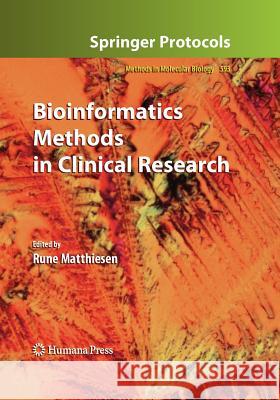
Rune Matthiesen
Bioinformatics Methods in Clinical Research Rune Matthiesen 9781617796708 Humana Press - książkaWidoczna okładka, to zdjęcie poglądowe, a rzeczywista szata graficzna może różnić się od prezentowanej.

Bioinformatics Methods in Clinical Research

ISBN-13: 9781617796708 / Angielski / Miękka / 2012 / 390 str.

Rune Matthiesen
cena 582,32
(netto: 554,59 VAT:  5%)

Najniższa cena z 30 dni: 559,02
Termin realizacji zamówienia:
ok. 22 dni roboczych
Dostawa w 2026 r.

Darmowa dostawa!
inne wydania

This volume discusses the latest developments in clinical proteomics and describes in detail the algorithms used in publicly available software tools. It should be considered as a proteomics-bioinformatics resource and offers the opportunity to understand the details of the various publicly available algorithms. The book should not only be considered as a pure bioinformatics resource filled with complex equations but it aims to describe the background of the biology and experimental methods. However, detailed experimental protocols will only be referenced. The pro and cons of the various experimental methods in relation to data analysis will be reviewed as well. In other words the intention is to make a connection between theory and practice. Practical examples showing results from the software tools will in some cases be given. The book is divided into five sections: Section I: A detailed discussion on algorithms implemented in software tools for assignment of MS and MS/MS spectra to peptides and proteins. The most popular tools for searching mass spectrometry data is currently commercial tools like Mascot and Seaquest. These tools provide the most basic analysis of mass spectrometry data however; by using the publicly available tools one can often move further with the data analysis and mass spectrometry data has more flavors than for example micro array data where the gene IDs is given directly by the array software. The problem is that mass spectrometry data acquisition methods are different depending on the specific task and produce slightly different data types. For example, the samples can be enriched for specific modifications and mass spectrometry settings can be optimized for the specific modification. Making specific algorithms for each type of spectra data will be a major task which deserves more attention. The different publicly available software tools have already some specialization for specific tasks and the different tools have both pro and cons in specific cases. Understanding the details and the philosophy behind the algorithms helps in deciding which tool is best for a specific search task. Section II: Starts with an overview of the different quantitative proteomics strategies which discusses the pro and cons of the different labeling strategies, labeling versus non-labeling, model system (cell or tissue types), and mass spectrometers in relation to quantitative proteomics. The consecutive contribution describes quantitative algorithms used in publicly available tools. Algorithms for label free quantitation by LC-MS intensity profiling, stable isotope labeling and MS, and quantitation from 2D-gels will be covered. Section III: Is titled "Finding biomarkers in MS data." The word biomarker has different meaning depending on the context in which it is used. It is here used in a clinical context and should be interpreted as: "a substance whose specific detection level indicates a particular cellular or clinical state." In theory one could easily imagine cases where one biomarker has several detection levels intervals that indicate various sates. A even more complex example would be a set of biomarkers and their corresponding set of dectection levels intervals could be used for classifying a specific cellular or clinical state. In complex cases more elaborat models based on machine learning is essential. This section therefor starts with a gentle introduction to machine learning followed by examples of useful algorithms and mehtods for classification based on mass spectrometry spectra. Section IV: The proteomics mass spectrometry data storage problem is still not solved to a satisfactory degree. Parsing the data into the databases is in some cases problematic. Other problems such database schemas that do not fully encapsulate the result from mass spectrometry data are also evident. However, the most common type of data and results can be stored in current proteomics databases. Section V: System biology is the study of the interactions between the components of a biological system. System biology is a broad field involving data storage, controlled vocabulary, data mining, interaction studies, data correlation, and modeling of biochemical pathways. The data input comes from various omics fields such as genomics, transcriptomics, proteomics, interactomics and metabolmics. Notice that metabolomics can be further divided in to subcategories such as peptidomics, glycomics, and lipidomics. The discussion in this section will be restricted to system biology in relation to proteomics. It will describe how to relate the proteomics result to result obtained in other omics fields and how one can automatically obtain functional annotation of the identified proteins.


Kategorie:
Nauka, Biologia i przyroda
Kategorie BISAC:
Science > Biochemia
Science > Bioinformatics
Science > Cytologia
Wydawca:
Humana Press
Seria wydawnicza:
Methods in Molecular Biology (Paperback)
Język:
Angielski
ISBN-13:
9781617796708
Rok wydania:
2012
Wydanie:
2010
Ilość stron:
390
Waga:
0.68 kg
Wymiary:
25.4 x 17.78 x 2.08
Oprawa:
Miękka
Wolumenów:
01
Dodatkowe informacje:
Komentarz

From the reviews:

"This volume of Methods in Molecular Biology provides an overview of the recent improvements in the use of bioinformatics in clinical research. ... All chapters provide pertinent examples. ... The book is intended primarily for scientists involved in biomedical informatics (computational biologists, biostatisticians, computer scientists) who are active in the field of clinical research. This includes both first-time and seasoned students and biomedical researchers who are interested in using bioinformatics. ... It also presents a number of valuable approaches currently in use." (Ruben Mestril, Doody's Review Service, April, 2010)

"This book 'Bioinformatics Methods in Clinical Research edited by Rune Matthiesen' contains sixteen chapters, and results from scientific cooperation of academics, specialists in the main areas of investigation on bioinformatics methods, and applications in clinical research from centers and universities of Europe such as Denmark, Spain, Portugal as well as Canada and the United States of North America. ... several specific fields are discussed including biomarkers in breast cancer and computational methods for two-dimensional analyses in gels." (Sílvia Regina Cavani Jorge Santos, Brazilian Journal of Pharmaceutical Sciences, Spring, 2011)

Section I: Algorithms for interpreting MS and MS/MS data Introduction: Assigning peptides and proteins to MS spectra Itziar Frades, Ewa Gubb and Rune Matthiesen Identification of Post-translational Modifications via Blind Search of Mass-Spectra Stephen Tanner Peptide sequence tags for fast database search in mass-spectrometry Ari Frank De novo sequencing with PepHMM Ting Chen The Global Proteome Machine Organization Ron Beavis GutenTag: Software for automated sequence tag identification of peptides John Yates, III Manual analysis emulator Katheryn Resing Ascore for phosphorylation sites Steven Gygi SILVER Steven Gygi Aldente: PEPTIDE MASS FINGERPRINTING TOOL Ron Appel Novel Peptide Identification using ESTs and Genomic Sequences Nathan Edwards Section II: Quantitative proteomics Overview of chemical labeling methods for quantitative proteomics Shabaz Mohammed Quantitative proteomics using SILAC Jens S. Andersen/Jakob Bunkenborg/Peter Mortensen MSquant Jens S. Andersen/Jakob Bunkenborg/Peter Mortensen ASAPRatio Li X-J XPRESS Han DK Quantitative algorithms in VEMS Rune Matthiesen Quantitation based on LC-MS intensity profiles Jennifer Listgarten Improving identification of protein complexes by using quantitative information Markus Müller OpenMS Knut Reinert Challenges Related to Analysis of Protein Spot Volumes from Two-Dimensional Gel Electrophoresis Ellen Mosleth Færgestad Quantitation from 2D gel spots Peter F. Lemkin SectionIII: Finding biomarkers in MS data Introduction: Classification by machine learning Iñaki Inza inza Feature selection and machine learning with mass spectrometry data Susmita Datta Identification of biomarkers from mass spectrometry data using a 'common' peak approach Tadayoshi Fushiki Annotated regions of significance of SELDI-TOF-MS spectra for detecting protein biomarkers Yudi Pawitan Analysis of mass spectral serum profiles for biomarker selection Habtom W. Ressom Comparison of statistical methods for classification of ovarian cancer using mass spectrometry data Hongyu Zhao A novel approach for clustering proteomics data using Bayesian fast Fourier transform Halima Bensmail A suite of algorithms for the comprehensive analysis of complex protein mixtures using high-resolution LC-MS Martin McIntosh Semi-supervised LC/MS alignment for differential proteomics Bernd Fischer Perspective: A Program to Improve Protein Biomarker Discovery for Cancer Leland Hartwell Section IV: Data storage PRIDE: open source proteomics identifications database Phil Jones Data storage using CPAS Ted Holzman GPMDB: The Global Proteome Machine Organization Proteomics Database Ron Beavis Data storage in dbVEMS Rune Matthiesen PROTEIOS: an open source proteomics initiative Jari Häkkinen Database tool for differential peptide expression Mark K Titulaer Section V: System biology Ontologies and databases at EBI Sandra Orchard Towards understanding biological processes: a text mining approach Alberto

Integrated bioinformatics solutions have become increasingly valuable in past years, as technological advances have allowed researchers to consider the potential of omics for clinical diagnosis, prognosis, and therapeutic purposes, and as the costs of such techniques have begun to lessen.  In Bioinformatics Methods in Clinical Research, experts examine the latest developments impacting clinical omics, and describe in great detail the algorithms that are currently used in publicly available software tools. Chapters discuss statistics, algorithms, automated methods of data retrieval, and experimental consideration in genomics, transcriptomics, proteomics, and metabolomics. Composed in the highly successful Methods in Molecular Biology™ series format, each chapter contains a brief introduction, provides practical examples illustrating methods, results, and conclusions from data mining strategies wherever possible, and includes a Notes section which shares tips on troubleshooting and avoiding known pitfalls.

Informative and ground-breaking, Bioinformatics Methods in Clinical Research establishes a much-needed bridge between theory and practice, making it an indispensable resource for bioinformatics researchers.


Udostępnij

Facebook - konto krainaksiazek.pl


Opinie o Krainaksiazek.pl na Opineo.pl

Partner Mybenefit

Krainaksiazek.pl w programie rzetelna firma Krainaksiaze.pl - płatności przez paypal

Czytaj nas na:

Facebook - krainaksiazek.pl
  • książki na zamówienie
  • granty
  • książka na prezent
  • kontakt
  • pomoc
  • opinie
  • regulamin
  • polityka prywatności

Zobacz:

  • Księgarnia czeska

  • Wydawnictwo Książkowe Klimaty

1997-2025 DolnySlask.com Agencja Internetowa

© 1997-2022 krainaksiazek.pl
     
KONTAKT | REGULAMIN | POLITYKA PRYWATNOŚCI | USTAWIENIA PRYWATNOŚCI
Zobacz: Księgarnia Czeska | Wydawnictwo Książkowe Klimaty | Mapa strony | Lista autorów
KrainaKsiazek.PL - Księgarnia Internetowa

Polityka prywatnosci - link
Krainaksiazek.pl - płatnośc Przelewy24
Przechowalnia Przechowalnia






