• Wyszukiwanie zaawansowane
  • Kategorie
  • Kategorie BISAC
  • Książki na zamówienie
  • Promocje
  • Granty
  • Książka na prezent
  • Opinie
  • Pomoc
  • Załóż konto
  • Zaloguj się

Aptamers in Bioanalysis » książka


zaloguj się | załóż konto
Logo Krainaksiazek.pl

koszyk

konto

szukaj
topmenu
Księgarnia internetowa
Szukaj
Książki na zamówienie
Promocje
Granty
Książka na prezent
Moje konto
Pomoc
 
 
Wyszukiwanie zaawansowane
Pusty koszyk
Bezpłatna dostawa dla zamówień powyżej 20 złBezpłatna dostawa dla zamówień powyżej 20 zł

Kategorie główne

• Nauka
 [2946350]
• Literatura piękna
 [1816154]

  więcej...
• Turystyka
 [70666]
• Informatyka
 [151172]
• Komiksy
 [35576]
• Encyklopedie
 [23172]
• Dziecięca
 [611458]
• Hobby
 [135995]
• AudioBooki
 [1726]
• Literatura faktu
 [225763]
• Muzyka CD
 [378]
• Słowniki
 [2917]
• Inne
 [444280]
• Kalendarze
 [1179]
• Podręczniki
 [166508]
• Poradniki
 [469467]
• Religia
 [507199]
• Czasopisma
 [496]
• Sport
 [61352]
• Sztuka
 [242330]
• CD, DVD, Video
 [3348]
• Technologie
 [219391]
• Zdrowie
 [98638]
• Książkowe Klimaty
 [124]
• Zabawki
 [2382]
• Puzzle, gry
 [3525]
• Literatura w języku ukraińskim
 [259]
• Art. papiernicze i szkolne
 [7107]
Kategorie szczegółowe BISAC

Aptamers in Bioanalysis

ISBN-13: 9780470148303 / Angielski / Twarda / 2009 / 336 str.
M. Mascini
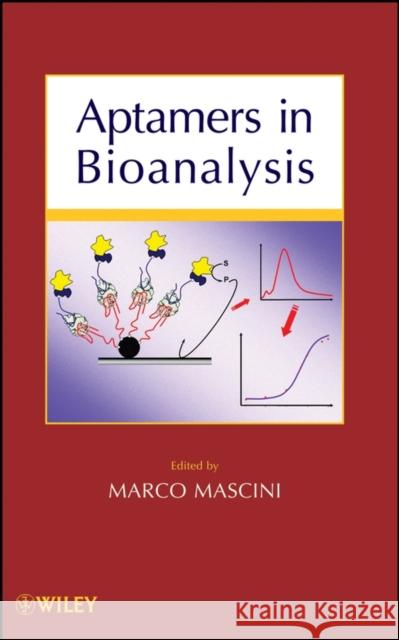
Aptamers in Bioanalysis M. Mascini 9780470148303 Wiley-Interscience - książkaWidoczna okładka, to zdjęcie poglądowe, a rzeczywista szata graficzna może różnić się od prezentowanej.

Aptamers in Bioanalysis

ISBN-13: 9780470148303 / Angielski / Twarda / 2009 / 336 str.

M. Mascini
cena 747,29
(netto: 711,70 VAT:  5%)

Najniższa cena z 30 dni: 738,16
Termin realizacji zamówienia:
ok. 30 dni roboczych.

Darmowa dostawa!

This is the first book to detail bioanalytical technologies and methods that have been developed using aptamers in analytical, medical, environmental, and food science applications. After an introduction to aptamers, aptamer targets, and their general uses, it discusses different applications with particular attention to the comparison between aptamer-based biosensors and methods versus the corresponding immunosensors. Examples of aptamer-based diagnostic techniques include whole-cell protein profiling (proteomics) and medical diagnostics for the distinction of diseased versus healthy states. This is a core reference for analytical chemists, electrochemists, pharmaceutical/medicinal chemists, biotechnologists, and others.


Kategorie:
Nauka, Chemia
Kategorie BISAC:
Science > Chemia - Analityczna
Science > Biotechnology
Wydawca:
Wiley-Interscience
Język:
Angielski
ISBN-13:
9780470148303
Rok wydania:
2009
Ilość stron:
336
Waga:
0.61 kg
Wymiary:
23.62 x 15.75 x 2.29
Oprawa:
Twarda
Wolumenów:
01
Dodatkowe informacje:
Wydanie ilustrowane

?This book provides descriptions of many applications of aptamers for biosensing, and for this reason, it is very useful and an interesting read.? ( JACS , August 2009)

PREFACE.

CONTRIBUTORS.

I INTRODUCTION.

1 APTAMERS: LIGANDS FOR ALL REASONS (Jean–Jacques Toulme , Jean–Pierre Daguer, and Eric Dausse).

1.1 Introduction.

1.2 The Power of Selection and Aptamer Refinement.

1.3 The Chemistry Drives the Shape.

1.4 Aptaregulators.

1.5 Aptasensors.

1.6 Prospects.

References.

2 SELEX AND ITS RECENT OPTIMIZATIONS (Beate Strehlitz and Regina Stoltenburg).

2.1 Introduction.

2.2 Aptamers and Their Selection by SELEX.

2.3 Modifications of SELEX Technology.

2.4 Advantages and Limitations of Aptamers and Their Selection Technology.

2.5 Applications of Aptamers Being Developed for the Market.

2.6 Future Perspectives.

References.

II BIOSENSORS.

3 ELECTROCHEMICAL APTASENSORS (Itamar Willner and Maya Zayats).

3.1 Introduction.

3.2 Electrochemical Aptasensor Based on Redox–Active Aptamer Monolayers Linked to Electrodes.

3.3 Enzyme–Based Amplified Electrochemical Aptasensors.

3.4 Amplified Electrochemical Aptasensors Based on Nanoparticles.

3.5 Label–Free Electrochemical Aptasensors.

3.6 Field–Effect Transistor Based Aptasensors.

3.7 Conclusions and Perspectives.

References.

4 APTAMERS: HYBRIDS BETWEEN NATURE AND TECHNOLOGY (Moritz K. Beissenhirtz, Eik Leupold, Walter Stocklein, Ulla Wollenberger, Oliver Panke, Fred Lisdat, and Frieder W. Scheller).

4.1 Introduction.

4.2 Specific Features of Aptamers.

4.3 Electrochemical Detection of Nucleic Acids.

4.4 Cytochrome c Binding by Aptamers.

4.5 DNA Machines and Aptamers.

References.

5 DETECTION OF PROTEIN APTAMER INTERACTIONS BY MEANS OF ELECTROCHEMICAL INDICATORS AND TRANSVERSE SHEAR MODE METHOD (Tibor Hianik).

5.1 Introduction.

5.2 Immobilization of Aptamers on a Solid Support.

5.3 Detection of Aptamer Ligand Interactions.

5.3.1 Electrochemical Methods.

5.3.2 Acoustic Methods.

5.4 Conclusions.

References.

6 BIOSENSORS USING THE APTAMERIC ENZYME SUBUNIT: THE USE OF APTAMERS IN THE ALLOSTERIC CONTROL OF ENZYMES (Kazunori Ikebukuro, Wataru Yoshida, and Koji Sode).

6.1 Aptamers as Molecular Recognition Elements of Biosensors.

6.1.1 Comparing Aptamers to Antibodies.

6.1.2 Signaling Aptamers.

6.2 Homogeneous Sensing.

6.2.1 Biosensor Systems That Do Not Require Bound Free Separation.

6.2.2 Aptameric Enzyme Subunit.

6.3 Evolution–mimicking Algorithm for the Improvement of Aptamers.

References.

7 NANOMATERIAL–BASED LABEL–FREE APTASENSORS (Kagan Kerman and Eiichi Tamiya).

7.1 Introduction.

7.2 Label–Free Electrochemical Aptasensors.

7.3 Field–Effect Transistor Based Aptasensors.

7.4 Label–Free Aptasensors Based on Localized Surface Plasmon Resonance.

7.5 Forthcoming Challenges and Concluding Remarks.

References.

8 APTAMER–BASED BIOANALYTICAL ASSAYS: AMPLIFICATION STRATEGIES (Sara Tombelli, Maria Minunni, and Marco Mascini).

8.1 Introduction.

8.2 Bioanalytical Assays Based on Aptamer–Functionalized Nanoparticles.

8.3 Aptamers and Quantum Dot Based Assays.

8.4 Aptazymes and Aptamer–Based Machines.

8.5 Polymerase Chain Reaction as an Amplification Method in Aptamer–Based Assays.

8.6 Conclusions.

References.

III APPLICATIONS.

9 KINETIC CAPILLARY ELECTROPHORESIS FOR SELECTION, CHARACTERIZATION, AND ANALYTICAL UTILIZATION OF APTAMERS (Sergey N. Krylov).

9.1 Introduction.

9.1.1 Kinetic Capillary Electrophoresis.

9.1.2 The Concept of NECEEM and ECEEM.

9.2 Selection of Aptamers Using KCE Methods for Partitioning and Affinity Control.

9.2.1 NECEEM–Based Selection of Aptamers.

9.2.2 ECEEM–Based Selection of Aptamers.

9.2.3 Optimization of PCR.

9.2.4 Future of KCE Methods for Aptamer Selection.

9.3 Measurements of Binding Parameters of Target Aptamer Interaction by KCE Methods.

9.3.1 Foundation.

9.3.2 Temperature Control Inside the Capillary.

9.3.3 Examples.

9.4 Quantitative Affinity Analysis of a Target Using Aptamer as an Affinity Probe.

9.4.1 Foundation.

9.4.2 Example.

9.5 Conclusions.

References.

10 APTAMERS FOR SEPARATION OF ENANTIOMERS (Corinne Ravelet and Eric Peyrin).

10.1 Introduction.

10.2 Generation and Properties of Enantioselective Aptamers.

10.3 Immobilized Aptamers for Enantiomeric Separation by Liquid Chromatography.

10.3.1 Stationary–Phase Preparation and Column Packing.

10.3.2 DNA Aptamer–Based CSPs.

10.3.3 RNA Aptamer–Based CSPs and the Mirror–Image Strategy.

10.3.4 Class–Specific Aptamer–Based CSPs.

10.4 Aptamers for Analysis of Enantiomers by Capillary Electrophoresis.

10.4.1 Aptamers as Chiral Additives in the Background Electrolyte for CE Enantiomeric Separation.

10.4.2 Aptamers for the Design of an Affinity CE–Based Enantioselective Competitive Assay.

10.5 Conclusions.

References.

11 APTAMER–MODIFIED SURFACES FOR AFFINITY CAPTURE AND DETECTION OF PROTEINS IN CAPILLARY ELECTROPHORESIS AND MALDI MASS SPECTROMETRY (Linda B. McGown).

11.1 Introduction.

11.2 Aptamer–Modified Capillaries in Affinity Capillary Electrophoresis.

11.3 Aptamer–Modified Surfaces for Affinity MALDI–MS.

11.3.1 Overview.

11.3.2 Affinity MALDI–MS of Thrombin.

11.3.3 Affinity MALDI–MS of IgE.

11.3.4 Summary.

11.4 Beyond Aptamers: Genome–Inspired DNA Binding Ligands.

References.

12 STRATEGY FOR USE OF SMART ROUTES TO PREPARE LABEL–FREE APTASENSORS FOR BIOASSAY USING DIFFERENT TECHNIQUES (Bingling Li, Hui Wei, and Shaojun Dong).

12.1 Introduction.

12.2 Electrochemical Aptasensors.

12.2.1 POSOALF Mode.

12.2.2 PFSOALF Mode.

12.2.3 Electrochemical Impedimetric Aptasensors.

12.2.4 Electrochemical Aptasensors with Nonlabeled Redox Probes.

12.3 Fluorescent Molecular Switches.

12.3.1 POSFALF Mode.

12.3.2 PFSFALF Mode.

12.4 Colorimetry.

12.4.1 POSFALF Mode.

12.4.2 PFSFALF Mode.

12.5 Hemin Aptamer DNAzyme–Based Aptasensor.

12.6 Liquid Chromatography, Electrochromatography, and Capillary Electrophoresis Applications.

12.7 Other Aptasensors.

12.8 Conclusions.

References.

INDEX.

MARCO MASCINI, PhD, is a Full Professor of Analytical Chemistry in the Department of Chemistry at the University of Firenze, Italy. He has been one of the pioneers of biosensor technology. His research interests are related to electrochemical, piezoelectric, and optical biosensors. He pioneered several practical applications of these devices in industrial prototypes for use in bioanalysis, medicine, the environment, and food quality and safety. Some of these devices are commercialized today. Dr. Mascini is the author of more than 300 publications and has taken part in several European Commission projects and steering committees.

Explore technologies and methods using aptamers in different applications

This book details bioanalytical technologies and methods that have been developed using aptamers in analytical, medical, environmental, and food science applications. Because aptamers have some advantages over their rival antibodies, this is a rapidly emerging field with vast potential in varied disciplines. After an introduction to aptamers, aptamer targets, and their general uses, Aptamers in Bioanalysis:

  • Discusses different applications, with particular attention to the comparison between aptamer–based biosensors and methods versus the corresponding immunosensors

  • Includes examples of aptamer–based diagnostic techniques such as whole–cell protein profiling (proteomics) and medical diagnostics for the distinction of diseased versus healthy states

  • Includes chapters written by leading experts in their fields

With an overview of proven bioanalytical technologies and methods and numerous references for further study, this is a core reference for analytical chemists, electrochemists, pharmaceutical/medicinal chemists, and biotechnologists.


Udostępnij

Facebook - konto krainaksiazek.pl


Opinie o Krainaksiazek.pl na Opineo.pl

Partner Mybenefit

Krainaksiazek.pl w programie rzetelna firma Krainaksiaze.pl - płatności przez paypal

Czytaj nas na:

Facebook - krainaksiazek.pl
  • książki na zamówienie
  • granty
  • książka na prezent
  • kontakt
  • pomoc
  • opinie
  • regulamin
  • polityka prywatności

Zobacz:

  • Księgarnia czeska

  • Wydawnictwo Książkowe Klimaty

1997-2026 DolnySlask.com Agencja Internetowa

© 1997-2022 krainaksiazek.pl
     
KONTAKT | REGULAMIN | POLITYKA PRYWATNOŚCI | USTAWIENIA PRYWATNOŚCI
Zobacz: Księgarnia Czeska | Wydawnictwo Książkowe Klimaty | Mapa strony | Lista autorów
KrainaKsiazek.PL - Księgarnia Internetowa

Polityka prywatnosci - link
Krainaksiazek.pl - płatnośc Przelewy24
Przechowalnia Przechowalnia






