• Wyszukiwanie zaawansowane
  • Kategorie
  • Kategorie BISAC
  • Książki na zamówienie
  • Promocje
  • Granty
  • Książka na prezent
  • Opinie
  • Pomoc
  • Załóż konto
  • Zaloguj się

Applied and Computational Control, Signals, and Circuits: Volume 1 » książka


zaloguj się | załóż konto
Logo Krainaksiazek.pl

koszyk

konto

szukaj
topmenu
Księgarnia internetowa
Szukaj
Książki na zamówienie
Promocje
Granty
Książka na prezent
Moje konto
Pomoc
 
 
Wyszukiwanie zaawansowane
Pusty koszyk
Bezpłatna dostawa dla zamówień powyżej 20 złBezpłatna dostawa dla zamówień powyżej 20 zł

Kategorie główne

• Nauka
 [2946600]
• Literatura piękna
 [1856966]

  więcej...
• Turystyka
 [72221]
• Informatyka
 [151456]
• Komiksy
 [35826]
• Encyklopedie
 [23190]
• Dziecięca
 [619653]
• Hobby
 [140543]
• AudioBooki
 [1577]
• Literatura faktu
 [228355]
• Muzyka CD
 [410]
• Słowniki
 [2874]
• Inne
 [445822]
• Kalendarze
 [1744]
• Podręczniki
 [167141]
• Poradniki
 [482898]
• Religia
 [510455]
• Czasopisma
 [526]
• Sport
 [61590]
• Sztuka
 [243598]
• CD, DVD, Video
 [3423]
• Technologie
 [219201]
• Zdrowie
 [101638]
• Książkowe Klimaty
 [124]
• Zabawki
 [2473]
• Puzzle, gry
 [3898]
• Literatura w języku ukraińskim
 [254]
• Art. papiernicze i szkolne
 [8170]
Kategorie szczegółowe BISAC

Applied and Computational Control, Signals, and Circuits: Volume 1

ISBN-13: 9780817639549 / Angielski / Twarda / 1999 / 539 str.
Biswa Nath Datta; B. Datta;Datta
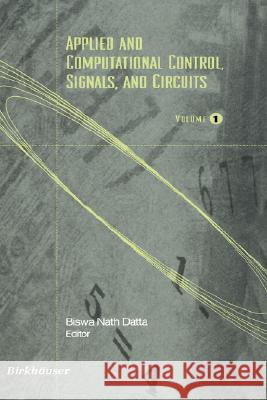
Applied and Computational Control, Signals, and Circuits: Volume 1 Datta, Biswa N. 9780817639549 Birkhauser - książkaWidoczna okładka, to zdjęcie poglądowe, a rzeczywista szata graficzna może różnić się od prezentowanej.

Applied and Computational Control, Signals, and Circuits: Volume 1

ISBN-13: 9780817639549 / Angielski / Twarda / 1999 / 539 str.

Biswa Nath Datta; B. Datta;Datta
cena 403,47 zł
(netto: 384,26 VAT:  5%)

Najniższa cena z 30 dni: 385,52 zł
Termin realizacji zamówienia:
ok. 22 dni roboczych
Bez gwarancji dostawy przed świętami

Darmowa dostawa!

The purpose of this annual series, Applied and Computational Control, Signals, and Circuits, is to keep abreast of the fast-paced developments in computational mathematics and scientific computing and their increasing use by researchers and engineers in control, signals, and circuits. The series is dedicated to fostering effective communication between mathematicians, computer scientists, computational scientists, software engineers, theorists, and practicing engineers. This interdisciplinary scope is meant to blend areas of mathematics (such as linear algebra, operator theory, and certain branches of analysis) and computational mathematics (numerical linear algebra, numerical differential equations, large scale and parallel matrix computations, numerical optimization) with control and systems theory, signal and image processing, and circuit analysis and design. The disciplines mentioned above have long enjoyed a natural synergy. There are distinguished journals in the fields of control and systems the ory, as well as signal processing and circuit theory, which publish high quality papers on mathematical and engineering aspects of these areas; however, articles on their computational and applications aspects appear only sporadically. At the same time, there has been tremendous recent growth and development of computational mathematics, scientific comput ing, and mathematical software, and the resulting sophisticated techniques are being gradually adapted by engineers, software designers, and other scientists to the needs of those applied disciplines."


Kategorie:
Informatyka
Kategorie BISAC:
Technology & Engineering > Robotics
Medical > Medycyna
Technology & Engineering > Electrical
Wydawca:
Birkhauser
Język:
Angielski
ISBN-13:
9780817639549
Rok wydania:
1999
Wydanie:
1999
Ilość stron:
539
Waga:
0.90 kg
Wymiary:
24.28 x 16.21 x 3.12
Oprawa:
Twarda
Wolumenów:
01
Dodatkowe informacje:
Wydanie ilustrowane

1 Discrete Event Systems: The State of the Art and New Directions.- 1.1 Introduction.- 1.2 DES Modeling Framework.- 1.3 Review of the State of the Art in DES Theory.- 1.3.1 Supervisory Control.- 1.3.2 Max-Plus Algebra.- 1.3.3 Sample Path Analysis and Performance Optimization.- 1.4 New Directions in DES Theory.- 1.5 Decentralized Control and Optimization.- 1.5.1 Some Key Issues.- 1.5.2 Decentralized Optimization Problem Formulation.- 1.5.3 Distributed Estimation.- 1.5.4 Weak Convergence Analysis.- 1.6 Failure Diagnosis.- 1.6.1 Statement of the Problem.- 1.6.2 Survey of Recent Literature.- 1.6.3 Presentation of One Approach to Failure Diagnosis.- 1.6.4 Some Issues for Future Research.- 1.7 Nondeterministic Supervisory Control.- 1.7.1 Nondeterminism and Semantics of Untimed Models.- 1.7.2 The Failure Semantics.- 1.7.3 The Trajectory Semantics.- 1.7.4 The Bisimulation Semantics.- 1.7.5 The Isomorphism Semantics.- 1.7.6 Discussion.- 1.8 Hybrid Systems and Optimal Control.- 1.8.1 Statement of the Problem.- 1.8.2 Using Optimal Control in Systems with Event-Driven Dynamics.- References.- 2 Array Algorithms forH2andH?Estimation.- 2.1 Introduction.- 2.2H2Square Root Array Algorithms.- 2.2.1 Kalman Filtering.- 2.2.2 Square Root Arrays.- 2.3HO?Square Root Array Algorithms.- 2.3.1H?Filtering.- 2.3.2 A Krein Space Formulation.- 2.3.3 J-Unitary Transformations.- 2.3.4 Square Root Array Algorithms.- 2.3.5 The Central Filters.- 2.4H2Fast Array Algorithms.- 2.5HO?Fast Array Algorithms.- 2.5.1 The General Case.- 2.5.2 The Central Filters.- 2.6 Conclusion.- References.- 2.A Unitary and Hyperbolic Rotations.- 2.A.1 Elementary Householder Transformations.- 2.A.2 Elementary Circular or Givens Rotations.- 2.A.3 Fast Givens Transformations.- 2.A.4 Hyperbolic Transformations.- 2.B Krein Spaces.- 2.B.1 A Geometric Interpretation.- 3 Nonuniqueness, Uncertainty, and Complexity in Modeling.- 3.1 Introduction.- 3.2 Issues of Models and Modeling.- 3.3 Nonuniqueness.- 3.4 Uncertainty.- 3.5 Complexity.- 3.6 Formulation of Model Set Identification.- 3.7 Learning or Optimization?.- 3.8 Conclusion.- References.- 4 Iterative Learning Control: An Expository Overview.- 4.1 Introduction.- 4.2 Generic Description of ILC.- 4.3 Two Illustrative Examples of ILC Algorithms.- 4.3.1 A Linear Example.- 4.3.2 An Adaptive ILC Algorithm for a Robotic Manipulator.- 4.4 The Literature, Context, and Terminology of ILC.- 4.4.1 Classifications of ILC Literature.- 4.4.2 Connections to Other Control Paradigms.- 4.5 ILC Algorithms and Results.- 4.5.1 Basic Ideas.- 4.5.2 Nonlinear Systems.- 4.5.3 Robotics and Other Applications.- 4.5.4 Some New Approaches to ILC Algorithms.- 4.6 Example: Combining Some New ILC Approaches.- 4.6.1 GMAW Model.- 4.6.2 ILC-Based Control Strategy.- 4.7 Conclusion: The Past, Present, and Future of ILC.- References.- 5 FIR Filter Design via Spectral Factorization and Convex Optimization.- 5.1 Introduction.- 5.2 Spectral Factorization.- 5.3 Convex Semi-infinite Optimization.- 5.4 Lowpass Filter Design.- 5.5 Log-Chebychev Approximation.- 5.6 Magnitude Equalizer Design.- 5.7 Linear Antenna Array Weight Design.- 5.8 Conclusions.- References.- 5.A Appendix: Spectral Factorization.- 6 Algorithms for Subspace State-Space System Identification: An Overview.- 6.1 System Identification: To Measure Is To Know’.- 6.2 Linear Subspace Identification: An Overview.- 6.2.1 Rediscovering the State.- 6.2.2 The Subspace Structure of Linear Systems.- 6.2.3 The Two Basic Steps in Subspace Identification.- 6.3 Comparing PEM with Subspace Methods.- 6.4 Statistical Consistency Results.- 6.5 Extensions.- 6.5.1 Deterministic Systems.- 6.5.2 Closed-loop Subspace System Identification.- 6.5.3 Frequency Domain Subspace Identification.- 6.5.4 Subspace Identification of Bilinear Systems.- 6.6 Software and DAISY.- 6.7 Conclusions and Open Research Problems.- References.- 7 Iterative Solution Methods for Large Linear Discrete Ill-Posed Problems.- 7.1 Introduction.- 7.2 Krylov Subspace Iterative Methods.- 7.2.1 The Standard Conjugate Gradient Algorithm.- 7.2.2 Conjugate Gradient Methods for Inconsistent Systems.- 7.3 Tikhonov Regularization.- 7.3.1 Factorization Methods.- 7.3.2 Algorithms Based on the Conjugate Gradient Method.- 7.3.3 Explicit Approximation of the Filter Function.- 7.3.4 A Comparison of Conjugate Gradient and Expansion Methods.- 7.3.5 Methods Based on the Total Variation Norm.- 7.4 An Exponential Filter Function.- 7.5 Iterative Methods Based on Implicitly Defined Filter Functions.- 7.5.1 Landweber Iteration.- 7.5.2 Truncated Conjugate Gradient Iteration.- 7.5.3 Regularizing Preconditioned Conjugate Gradient Methods.- 7.6 Toward a Black Box.- 7.6.1 Computation of the Regularization Parameter.- 7.6.2 Two Algorithms for Tikhonov Regularization.- 7.7 Computed Examples.- References.- 8 Wavelet-Based Image Coding: An Overview.- 8.1 Introduction.- 8.1.1 Image Compression.- 8.2 Quantization.- 8.2.1 Vector Quantization.- 8.2.2 Optimal Vector Quantizers.- 8.2.3 Sphere Covering and Density Shaping.- 8.2.4 Cross-Variable Dependencies.- 8.2.5 Fractional Bitrates.- 8.3 Transform Coding.- 8.3.1 The Karhunen-Loève Transform.- 8.3.2 Optimal Bit Allocation.- 8.3.3 Optimality of the Karhunen-Loève Transform.- 8.3.4 The Discrete Cosine Transform.- 8.3.5 Subband Transforms.- 8.4 Wavelets: A Different Perspective.- 8.4.1 Multiresolution Analyses.- 8.4.2 Wavelets.- 8.4.3 Recurrence Relations.- 8.4.4 Wavelet Transforms vs. Subband Decompositions.- 8.4.5 Wavelet Properties.- 8.5 A Basic Wavelet Image Coder.- 8.5.1 Choice of Wavelet Basis.- 8.5.2 Boundaries.- 8.5.3 Quantization.- 8.5.4 Entropy Coding.- 8.5.5 Bit Allocation.- 8.5.6 Perceptually Weighted Error Measures.- 8.6 Extending the Transform Coder Paradigm.- 8.7 Zerotree Coding.- 8.7.1 The Shapiro and Said-Pearlman Coders.- 8.7.2 Zerotrees and Rate-Distortion Optimization.- 8.8 Frequency and Space-Frequency Adaptive Coders.- 8.8.1 Wavelet Packets.- 8.8.2 Frequency Adaptive Coders.- 8.8.3 Space-Frequency Adaptive Coders.- 8.9 Utilizing Intra-band Dependencies.- 8.9.1 Trellis Coded Quantization.- 8.9.2 TCQ Subband Coders.- 8.9.3 Mixture Modeling and Estimation.- 8.10 Future Trends.- 8.11 Summary and Conclusion.- References.- 9 Reduced-Order Modeling Techniques Based on Krylov Subspaces and Their Use in Circuit Simulation.- 9.1 Introduction.- 9.2 Reduced-Order Modeling of Linear Dynamical Systems.- 9.2.1 Linear Dynamical Systems.- 9.2.2 Reduced-Order Modeling.- 9.2.3 Reduction to One Matrix.- 9.3 Linear Systems in Circuit Simulation.- 9.3.1 General Circuit Equations.- 9.3.2 Linear Subcircuits and Linearized Circuits.- 9.3.3 Linear RLC Circuits.- 9.4 Krylov Subspaces and Moment Matching.- 9.4.1 Assumptions and a Convention.- 9.4.2 Single Starting Vectors.- 9.4.3 Connection to Moment Matching.- 9.4.4 Multiple Starting Vectors.- 9.5 The Lanczos Process.- 9.5.1 The Classical Algorithm for Single Starting Vectors.- 9.5.2 A Lanczos-Type Algorithm for Multiple Starting Vectors.- 9.5.3 Exploiting Symmetry.- 9.6 Lanczos-Based Reduced-Order Modeling.- 9.6.1 The Classical Lanczos-Padé Connection.- 9.6.2 The Multi-Input Multi-Output Case.- 9.6.3 Stability and Passivity.- 9.6.4 PVL7r: Post-Processing of PVL.- 9.6.5 Passive Reduced-Order Models from SyMPVL.- 9.6.6 How to Achieve Passivity in Practice.- 9.6.7 Two Other Lanczos-Based Approaches.- 9.7 The Arnoldi Process.- 9.8 Arnoldi-Based Reduced-Order Modeling.- 9.9 Circuit-Noise Computations.- 9.9.1 The Problem.- 9.9.2 Reformulation as a Transfer Function.- 9.9.3 A PVL Simulation.- 9.10 Concluding Remarks.- References.- 10 SLICOT—A Subroutine Library in Systems and Control Theory.- 10.1 Introduction.- 10.2 Why Do We Need More Than MATLAB Numerics?.- 10.2.1 Limitations of MATLAB.- 10.2.2 The Need for Production Quality Numerical Software.- 10.2.3 Low-Level Reusability of Fortran Libraries.- 10.2.4 Structure Preserving Algorithms.- 10.3 Retrospect.- 10.3.1 Short History of Control Subroutine Libraries.- 10.3.2 Standard Libraries RASP and SLICOT: Present Status.- 10.3.3 RASP/SLICOT Mutual Compatibility Concept.- 10.4 The Design of SLICOT.- 10.4.1 Structure of the Library.- 10.4.2 Choice of Algorithms.- 10.4.3 User Manual.- 10.4.4 Implementation and Documentation Standards.- 10.4.5 Benchmarks.- 10.5 Contents of SLICOT.- 10.5.1 Current Contents of the Library.- 10.5.2 Development of the Public Release of SLICOT.- 10.5.3 In the Queue.- 10.6 Performance Results.- 10.7 The Future — NICONET.- 10.7.1 Objectives and Exploratory Phase of NICONET.- 10.7.2 Development of Performant Numerical Software for CACSD.- 10.7.3 Integration of Software in a User-Friendly Environment.- 10.7.4 Benchmarking and Testing the Software in an Industrial Environment.- 10.7.5 Information Dissemination and Access to Control Software.- 10.7.6 Implementation Phase.- 10.8 Concluding Remarks.- References.- 10.A Contents of SLICOT Release 3.0.- 10.B Electronic Access to the Library and Related Literature.

Datta, Biswa Nath Biswa Nath Datta is Professor of Mathematical Scie... więcej >


Udostępnij

Facebook - konto krainaksiazek.pl


Opinie o Krainaksiazek.pl na Opineo.pl

Partner Mybenefit

Krainaksiazek.pl w programie rzetelna firma Krainaksiaze.pl - płatności przez paypal

Czytaj nas na:

Facebook - krainaksiazek.pl
  • książki na zamówienie
  • granty
  • książka na prezent
  • kontakt
  • pomoc
  • opinie
  • regulamin
  • polityka prywatności

Zobacz:

  • Księgarnia czeska

  • Wydawnictwo Książkowe Klimaty

1997-2025 DolnySlask.com Agencja Internetowa

© 1997-2022 krainaksiazek.pl
     
KONTAKT | REGULAMIN | POLITYKA PRYWATNOŚCI | USTAWIENIA PRYWATNOŚCI
Zobacz: Księgarnia Czeska | Wydawnictwo Książkowe Klimaty | Mapa strony | Lista autorów
KrainaKsiazek.PL - Księgarnia Internetowa

Polityka prywatnosci - link
Krainaksiazek.pl - płatnośc Przelewy24
Przechowalnia Przechowalnia





