• Wyszukiwanie zaawansowane
  • Kategorie
  • Kategorie BISAC
  • Książki na zamówienie
  • Promocje
  • Granty
  • Książka na prezent
  • Opinie
  • Pomoc
  • Załóż konto
  • Zaloguj się

Analytical Methods for Drinking Water: Advances in Sampling and Analysis » książka


zaloguj się | załóż konto
Logo Krainaksiazek.pl

koszyk

konto

szukaj
topmenu
Księgarnia internetowa
Szukaj
Książki na zamówienie
Promocje
Granty
Książka na prezent
Moje konto
Pomoc
 
 
Wyszukiwanie zaawansowane
Pusty koszyk
Bezpłatna dostawa dla zamówień powyżej 20 złBezpłatna dostawa dla zamówień powyżej 20 zł

Kategorie główne

• Nauka
 [2949965]
• Literatura piękna
 [1857847]

  więcej...
• Turystyka
 [70818]
• Informatyka
 [151303]
• Komiksy
 [35733]
• Encyklopedie
 [23180]
• Dziecięca
 [617748]
• Hobby
 [139972]
• AudioBooki
 [1650]
• Literatura faktu
 [228361]
• Muzyka CD
 [398]
• Słowniki
 [2862]
• Inne
 [444732]
• Kalendarze
 [1620]
• Podręczniki
 [167233]
• Poradniki
 [482388]
• Religia
 [509867]
• Czasopisma
 [533]
• Sport
 [61361]
• Sztuka
 [243125]
• CD, DVD, Video
 [3451]
• Technologie
 [219309]
• Zdrowie
 [101347]
• Książkowe Klimaty
 [123]
• Zabawki
 [2362]
• Puzzle, gry
 [3791]
• Literatura w języku ukraińskim
 [253]
• Art. papiernicze i szkolne
 [7933]
Kategorie szczegółowe BISAC

Analytical Methods for Drinking Water: Advances in Sampling and Analysis

ISBN-13: 9780470094914 / Angielski / Twarda / 2005 / 232 str.
Philippe Quevauviller; K. Clive Thompson
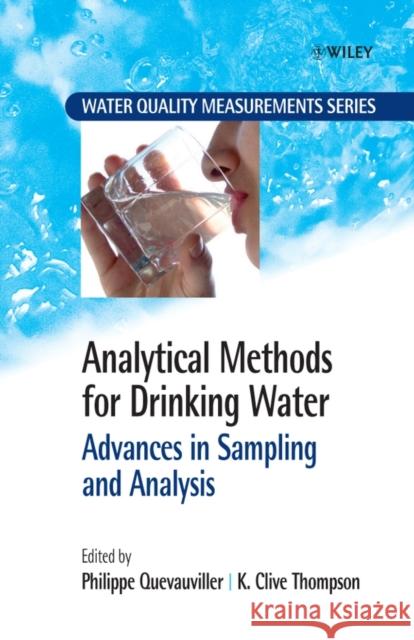
Analytical Methods for Drinking Water: Advances in Sampling and Analysis Thompson, K. Clive 9780470094914 John Wiley & Sons - książkaWidoczna okładka, to zdjęcie poglądowe, a rzeczywista szata graficzna może różnić się od prezentowanej.

Analytical Methods for Drinking Water: Advances in Sampling and Analysis

ISBN-13: 9780470094914 / Angielski / Twarda / 2005 / 232 str.

Philippe Quevauviller; K. Clive Thompson
cena 840,08
(netto: 800,08 VAT:  5%)

Najniższa cena z 30 dni: 833,20
Termin realizacji zamówienia:
ok. 30 dni roboczych
Bez gwarancji dostawy przed świętami

Darmowa dostawa!

Drinking water policies and research are intimately linked. It is thanks to the scientific progress made over the last 25 years in identifying and controlling toxic products in drinking water that regulations have developed in such a way that the protection of public health from waterborne diseases has drastically improved. The integration of research outputs into the policy-making progress requires close cooperation among the scientific and policy communities, which is not always straightforward. Exchanges among scientific and policy-making communities are certainly representing key elements of progress for a better environmental protection. In this respect, analytical developments linked to drinking water are at the core of the science-policy debate.

This book "Analytical Methods for Drinking Water: Advances in Sampling and Analysis" reflects this awareness in joining recent analytical developments with policy considerations. A first chapter gives an overview of EU and US drinking water policies, as well as on standardization. Analytical developments are described in depth in the second chapter, focusing on bromate in drinking water. The third chapter deals with the development of a sampling protocol for lead in drinking water, thus mixing analytical development with standardization needs. Finally, the fourth chapter focuses on standardization aspects (pre-normative research) related to materials in contact with drinking water.

This book, written by experts in the field of drinking water policy and analysis, illustrates recent scientific advances in this area, which have contributed to policy development and will be of direct use to policy-makers, water scientists, researchers and analytical laboratories.


Kategorie:
Nauka, Chemia
Kategorie BISAC:
Science > Environmental Science (see also Chemistry - Environmental)
Technology & Engineering > Environmental - Water Supply
Science > Chemia - Organiczna
Wydawca:
John Wiley & Sons
Seria wydawnicza:
Water Quality Measurements
Język:
Angielski
ISBN-13:
9780470094914
Rok wydania:
2005
Numer serii:
000314803
Ilość stron:
232
Waga:
0.41 kg
Wymiary:
23.44 x 15.82 x 1.6
Oprawa:
Twarda
Wolumenów:
01
Dodatkowe informacje:
Bibliografia
Wydanie ilustrowane

"This book, written by experts in the field illustrates recent scientific advances and will be of direct use to policy makers, water scientists, researchers, and analytical laboratories." ( Journal of the American Water Resources Association, February 2006)

Series Preface.

Preface.

List of Contributors.

1 DrinkingWater Regulations (Pierre Hecq, Adriana Hulsmann, Fred S. Hauchman, Jennifer L. McLain and Franz Schmitz).

1.1 EU Directive on Drinking Water Past, Present and Future.

1.1.1 EU Water Legislation.

1.1.2 The Drinking Water Directives Revision Processes.

1.1.3 Main Aspects of the Drinking Water Directives.

1.1.4 Revision of the DWD and WHO Guidelines.

1.1.5 Conclusions.

1.2 Drinking Water Regulations in the United States.

1.2.1 Introduction.

1.2.2 History of the Safe Drinking Water Act.

1.2.3 Development of Regulations.

1.2.4 Highlights of the Safe Drinking Water Act.

1.2.5 Implementation of Regulations.

1.2.6 Conclusions.

1.3 Standardization.

1.3.1 Introduction.

1.3.2 Requirements to be met by Laboratories and Analytical Methods.

1.3.3 Standardization in CEN TC 230 Water Analysis and ISO TC 147 Water Quality.

1.3.4 Development of Standards in ISO/TC 147.

1.3.5 Special Standards Development Procedures.

1.3.6 Drafting of Standards.

1.3.7 EU Requirements for Standard Methods.

References.

2 Bromate Determination (A.–Hakim R. Elwaer, Philippe Quevauviller, K. Clive Thompson and Cameron W. McLeod).

2.1 Introduction.

2.2 Ion Chromatographic Methods.

2.2.1 Identification and Removal of the Main Interferences.

2.2.2 Sample Pre–treatment Automation.

2.3 Alternative Laboratory Methods.

2.3.1 Ion Chromatography / ICP–MS.

2.3.2 Ion Chromatography Spectrophotometry Detection.

2.3.3 Ion Pair Chromatography Fluorescence Detection.

2.3.4 Flow Injection ICP–MS.

2.4 Field–based Methods.

2.4.1 Spectrophotometric Method with Methylene Blue.

2.4.2 Flow Injection Spectrophotometric Detection.

2.5 Stability of Bromate.

2.5.1 Effect of Water Matrix on Bromate Stability.

2.5.2 Stability of Bromate Species Immobilized on Alumina Microcolumns.

2.6 Interlaboratory Excercise for Bromate Determination.

2.7 Toxicity, Occurrence and Current Status of Bromate in Drinking Waters.

References.

3 Lead Monitoring (Theo van den Hoven and Nellie Slaats).

3.1 Factors Determining the Lead Concentration in Drinking Water.

3.1.1 Sources of Lead in Drinking Water.

3.1.2 Factors Determining the Lead Concentration in Drinking Water.

3.2 Sampling of Lead in Drinking Water.

3.2.1 Available Sampling Procedures.

3.2.2 Definition of a Representative Sample .

3.2.3 Representative Sampling at an Individual Consumer s Tap.

3.2.4 Lead Analyses in Tap Water.

3.3 Comparison of Sampling Procedures in the Field.

3.3.1 European Study.

3.3.2 Applied Sampling Procedures.

3.3.3 Characteristics of Test Areas.

3.3.4 Applied Test Procedures.

3.3.5 Performance Criteria of Sampling Protocols.

3.3.6 Representativeness of the Tested Protocols.

3.3.7 Reproducibility of the Tested Protocols.

3.3.8 Costs, Practicality and Consumer Acceptance.

3.3.9 Final Evaluation of Sampling Procedures.

3.3.10 Experience with the Monitoring Protocol in France.

3.4 Fit for Purpose Lead Monitoring Protocols.

3.4.1 The Requirements for Sampling and Monitoring Lead in Accordance with the DWD 98/83/EC.

3.4.2 Sampling and Monitoring Strategy.

3.4.3 Lead Monitoring Purposes.

3.5 Lead Levels in Drinking Water in Tap Water.

3.5.1 Overview of Lead Levels in Test Areas.

3.5.2 Effect of Water Composition.

3.5.3 Effect of Plumbing Materials.

3.5.4 Water Consumption.

References.

4 Materials in Contact with Drinking Water (Jean Baron).

4.1 Parameters Used for the Control of Materials Effects.

4.1.1 Organoleptic Assessments.

4.1.2 General Hygiene Assessments.

4.1.3 Substances that Pose a Risk to Health.

4.1.4 Enhancement of Microbial Growth.

4.2 Test Procedure for Metallic Materials.

4.2.1 Introduction.

4.2.2 Metallic Materials.

4.2.3 Experiments within Conormative Research.

4.2.4 Discussion.

4.2.5 Conclusions.

4.3 Test Procedure for Cementitious Materials.

4.3.1 Introduction.

4.3.2 Technical Background.

4.3.3 Effect of Preconditioning and Migration Water.

4.3.4 Reproducibility Tests.

4.3.5 Effect of Preconditioning at Different Ageing Times.

4.3.6 Conclusions.

References and Bibliography.

Index.

Dr Philippe Quevauviller, European Commission, Belgium; European Commission, Brussels

Series Editor for Water Quality Measurement Series

Prof K. Clive Thompson, Chief Scientist, Alcontrol Laboratories, UK. Experienced and well–known environmetal researcher in analytical field.

Drinking water policies and research are intimately linked. It is thanks to the scientific progress made over the last 25 years in identifying and controlling toxic products in drinking water that regulations have developed in such a way that the protection of public health from waterborne diseases has drastically improved. The integration of research outputs into the policy–making progress requires close cooperation among the scientific and policy communities, which is not always straightforward. Exchanges among scientific and policy–making communities are certainly representing key elements of progress for a better environmental protection. In this respect, analytical developments linked to drinking water are at the core of the science–policy debate.

This book Analytical Methods for Drinking Water: Advances in Sampling and Analysis reflects this awareness in joining recent analytical developments with policy considerations. A first chapter gives an overview of EU and US drinking water policies, as well as on standardization. Analytical developments are described in depth in the second chapter, focusing on bromate in drinking water. The third chapter deals with the development of a sampling protocol for lead in drinking water, thus mixing analytical development with standardization needs. Finally, the fourth chapter focuses on standardization aspects (pre–normative research) related to materials in contact with drinking water.

This book, written by experts in the field of drinking water policy and analysis, illustrates recent scientific advances in this area, which have contributed to policy development and will be of direct use to policy–makers, water scientists, researchers and analytical laboratories.



Udostępnij

Facebook - konto krainaksiazek.pl


Opinie o Krainaksiazek.pl na Opineo.pl

Partner Mybenefit

Krainaksiazek.pl w programie rzetelna firma Krainaksiaze.pl - płatności przez paypal

Czytaj nas na:

Facebook - krainaksiazek.pl
  • książki na zamówienie
  • granty
  • książka na prezent
  • kontakt
  • pomoc
  • opinie
  • regulamin
  • polityka prywatności

Zobacz:

  • Księgarnia czeska

  • Wydawnictwo Książkowe Klimaty

1997-2025 DolnySlask.com Agencja Internetowa

© 1997-2022 krainaksiazek.pl
     
KONTAKT | REGULAMIN | POLITYKA PRYWATNOŚCI | USTAWIENIA PRYWATNOŚCI
Zobacz: Księgarnia Czeska | Wydawnictwo Książkowe Klimaty | Mapa strony | Lista autorów
KrainaKsiazek.PL - Księgarnia Internetowa

Polityka prywatnosci - link
Krainaksiazek.pl - płatnośc Przelewy24
Przechowalnia Przechowalnia




