• Wyszukiwanie zaawansowane
  • Kategorie
  • Kategorie BISAC
  • Książki na zamówienie
  • Promocje
  • Granty
  • Książka na prezent
  • Opinie
  • Pomoc
  • Załóż konto
  • Zaloguj się

An Outline of Informational Genetics » książka


zaloguj się | załóż konto
Logo Krainaksiazek.pl

koszyk

konto

szukaj
topmenu
Księgarnia internetowa
Szukaj
Książki na zamówienie
Promocje
Granty
Książka na prezent
Moje konto
Pomoc
 
 
Wyszukiwanie zaawansowane
Pusty koszyk
Bezpłatna dostawa dla zamówień powyżej 20 złBezpłatna dostawa dla zamówień powyżej 20 zł

Kategorie główne

• Nauka
 [2949965]
• Literatura piękna
 [1857847]

  więcej...
• Turystyka
 [70818]
• Informatyka
 [151303]
• Komiksy
 [35733]
• Encyklopedie
 [23180]
• Dziecięca
 [617748]
• Hobby
 [139972]
• AudioBooki
 [1650]
• Literatura faktu
 [228361]
• Muzyka CD
 [398]
• Słowniki
 [2862]
• Inne
 [444732]
• Kalendarze
 [1620]
• Podręczniki
 [167233]
• Poradniki
 [482388]
• Religia
 [509867]
• Czasopisma
 [533]
• Sport
 [61361]
• Sztuka
 [243125]
• CD, DVD, Video
 [3451]
• Technologie
 [219309]
• Zdrowie
 [101347]
• Książkowe Klimaty
 [123]
• Zabawki
 [2362]
• Puzzle, gry
 [3791]
• Literatura w języku ukraińskim
 [253]
• Art. papiernicze i szkolne
 [7933]
Kategorie szczegółowe BISAC

An Outline of Informational Genetics

ISBN-13: 9783031005015 / Angielski / Miękka / 2008 / 208 str.
Gerard Battail
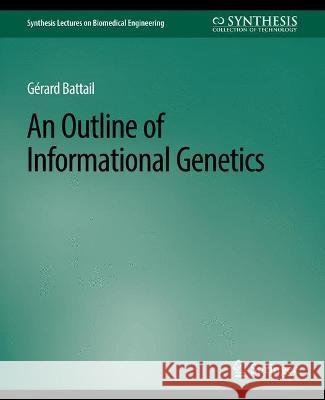
An Outline of Informational Genetics Gerard Battail   9783031005015 Springer International Publishing AG - książkaWidoczna okładka, to zdjęcie poglądowe, a rzeczywista szata graficzna może różnić się od prezentowanej.

An Outline of Informational Genetics

ISBN-13: 9783031005015 / Angielski / Miękka / 2008 / 208 str.

Gerard Battail
cena 141,19
(netto: 134,47 VAT:  5%)

Najniższa cena z 30 dni: 134,90
Termin realizacji zamówienia:
ok. 22 dni roboczych
Bez gwarancji dostawy przed świętami

Darmowa dostawa!

Heredity performs literal communication of immensely long genomes through immensely long time intervals. Genomes nevertheless incur sporadic errors referred to as mutations which have significant and often dramatic effects, after a time interval as short as a human life. How can faithfulness at a very large timescale and unfaithfulness at a very short one be conciliated? The engineering problem of literal communication has been completely solved during the second half of the XX-th century. Originating in 1948 from Claude Shannon's seminal work, information theory provided means to measure information quantities and proved that communication is possible through an unreliable channel (by means left unspecified) up to a sharp limit referred to as its capacity, beyond which communication becomes impossible. The quest for engineering means of reliable communication, named error-correcting codes, did not succeed in closely approaching capacity until 1993 when Claude Berrou and Alain Glavieux invented turbocodes. By now, the electronic devices which invaded our daily lives (e.g., CD, DVD, mobile phone, digital television) could not work without highly efficient error-correcting codes. Reliable communication through unreliable channels up to the limit of what is theoretically possible has become a practical reality: an outstanding achievement, however little publicized. As an engineering problem that nature solved aeons ago, heredity is relevant to information theory. The capacity of DNA is easily shown to vanish exponentially fast, which entails that error-correcting codes must be used to regenerate genomes so as to faithfully transmit the hereditary message. Moreover, assuming that such codes exist explains basic and conspicuous features of the living world, e.g., the existence of discrete species and their hierarchical taxonomy, the necessity of successive generations and even the trend of evolution towards increasingly complex beings. Providing geneticists with an introduction to information theory and error-correcting codes as necessary tools of hereditary communication is the primary goal of this book. Some biological consequences of their use are also discussed, and guesses about hypothesized genomic codes are presented. Another goal is prompting communication engineers to get interested in genetics and biology, thereby broadening their horizon far beyond the technological field, and learning from the most outstanding engineer: Nature. Table of Contents: Foreword / Introduction / A Brief Overview of Molecular Genetics / An Overview of Information Theory / More on Molecular Genetics / More on Information Theory / An Outline of Error-Correcting Codes / DNA is an Ephemeral Memory / A Toy Living World / Subsidiary Hypothesis, Nested System / Soft Codes / Biological Reality Conforms to the Hypotheses / Identification of Genomic Codes / Conclusion and Perspectives


Kategorie:
Technologie
Kategorie BISAC:
Science > Bioinformatics
Technology & Engineering > Biomedical
Science > Biofizyka
Wydawca:
Springer International Publishing AG
Język:
Angielski
ISBN-13:
9783031005015
Rok wydania:
2008
Dostępne języki:
Ilość stron:
208
Waga:
0.36 kg
Wymiary:
23.5 x 19.05 x 1.12
Oprawa:
Miękka
Dodatkowe informacje:
Wydanie ilustrowane

Foreword.- Introduction.- A Brief Overview of Molecular Genetics.- An Overview of Information Theory.- More on Molecular Genetics.- More on Information Theory.- An Outline of Error-Correcting Codes.- DNA is an Ephemeral Memory.- A Toy Living World.- Subsidiary Hypothesis, Nested System.- Soft Codes.- Biological Reality Conforms to the Hypotheses.- Identification of Genomic Codes.- Conclusion and Perspectives.

Gérard Battail was born in Paris, France, on June 5, 1932. He graduated at the Faculté des Sciences (1954) and the Ecole nationale supérieure des Télécommunications (ENST) in 1956, both in Paris. After his military duty, he joined the Centre national d’Etudes des Télécommunications (CNET) in 1959. He worked there on modulation systems and especially on frequency modulation, using fundamental concepts of information theory to understand its behaviour in the presence of noise, especially the threshold effect. In 1966, he joined the Compagnie française Thomson-Houston (later become Thomson-CSF) as a scientific advisor to technical teams designing radioelectric de[1]vices. There he interpreted channel coding as a diversity system for designing decoders, especially soft-input ones. He also worked on source coding, frequency synthesizers, mobile communication and other problems related to the design of industrial radiocommunication devices. In 1973, he joined ENST as a Professor. He taught there modulation, information theory and coding. He had also research activities in the same fields with special emphasis on adaptive algorithms as regards source coding and, for channel coding, on soft-in, soft-output decoding of product and concatenated codes. He proposed as a criterion for designing good codes the closeness of its distance distribution with respect to that of random coding instead of maximizing the minimum distance. These rather unorthodox views are now recognized as having paved the way to the invention of turbocodes by Berrou and Glavieux in the early 90s. After his retirement in 1997, he started working on applications of information theory to the sciences of nature. He especially investigated the role of information theory and error-correcting codes in genetics and biological evolution, showing that the conservation of genomes needs error-correcting means. He applied for many patents, wrote many papers and participated in many symposia and workshops. He also authored a textbook on information theory published by Masson in 1997. He is a member of the Société de l’Electricité, de l’Electronique, des Technologies de l’Information et de la Communication (SEE) and of the Institute of Electrical and Electronics Engineers (IEEE). Before his retirement, he was a member of the editorial board of the Annales des Télécommunications. From 1990 to 1997, he was the French official member of Commission C of URSI (International Radio-Scientific Union). From June 2001 to May 2004, he served as Associate Editor at Large of the IEEE Transactions on Information Theory.


Udostępnij

Facebook - konto krainaksiazek.pl


Opinie o Krainaksiazek.pl na Opineo.pl

Partner Mybenefit

Krainaksiazek.pl w programie rzetelna firma Krainaksiaze.pl - płatności przez paypal

Czytaj nas na:

Facebook - krainaksiazek.pl
  • książki na zamówienie
  • granty
  • książka na prezent
  • kontakt
  • pomoc
  • opinie
  • regulamin
  • polityka prywatności

Zobacz:

  • Księgarnia czeska

  • Wydawnictwo Książkowe Klimaty

1997-2025 DolnySlask.com Agencja Internetowa

© 1997-2022 krainaksiazek.pl
     
KONTAKT | REGULAMIN | POLITYKA PRYWATNOŚCI | USTAWIENIA PRYWATNOŚCI
Zobacz: Księgarnia Czeska | Wydawnictwo Książkowe Klimaty | Mapa strony | Lista autorów
KrainaKsiazek.PL - Księgarnia Internetowa

Polityka prywatnosci - link
Krainaksiazek.pl - płatnośc Przelewy24
Przechowalnia Przechowalnia





