• Wyszukiwanie zaawansowane
  • Kategorie
  • Kategorie BISAC
  • Książki na zamówienie
  • Promocje
  • Granty
  • Książka na prezent
  • Opinie
  • Pomoc
  • Załóż konto
  • Zaloguj się

An Introduction to the Optical Spectroscopy of Inorganic Solids » książka

zaloguj się | załóż konto
Logo Krainaksiazek.pl

koszyk

konto

szukaj
topmenu
Księgarnia internetowa
Szukaj
Książki na zamówienie
Promocje
Granty
Książka na prezent
Moje konto
Pomoc
 
 
Wyszukiwanie zaawansowane
Pusty koszyk
Bezpłatna dostawa dla zamówień powyżej 20 złBezpłatna dostawa dla zamówień powyżej 20 zł

Kategorie główne

• Nauka
 [2946600]
• Literatura piękna
 [1856966]

  więcej...
• Turystyka
 [72221]
• Informatyka
 [151456]
• Komiksy
 [35826]
• Encyklopedie
 [23190]
• Dziecięca
 [619653]
• Hobby
 [140543]
• AudioBooki
 [1577]
• Literatura faktu
 [228355]
• Muzyka CD
 [410]
• Słowniki
 [2874]
• Inne
 [445822]
• Kalendarze
 [1744]
• Podręczniki
 [167141]
• Poradniki
 [482898]
• Religia
 [510455]
• Czasopisma
 [526]
• Sport
 [61590]
• Sztuka
 [243598]
• CD, DVD, Video
 [3423]
• Technologie
 [219201]
• Zdrowie
 [101638]
• Książkowe Klimaty
 [124]
• Zabawki
 [2473]
• Puzzle, gry
 [3898]
• Literatura w języku ukraińskim
 [254]
• Art. papiernicze i szkolne
 [8170]
Kategorie szczegółowe BISAC

An Introduction to the Optical Spectroscopy of Inorganic Solids

ISBN-13: 9780470868867 / Angielski / Miękka / 2005 / 304 str.
J. Garcia Sole; Jose Soli; Luisa Bausa
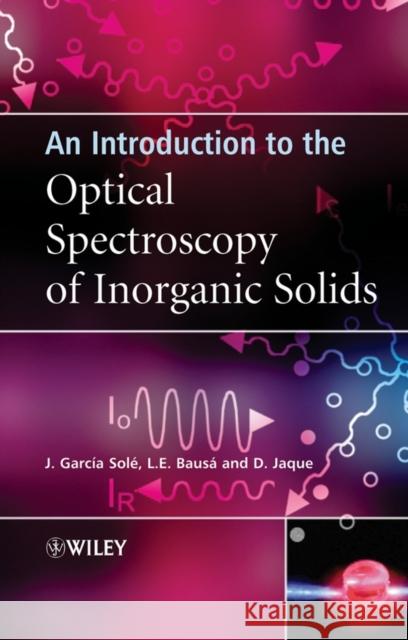
An Introduction to the Optical Spectroscopy of Inorganic Solids J. Garci Jose Soli Luisa Bausa 9780470868867 John Wiley & Sons - książkaWidoczna okładka, to zdjęcie poglądowe, a rzeczywista szata graficzna może różnić się od prezentowanej.

An Introduction to the Optical Spectroscopy of Inorganic Solids

ISBN-13: 9780470868867 / Angielski / Miękka / 2005 / 304 str.

J. Garcia Sole; Jose Soli; Luisa Bausa
cena 399,42 zł
(netto: 380,40 VAT:  5%)

Najniższa cena z 30 dni: 396,14 zł
Termin realizacji zamówienia:
ok. 30 dni roboczych
Bez gwarancji dostawy przed świętami

Darmowa dostawa!

This practical guide to spectroscopy and inorganic materials meets the demand from academia and the science community for an introductory text that introduces the different optical spectroscopic techniques, used in many laboratories, for material characterisation.

  • Treats the most basic aspects to be introduced into the field of optical spectroscopy of inorganic materials, enabling a student to interpret simple optical (absorption, reflectivity, emission and scattering) spectra
  • Contains simple, illustrative examples and solved exercises
  • Covers the theory, instrumentation and applications of spectroscopy for the characterisation of inorganic materials, including lasers, phosphors and optical materials such as photonics
This is an ideal beginner's guide for students with some previous knowledge in quantum mechanics and optics, as well as a reference source for professionals or researchers in materials science, especially the growing field of optical materials.

Kategorie:
Nauka, Chemia
Kategorie BISAC:
Science > Spectroscopy & Spectrum Analysis
Science > Physics - Condensed Matter
Wydawca:
John Wiley & Sons
Język:
Angielski
ISBN-13:
9780470868867
Rok wydania:
2005
Ilość stron:
304
Waga:
0.44 kg
Wymiary:
23.11 x 16.92 x 1.68
Oprawa:
Miękka
Wolumenów:
01
Dodatkowe informacje:
Wydanie ilustrowane

"This is a useful book for an undergraduate or an early–stage postgraduate course in spectroscopy." ( Reviews, June 2008)

"[allows] students with a background in quantum physics and solid state physics, to interpret simple optical spectra and obtain knowledge of the main instrumentation used in this field." (Chimie Nouvelle, March 2007)

PREFACE.

ACKNOWLEDGEMENTS.

SOME PHYSICAL CONSTANTS OF INTEREST IN SPECTROSCOPY.

I FUNDAMENTALS.

I.1 Origin of the Spectroscopy.

I.2 Electromagnetic Spectrum. Optical Spectroscopy.

I.3 Absorption. The Spectrophotometer.

I.4 Luminescence. The Spectrofluorimeter. Time resolved luminescence.

I.5 Scattering. The Raman effect.

I.6 Advanced topic: The Fourier Transform Spectrophotometer.

Exercises.

II LIGHT SOURCES.

II.1 Introduction.

II.2 Lamps.

II.3 The Laser. Basic principles.

II.4 Types of Lasers.

II.5 Tunability of laser radiation. The Optical Parametric Oscillator.

II.6 Advanced Topic:1) Site Selective Spectroscopy. 2) Excited State Absorption.

Exercises.

III MONOCHROMATORS AND DETECTORS.

III.1 Introduction.

III.2 Monochromators.

III.3 Types of detectors. Basic parameters.

III.4 The Photomultiplier.

III.5 Signal/noise ratio optimisation.

III.6 Detection of pulses.

III.7 Advanced Topic: Detection of very fast pulses; The Streak Camera; The Correlator.

Exercises.

IV. OPTICAL TRANSPARENCY OF SOLIDS.

IV.1 Introduction.

IV.2 Optical magnitudes and the dielectric constant.

IV.3The Lorentz oscillator.

IV.4 Metals.

IV.5 Semiconductors and insulators.

IV.6 Spectral shape of the fundamental absorption edge.

IV.7 Excitons.

IV.8 Advanced topic: The colour of metals.

Exercises.

V. OPTICALLY ACTIVE CENTRES.

V.1 Introduction.

V.2 Static interaction. The crystalline field.

V.3 Band intensities. The oscillator strength.

V.4 Dynamic interaction. The coordinate configuration diagram.

V.5 Band shape. The Huang–Rhys factor.

V.6 Non radiative transitions. Energy transfer.

V.7 Advanced topic: Determination of quantum efficiencies.

Exercises.

VI. APPLICATIONS: RARE EARTH AND TRANSITION METAL IONS, COLOUR CENTERS.

VI.1 Introduction.

VI.2 Trivalent rare earth ions. Diagram of Dieke.

VI.3 Non radiative transitions in rare earth ions; The "energy gap" law.

VI.4 Transition metal ions. Tanabe– Sugano diagrams.

VI.5 Colour centres.

VI.6 Advanced topic: 1) The Judd and Ofelt method. 2) Optical cooling of solids.

Exercises.

VII. GROUP THEORY AND SPECTROSCOPY.

VII.1 Introduction.

VII.2 Symmetry operations and classes.

VII.3 Representations. The character table.

VII.4 Reduction in symmetry and splitting of energy levels.

VII.5 Selection rules for optical transitions.

VII.6 Illustrative examples.

VII.7 Advanced topic: Applications to optical transitions of Kramers ions.

Exercises.

APPENDICES.

APPENDIX A1.– The joint density of states.

APPENDIX A2.– Effect of an octahedral field on a valence electron d1.

APPENDIX A3.– Calculation of the spontaneous emission probability by the Einstein thermodynamic treatment.

APPENDIX A4.– Determination of the Smakula´s formula.

INDEX.

This book presents the basic aspects of the field of the optical spectroscopy of solids, allowing students with a background in quantum physics, optics and solid state physics, to interpret simple optical spectra (absorption, reflectivity, emission, scattering ) and obtain knowledge of the main instrumentation used in this field. Although most of the material treated in this book concerns the spectroscopy of centres embedded in inorganic materials, the principles described are also applicable to molecules and atoms in the gas and /or the liquid state.

This book is organized as follows:

  • The opening chapter provides a short introduction of the fundamentals of optical spectroscopy, describing the basic standard equipment needed to measure optical spectra and the main optical magnitudes that can be measured.
  • The next two chapters are devoted to describing the main characteristics and the basic working principles for the general instrumentation used in optical spectroscopy.
  • Chapter 4 analyses the absorption and reflectivity spectra of pure crystals.
  • The next two chapters deal with the spectra of "optically active centres", including a large variety of optical materials, such as phosphors, solid–state lasers and amplifiers.
  • The final chapter presents a simple introduction to group theory and its usefulness in interpreting the optical spectra of active centres.

The book is suitable for undergraduate and postgraduate students in chemistry, physics and materials sciences, especially for those enrolled in courses in optics and laser spectroscopy, solid–state spectroscopy and introductory solid–state physics. It will also be of interest to researchers, teachers and libraries, with interests in the area of materials science, especially in the growing field of optical materials


Udostępnij

Facebook - konto krainaksiazek.pl


Opinie o Krainaksiazek.pl na Opineo.pl

Partner Mybenefit

Krainaksiazek.pl w programie rzetelna firma Krainaksiaze.pl - płatności przez paypal

Czytaj nas na:

Facebook - krainaksiazek.pl
  • książki na zamówienie
  • granty
  • książka na prezent
  • kontakt
  • pomoc
  • opinie
  • regulamin
  • polityka prywatności

Zobacz:

  • Księgarnia czeska

  • Wydawnictwo Książkowe Klimaty

1997-2025 DolnySlask.com Agencja Internetowa

© 1997-2022 krainaksiazek.pl
     
KONTAKT | REGULAMIN | POLITYKA PRYWATNOŚCI | USTAWIENIA PRYWATNOŚCI
Zobacz: Księgarnia Czeska | Wydawnictwo Książkowe Klimaty | Mapa strony | Lista autorów
KrainaKsiazek.PL - Księgarnia Internetowa

Polityka prywatnosci - link
Krainaksiazek.pl - płatnośc Przelewy24
Przechowalnia Przechowalnia







