• Wyszukiwanie zaawansowane
  • Kategorie
  • Kategorie BISAC
  • Książki na zamówienie
  • Promocje
  • Granty
  • Książka na prezent
  • Opinie
  • Pomoc
  • Załóż konto
  • Zaloguj się

An Introduction to Optimal Designs for Social and Biomedical Research » książka

zaloguj się | załóż konto
Logo Krainaksiazek.pl

koszyk

konto

szukaj
topmenu
Księgarnia internetowa
Szukaj
Książki na zamówienie
Promocje
Granty
Książka na prezent
Moje konto
Pomoc
 
 
Wyszukiwanie zaawansowane
Pusty koszyk
Bezpłatna dostawa dla zamówień powyżej 20 złBezpłatna dostawa dla zamówień powyżej 20 zł

Kategorie główne

• Nauka
 [2950560]
• Literatura piękna
 [1849509]

  więcej...
• Turystyka
 [71097]
• Informatyka
 [151150]
• Komiksy
 [35848]
• Encyklopedie
 [23178]
• Dziecięca
 [617388]
• Hobby
 [139064]
• AudioBooki
 [1657]
• Literatura faktu
 [228597]
• Muzyka CD
 [383]
• Słowniki
 [2855]
• Inne
 [445295]
• Kalendarze
 [1464]
• Podręczniki
 [167547]
• Poradniki
 [480102]
• Religia
 [510749]
• Czasopisma
 [516]
• Sport
 [61293]
• Sztuka
 [243352]
• CD, DVD, Video
 [3414]
• Technologie
 [219456]
• Zdrowie
 [101002]
• Książkowe Klimaty
 [124]
• Zabawki
 [2311]
• Puzzle, gry
 [3459]
• Literatura w języku ukraińskim
 [254]
• Art. papiernicze i szkolne
 [8079]
Kategorie szczegółowe BISAC

An Introduction to Optimal Designs for Social and Biomedical Research

ISBN-13: 9780470694503 / Angielski / Twarda / 2009 / 346 str.
Martijn P. F. Berger; Weng Kee Wong
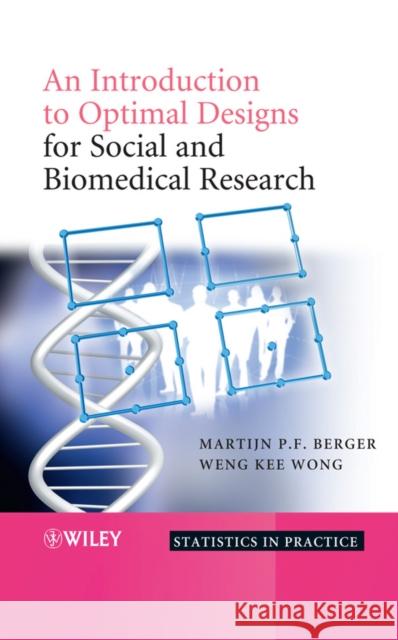
An Introduction to Optimal Designs for Social and Biomedical Research Martijn P. F. Berger Weng-Kee Wong 9780470694503 John Wiley & Sons - książkaWidoczna okładka, to zdjęcie poglądowe, a rzeczywista szata graficzna może różnić się od prezentowanej.

An Introduction to Optimal Designs for Social and Biomedical Research

ISBN-13: 9780470694503 / Angielski / Twarda / 2009 / 346 str.

Martijn P. F. Berger; Weng Kee Wong
cena 373,03
(netto: 355,27 VAT:  5%)

Najniższa cena z 30 dni: 370,73
Termin realizacji zamówienia:
ok. 30 dni roboczych
Dostawa w 2026 r.

Darmowa dostawa!

The increasing cost of research means that scientists are in more urgent need of optimal design theory to increase the efficiency of parameter estimators and the statistical power of their tests. The objectives of a good design are to provide interpretable and accurate inference at minimal costs. Optimal design theory can help to identify a design with maximum power and maximum information for a statistical model and, at the same time, enable researchers to check on the model assumptions. This Book:

  • Introduces optimal experimental design in an accessible format.
  • Provides guidelines for practitioners to increase the efficiency of their designs, and demonstrates how optimal designs can reduce a study's costs.
  • Discusses the merits of optimal designs and compares them with commonly used designs.
  • Takes the reader from simple linear regression models to advanced designs for multiple linear regression and nonlinear models in a systematic manner.
  • Illustrates design techniques with practical examples from social and biomedical research to enhance the reader's understanding.
Researchers and students studying social, behavioural and biomedical sciences will find this book useful for understanding design issues and in putting optimal design ideas to practice.

Kategorie:
Nauka, Matematyka
Kategorie BISAC:
Social Science > Badania społeczne i statystyki
Psychology > Research & Methodology
Medical > Research
Wydawca:
John Wiley & Sons
Seria wydawnicza:
Statistics in Practice
Język:
Angielski
ISBN-13:
9780470694503
Rok wydania:
2009
Numer serii:
000022326
Ilość stron:
346
Waga:
0.61 kg
Wymiary:
23.11 x 15.75 x 2.29
Oprawa:
Twarda
Wolumenów:
01
Dodatkowe informacje:
Bibliografia
Wydanie ilustrowane

Preface xi

Acknowledgements xiii

1 Introduction to designs 1

1.1 Introduction 1

1.2 Stages of the research process 4

1.2.1 Choice of a good design 5

1.3 Research design 6

1.3.1 Choice of independent variables and levels 6

1.3.2 Units of analysis 6

1.3.3 Variables 7

1.3.4 Replication 8

1.4 Types of research designs 8

1.5 Requirements for a good design 9

1.5.1 Statistical conclusion validity 10

1.5.2 Internal validity 12

1.5.3 Control of (unwanted) variation 13

1.6 Ethical aspects of design choice 16

1.7 Exact versus approximate designs 17

1.8 Examples 19

1.8.1 Radiation dosage example 19

1.8.2 Designs for the Poggendorff and Ponzo illusion experiments 20

1.8.3 Uncertainty about best fitting regression models 22

1.8.4 Designs for a priori contrasts among composite faces 23

1.8.5 Designs for calibration of item parameters in item response theory models 24

1.9 Summary 26

2 Designs for simple linear regression 27

2.1 Design problem for a linear model 27

2.1.1 The design 28

2.1.2 The linear regression model 31

2.1.3 Estimation of parameters and efficiency 32

2.2 Designs for radiation–dosage example 35

2.3 Relative efficiency and sample size 36

2.4 Simultaneous inference 37

2.5 Optimality criteria 39

2.5.1 D–optimality criterion 40

2.5.2 A–optimality criterion 41

2.5.3 G–optimality criterion 41

2.5.4 E–optimality criterion 43

2.5.5 Number of distinct design points 43

2.6 Relative efficiency 44

2.7 Matrix formulation of designs for linear regression 44

2.8 Summary 49

3 Designs for multiple linear regression analysis 51

3.1 Design problem for multiple linear regression 51

3.1.1 The design 52

3.1.2 The multiple linear regression model 54

3.1.3 Estimation of parameters and efficiency 54

3.2 Designs for vocabulary–growth study 56

3.3 Relative efficiency and sample size 60

3.4 Simultaneous inference 61

3.5 Optimality criteria for a subset of parameters 62

3.6 Relative efficiency 64

3.7 Designs for polynomial regression model 65

3.7.1 Exact D–optimal designs for a quadratic regression model 69

3.7.2 Scale dependency of A– and E–optimality criteria 71

3.8 The Poggendorff and Ponzo illusion study 71

3.9 Uncertainty about best fitting regression models 76

3.10 Matrix notation of designs for multiple regression models 79

3.10.1 Design for regression models with two independent variables 80

3.10.2 Design for regression models with two non–additive independent variables 82

3.11 Summary 85

4 Designs for analysis of variance models 87

4.1 A typical design problem for an analysis of variance model 87

4.1.1 The design 89

4.1.2 The analysis of variance model 90

4.1.3 Formulation of an ANOVA model as a regression model 91

4.2 Estimation of parameters and efficiency 95

4.2.1 Measures of uncertainty 96

4.3 Simultaneous inference and optimality criteria 97

4.4 Designs for groups under stress study 98

4.4.1 A priori planned unequal sample sizes 99

4.4.2 Not planned unequal sample sizes 100

4.5 Specific hypotheses and contrasts 101

4.5.1 Loss of efficiency and power 103

4.6 Designs for the composite faces study 106

4.7 Balanced designs versus unbalanced designs 109

4.8 Matrix notation for Groups under Stress study 109

4.9 Summary 111

5 Designs for logistic regression models 113

5.1 Design problem for logistic regression 113

5.2 The design 114

5.3 The logistic regression model 115

5.3.1 Design for a single dichotomous independent variable 116

5.3.2 Design for multiple qualitative independent variables 122

5.3.3 Design for a single quantitative independent variable 125

5.3.4 Design for two independent quantitative variables 130

5.4 Approaches to deal with local optimality 133

5.5 Designs for calibration of item parameters in item response theory models 134

5.6 Matrix formulation of designs for logistic regression 137

5.6.1 Hours of practice experiment 138

5.6.2 Problem solving study 140

5.7 Summary 141

6 Designs for multilevel models 143

6.1 Design problem for multilevel models 143

6.1.1 The design 144

6.1.2 Validity considerations 146

6.2 The multilevel regression model 147

6.2.1 Cluster randomization of treatment 147

6.2.2 Subject randomization of treatment 149

6.3 Cluster versus subject randomization 151

6.4 Cost function 153

6.5 Example: Nursing home study 155

6.5.1 Cluster randomization 157

6.5.2 Subject randomization 159

6.6 Optimal design and power 160

6.6.1 Power for cluster randomized design 162

6.6.2 Power for multi–center design 164

6.6.3 Increase of efficiency and power by including covariates 165

6.6.4 Unequal sample sizes 165

6.7 Design effect in multilevel surveys 166

6.7.1 Values of intra–class correlation 168

6.7.2 Cluster randomized sampling versus simple random sampling 168

6.8 Matrix formulation of the multilevel model 169

6.8.1 Cluster randomization of treatment 170

6.8.2 Subject randomization of treatment 172

6.9 Summary 174

7 Longitudinal designs for repeated measurement models 175

7.1 Design problem for repeated measurements 175

7.2 The design 179

7.3 Analysis techniques for repeated measures 180

7.4 The linear mixed effects model for repeated measurement data 181

7.4.1 Random intercept model 182

7.4.2 Random intercept and slope model 183

7.5 Variance covariance structures 184

7.5.1 Compound symmetry structure 184

7.5.2 Auto–correlation structure 185

7.6 Estimation of parameters and efficiency 187

7.6.1 Small sample behaviour of estimators 188

7.7 Bone mineral density example 189

7.7.1 Improvement of the longitudinal design 194

7.8 Cost function 196

7.9 D–optimal designs for linear mixed effects models with autocorrelated errors 200

7.10 Miscellanea 207

7.10.1 Homoscedasticity 207

7.10.2 Uninformative dropout 208

7.11 Matrix formulation of the linear mixed effects model 208

7.12 Summary 211

8 Two–treatment crossover designs 213

8.1 Design problem for crossover studies 213

8.2 The design 216

8.3 Confounding treatment effects with nuisance effects 218

8.4 The linear model for crossover designs 221

8.5 Estimation of parameters and efficiency 223

8.6 Cost and efficiency of the crossover design 223

8.6.1 Cost function 226

8.7 Optimal crossover designs for two treatments 229

8.7.1 Some further observations 231

8.8 Matrix formulation of the mixed model for crossover designs 232

8.9 Summary 235

9 Alternative optimal designs for linear models 237

9.1 Introduction 237

9.2 Information matrix 238

9.3 DA– or Ds–optimal designs 239

9.4 Extrapolation optimal design 241

9.5 L–optimal designs 242

9.6 Bayesian optimal designs 244

9.7 Minimax optimal design 247

9.8 Multiple–objective optimal designs 250

9.8.1 Constrained optimal design 251

9.8.2 Compound optimal design 253

9.9 Summary 255

10 Optimal designs for nonlinear models 257

10.1 Introduction 257

10.2 Linear models versus nonlinear models 258

10.2.1 The Arrhenius equation 258

10.2.2 The compartmental model 259

10.2.3 The Michaelis Menten model 260

10.2.4 The Emax model 261

10.3 Design issues for nonlinear models 261

10.3.1 Local optimality 262

10.4 Alternative optimal designs with examples 265

10.4.1 DA or Ds–optimal design 265

10.4.2 Extrapolation optimal design 266

10.4.3 Optimal design for estimating percentiles 266

10.5 Bayesian optimal designs 267

10.6 Minimax optimal design 269

10.7 Multiple–objective optimal designs 271

10.8 Optimal design for model discrimination 273

10.9 Summary 275

11 Resources for the construction of optimal designs 277

11.1 Introduction 277

11.2 Sequential construction of optimal designs 278

11.3 Exchange of design points 283

11.3.1 Exchange algorithms 283

11.4 Other algorithms 284

11.5 Optimal design software 285

11.6 A web site for finding optimal designs 286

11.6.1 Optimal designs for the Michaelis Menten and Emax models 288

11.6.2 Optimal designs for discriminating among toxicological models 290

11.7 Summary 294

References 295

Author Index 313

Subject Index 319

The increasing cost of research means that scientists are in more urgent need of optimal design theory to increase the efficiency of parameter estimators and the statistical power of their tests.

The objectives of a good design are to provide interpretable and accurate inference at minimal costs. Optimal design theory can help to identify a design with maximum power and maximum information for a statistical model and, at the same time, enable researchers to check on the model assumptions.

This Book:

  • Introduces optimal experimental design in an accessible format.
  • Provides guidelines for practitioners to increase the efficiency of their designs, and demonstrates how optimal designs can reduce a study s costs.
  • Discusses the merits of optimal designs and compares them with commonly used designs.
  • Takes the reader from simple linear regression models to advanced designs for multiple linear regression and nonlinear models in a systematic manner.
  • Illustrates design techniques with practical examples from social and biomedical research to enhance the reader s understanding.

Researchers and students studying social, behavioural and biomedical sciences will find this book useful for understanding design issues and in putting optimal design ideas to practice.


Udostępnij

Facebook - konto krainaksiazek.pl


Opinie o Krainaksiazek.pl na Opineo.pl

Partner Mybenefit

Krainaksiazek.pl w programie rzetelna firma Krainaksiaze.pl - płatności przez paypal

Czytaj nas na:

Facebook - krainaksiazek.pl
  • książki na zamówienie
  • granty
  • książka na prezent
  • kontakt
  • pomoc
  • opinie
  • regulamin
  • polityka prywatności

Zobacz:

  • Księgarnia czeska

  • Wydawnictwo Książkowe Klimaty

1997-2025 DolnySlask.com Agencja Internetowa

© 1997-2022 krainaksiazek.pl
     
KONTAKT | REGULAMIN | POLITYKA PRYWATNOŚCI | USTAWIENIA PRYWATNOŚCI
Zobacz: Księgarnia Czeska | Wydawnictwo Książkowe Klimaty | Mapa strony | Lista autorów
KrainaKsiazek.PL - Księgarnia Internetowa

Polityka prywatnosci - link
Krainaksiazek.pl - płatnośc Przelewy24
Przechowalnia Przechowalnia








