• Wyszukiwanie zaawansowane
  • Kategorie
  • Kategorie BISAC
  • Książki na zamówienie
  • Promocje
  • Granty
  • Książka na prezent
  • Opinie
  • Pomoc
  • Załóż konto
  • Zaloguj się

Alzheimer's Disease » książka


zaloguj się | załóż konto
Logo Krainaksiazek.pl

koszyk

konto

szukaj
topmenu
Księgarnia internetowa
Szukaj
Książki na zamówienie
Promocje
Granty
Książka na prezent
Moje konto
Pomoc
 
 
Wyszukiwanie zaawansowane
Pusty koszyk
Bezpłatna dostawa dla zamówień powyżej 20 złBezpłatna dostawa dla zamówień powyżej 20 zł

Kategorie główne

• Nauka
 [2950560]
• Literatura piękna
 [1849509]

  więcej...
• Turystyka
 [71097]
• Informatyka
 [151150]
• Komiksy
 [35848]
• Encyklopedie
 [23178]
• Dziecięca
 [617388]
• Hobby
 [139064]
• AudioBooki
 [1657]
• Literatura faktu
 [228597]
• Muzyka CD
 [383]
• Słowniki
 [2855]
• Inne
 [445295]
• Kalendarze
 [1464]
• Podręczniki
 [167547]
• Poradniki
 [480102]
• Religia
 [510749]
• Czasopisma
 [516]
• Sport
 [61293]
• Sztuka
 [243352]
• CD, DVD, Video
 [3414]
• Technologie
 [219456]
• Zdrowie
 [101002]
• Książkowe Klimaty
 [124]
• Zabawki
 [2311]
• Puzzle, gry
 [3459]
• Literatura w języku ukraińskim
 [254]
• Art. papiernicze i szkolne
 [8079]
Kategorie szczegółowe BISAC

Alzheimer's Disease

ISBN-13: 9780896037373 / Angielski / Twarda / 1999 / 408 str.
Nigel M. Hooper
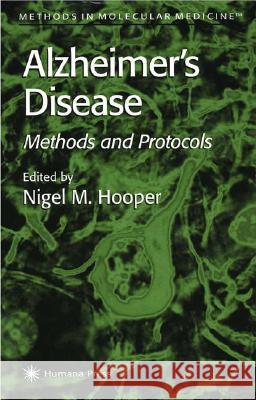
Alzheimer's Disease Hooper, Nigel M. 9780896037373 Humana Press - książkaWidoczna okładka, to zdjęcie poglądowe, a rzeczywista szata graficzna może różnić się od prezentowanej.

Alzheimer's Disease

ISBN-13: 9780896037373 / Angielski / Twarda / 1999 / 408 str.

Nigel M. Hooper
cena 402,53
(netto: 383,36 VAT:  5%)

Najniższa cena z 30 dni: 385,52
Termin realizacji zamówienia:
ok. 22 dni roboczych
Dostawa w 2026 r.

Darmowa dostawa!

Alzheimer's disease is the most common cause of senile dementia. Since the discovery in 1984 of the amyloid ?-peptide (A?) as the core protein of the senile plaques present in the brains of Alzheimer's disease sufferers, an immense amount of research has gone into mapping out the molecular basis of this debilitating disease. The aim of Alzheimer's Disease: Methods and Protocols is to bring together the main biochemical, cell biological, and molecular biological techniques and approaches that are being used to investigate the molecular basis of Alzheimer's disease. This volume begins with chapters of an introductory/ review nature. Chapter 1 provides a historical introduction to Alzheimer's d- ease with particular emphasis on the central role played by A? and its re- tion to tau. Chapter 2 examines the genetics underlying this neurodegenerative disease, covering the amyloid precursor protein, apolipoprotein E, and the presenilins. Chapter 3 presents an overview of currently available therapeutic agents and prospects for drugs of the future.


Kategorie:
Nauka, Medycyna
Kategorie BISAC:
Medical > Neurologia i neurofizjologia kliniczna
Science > Biologia molekularna
Medical > Geriatrics
Wydawca:
Humana Press
Seria wydawnicza:
Methods in Molecular Medicine
Język:
Angielski
ISBN-13:
9780896037373
Rok wydania:
1999
Wydanie:
2000
Numer serii:
000014951
Ilość stron:
408
Waga:
0.79 kg
Wymiary:
23.83 x 16.15 x 3.12
Oprawa:
Twarda
Wolumenów:
01
Dodatkowe informacje:
Bibliografia
Wydanie ilustrowane

"...this volume contains well-written chapters containing factual insights and useful clarifications. An example is David Allsop's introduction of the field through the orthodox views of the amyloid cascade hypothesis that in the exposition of others is often quite simplistic, but here is presented with complexity and wisdom deserving of serious consideration....they are provided in a format that invites the reader to undertake studies and examine the underpinnings of the subject beyond that found in the primary publications and not covered in such a practical manner in other reviews."- Journal of Molecular Neuroscience

Introduction to Alzheimer's Disease, David Allsop. The Genetics of Alzheimer's Disease, Nick Brindle and Peter St. George-Hyslop. Advances in Methodology and Current Prospects for Primary Drug Therapies for Alzheimer's Disease, David S. Knopman. Production and Functional Assays of Recombinant Secreted Amyloid Precursor Protein (APP) (sAPPa), Steven W. Barger. Quantifying Ab1-40 and Ab1-42 Using Sandwich-ELISA, Daniel M. Skovronsky, Jun Wang, Virginia M.-Y. Lee, and Robert W. Doms. Electrophoretic Separation and Immunoblotting of Ab1-40 and Ab1-42 Matthias Staufenbiel and Paolo A. Paganetti. Ab-Induced Proinflammatory Cytokine Release from Differentiated Human THP-1 Monocytes, Kurt R. Brunden, June Kocsis-Angle, Paula Embury, and Stephen L. Yates. Effects of the b-Amyloid Peptide on Membrane Ion Permeability, Hugh A. Pearson. Analysis of b-Amyloid Peptide Degradation In Vitro, Barbara Cordell and Asha Naidu. Posttranslational Modifications of the Amyloid Precursor Protein: Ectodomain Phosphorylation and Sulfation, Jochen Walter and Christian Haass. Posttranslational Modifications of the Amyloid Precursor Protein: Glycosylation, Chen Liu, Tomasz Rozmyslowicz, Magda Stwora-Wojczyk, Boguslaw Wojczyk, and Steven L. Spitalnik. Using an Amyloid Precursor Protein (APP) Reporter to Characterize a-Secretase, Susan Boseman Roberts. Inhibition of a-Secretase by Zinc Metalloproteinase Inhibitors, S. Parvathy, Anthony J. Turner, and Nigel M. Hooper. Development of Neoepitope Antibodies Against the b-Secretase Cleavage Site in the Amyloid Precursor Protein Carol W. Gray and Eric H. Karran. b-Secretase: Tissue Culture Studies of Sequence Specificity, Inhibitors, and Candidate Enzymes, Martin Citron. Using g-Secretase Inhibitors to Distiguish the Generation of the Ab Peptides Terminating at Val-40 and Ala-42, Paolo A. Paganetti and Matthia Staufenbiel. Designing Animal Models of Alzheimer's Disease with Amyloid Precursor Protein (APP) Transgenes, Jeanne F. Loring. Phosphorylation ofAmyloid Precursor Protein (APP) Family Proteins, Toshiharu Suzuki, Kanae Ando, Ko-ichi Iijima, Shinobu Oguchi, and Shizu Takeda. Determining the Transmembrane Topology of the Presenilins, Gopal Thinakaran and Andrew Doan. Normal Proteolytic Processing of the Presenilins, Henrike Hartmann and Bruce A. Yankner. Apoptotic Proteolytic Cleavage of the Presenilins by Caspases, Tae-Wan Kim. The Phosphorylation of Presenilin Proteins, Jochen Walter. Interaction of the Presenilins with the Amyloid Precursor Protein (APP), Andreas Weidemann, Krzysztof Paliga, Ulrike Dürrwang, Friedrich Reinhard, Dai Zhang, Rupert Sandbrink, Geneviève Evin, Colin L. Masters, and Konrad Beyreuther. Distribution of Presenilins and Amyloid Precursor Protein (APP) in Detergent-Insoluble Membrane Domains, Edward T. Parkin, Anthony J. Turner and Nigel M. Hooper. Characterization and Use of Monoclonal Antibodies to Tau and Paired Helical Filament Tau, Peter Davies. Tau Phosphorylation Both In Vitro and in Cells. C. Hugh Reynolds, Graham M. Gibb, and Simon Lovestone. Transglutaminase-Catalyzed Formation of Alzheimer-Like Insoluble Complexes from Recombinant Tau, Brian J. Balin and Denah M. Appelt. Index.

With the molecular mechanisms underlying the various forms of muscular dystrophy now rapidly clarifying, precise diagnosis has become a reality, and even a requirement in clinical practice. In Muscular Dystrophy: Methods and Protocols, Katherine Bushby and Louise Anderson have assembled an outstanding collection of key techniques for the analysis of DNA and protein from patients suspected to suffer from muscular dystrophy. Each method is highly detailed to ensure success and is presented by a hands-on expert who uses it on a day-to-day basis. The various DNA techniques focus on both the X-linked muscular dystrophies and the autosomal recessive muscular dystrophies. The protein methods include expression analysis, multiplex western blot analysis, immunocytochemical analysis, and reviews of immunological reagants and of amplification systems. Also discussed are the use of animal models to understand human muscular dystrophy and the available options for gene-based therapy.
Comprehensive and highly practical, Muscular Dystrophy: Methods and Protocols offers today‚s diagnostic laboratories, basic and medical researchers, and active clinicians an authoritative collection of tools that will serve as exacting diagnostic tools as well as greatly empowering research on the novel therapeutics now beginning to emerge.

Hooper, Nigel M. Nigel Hooper is Professor of Biochemistry in t... więcej >


Udostępnij

Facebook - konto krainaksiazek.pl


Opinie o Krainaksiazek.pl na Opineo.pl

Partner Mybenefit

Krainaksiazek.pl w programie rzetelna firma Krainaksiaze.pl - płatności przez paypal

Czytaj nas na:

Facebook - krainaksiazek.pl
  • książki na zamówienie
  • granty
  • książka na prezent
  • kontakt
  • pomoc
  • opinie
  • regulamin
  • polityka prywatności

Zobacz:

  • Księgarnia czeska

  • Wydawnictwo Książkowe Klimaty

1997-2025 DolnySlask.com Agencja Internetowa

© 1997-2022 krainaksiazek.pl
     
KONTAKT | REGULAMIN | POLITYKA PRYWATNOŚCI | USTAWIENIA PRYWATNOŚCI
Zobacz: Księgarnia Czeska | Wydawnictwo Książkowe Klimaty | Mapa strony | Lista autorów
KrainaKsiazek.PL - Księgarnia Internetowa

Polityka prywatnosci - link
Krainaksiazek.pl - płatnośc Przelewy24
Przechowalnia Przechowalnia





