• Wyszukiwanie zaawansowane
  • Kategorie
  • Kategorie BISAC
  • Książki na zamówienie
  • Promocje
  • Granty
  • Książka na prezent
  • Opinie
  • Pomoc
  • Załóż konto
  • Zaloguj się

Advanced Physical Models for Silicon Device Simulation » książka


zaloguj się | załóż konto
Logo Krainaksiazek.pl

koszyk

konto

szukaj
topmenu
Księgarnia internetowa
Szukaj
Książki na zamówienie
Promocje
Granty
Książka na prezent
Moje konto
Pomoc
 
 
Wyszukiwanie zaawansowane
Pusty koszyk
Bezpłatna dostawa dla zamówień powyżej 20 złBezpłatna dostawa dla zamówień powyżej 20 zł

Kategorie główne

• Nauka
 [2946600]
• Literatura piękna
 [1856966]

  więcej...
• Turystyka
 [72221]
• Informatyka
 [151456]
• Komiksy
 [35826]
• Encyklopedie
 [23190]
• Dziecięca
 [619653]
• Hobby
 [140543]
• AudioBooki
 [1577]
• Literatura faktu
 [228355]
• Muzyka CD
 [410]
• Słowniki
 [2874]
• Inne
 [445822]
• Kalendarze
 [1744]
• Podręczniki
 [167141]
• Poradniki
 [482898]
• Religia
 [510455]
• Czasopisma
 [526]
• Sport
 [61590]
• Sztuka
 [243598]
• CD, DVD, Video
 [3423]
• Technologie
 [219201]
• Zdrowie
 [101638]
• Książkowe Klimaty
 [124]
• Zabawki
 [2473]
• Puzzle, gry
 [3898]
• Literatura w języku ukraińskim
 [254]
• Art. papiernicze i szkolne
 [8170]
Kategorie szczegółowe BISAC

Advanced Physical Models for Silicon Device Simulation

ISBN-13: 9783211830529 / Angielski / Twarda / 1998 / 354 str.
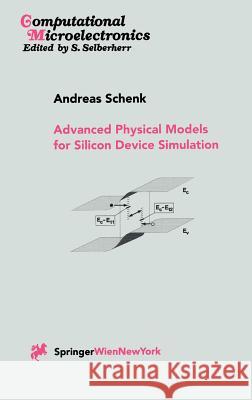
Andreas Schenk; A. Schenk
Advanced Physical Models for Silicon Device Simulation Andreas Schenk A. Schenk 9783211830529 Springer - książkaWidoczna okładka, to zdjęcie poglądowe, a rzeczywista szata graficzna może różnić się od prezentowanej.

Advanced Physical Models for Silicon Device Simulation

ISBN-13: 9783211830529 / Angielski / Twarda / 1998 / 354 str.

Andreas Schenk; A. Schenk
cena 605,23 zł
(netto: 576,41 VAT:  5%)

Najniższa cena z 30 dni: 578,30 zł
Termin realizacji zamówienia:
ok. 22 dni roboczych
Bez gwarancji dostawy przed świętami

Darmowa dostawa!

Device simulation has two main purposes: to understand and depict the physical processes in the interior of a device, and to make reliable predictions of the behavior of an anticipated new device generation. Towards these goals the quality of the physical models is decisive. The introductory chapter of this book contains a critical review on models for silicon device simulators, which rely on moments of the Boltzmann equation. With reference to fundamental experimental and theoretical work an extensive collection of widely used models is discussed in terms of physical accuracy and application results. This review shows that the quality and efficiency of the phys ical models, which have been developed for the purpose of numerical simulation over the last three decades, is sufficient for many applications. Nevertheless, the basic understanding of the microscopic processes, as well as the uniqueness and accuracy of the models are still unsatisfactory. Hence, the following chapters of the book deal with the derivation of physics-based models from a microscopic level, also using new approaches of "taylored quantum-mechanics." Each model is compared with experimental data and applied to a number of simulation exam ples. The problems when starting from "first principles" and making the models suitable for a device simulator will also be demonstrated. We will show that demands for rapid computation and numerical robustness require a compromise between physical soundness and analytical simplicity, and that the attainable accuracy is limited by the complexity of the problems."


Kategorie:
Technologie
Kategorie BISAC:
Technology & Engineering > Electronics - Semiconductors
Technology & Engineering > Electrical
Technology & Engineering > Optics
Wydawca:
Springer
Seria wydawnicza:
Computational Microelectronics
Język:
Angielski
ISBN-13:
9783211830529
Rok wydania:
1998
Wydanie:
1998
Numer serii:
000080389
Ilość stron:
354
Waga:
0.70 kg
Wymiary:
23.39 x 15.6 x 2.24
Oprawa:
Twarda
Wolumenów:
01
Dodatkowe informacje:
Wydanie ilustrowane

"... this is a well produced book, written in a easy to read style, and will also be a very useful primer for someone starting out the field who wants to know what can and cannot be done, and a useful source of reference for experienced users ...” Microelectronics Journal

1 Simulation of Silicon Devices: An Overview.- 1.1 Transport Models.- 1.1.1 Quantum Transport.- 1.1.2 Boltzmann Equation.- 1.1.3 Method of Moments.- 1.1.3.1 Transport Models.- 1.1.4 Thermodynamic Approach.- 1.2 Review of Physical Models for Drift-Diffusion Equations.- 1.2.1 Effective Intrinsic Density.- 1.2.1.1 Effective Masses and Effective Densities of States.- 1.2.1.2 Intrinsic Gap and Intrinsic Carrier Density.- 1.2.1.3 Band Gap Narrowing: Theoretical Models.- 1.2.1.4 Band Gap Narrowing: Empirical Models.- 1.2.1.5 Effective Intrinsic Density with Fermi Statistics.- 1.2.2 Mobility.- 1.2.2.1 Theoretical Background.- 1.2.2.2 Empirical Models for the Low Field Mobility.- 1.2.2.3 Empirical High-Field Corrections.- 1.2.2.4 Some Remarks.- 1.2.3 Generation-Recombination.- 1.2.3.1 Shockley-Read-Hall Recombination.- 1.2.3.2 Auger Recombination.- 1.2.3.3 Impact Ionization.- 1.3 Simulation Example: Gated Diode.- References.- 2 Mobility Model for Hydrodynamic Transport Equations.- 2.1 Analytical Model of the Electron Mobility.- 2.1.1 Variational Method with a Heated Maxwellian.- 2.1.2 Scattering Mechanisms.- 2.1.2.1 Intravalley Acoustic-Phonon Scattering.- 2.1.2.2 Intervalley Scattering.- 2.1.2.3 Impurity Scattering.- 2.1.3 Analytical Results for the Partial Mobilities.- 2.1.3.1 Non-Elastic Approach for Intravalley Acoustic-Phonon Scattering.- 2.1.3.2 Intervalley Scattering.- 2.1.3.3 Impurity Scattering Including Dispersive Screening.- 2.2 Parameter Fit and Comparison with Experimental Data.- 2.2.1 Fit Procedure.- 2.2.2 Dependence on Ambient Temperature.- 2.2.3 Dependence on Carrier Temperature, Velocity Saturation.- 2.2.4 Doping Dependence.- 2.3 Hole Mobility.- 2.3.1 Band Model.- 2.3.2 Analytical Model for the Hole Mobility.- 2.3.3 Dependence on Ambient Temperature, Carrier Temperature, and Doping.- 2.4 Simulation Results.- References.- 3 Advanced Generation-Recombination Models.- 3.1 Band-to-Band Tunneling.- 3.1.1 Microscopic Model.- 3.1.1.1 Kubo Formalism for the Tunneling Conductivity.- 3.1.1.2 Direct (Zero Phonon) Transitions.- 3.1.1.3 Indirect (Phonon-Assisted) Transitions.- 3.1.2 Model for Device Simulation.- 3.1.2.1 Simplifications.- 3.1.2.2 Comparison of Direct and Indirect Band-to-Band Tunneling.- 3.1.3 Field and Angular Dependence.- 3.2 Defect-Assisted Tunneling.- 3.2.1 Field Enhancement Factors for SRH Lifetimes.- 3.2.2 Simplified Models of the Field Enhancement.- 3.2.2.1 High-Temperature Approximation.- 3.2.2.2 Low-Temperature Approximation.- 3.2.3 On the Temperature Dependence of SRH Lifetimes.- 3.2.3.1 High-Temperature Approximation.- 3.2.3.2 Low-Temperature Approximation.- 3.2.4 Example: The Gold Acceptor in Silicon.- 3.3 Numerical Simulation of Tunnel Generation Currents.- 3.3.1 Band-to-Band Tunneling versus Defect-Assisted Tunneling.- 3.3.2 Local versus Nonlocal Description.- 3.4 Coupled Defect-Level Recombination.- 3.4.1 Theory of Coupled Defect-Level Recombination.- 3.4.1.1 Steady-State Recombination Rate.- 3.4.1.2 Field-Enhancement of the Coupled Defect-Level Rate.- 3.4.2 Simulation of LPE-Grown Junctions.- 3.4.3 Effect of Different Two-Level Systems.- References.- 4 Metal-Semiconductor Contact.- 4.1 Emission Current Through a Parabolic Barrier.- 4.2 Interpolation Scheme for the Transmission Probability.- 4.3 Analytical Model of the Contact Current.- 4.4 Boundary Conditions for Device Simulation.- 4.5 Comparison with Measurements.- 4.6 Results of Numerical Simulation.- 4.6.1 Implementation.- 4.6.2 Schottky nin Diode.- 4.6.3 Merged pin/Schottky (MPS) Diode.- References.- 5 Modeling Transport Across Thin Dielectric Barriers.- 5.1 One-Step Tunneling.- 5.1.1 Transmission Probability.- 5.1.2 I (V)-Characteristics of Direct and FN Tunneling.- 5.2 Two-Step Multiphonon-Assisted Tunneling.- 5.3 Resonant Tunneling.- 5.4 Comparison of Two-Step Zero-Phonon Tunneling and Resonant Tunneling.- 5.5 Simulation of the Long-Term Charge Loss in EPROMs.- 5.5.1 Measurements.- 5.5.2 Simulated Field and High-Temperature Dependence of the Leakage Current.- 5.5.3 Comparison of Various Loss Mechanisms.- References.- 6 Summary and Outlook.- References.- Appendices.- B Evaluation of a Double Integral.- C Transmission Probability for a Parabolic Barrier.- D Asymptotic Forms and Interpolation of Cylinder Functions.- E Energy Limit for Gaussian Approximation.- G Probability of Resonant Tunneling.- References.- List of Figures.- List of Tables.


Udostępnij

Facebook - konto krainaksiazek.pl


Opinie o Krainaksiazek.pl na Opineo.pl

Partner Mybenefit

Krainaksiazek.pl w programie rzetelna firma Krainaksiaze.pl - płatności przez paypal

Czytaj nas na:

Facebook - krainaksiazek.pl
  • książki na zamówienie
  • granty
  • książka na prezent
  • kontakt
  • pomoc
  • opinie
  • regulamin
  • polityka prywatności

Zobacz:

  • Księgarnia czeska

  • Wydawnictwo Książkowe Klimaty

1997-2025 DolnySlask.com Agencja Internetowa

© 1997-2022 krainaksiazek.pl
     
KONTAKT | REGULAMIN | POLITYKA PRYWATNOŚCI | USTAWIENIA PRYWATNOŚCI
Zobacz: Księgarnia Czeska | Wydawnictwo Książkowe Klimaty | Mapa strony | Lista autorów
KrainaKsiazek.PL - Księgarnia Internetowa

Polityka prywatnosci - link
Krainaksiazek.pl - płatnośc Przelewy24
Przechowalnia Przechowalnia





