• Wyszukiwanie zaawansowane
  • Kategorie
  • Kategorie BISAC
  • Książki na zamówienie
  • Promocje
  • Granty
  • Książka na prezent
  • Opinie
  • Pomoc
  • Załóż konto
  • Zaloguj się

Absorption 2e » książka


zaloguj się | załóż konto
Logo Krainaksiazek.pl

koszyk

konto

szukaj
topmenu
Księgarnia internetowa
Szukaj
Książki na zamówienie
Promocje
Granty
Książka na prezent
Moje konto
Pomoc
 
 
Wyszukiwanie zaawansowane
Pusty koszyk
Bezpłatna dostawa dla zamówień powyżej 20 złBezpłatna dostawa dla zamówień powyżej 20 zł

Kategorie główne

• Nauka
 [2946350]
• Literatura piękna
 [1816154]

  więcej...
• Turystyka
 [70666]
• Informatyka
 [151172]
• Komiksy
 [35576]
• Encyklopedie
 [23172]
• Dziecięca
 [611458]
• Hobby
 [135995]
• AudioBooki
 [1726]
• Literatura faktu
 [225763]
• Muzyka CD
 [378]
• Słowniki
 [2917]
• Inne
 [444280]
• Kalendarze
 [1179]
• Podręczniki
 [166508]
• Poradniki
 [469467]
• Religia
 [507199]
• Czasopisma
 [496]
• Sport
 [61352]
• Sztuka
 [242330]
• CD, DVD, Video
 [3348]
• Technologie
 [219391]
• Zdrowie
 [98638]
• Książkowe Klimaty
 [124]
• Zabawki
 [2382]
• Puzzle, gry
 [3525]
• Literatura w języku ukraińskim
 [259]
• Art. papiernicze i szkolne
 [7107]
Kategorie szczegółowe BISAC

Absorption 2e

ISBN-13: 9781118057452 / Angielski / Twarda / 2012 / 744 str.
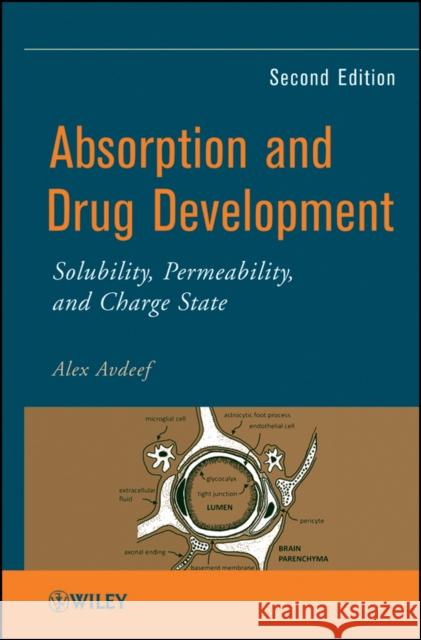
Alex Avdeef
Absorption 2e Avdeef, Alex 9781118057452 John Wiley & Sons - książkaWidoczna okładka, to zdjęcie poglądowe, a rzeczywista szata graficzna może różnić się od prezentowanej.

Absorption 2e

ISBN-13: 9781118057452 / Angielski / Twarda / 2012 / 744 str.

Alex Avdeef
cena 736,97
(netto: 701,88 VAT:  5%)

Najniższa cena z 30 dni: 727,98
Termin realizacji zamówienia:
ok. 30 dni roboczych.

Darmowa dostawa!

Explains how to perform and analyze the results of the latest physicochemical methods With this book as their guide, readers have access to all the current information needed to thoroughly investigate and accurately determine a compound's pharmaceutical properties and their effects on drug absorption. The book emphasizes oral absorption, explaining all the physicochemical methods used today to analyze drug candidates. Moreover, the author provides expert guidance to help readers analyze the results of their studies in order to select the most promising drug candidates. This Second Edition has been thoroughly updated and revised, incorporating all the latest research findings, methods, and resources, including:

  • Descriptions and applications of new PAMPA models, drawing on more than thirty papers published by the author's research group
  • Two new chapters examining permeability and Caco-2/MDCK and permeability and the blood-brain barrier
  • Expanded information and methods to support pKa determination
  • New examples explaining the treatment of practically insoluble test compounds
  • Additional case studies demonstrating the use of the latest physicochemical techniques
  • New, revised, and expanded database tables throughout the book
Well over 200 drawings help readers better understand difficult concepts and provide a visual guide to complex procedures. In addition, over 800 references serve as a gateway to the primary literature in the field, facilitating further research into all the topics covered in the book. This Second Edition is recommended as a reference for researchers in pharmaceutical R&D as well as in agrochemical, environmental, and other related areas of research. It is also recommended as a supplemental text for graduate courses in pharmaceutics.

Kategorie:
Nauka, Chemia
Kategorie BISAC:
Medical > Farmacja
Science > Chemistry - Industrial & Technical
Medical > Farmakologia
Wydawca:
John Wiley & Sons
Język:
Angielski
ISBN-13:
9781118057452
Rok wydania:
2012
Wydanie:
Revised
Ilość stron:
744
Waga:
1.28 kg
Wymiary:
24.4 x 16.6 x 4.5
Oprawa:
Twarda
Wolumenów:
01
Dodatkowe informacje:
Bibliografia

Preface xxiii

Preface to the First Edition xxvii

List of Abbreviations xxxi

Nomenclature xxxv

Commercial Trademarks xli

1 Introduction 1

1.1 Bulldozer Searching for a Needle in the Haystack? 1

1.2 As the Paradigm Turns 4

1.3 Screen for the Target or ADME First? 5

1.4 ADME and Multimechanism Screens 6

1.5 ADME and the Medicinal Chemist 7

1.6 The Absorption in ADME 8

1.7 It Is Not Just a Number It Is a Multimechanism 9

References 9

2 Transport Model 12

2.1 Permeability Solubility Charge State and pH–Partition Hypothesis 12

2.2 Properties of the Gastrointestinal Tract (GIT) 17

2.3 pH Microclimate 22

2.4 Intracellular pH Environment 23

2.5 Tight Junction Complex 23

2.6 Structure of Octanol 23

2.7 Biopharmaceutics Classification System 25

References 26

3 pKa Determination 31

3.1 Charge State and the pKa 32

3.2 Methods of Choice for the Determination of the pKa 34

3.3 Titration with a Glass–Membrane pH Electrode 34

3.4 Equilibrium Equations and the Ionization Constant 38

3.5 Pure Solvent Activity Scale 41

3.6 Ionic Strength and Debye Hückel/Davies Equation 41

3.7 Constant Ionic Medium Activity Scale 43

3.8 Temperature Dependence of pKa Values 47

3.9 Electrode Calibration and Standardization 55

3.10 Bjerrum Plot: Most Useful Graphical Tool in pKa Analysis 66

3.11 Cosolvent Methods for pKa Determination of Practically Insoluble Substances 78

3.12 Other Methods for pKa Measurement 96

3.13 pKa Microconstants 102

3.14 pKa Compilations 107

3.15 pKa Prediction Programs 107

3.16 Database of pKa (25°C and 37°C) 107

Appendix 3.1 Quick Start: Determination of the pKa of Codeine 127

Appendix 3.2 Tutorial for Measurements with Glass–Membrane pH Electrode 130

Appendix 3.3 pH Convention Adopted by IUPAC and Supported by NIST 137

Appendix 3.4 Liquid–Junction Potentials (LJP) 140

Appendix 3.5 pKa Refi nement by Weighted Nonlinear Regression 146

Appendix 3.6 Molality to Molarity Conversion 157

References 158

4 Octanol Water Partitioning 174

4.1 Overton Hansch Model 175

4.2 Tetrad of Equilibria 175

4.3 Conditional Constants 177

4.4 log P Data Sources 178

4.5 log D Lipophilicity Profile 178

4.6 Ion–Pair Partitioning 183

4.7 Micro–log P 187

4.8 Methods for log P Determination 188

4.9 Dyrssen Dual–Phase Titration log P Method 189

4.10 Ionic Strength Dependence of log P 194

4.11 Temperature Dependence of log P 194

4.12 Calculated versus Measured log P of Research Compounds 194

4.13 log D versus pH Case Study: Procaine Structural Analogs 196

4.14 Database of Octanol Water log PN log PI and log D7.4 201

References 209

5 Liposome Water Partitioning 220

5.1 Biomimetic Lipophilicity 221

5.2 Tetrad of Equilibria and Surface Ion–Pairing (SIP) 221

5.3 Data Sources 222

5.4 Location of Drugs Partitioned into Bilayers 222

5.5 Thermodynamics of Partitioning: Entropy– or Enthalpy–Driven? 223

5.6 Electrostatic and Hydrogen Bonding in a Low Dielectric Medium 224

5.7 Water Wires H+/OH Currents and Permeability of Amino Acids and Peptides 227

5.8 Preparation Methods: MLV SUV FAT LUV ET 228

5.9 Experimental Methods 229

5.10 Prediction of log PMEM from log POCT 229

5.11 log DMEM diff log PMEM and Prediction of log PSI M P EM from log PI OCT 233

5.12 Three Indices of Lipophilicity: Liposomes IAM and Octanol 238

5.13 Getting It Wrong from One–Point log DMEM Measurement 239

5.14 Partitioning into Charged Liposomes 240

5.15 pKa MEM Shifts in Charged Liposomes and Micelles 240

5.16 Prediction of Absorption from Liposome Partition Studies? 241

5.17 Database of log PMEM and log PSI M P EM 242

References 245

6 Solubility 251

6.1 It s Not Just a Number 252

6.2 Why Is Solubility Measurement Difficult? 252

6.3 Mathematical Models for Solubility pH Profiles 255

6.4 Experimental Methods 270

6.5 Correction for the DMSO Effect by the –Shift Method 287

6.6 Case Studies (Solubility pH Profi les) 289

6.7 Limits of Detection Precision versus Accuracy 306

6.8 Data Sources and the Ionizable–Drug Problem 308

6.9 Database of log S0 308

References 310

7 Permeability PAMPA 319

7.1 Permeability in the Gastrointestinal Tract 320

7.2 Historical Developments in Permeability Models 323

7.3 Rise of PAMPA A Useful Tool in Early Drug Discovery 336

7.4 PAMPA–HDM –DOPC –DS Models Compared 343

7.5 Modeling Biological Membranes 354

7.6 Permeability pH Relationship and the Mitigating Effect of the Aqueous Boundary Layer 362

7.7 pKa FLUX–Optimized Design (pOD) 386

7.8 Cosolvent PAMPA 389

7.9 UV versus LC/MS Detection 397

7.10 Assay Time Points 400

7.11 Buffer Effects 402

7.12 Apparent Filter Porosity 404

7.13 PAMPA Errors: Intra–Plate and Inter–Plate Reproducibility 407

7.14 Human Intestinal Absorption (HIA) and PAMPA 409

7.15 Permeation of Permanently Charged Molecules 416

7.16 Permeation of Zwitterions/Ampholytes In Combo PAMPA 424

7.17 PAMPA in Formulation: Solubilizing Excipient Effects 433

7.18 Database of Double–Sink PAMPA log P0 log Pm 6.5 and log Pm 7.4 448

Appendix 7.1 Quick Start: Double–Sink PAMPA of Metoprolol 460

Appendix 7.2 Permeability Equations 465

Appendix 7.3 PAMPA Paramembrane Water Channels 481

References 484

8 Permeability: Caco–2/MDCK 499

8.1 Permeability in the Gastrointestinal Tract 500

8.2 Cell–Based In Vitro Permeability Model 505

8.3 In Situ Human Jejunum Permeability (HJP) Model 514

8.4 Passive Intrinsic Permeability Coefficients of Caco–2 and MDCK Compared 515

8.5 Theory (Stage 1): Paracellular Leakiness and Size Exclusion in Caco–2 MDCK and 2/4/A1 Cell Lines 516

8.6 Theory (Stage 2): Regression Method for In Vitro Cellular Permeability 524

8.7 Case Studies of Cell–Based Permeability as a Function of pH 525

8.8 Human Jejunal Permeability Predicted Directly from Caco–2/MDCK 533

8.9 Caco–2/MDCK Database and Its In Combo PAMPA Prediction 550

References 563

9 Permeability: Blood Brain Barrier 575

9.1 The Blood Brain Barrier: A Key Element for Drug Access to the Central Nervous System 576

9.2 The Blood Brain Barrier 576

9.3 Noncellular BBB Models 580

9.4 In Vitro BBB Cell–Based Models 586

9.5 In Vivo BBB Models 589

9.6 Paradigm Shift 592

9.7 In Silico BBB Models 608

9.8 Biophysical Analysis of In Vitro Endothelial Cell Models 608

9.9 In Situ Brain Perfusion Analysis of Flow 618

9.10 In Combo PAMPA BBB Model for Passive BBB Permeability 631

References 663

10 Summary and Some Simple Approximations 681

Index 685

ALEX AVDEEF, PhD, is the founder of in–ADME Research. He has more than thirty years of experience in chemical instrumentation and software development. Internationally recognized as an authority in the field of solution chemistry, Dr. Avdeef has an extensive list of scholarly publications to his credit.

Explains how to perform and analyze the results of the latest physicochemical methods

With this book as their guide, readers have access to all the current information needed to thoroughly investigate and accurately determine a compound′s pharmaceutical properties and their effects on drug absorption. The book emphasizes oral absorption, explaining all the physicochemical methods used today to analyze drug candidates. Moreover, the author provides expert guidance to help readers analyze the results of their studies in order to select the most promising drug candidates.

This Second Edition has been thoroughly updated and revised, incorporating all the latest research findings, methods, and resources, including:

  • Descriptions and applications of new PAMPA models, drawing on more than thirty papers published by the author′s research group

  • Two new chapters examining permeability and Caco–2/MDCK and permeability and the blood–brain barrier

  • Expanded information and methods to support pKa determination

  • New examples explaining the treatment of practically insoluble test compounds

  • Additional case studies demonstrating the use of the latest physicochemical techniques

  • New, revised, and expanded database tables throughout the book

Well over 200 drawings help readers better understand difficult concepts and provide a visual guide to complex procedures. In addition, over 800 references serve as a gateway to the primary literature in the field, facilitating further research into all the topics covered in the book.

This Second Edition is recommended as a reference for researchers in pharmaceutical R&D as well as in agrochemical, environmental, and other related areas of research. It is also recommended as a supplemental text for graduate courses in pharmaceutics.

Avdeef, Alex Alex Avdeef, PhD, is CEO and CSO of pION Inc., and... więcej >


Udostępnij

Facebook - konto krainaksiazek.pl


Opinie o Krainaksiazek.pl na Opineo.pl

Partner Mybenefit

Krainaksiazek.pl w programie rzetelna firma Krainaksiaze.pl - płatności przez paypal

Czytaj nas na:

Facebook - krainaksiazek.pl
  • książki na zamówienie
  • granty
  • książka na prezent
  • kontakt
  • pomoc
  • opinie
  • regulamin
  • polityka prywatności

Zobacz:

  • Księgarnia czeska

  • Wydawnictwo Książkowe Klimaty

1997-2026 DolnySlask.com Agencja Internetowa

© 1997-2022 krainaksiazek.pl
     
KONTAKT | REGULAMIN | POLITYKA PRYWATNOŚCI | USTAWIENIA PRYWATNOŚCI
Zobacz: Księgarnia Czeska | Wydawnictwo Książkowe Klimaty | Mapa strony | Lista autorów
KrainaKsiazek.PL - Księgarnia Internetowa

Polityka prywatnosci - link
Krainaksiazek.pl - płatnośc Przelewy24
Przechowalnia Przechowalnia






