• Wyszukiwanie zaawansowane
  • Kategorie
  • Kategorie BISAC
  • Książki na zamówienie
  • Promocje
  • Granty
  • Książka na prezent
  • Opinie
  • Pomoc
  • Załóż konto
  • Zaloguj się

Ecophysiology of Desert Arthropods and Reptiles » książka


zaloguj się | załóż konto
Logo Krainaksiazek.pl

koszyk

konto

szukaj
topmenu
Księgarnia internetowa
Szukaj
Książki na zamówienie
Promocje
Granty
Książka na prezent
Moje konto
Pomoc
 
 
Wyszukiwanie zaawansowane
Pusty koszyk
Bezpłatna dostawa dla zamówień powyżej 20 złBezpłatna dostawa dla zamówień powyżej 20 zł

Kategorie główne

• Nauka
 [2950560]
• Literatura piękna
 [1849509]

  więcej...
• Turystyka
 [71097]
• Informatyka
 [151150]
• Komiksy
 [35848]
• Encyklopedie
 [23178]
• Dziecięca
 [617388]
• Hobby
 [139064]
• AudioBooki
 [1657]
• Literatura faktu
 [228597]
• Muzyka CD
 [383]
• Słowniki
 [2855]
• Inne
 [445295]
• Kalendarze
 [1464]
• Podręczniki
 [167547]
• Poradniki
 [480102]
• Religia
 [510749]
• Czasopisma
 [516]
• Sport
 [61293]
• Sztuka
 [243352]
• CD, DVD, Video
 [3414]
• Technologie
 [219456]
• Zdrowie
 [101002]
• Książkowe Klimaty
 [124]
• Zabawki
 [2311]
• Puzzle, gry
 [3459]
• Literatura w języku ukraińskim
 [254]
• Art. papiernicze i szkolne
 [8079]
Kategorie szczegółowe BISAC

Ecophysiology of Desert Arthropods and Reptiles

ISBN-13: 9783642753398 / Angielski / Miękka / 2011 / 203 str.
John L. Cloudsley-Thompson
Ecophysiology of Desert Arthropods and Reptiles John L. Cloudsley-Thompson 9783642753398 Springer - książkaWidoczna okładka, to zdjęcie poglądowe, a rzeczywista szata graficzna może różnić się od prezentowanej.

Ecophysiology of Desert Arthropods and Reptiles

ISBN-13: 9783642753398 / Angielski / Miękka / 2011 / 203 str.

John L. Cloudsley-Thompson
cena 402,53
(netto: 383,36 VAT:  5%)

Najniższa cena z 30 dni: 385,52
Termin realizacji zamówienia:
ok. 22 dni roboczych
Dostawa w 2026 r.

Darmowa dostawa!

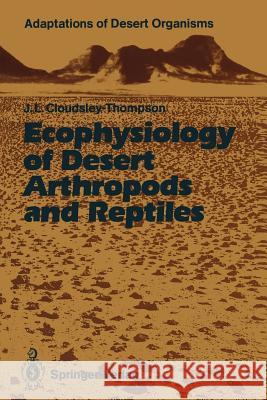
Ecophysiology of Desert Arthropods and Reptiles starts with a new classification of the world's deserts, based upon the type of precipitation and the effect on their faunas of arthropods and reptiles. This is followed by an account of microclimates and the avoidance of environmental extremes. Whereas thermoregulation is primarily behavioural, responses to water shortage are largely physiological. Seasonal activity and phenology are described, adaptations for burrowing, the avoidance of enemies, and defence, are also outlined. A comparative account of interspecific relationships, feeding specializations, and species diversity in the two taxa is described. The purpose of the book is to provide a new and up-to-date analysis that will stimulate further research along these lines.


Kategorie:
Nauka, Biologia i przyroda
Kategorie BISAC:
Science > Biochemia
Science > Zoologia i nauki o zwierzętach
Science > Life Sciences - Ecology
Wydawca:
Springer
Seria wydawnicza:
Adaptations of Desert Organisms
Język:
Angielski
ISBN-13:
9783642753398
Rok wydania:
2011
Wydanie:
Softcover Repri
Numer serii:
000034705
Ilość stron:
203
Waga:
0.34 kg
Wymiary:
23.5 x 15.5
Oprawa:
Miękka
Wolumenów:
01

1 Introduction.- 2 The Deserts of the World and Their Faunas.- 2.1 Classification of Deserts.- 2.2 Precipitation and Moisture.- 2.3 Exposure.- 2.4 Parallel Evolution, Convergence and Ecological Equivalents.- 2.4.1 Reptilian Examples of Convergence.- 2.4.2 Parallel Evolution Among Lizard Assemblages.- 2.4.3 Arthropodan Examples of Convergence.- 2.5 Energy Flow.- 2.6 Trophic Level Patterns of Process-Functioning.- 2.6.1 Herbivores and Detritivores.- 2.6.2 Carnivores.- 2.6.3 Omnivores.- 2.7 Moisture-Associated Patterns of Process-Functioning.- 2.8 Field Metabolic Rates.- 2.9 Conclusions.- 3 Avoidance of Environmental Extremes.- 3.1 Introduction.- 3.2 Desert Microclimates.- 3.3 Circadian Locomotory Rhythms.- 3.3.1 Arthropods.- 3.3.2 Reptiles.- 3.4 Seasonal Rhythms in Locomotory Activity.- 3.4.1 Arthropods.- 3.4.2 Reptiles.- 3.5 Social Behaviour.- 3.6 Conclusions.- 4 Thermal Regulation and Control.- 4.1 Introduction.- 4.2 Behavioural Thermoregulation.- 4.2.1 Insect Flight.- 4.2.2 Moving and Shuttling Between Sunlight and Shade.- 4.2.2.1 Arthropods.- 4.2.2.2 Reptiles.- 4.2.3 Posture and Orientation.- 4.3 Thermal Tolerance.- 4.3.1 Heat Tolerance.- 4.3.2 Maxithermy.- 4.3.3 Cold Tolerance.- 4.4 Thermal Control.- 4.4.1 Metabolic Effects.- 4.4.2 Colour and Reflectivity.- 4.5 Responses to Ultraviolet Radiation.- 4.6 The Mechanism of Heat Death.- 4.7 Conclusions.- 5 Water Balance and Nitrogenous Excretion.- 5.1 Introduction.- 5.2 Evaporative Water Loss.- 5.2.1 Integumental Transpiration.- 5.2.1.1 Arthropods.- 5.2.1.2 Reptiles.- 5.2.2 Transpiration from Eggs.- 5.2.3 Thermoregulatory Heat Loss.- 5.2.3.1 Flying Insects.- 5.2.3.2 Reptiles.- 5.3 Excretory Water Loss.- 5.4 Osmoregulation.- 5.4.1 Arthropods.- 5.4.2 Reptiles.- 5.5 Behavioural Regulation of Water Loss.- 5.6 Water Uptake.- 5.6.1 Drinking and ‘Fog Basking’.- 5.6.2 Uptake of Soil Moisture.- 5.6.3 Absorption of Atmospheric Moisture.- 5.7 Conclusions.- 6 Seasonal Activity and Phenology.- 6.1 Introduction.- 6.2 The Arthropods of Temporary Rain Pools.- 6.3 Flooding.- 6.4 Diapause, Aestivation and Seasonal Patterns of Activity.- 6.4.1 Arthropods.- 6.4.2 Reptiles.- 6.5 Phenology of Reproduction.- 6.6 Conclusions.- 7 Adaptations for Burrowing in Sand, Avoidance of Enemies and Defence.- 7.1 Introduction.- 7.2 Burrowing.- 7.3 Sand Swimming and Sand Running.- 7.3.1 Arthropods.- 7.3.2 Reptiles.- 7.4 Adaptive Colouration.- 7.4.1 Cryptic Colouration.- 7.4.2 Aposematic Colouration.- 7.4.3 Mimicry.- 7.4.4 Warning Sounds and Threat Displays.- 7.5 Defences.- 7.5.1 Urticating Hairs.- 7.5.2 Repellent Chemicals.- 7.5.3 Venoms.- 7.5.4 Autotomy.- 7.5.5 Flight.- 7.5.6 Sensory Physiology.- 7.6 Conclusions.- 8 Interspecific Relationships, Feeding Specializations and Species Diversity.- 8.1 Introduction.- 8.2 Food Selection and Consumption.- 8.2.1 Interspecific Competition.- 8.2.2 Intraspecific Competition.- 8.3 Feeding Specializations.- 8.3.1 Detection and Capture of Prey.- 8.3.2 Foraging Tactics of Predators.- 8.3.3 Nature of Reptilian Prey and Its Reproductive Consequences.- 8.4 Species Diversity and Competition.- 8.4.1 Distribution and Abundance of Scorpions.- 8.4.2 Distribution and Diversity of Reptiles.- 8.5 Interacting Factors.- 8.5.1 Partitioning of Resources by Reptiles.- 8.5.2 Body Size and Biomass.- 8.5.3 Interactions Between Animals and Plants.- 8.6 Conclusions.- 9 Final Conclusions.- References.

Arthropods (e.g. spiders and insects) and reptiles (e.g. snakes) belong to the most successful desert animals. How they manage to survive under the extreme conditions of deserts is treated in the book.


Udostępnij

Facebook - konto krainaksiazek.pl


Opinie o Krainaksiazek.pl na Opineo.pl

Partner Mybenefit

Krainaksiazek.pl w programie rzetelna firma Krainaksiaze.pl - płatności przez paypal

Czytaj nas na:

Facebook - krainaksiazek.pl
  • książki na zamówienie
  • granty
  • książka na prezent
  • kontakt
  • pomoc
  • opinie
  • regulamin
  • polityka prywatności

Zobacz:

  • Księgarnia czeska

  • Wydawnictwo Książkowe Klimaty

1997-2025 DolnySlask.com Agencja Internetowa

© 1997-2022 krainaksiazek.pl
     
KONTAKT | REGULAMIN | POLITYKA PRYWATNOŚCI | USTAWIENIA PRYWATNOŚCI
Zobacz: Księgarnia Czeska | Wydawnictwo Książkowe Klimaty | Mapa strony | Lista autorów
KrainaKsiazek.PL - Księgarnia Internetowa

Polityka prywatnosci - link
Krainaksiazek.pl - płatnośc Przelewy24
Przechowalnia Przechowalnia





