• Wyszukiwanie zaawansowane
  • Kategorie
  • Kategorie BISAC
  • Książki na zamówienie
  • Promocje
  • Granty
  • Książka na prezent
  • Opinie
  • Pomoc
  • Załóż konto
  • Zaloguj się

Interpenetrating Polymer Networks and Related Materials » książka


zaloguj się | załóż konto
Logo Krainaksiazek.pl

koszyk

konto

szukaj
topmenu
Księgarnia internetowa
Szukaj
Książki na zamówienie
Promocje
Granty
Książka na prezent
Moje konto
Pomoc
 
 
Wyszukiwanie zaawansowane
Pusty koszyk
Bezpłatna dostawa dla zamówień powyżej 20 złBezpłatna dostawa dla zamówień powyżej 20 zł

Kategorie główne

• Nauka
 [2950560]
• Literatura piękna
 [1849509]

  więcej...
• Turystyka
 [71097]
• Informatyka
 [151150]
• Komiksy
 [35848]
• Encyklopedie
 [23178]
• Dziecięca
 [617388]
• Hobby
 [139064]
• AudioBooki
 [1657]
• Literatura faktu
 [228597]
• Muzyka CD
 [383]
• Słowniki
 [2855]
• Inne
 [445295]
• Kalendarze
 [1464]
• Podręczniki
 [167547]
• Poradniki
 [480102]
• Religia
 [510749]
• Czasopisma
 [516]
• Sport
 [61293]
• Sztuka
 [243352]
• CD, DVD, Video
 [3414]
• Technologie
 [219456]
• Zdrowie
 [101002]
• Książkowe Klimaty
 [124]
• Zabawki
 [2311]
• Puzzle, gry
 [3459]
• Literatura w języku ukraińskim
 [254]
• Art. papiernicze i szkolne
 [8079]
Kategorie szczegółowe BISAC

Interpenetrating Polymer Networks and Related Materials

ISBN-13: 9781468438321 / Angielski / Miękka / 2012 / 265 str.
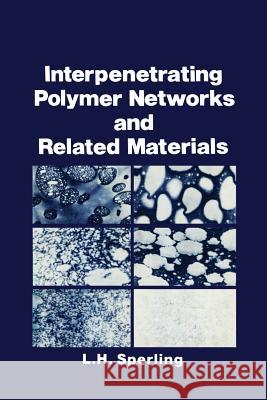
L. H. Sperling
Interpenetrating Polymer Networks and Related Materials L. H. Sperling 9781468438321 Springer - książkaWidoczna okładka, to zdjęcie poglądowe, a rzeczywista szata graficzna może różnić się od prezentowanej.

Interpenetrating Polymer Networks and Related Materials

ISBN-13: 9781468438321 / Angielski / Miękka / 2012 / 265 str.

L. H. Sperling
cena 201,24
(netto: 191,66 VAT:  5%)

Najniższa cena z 30 dni: 192,74
Termin realizacji zamówienia:
ok. 22 dni roboczych
Dostawa w 2026 r.

Darmowa dostawa!

To the surprise of practically no one, research and engineering on multi polymer materials has steadily increased through the 1960s and 1970s. More and more people are remarking that we are running out of new monomers to polymerize, and that the improved polymers of the future will depend heavily on synergistic combinations of existing materials. In the era of the mid-1960s, three distinct multipolymer combinations were recognized: polymer blends, grafts, and blocks. Although inter penetrating polymer networks, lPNs, were prepared very early in polymer history, and already named by Millar in 1960, they played a relatively low-key role in polymer research developments until the late 1960s and 1970s. I would prefer to consider the IPNs as a subdivision of the graft copolymers. Yet the unique topology of the IPNs imparts properties not easily obtainable without the presence of crosslinking. One of the objectives of this book is to point out the wealth of work done on IPNs or closely related materials. Since many papers and patents actually concerned with IPNs are not so designated, this literature is significantly larger than first imagined. It may also be that many authors will meet each other for the first time on these pages and realize that they are working on a common topology. The number of applications suggested in the patent literature is large and growing. Included are impact-resistant plastics, ion exchange resins, noise-damping materials, a type of thermoplastic elastomer, and many more."


Kategorie:
Nauka, Chemia
Kategorie BISAC:
Gardening > General
Science > Chemia - Nieorganiczna
Science > Chemia - Organiczna
Wydawca:
Springer
Język:
Angielski
ISBN-13:
9781468438321
Rok wydania:
2012
Wydanie:
Softcover Repri
Ilość stron:
265
Waga:
0.41 kg
Wymiary:
22.9 x 15.2
Oprawa:
Miękka
Wolumenów:
01
Dodatkowe informacje:
Komentarz
Bibliografia

1. An Introduction to Polymer Networks and IPNs.- 1.1. On the Nature of a Crosslink.- 1.2. Definition of an Interpenetrating Polymer Network.- 1.3. Historical Development of IPNs.- 1.4. A Researcher’s Approach to IPNs.- Suggested Reading. Bibliography of Selected Polymer Books.- 2. Phase Separation and Mechanical Behavior of Multicomponent Polymer Systems.- 2.1. Introduction.- 2.2. Polymer I/Polymer II Incompatibility.- 2.3. Polymer/Polymer Phase Diagrams.- 2.4. Morphology of Two-Phased Systems.- 2.5. More Complex Materials.- 2.6. On Determining Phase Continuity.- 2.7. Mechanical Behavior of Two-Phased Systems.- 2.8. Applications of Polymer Blends, Grafts, and Blocks.- Suggested Reading. Recent Multicomponent Polymer Books.- 3. A Nomenclature for Multipolymer Systems.- 3.1. Existing Nomenclature.- 3.2. Introduction to the New System.- 3.2.1. Reaction Examples.- 3.2.2. Simultaneous Mixing or Reacting.- 3.2.3. Coefficients and Molecular Weights.- 3.3. Nomenclature in this Work.- 3.4. Abbreviations and Jargon.- Appendix 3.1. Examples of the Proposed Nomenclature.- Appendix 3.2. Relating the New System to the Old.- 4. Homo-IPNs as Model Networks.- 4.1. Polystyrene/Polystyrene IPNs.- 4.2. Development of Theory.- 4.2.1. Sequential IPN Rubbery Modulus.- 4.2.2. The Thiele-Cohen Swelling Equation.- 4.3. Relative Network Continuity and Physical Crosslinks.- 4.3.1. Swelling Studies.- 4.3.2. Analysis of Modulus Data.- 5. Synthesis of IPNs and Related Materials.- 5.1. Introduction.- 5.2. Sequential IPNs.- 5.2.1. Poly(ethyl acrylate)/Polystyrene, PEA/PS.- 5.2.2. SBR/PS.- 5.2.3. Castor Oil/Polystyrene.- 5.2.4. Filled IPNs.- 5.2.5. Anionically Polymerized IPNs.- 5.3. Latex Interpenetrating Elastomeric Networks (IENs).- 5.4. Latex IPNs.- 5.4.1. Methacrylie/Acrylic Compositions.- 5.4.2. PVC/Nitrile Rubber.- 5.4.3. Latex Semi-IPNs.- 5.5. Simultaneous Interpenetrating Networks (SINs).- 5.5.1. Simultaneous Gelation.- 5.5.2. Sequential Polymerization of a Prepolymer Mix.- 5.5.3. Grafted SINs.- 5.6. AB-Crosslinked Polymers (ABCPs).- 5.6.1. Poly(vinyl trichloroacetate)-Based ABCPs.- 5.6.2. Conjugated Diene ABCPs.- 5.6.3. Castable Polyesters.- 5.6.4. Epoxy/CTBN Materials.- 5.7. Thermoplastic IPNs.- 6. Morphology and Glass Transition Behavior.- 6.1. Introduction.- 6.2. Molecular Control of Morphology.- 6.3. Morphology via Optical Microscopy.- 6.4. Morphology via Transmission Electron Microscopy.- 6.4.1. Sequential IPNs.- 6.4.2. Simultaneous Interpenetrating Networks.- 6.4.3. Latex IENs and IPNs.- 6.4.4. Effect of Composition Ratio.- 6.5. Quantitative Expressions for Phase Domain Size.- 6.5.1. Block Copolymers and ABCPs.- 6.5.2. Sequential IPNs and Semi-IPNs.- 6.6. Induced Morphological Changes.- 6.6.1. Inverse IPNs.- 6.6.2. Decrosslinked IPNs.- 6.7. Physical and Glass Transition Behavior.- 6.7.1. General Properties.- 6.7.2. Glass Transition Behavior.- 6.8. Transition Layer Thickness.- 6.9. Phase Continuity Evaluation via Modulus.- 6.10. The Interpenetration Problem.- 7. Engineering, Mechanical, and General Behavior.- 7.1. Introduction.- 7.2. Filled Interpenetrating Polymer Networks.- 7.2.1. Density and Crosslink Levels.- 7.2.2. Dielectric Loss Measurements.- 7.3. Ultimate Behavior.- 7.3.1. Latex IENs.- 7.3.2. Sequential IPNs.- 7.3.3. Simultaneous Interpenetrating Networks.- 7.4. Electrical and Barrier Properties.- 7.4.1. Volume Resistivity.- 7.4.2. Barrier Properties.- 7.4.3. Critical Surface Tension.- 7.5. Ionically Charged IPNs.- 7.5.1. Cationic/Anionic Ion Exchange Resins.- 7.5.2. Piezodialysis Membranes.- 7.6. Gradient IPNs.- 7.7. Vulcanized Rubber/Rubber Blends.- 8. Actual or Proposed Applications.- 8.1. Reinforced Elastomers.- 8.2. Sheet Molding Compounds.- 8.3. Dynamically Partly Cured Thermoplastic Elastomer Blends.- 8.4. Use of Graded Rubber Latexes with Surface Functionality in Thermosets.- 8.5. Dental Fillings.- 8.6. Graft Copolymerization onto Leather.- 8.7. Thermoplastic IPNs.- 8.8. Noise- and Vibration-Damping Materials.- 8.8.1. Theory of Broad-Temperature Damping.- 8.8.2. Constrained Layer Damping with IPNs.- 8.9. Coatings and Adhesives.- 8.9.1. Modified Phenol-Formaldehyde Resins.- 8.9.2. Modified Alkyd Resins.- 8.10. Miscellaneous IPN Patents and Studies.- 8.10.1. Crosslinked Acrylic Elastomer Latexes.- 8.10.2. MBS Resins.- 8.10.3. Unsaturated Polyester-Styrene Compositions.- 8.10.4. Epoxy-Based Compositions.- 8.10.5. Polyurethane-Based Compositions.- 8.10.6. Silicone-Rubber-Based Compositions.- 8.10.7. Natural-Rubber-Based Compositions.- 8.10.8. Low-Profile Polyesters.- 8.11. Summary of Applications.- Annotated Bibliography.

L. H. SPERLING is Professor of Chemical Engineering and Materials Science and Engineering, and Director of the Polymer Laboratory at Lehigh University in Bethlehem, Pennsylvania.

Sperling, L. H. Trained as a chemist, L. H. SPERLING is Professor ... więcej >


Udostępnij

Facebook - konto krainaksiazek.pl


Opinie o Krainaksiazek.pl na Opineo.pl

Partner Mybenefit

Krainaksiazek.pl w programie rzetelna firma Krainaksiaze.pl - płatności przez paypal

Czytaj nas na:

Facebook - krainaksiazek.pl
  • książki na zamówienie
  • granty
  • książka na prezent
  • kontakt
  • pomoc
  • opinie
  • regulamin
  • polityka prywatności

Zobacz:

  • Księgarnia czeska

  • Wydawnictwo Książkowe Klimaty

1997-2025 DolnySlask.com Agencja Internetowa

© 1997-2022 krainaksiazek.pl
     
KONTAKT | REGULAMIN | POLITYKA PRYWATNOŚCI | USTAWIENIA PRYWATNOŚCI
Zobacz: Księgarnia Czeska | Wydawnictwo Książkowe Klimaty | Mapa strony | Lista autorów
KrainaKsiazek.PL - Księgarnia Internetowa

Polityka prywatnosci - link
Krainaksiazek.pl - płatnośc Przelewy24
Przechowalnia Przechowalnia





