• Wyszukiwanie zaawansowane
  • Kategorie
  • Kategorie BISAC
  • Książki na zamówienie
  • Promocje
  • Granty
  • Książka na prezent
  • Opinie
  • Pomoc
  • Załóż konto
  • Zaloguj się

Chemistry of Precious Metals » książka


zaloguj się | załóż konto
Logo Krainaksiazek.pl

koszyk

konto

szukaj
topmenu
Księgarnia internetowa
Szukaj
Książki na zamówienie
Promocje
Granty
Książka na prezent
Moje konto
Pomoc
 
 
Wyszukiwanie zaawansowane
Pusty koszyk
Bezpłatna dostawa dla zamówień powyżej 20 złBezpłatna dostawa dla zamówień powyżej 20 zł

Kategorie główne

• Nauka
 [2946912]
• Literatura piękna
 [1852311]

  więcej...
• Turystyka
 [71421]
• Informatyka
 [150889]
• Komiksy
 [35717]
• Encyklopedie
 [23177]
• Dziecięca
 [617324]
• Hobby
 [138808]
• AudioBooki
 [1671]
• Literatura faktu
 [228371]
• Muzyka CD
 [400]
• Słowniki
 [2841]
• Inne
 [445428]
• Kalendarze
 [1545]
• Podręczniki
 [166819]
• Poradniki
 [480180]
• Religia
 [510412]
• Czasopisma
 [525]
• Sport
 [61271]
• Sztuka
 [242929]
• CD, DVD, Video
 [3371]
• Technologie
 [219258]
• Zdrowie
 [100961]
• Książkowe Klimaty
 [124]
• Zabawki
 [2341]
• Puzzle, gry
 [3766]
• Literatura w języku ukraińskim
 [255]
• Art. papiernicze i szkolne
 [7810]
Kategorie szczegółowe BISAC

Chemistry of Precious Metals

ISBN-13: 9780751404135 / Angielski / Twarda / 1997 / 376 str.
Simon Cotton;Cotton; S. a. Cotton
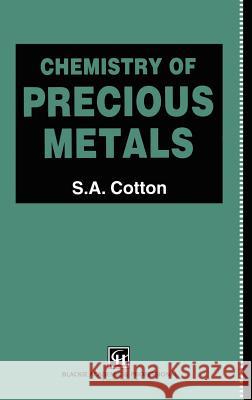
Chemistry of Precious Metals Simon Cotton Cotton                                   S. a. Cotton 9780751404135 Springer - książkaWidoczna okładka, to zdjęcie poglądowe, a rzeczywista szata graficzna może różnić się od prezentowanej.

Chemistry of Precious Metals

ISBN-13: 9780751404135 / Angielski / Twarda / 1997 / 376 str.

Simon Cotton;Cotton; S. a. Cotton
cena 1328,44
(netto: 1265,18 VAT:  5%)

Najniższa cena z 30 dni: 1156,64
Termin realizacji zamówienia:
ok. 22 dni roboczych
Bez gwarancji dostawy przed świętami

Darmowa dostawa!

Some 20 years ago, I was privileged to share in writing a book on the descriptive chemistry of the 4d, 5d, 4f and 5f metals that included these eight elements within its compass (S.A. Cotton and F.A. Hart, The Heavy Transition Elements, Macmillan, 1975). This volume shares the same aim of covering the descriptive chemistry of silver, gold and the six platinum metals in some detail at a level suitable for advanced undergraduate and postgraduate study. It does not attempt to be a comprehensive treatise on the chemistry of these metals. It attempts to fill a slot between the general text and the in-depth review or monograph. The organometallic chemistry is confined to a-bonded com pounds in normal oxidation states; compounds with IT-bonding ligands are generally excluded. Their inclusion would have increased the length of the book considerably and, moreover, their recent chemistry has been extensively and expertly reviewed in the new Comprehensive Organometallic Chemistry, II, eds G. Wilkinson, F.G.A. Stone and E.W. Abel, Pergamon, Oxford, 1995."


Kategorie:
Nauka, Chemia
Kategorie BISAC:
Science > Chemia - Organiczna
Science > Chemia - Nieorganiczna
Science > Chemia - Fizyczna
Wydawca:
Springer
Język:
Angielski
ISBN-13:
9780751404135
Rok wydania:
1997
Wydanie:
1997
Ilość stron:
376
Waga:
1.61 kg
Wymiary:
23.4 x 15.6
Oprawa:
Twarda
Wolumenów:
01
Dodatkowe informacje:
Bibliografia
Wydanie ilustrowane

1 Ruthenium and osmium.- 1.1 Introduction.- 1.2 The elements and uses.- 1.2.1 Extraction.- 1.3 Halides.- 1.3.1 Ruthenium halides.- 1.3.2 Osmium halides.- 1.3.3 Oxyhalides.- 1.3.4 Halide complexes.- 1.3.5 ‘Ruthenium blues’.- 1.3.6 Oxyhalide complexes.- 1.4 Oxides and related anions.- 1.4.1 Anions.- 1.5 Other binary compounds.- 1.6 Aqua ions.- 1.7 Compounds of ruthenium(0).- 1.8 Compounds of ruthenium(II) and (III).- 1.8.1 Ammine complexes.- 1.8.2 Tertiary phosphine complexes.- 1.8.3 Carboxylate complexes.- 1.8.4 Sulphide and sulphoxide complexes.- 1.8.5 Nitrosyl complexes.- 1.8.6 Porphyrin complexes.- 1.8.7 EDTA complexes.- 1.8.8 Other complexes of ruthenium.- 1.9 Complexes of ruthenium(IV).- 1.10 Complexes of osmium(0).- 1.11 Osmium complexes in oxidation states (II–IV).- 1.11.1 Ammine complexes.- 1.11.2 Tertiary phosphine complexes.- 1.11.3 Carboxylate complexes.- 1.11.4 Nitrosyl complexes.- 1.11.5 Other osmium complexes.- 1.12 Compounds in high oxidation states.- 1.12.1 Compounds of the MO22+ groups.- 1.12.2 Nitride complexes.- 1.12.3 Imides.- 1.13 Simple alkyls and aryls.- 2 Rhodium and iridium.- 2.1 Introduction.- 2.2 The elements and uses 78 2.2.1 Extraction.- 2.3 Halides and halide complexes.- 2.3.1 Rhodium halides.- 2.3.2 Iridium halides.- 2.3.3 Halometallates.- 2.4 Oxides, hydrides and other binary compounds.- 2.5 Aqua ions and simple salts.- 2.6 Compounds of rhodium(0).- 2.7 Compounds of rhodium(I).- 2.7.1 Tertiary phosphine complexes.- 2.7.2 Carbonyl complexes.- 2.7.3 Alkene complexes.- 2.7.4 Isocyanide complexes.- 2.8 Rhodium(II) complexes.- 2.8.1 Phosphine complexes.- 2.8.2 Dimers.- 2.8.3 Other complexes.- 2.9 Rhodium(III) complexes.- 2.9.1 Complexes of O-donors.- 2.9.2 Complexes of ammines.- 2.9.3 Complexes of other N-donors.- 2.9.4 Complexes of S-donors.- 2.9.5 Tertiary phosphine complexes.- 2.10 Iridium (I) complexes.- 2.10.1 Tertiary phosphine complexes.- 2.10.2 Vaska’s compound.- 2.11 Dioxygen complexes.- 2.12 Iridium(II) complexes.- 2.13 Iridium(III) complexes.- 2.13.1 Complexes of ammines.- 2.13.2 Complexes of S-donors.- 2.13.3 Tertiary phosphine and arsine complexes.- 2.13.4 Hydride complexes.- 2.13.5 Case study of dimethylphenylphosphine complexes.- 2.14 Iridium(IV) complexes.- 2.15 Iridium(V) complexes.- 2.16 Nitrosyls of iridium and rhodium.- 2.17 Simple alkyls and aryls of iridium and rhodium.- 3 Palladium and platinum.- 3.1 Introduction.- 3.2 The elements and uses.- 3.2.1 Extraction.- 3.3 Halides.- 3.3.1 Palladium halides.- 3.3.2 Platinum halides.- 3.3.3 Halide complexes.- 3.4 Other binary complexes.- 3.5 Aqua ions.- 3.6 Palladium(O) and platinum(O) compounds.- 3.6.1 Tertiary phosphine complexes.- 3.6.2 Reactions of Pt(PPh3)n and related species.- 3.6.3 Carbonyl complexes.- 3.6.4 Carbonyl clusters.- 3.6.5 Isocyanide complexes.- 3.7 Palladium(I) and platinum(I) compounds.- 3.7.1 Phosphine complexes.- 3.7.2 Isocyanide complexes.- 3.8 Complexes of palladium(II) and platinum(II).- 3.8.1 Complexes of O-donors.- 3.8.2 Complexes of N-donors.- 3.8.3 Tertiary phosphine complexes.- 3.8.4 Complexes of C-donors.- 3.8.5 Complexes of S-donors.- 3.8.6 Complexes of ambidentate ligands.- 3.8.7 Stability of cis- and tran-isomers.- 3.8.8 Five-coordinate compounds.- 3.8.9 The trans-effect.- 3.8.10 Structural evidence for trans-influence.- 3.8.11 Spectroscopic evidence for trans-influence.- 3.9 Palladium(III) and platinum(III).- 3.10 Complexes of platinum(IV).- 3.10.1 Complexes of N-donors.- 3.10.2 Tertiary phosphine complexes.- 3.10.3 Complexes of S-donors.- 3.10.4 Application of the trans-effect to synthesis of platinum(IV) complexes.- 3.10.5 The trans-influence in some platinum(IV) compounds.- 3.11 Complexes of palladium(IV).- 3.12 The ?-bonded organometallics of palladium(IV) and platinum(IV).- 3.12.1 Reductive elimination reactions.- 3.13 Anti-tumour activity of platinum complexes.- 3.14 Bond lengths in palladium and platinum analogues.- 4 Silver and gold.- 4.1 Introduction.- 4.2 The elements and uses.- 4.2.1 Extraction.- 4.2.2 Gold plating and other methods of gold deposition.- 4.3 Halides.- 4.3.1 Silver halides.- 4.3.2 Gold halides.- 4.4 Oxides and other binary compounds.- 4.5 Aqua ions.- 4.6 Silver(I) complexes.- 4.6.1 Complexes of O-donors.- 4.6.2 Complexes of N-donors.- 4.6.3 Tertiary phosphine and arsine complexes.- 4.6.4 Complexes of halogen-donors.- 4.6.5 Complexes of C-donors.- 4.6.6 Complexes of S-donors.- 4.7 Silver(II) complexes.- 4.8 Silver(III) complexes.- 4.9 Gold(-I) complexes.- 4.10 GoId(I) complexes.- 4.10.1 Complexes of O-donors.- 4.10.2 Complexes of N-donors.- 4.10.3 Tertiary phosphine and arsine complexes.- 4.10.4 Complexes of halogen-donors.- 4.10.5 Complexes of C-donors.- 4.10.6 Complexes of S-donors.- 4.10.7 MO schemes for 2-coordinate gold(I) complexes.- 4.11 Gold(II) complexes.- 4.12 Gold(III) complexes.- 4.12.1 Complexes of halogens.- 4.12.2 Complexes of N-donors.- 4.12.3 Tertiary phosphine and arsine complexes.- 4.12.4 Other complexes.- 4.12.5 Coordination numbers and gold(III).- 4.12.6 The trans-effect and trans-influence.- 4.13 Gold(IV) complexes.- 4.14 Gold(V) complexes.- 4.15 Organometallic compounds of silver.- 4.15.1 Complexes of unsaturated hydrocarbons.- 4.16 Organometallic compounds of gold.- 4.16.1 Gold(I) complexes.- 4.16.2 Gold(III) complexes.- 4.17 Gold cluster complexes.- 4.18 Relativistic effects in gold chemistry.- 4.19 Aurophilicity.- 4.20 Silver and gold compounds in medicine.- 4.21 Mössbauer spectroscopy of gold compounds.- References.

Cotton, Simon Dr. Simon Cotton obtained his PhD at Imperial Coll... więcej >


Udostępnij

Facebook - konto krainaksiazek.pl


Opinie o Krainaksiazek.pl na Opineo.pl

Partner Mybenefit

Krainaksiazek.pl w programie rzetelna firma Krainaksiaze.pl - płatności przez paypal

Czytaj nas na:

Facebook - krainaksiazek.pl
  • książki na zamówienie
  • granty
  • książka na prezent
  • kontakt
  • pomoc
  • opinie
  • regulamin
  • polityka prywatności

Zobacz:

  • Księgarnia czeska

  • Wydawnictwo Książkowe Klimaty

1997-2025 DolnySlask.com Agencja Internetowa

© 1997-2022 krainaksiazek.pl
     
KONTAKT | REGULAMIN | POLITYKA PRYWATNOŚCI | USTAWIENIA PRYWATNOŚCI
Zobacz: Księgarnia Czeska | Wydawnictwo Książkowe Klimaty | Mapa strony | Lista autorów
KrainaKsiazek.PL - Księgarnia Internetowa

Polityka prywatnosci - link
Krainaksiazek.pl - płatnośc Przelewy24
Przechowalnia Przechowalnia





