• Wyszukiwanie zaawansowane
  • Kategorie
  • Kategorie BISAC
  • Książki na zamówienie
  • Promocje
  • Granty
  • Książka na prezent
  • Opinie
  • Pomoc
  • Załóż konto
  • Zaloguj się

Multi-way Analysis : Applications in the Chemical Sciences » książka

zaloguj się | załóż konto
Logo Krainaksiazek.pl

koszyk

konto

szukaj
topmenu
Księgarnia internetowa
Szukaj
Książki na zamówienie
Promocje
Granty
Książka na prezent
Moje konto
Pomoc
 
 
Wyszukiwanie zaawansowane
Pusty koszyk
Bezpłatna dostawa dla zamówień powyżej 20 złBezpłatna dostawa dla zamówień powyżej 20 zł

Kategorie główne

• Nauka
 [2948695]
• Literatura piękna
 [1824038]

  więcej...
• Turystyka
 [70868]
• Informatyka
 [151073]
• Komiksy
 [35227]
• Encyklopedie
 [23181]
• Dziecięca
 [621575]
• Hobby
 [138961]
• AudioBooki
 [1642]
• Literatura faktu
 [228651]
• Muzyka CD
 [371]
• Słowniki
 [2933]
• Inne
 [445341]
• Kalendarze
 [1243]
• Podręczniki
 [164416]
• Poradniki
 [479493]
• Religia
 [510449]
• Czasopisma
 [502]
• Sport
 [61384]
• Sztuka
 [243086]
• CD, DVD, Video
 [3417]
• Technologie
 [219673]
• Zdrowie
 [100865]
• Książkowe Klimaty
 [124]
• Zabawki
 [2168]
• Puzzle, gry
 [3372]
• Literatura w języku ukraińskim
 [260]
• Art. papiernicze i szkolne
 [7838]
Kategorie szczegółowe BISAC

Multi-way Analysis : Applications in the Chemical Sciences

ISBN-13: 9780471986911 / Angielski / Twarda / 2004 / 396 str.
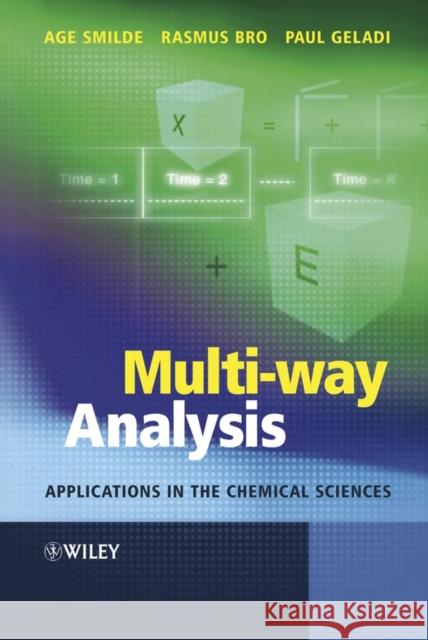
Age K. Smilde; Rasmus Bro; Paul Geladi
Multi-way Analysis : Applications in the Chemical Sciences Age K. Smilde Rasmus Bro Paul Geladi 9780471986911 John Wiley & Sons - książkaWidoczna okładka, to zdjęcie poglądowe, a rzeczywista szata graficzna może różnić się od prezentowanej.

Multi-way Analysis : Applications in the Chemical Sciences

ISBN-13: 9780471986911 / Angielski / Twarda / 2004 / 396 str.

Age K. Smilde; Rasmus Bro; Paul Geladi
cena 807,51
(netto: 769,06 VAT:  5%)

Najniższa cena z 30 dni: 797,62
Termin realizacji zamówienia:
ok. 30 dni roboczych.

Darmowa dostawa!

This book is an introduction to the field of multi-way analysis for chemists and chemometricians. Its emphasis is on the ideas behind the method and its pratical applications. Sufficient mathematical background is given to provide a solid understanding of the ideas behind the method. There are currently no other books on the market which deal with this method from the viewpoint of its applications in chemistry.

  • Applicable in many areas of chemistry.
  • No comparable volume currently available.
  • The field is becoming increasingly important.

Kategorie:
Nauka, Chemia
Kategorie BISAC:
Science > Chemia - Analityczna
Wydawca:
John Wiley & Sons
Język:
Angielski
ISBN-13:
9780471986911
Rok wydania:
2004
Ilość stron:
396
Waga:
0.64 kg
Wymiary:
25.1 x 17.9 x 2.3
Oprawa:
Twarda

"...covers some very important topics in modern chemical data analysis...this book is a reasonable place to start. I know of no others." ( Technometrics, November 2005)

"It will be a valuable addition to the library collections at universities and companies." (E–STREAMS, September 2005)

"...extremely useful..." (Journal of Chemometrics, Vol 19 (2), February 2005)

Foreword.

Preface.

Nomenclature and Conventions.

1 Introduction.

1.1 What is multi–way analysis?

1.2 Conceptual aspects of multi–way data analysis.

1.3 Hierarchy of multivariate data structures in chemistry.

1.4 Principal component analysis and PARAFAC.

1.5 Summary.

2 Array definitions and properties.

2.1 Introduction.

2.2 Rows, columns and tubes; frontal, lateral and horizontal slices.

2.3 Elementary operations.

2.4 Linearity concepts.

2.5 Rank of two–way arrays.

2.6 Rank of three–way arrays.

2.7 Algebra of multi–way analysis.

2.8 Summary.

Appendix 2.A.

3 Two–way component and regression models.

3.1 Models for two–way one–block data analysis: component models.

3.2 Models for two–way two–block data analysis: regression models.

3.3 Summary.

Appendix 3.A: some PCA results.

Appendix 3.B: PLS algorithms.

4 Three–way component and regression models.

4.1 Historical introduction to multi–way models.

4.2 Models for three–way one–block data: three–way component models.

4.3 Models for three–way two–block data: three–way regression models.

4.4 Summary.

Appendix 4.A: alternative notation for the PARAFAC model.

Appendix 4.B: alternative notations for the Tucker3 model.

5 Some properties of three–way component models.

5.1 Relationships between three–way component models.

5.2 Rotational freedom and uniqueness in three–way component models.

5.3 Properties of Tucker3 models.

5.4 Degeneracy problem in PARAFAC models.

5.5 Summary.

6 Algorithms.

6.1 Introduction.

6.2 Optimization techniques.

6.3 PARAFAC algorithms.

6.4 Tucker3 algorithms.

6.5 Tucker2 and Tucker1 algorithms.

6.6 Multi–linear partial least squares regression.

6.7 Multi–way covariates regression models.

6.8 Core rotation in Tucker3 models.

6.9 Handling missing data.

6.10 Imposing non–negativity.

6.11 Summary.

Appendix 6.A: closed–form solution for the PARAFAC model.

Appendix 6.B: proof that the weights in trilinear PLS1 can be obtained from a singular value decomposition.

7 Validation and diagnostics.

7.1 What is validation?

7.2 Test–set and cross–validation.

7.3 Selecting which model to use.

7.4 Selecting the number of components.

7.5 Residual and influence analysis.

7.6 Summary.

8 Visualization.

8.1 Introduction.

8.2 History of plotting in three–way analysis.

8.3 History of plotting in chemical three–way analysis.

8.4 Scree plots.

8.5 Line plots.

8.6 Scatter plots.

8.7 Problems with scatter plots.

8.8 Image analysis.

8.9 Dendrograms.

8.10 Visualizing the Tucker core array.

8.11 Joint plots.

8.12 Residual plots.

8.13 Leverage plots.

8.14 Visualization of large data sets.

8.15 Summary.

9 Preprocessing.

9.1 Background.

9.2 Two–way centering.

9.3 Two–way scaling.

9.4 Simultaneous two–way centering and scaling.

9.5 Three–way preprocessing.

9.6 Summary.

Appendix 9.A: other types of preprocessing.

Appendix 9.B: geometric view of centering.

Appendix 9.C: fitting bilinear model plus offsets across one mode equals fitting a bilinear model to centered data.

Appendix 9.D: rank reduction and centering.

Appendix 9.E: centering data with missing values.

Appendix 9.F: incorrect centering introduces artificial variation.

Appendix 9.G: alternatives to centering.

10 Applications.

10.1 Introduction.

10.2 Curve resolution of fluorescence data.

10.3 Second–order calibration.

10.4 Multi–way regression.

10.5 Process chemometrics.

10.6 Exploratory analysis in chromatography.

10.7 Exploratory analysis in environmental sciences.

10.8 Exploratory analysis of designed data.

10.9 Analysis of variance of data with complex interactions.

Appendix 10.A: an illustration of the generalized rank annihilation method.

Appendix 10.B: other types of second–order calibration problems.

Appendix 10.C: the multiple standards calibration model of the second–order calibration example.

References.

Index.

Age K. Smilde received his MSc in Econometrics at the University of Groningen in 1986. He moved to the Department of Pharmacy in the same city where he did his PhD in Analytical Chemistry. His PhD was on "Multivariate Calibration of Reversed Phase Chromatographic Systems", and he received his degree in 1990. In the year 1992, he visited the Center for Process Analytical Chemistry (Seattle, USA), where he worked together with Prof. Bruce Kowalski. He is the Eastern Analytical Symposium 2006 Award Recipient for Achievements in Chemo metrics. In 1996 he was chairman of the Gordon Research Conference on Statistics in Chemistry and Chemical Engineering in Oxford (UK). Together with Rasmus Bro and Paul Geladi he wrote the book Multiway Analysis: Applications in the Chemical Sciences.

Rasmus Bro (born 1965) studied mathematics and analytical chemistry at the Technical University of Denmark and received his M.Sc. in 1994. In 1998 he obtained his Ph.D. (Cum Laude) in multiway analysis from the University of Amsterdam, The Netherlands. In 2000 he received the third Elsevier Chemo metrics Award for noteworthy accomplishments in the field of chemo metrics by younger scientists, and in 2004 he received the Eastern Analytical Symposium Award for Achievements in Chemo metrics. He has authored more than 100 peer–reviewed scientific papers, 2 books on chemo metrics, and more than 20 proceedings, book contributions, reviews, and patents.

Paul Geladi currently works at the Department of Food Science, Stellenbosch University. Paul does research in Analytical Chemistry, Chemo–informatics and Electrochemistry. Their most recent publication is ′Covalently electro grafted carb ox phenyl layers onto gold surface serving as a platform for the construction of an immune sensor for detection of methotrexate.

This book presents a detailed description of three–way and multi–way arrays, their properties and the methods utilised to model these arrays mathematically. Multi–way component analysis is introduced by its two most important models – Tucker3 and PARAFAC. In addition, intermediate and derived models are included. Multi–way regression methods receive special attention and a number of algorithms are presented. The book includes detailed accounts of diagnostics, visualization of results and handling of residuals. Appropriate attention is given to the preprocessing of data. Mathematical rigor is applied where necessary and numerous proofs are included. The book concludes with an overview of the different application fields of multi–way analysis, including analytical chemistry, process monitoring, environmental analysis and three–way data resulting from ANOVA or designed experiments. The relationship of these methods to chemistry is always emphasized.

The book is aimed at researchers who are interested in theoretical and practical aspects of data analysis. It is directly relevant to chemical sciences such as analytical, environmental, clinical and physical chemistry. In addition, it is pertinent to chemometrics, bioinformatics, biochemistry, process analysis, food chemistry and sensory analysis.


Udostępnij

Facebook - konto krainaksiazek.pl


Opinie o Krainaksiazek.pl na Opineo.pl

Partner Mybenefit

Krainaksiazek.pl w programie rzetelna firma Krainaksiaze.pl - płatności przez paypal

Czytaj nas na:

Facebook - krainaksiazek.pl
  • książki na zamówienie
  • granty
  • książka na prezent
  • kontakt
  • pomoc
  • opinie
  • regulamin
  • polityka prywatności

Zobacz:

  • Księgarnia czeska

  • Wydawnictwo Książkowe Klimaty

1997-2026 DolnySlask.com Agencja Internetowa

© 1997-2022 krainaksiazek.pl
     
KONTAKT | REGULAMIN | POLITYKA PRYWATNOŚCI | USTAWIENIA PRYWATNOŚCI
Zobacz: Księgarnia Czeska | Wydawnictwo Książkowe Klimaty | Mapa strony | Lista autorów
KrainaKsiazek.PL - Księgarnia Internetowa

Polityka prywatnosci - link
Krainaksiazek.pl - płatnośc Przelewy24
Przechowalnia Przechowalnia








